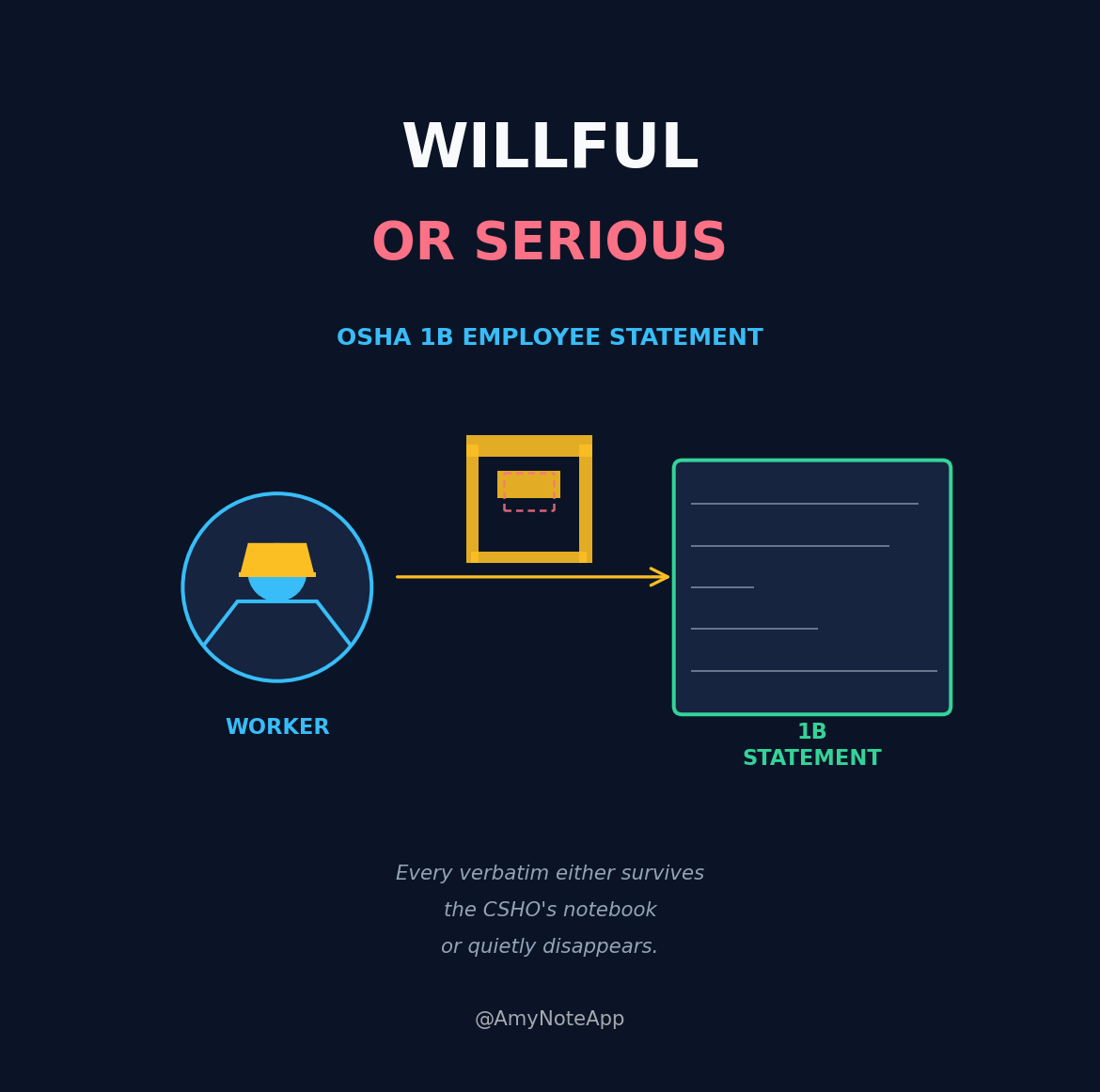
An operator on a punch press tells the OSHA Compliance Safety and Health Officer in a parking lot interview that the point-of-operation guard came off three weeks before the inspection and that he told the second-shift foreman twice. By the time the citation packet is delivered, the OSHA-1B Statement reads "guard missing." The hazard is the same. The penalty multiplier is not. Willful collapses into Serious and the employer's exposure drops by an order of magnitude.
That gap — between what a worker said in the parking lot and what later survives on the 1B Statement — is the single most consequential documentation problem in OSHA enforcement. It is also the easiest one to close.
The 1B Statement Locks On The CSHO's Notebook
Under 29 CFR Part 1903, an OSHA Compliance Safety and Health Officer runs every inspection through an opening conference, a walk-around, private employee interviews, and a closing conference. The CSHO documents each interview on the OSHA-1B Employee Statement and weaves the statements into the OSHA-1A Inspection Narrative. Those two forms travel from the field to the Area Office, then to the Regional Solicitor, then into the Citation and Notification packet, then into the OSHRC contest file if the employer challenges within fifteen working days.
The employee on the call is rarely the same person who later defends the citation. The 1B notebook passes from the parking lot to the CSHO's hotel desk, then to the Area Director, then to the Solicitor's office, then to the OSHRC Administrative Law Judge who reads it at hearing. Each handoff strips information. The worker's exact words exist only in whatever the CSHO typed into the 1B Statement while the conversation was still fresh.
At every link in that chain, the document is read as if it were a transcript. It is not. It is a paraphrase made under inspection-day time pressure, by a CSHO who was also walking the floor, photographing machinery, and trying to keep an interview discreet enough that the worker would speak honestly. The drift between what was said and what was written is invisible to every reader downstream.
Why Paraphrased Employee Statements Collapse Willful Into Serious
A willful violation requires that the employer knew of the hazard and showed plain indifference. A serious violation only requires that the employer could have known with reasonable diligence. The penalty gap is roughly tenfold per instance. "I told the foreman twice and he said run it anyway" is the willful evidence. "Guard missing" is not.
A 1B Statement that flattens the supervisor-knowledge chain into a hazard description walks the case away from willful and toward serious. The Solicitor at OSHRC reads the second version. The ALJ vacates the willful classification because the record does not support actual knowledge. The penalty drops from six figures to five. The employer's exposure shrinks, the deterrent effect dissipates, and the next employer in the same industry reads the contest outcome as a green light.
The same drift happens in the other direction at every stage of the case. Quoted abatement attempts get reduced to "no abatement." Quoted prior-report language ("I filled out the maintenance ticket") becomes "no reports." A worker's careful explanation of why the guard was bypassed during changeover ("we needed to clear a jam and the lockout takes ten minutes per shift") becomes a hazard noun. The 1B Statement does what its template asks it to do: it describes the hazard. The willful evidence quietly exits the file.
Where The Gap Shows Up
- Supervisor-knowledge testimony. A worker reports having told a foreman by name, twice, in front of a specific co-worker. The 1B reduces it to "employee reported the condition." Actual knowledge becomes constructive knowledge.
- Abatement-attempt language. "I asked maintenance three times" becomes "no abatement requested." Good-faith effort, which OSHA's Field Operations Manual weighs at classification, disappears.
- Specialized worksite vocabulary. LOTO, interlock, point-of-operation, tie-off, competent person, qualified person, atmospheric monitoring — each carries regulatory weight. Paraphrased into general English, that weight is lost.
- Timing and frequency detail. "Three weeks before the inspection" anchors a hazard exposure timeline. "For some time" does not.
- Worker hesitation and qualification. A nervous worker's "I think Mike knew" reads very differently from a confident "Mike was standing right there." Both turn into "supervisor was aware" on a 1B.
What Actually Works At The Worksite Interview
The fix is not a longer 1B template. The fix is a verbatim audio record of every private employee interview, transcribed, timestamped, and searchable from the Area Office back to the contest hearing.
Employee consent for recording is straightforward under the Section 8(a) inspection authority and parallel state plan procedures. Once consent is captured, the CSHO stops paraphrasing under time pressure during a multi-day inspection. The 1B Statement quotes the worker saying "I told Mike on second shift twice" rather than reducing the testimony to a hazard noun. The Solicitor builds the willful classification on quoted supervisor knowledge. The party submissions can dispute interpretation, not whether the words were said.
This is where AmyNote fits. The app records the parking lot or break room interview on a laptop or a phone, transcribes through OpenAI's Speech API with industrial vocabulary like LOTO, interlock, point-of-operation, tie-off, and competent person handled cleanly, and produces speaker-attributed, timestamped segments. Open the case six weeks later, search "foreman" or "bypassed" or "told" and the worker's exact phrasing surfaces with the surrounding minute of context. Claude organizes the transcript into the 1B Statement skeleton: employee identification, job duties, hazard observed, supervisor knowledge, prior reports, abatement attempts, verbatim quotes. The Solicitor edits from real testimony rather than from one bullet.
Both OpenAI and Anthropic contractually guarantee zero training on user data. Audio is encrypted in transit; processing copies may be retained to deliver and recover requested features. Transcripts are stored locally on the device with encrypted transport. The recording lives inside the Area Office case file under the same access controls as the rest of the inspection packet.
The Same Pattern, Three Other Inspection Settings
The 1B gap is the headline, but the structural problem — one CSHO, multiple workers, time pressure, downstream readers who treat the paraphrase as the record — shows up across the inspection workflow.
- Whistleblower 11(c) interviews. Section 11(c) anti-retaliation cases turn on what the employee said and when. A verbatim record protects both sides: the worker's exact disclosure and the CSHO's careful intake.
- Multi-employer worksite interviews. Host employer, controlling employer, exposing employer, correcting employer. Quoted testimony about who told whom what is the only way the multi-employer policy actually attaches in contest.
- Whistleblower complaint intake at the Area Office. The same gap appears earlier in the pipeline, with the same downstream consequences for both the worker's protection and the employer's eventual contest record.
Getting Started
Confirm your consent script and your Section 11(c) anti-retaliation language for private interviews. Run AmyNote on the CSHO laptop alongside your existing 1B template. Before the citation packet leaves the Area Office, sweep the transcript for every verbatim the bullet flattened and paste the exact phrasing into the 1B Statement. That is where the willful evidence hides.
On the defense side, the same recording posture protects the employer's contest record. Witness interviews during incident response, root-cause investigations, and abatement documentation all benefit from a verbatim audio record that survives the months between the citation and the OSHRC hearing. The party that walks into contest with quoted testimony controls the record. The party that walks in with a bullet list defers to whoever has the quotes.
Originally published as an X Article.