A GS-14 program manager sits across from an agency investigator and a union steward in a windowless conference room. Three hours of questions about a misdirected award, a contested email thread, and an after-hours laptop access. Twenty-six days later the Proposal Notice arrives. It quotes seven specific statements from that interview as the factual basis for proposed removal.
This is not unusual. It is the standard sequence under federal personnel law. And it is the exact point at which most adverse-action defenses lose the reply window before they ever begin drafting.
The Investigation Becomes The Case Against You
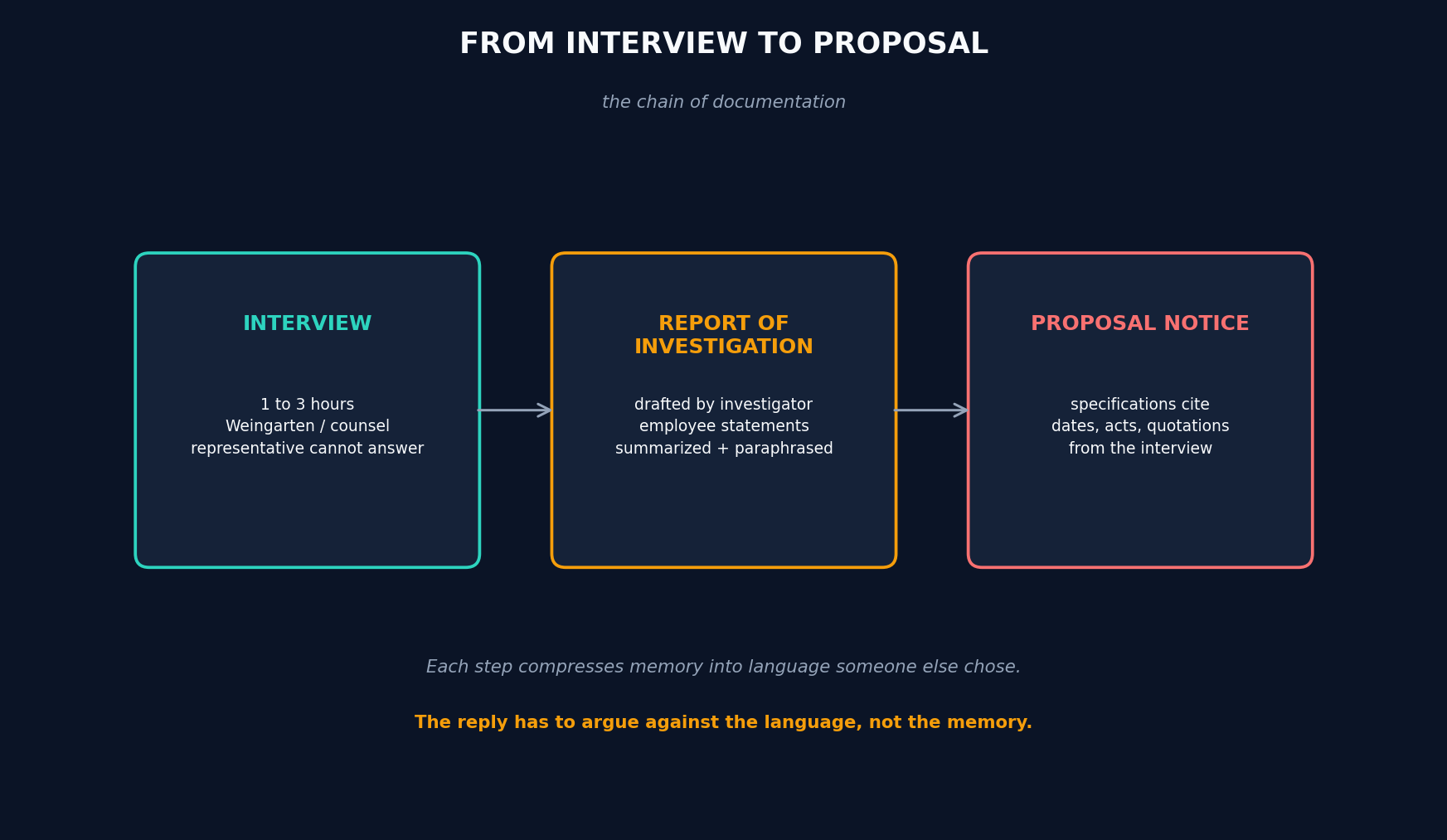
Federal adverse actions under 5 U.S.C. Chapter 75 (misconduct) and Chapter 43 (performance) almost always begin with an administrative investigation. The investigator may be from the Office of Inspector General, an Office of Special Counsel attorney, an internal table-of-penalties officer, or an agency-specific investigative unit. The interview runs one to three hours and is almost always recorded by the agency.
The employee is entitled to a union representative under Weingarten or, in non-bargaining-unit positions, to personal counsel. The representative cannot answer for the employee. They can object, request breaks, and clarify. They take notes on their side of the table. The investigator takes notes on theirs. Days or weeks later, the Report of Investigation lands on the proposing official’s desk, and the gap between the two notebooks becomes the case.
The Proposal Notice is built around specifications. Each specification cites a date, an act, and almost always a quotation or paraphrase of what the employee said in the interview. Under Douglas factor analysis the employee’s own interview statements become evidence of intent, knowledge of duty, and acceptance of responsibility, or the lack of it.
The MSPB has been explicit on this point for decades. The deciding official is allowed to weigh demeanor, candor, and acknowledgment as gleaned from the investigation record. Douglas v. Veterans Administration, 5 MSPR 280 (1981), made the twelve-factor analysis mandatory, and at least five of those factors turn on what the employee said or failed to say during the agency’s questioning.
Why Bullet-Point Notes Are Not Enough
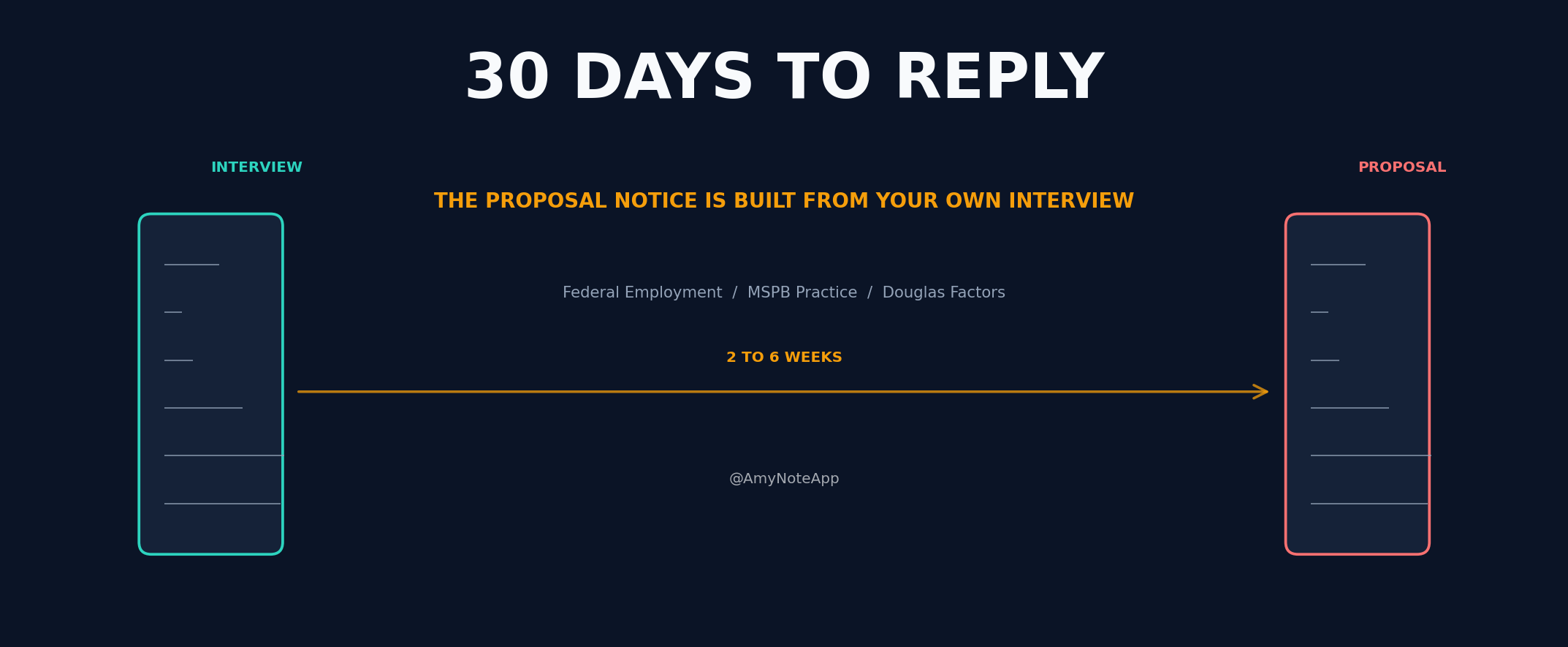
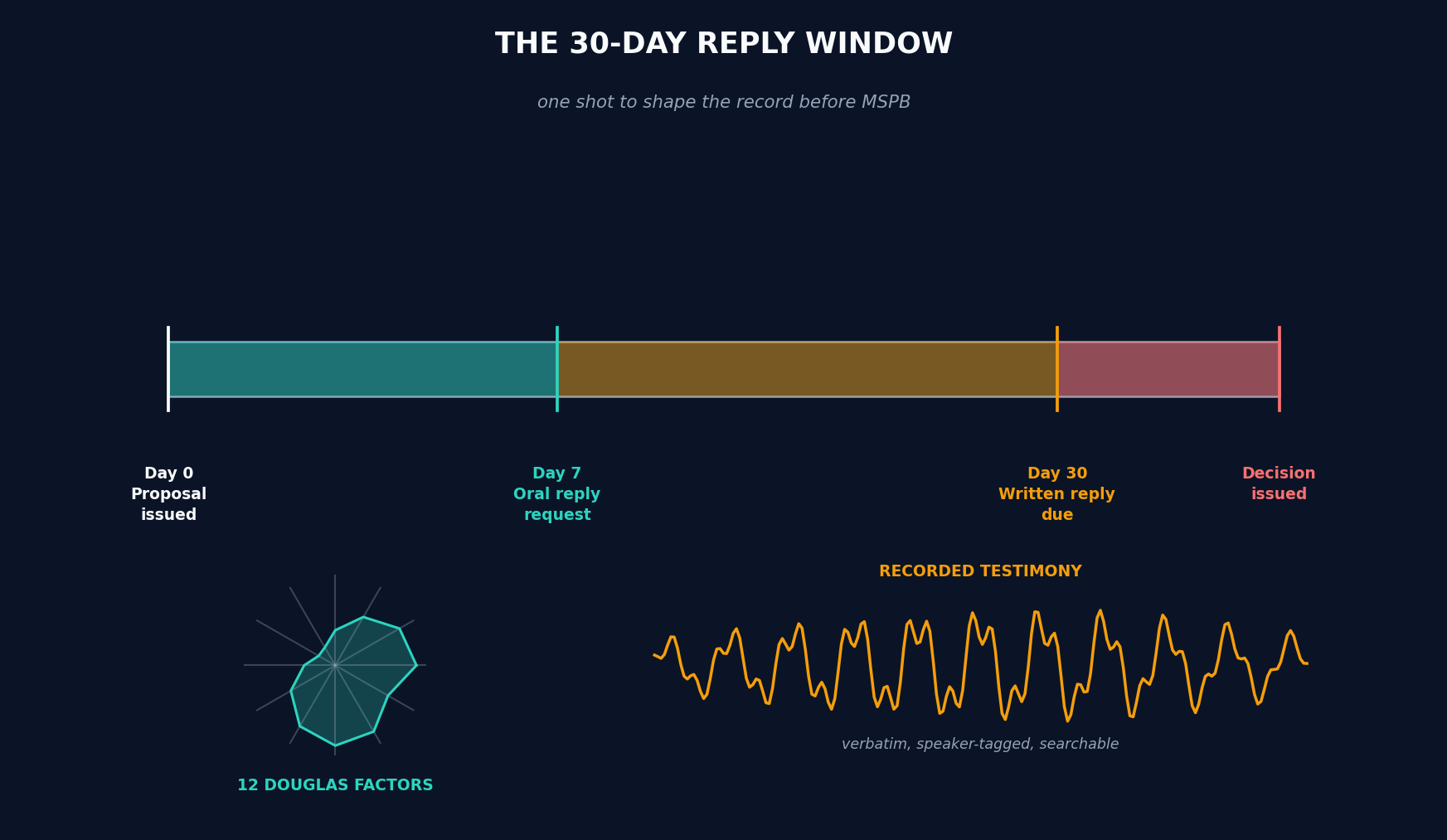
The Proposal Notice arrives two to six weeks after the interview. The employee has seven to thirty days to file an oral or written reply, depending on the agency’s table of penalties and the statutory floor (30 days under Chapter 75, often shorter under Chapter 43, and sometimes a hard seven-day window under expedited authorities).
Counsel’s bullet notes capture topics, not exact phrasing. When the specification reads “Employee admitted during the August 4 interview that they accessed the system after duty hours without authorization,” the reply must address that exact framing. Was the word “without authorization” said by the employee, by the investigator in the question, or by the report writer summarizing both? Was the employee responding to a conditional hypothetical? Did they qualify the answer with “I think” or “I would have to check”?
Three weeks of memory will not reconstruct it. And the deciding official does not weigh the reply against the recording. They weigh it against the Report of Investigation, which is the agency’s curated version of the interview, with the qualifiers stripped out.
The reply is the last meaningful chance to shape the record before MSPB appeal. After the decision letter issues, the burden shifts. The agency only needs to prove the charge by preponderant evidence (Chapter 75) or substantial evidence (Chapter 43), and the Board reviews the reply as part of the administrative record. A reply that concedes a specification by silence is a specification the Board treats as conceded.
What The Reply Actually Has To Do
A defensible reply does three things at once. First, it contests each specification on its own terms, citing the date, the act, and the language used. Second, it addresses each applicable Douglas factor with concrete evidence. Third, it preserves the record for appeal, which means flagging procedural errors, Weingarten violations, and any due-process gaps in the proposal itself.
None of that is possible without a precise account of what was said in the interview. The reply that quotes the actual exchange beats the reply that paraphrases. The reply that surfaces the leading question behind the apparent admission beats the reply that argues the admission was misunderstood. And the reply that catches the report writer’s summary error (a paraphrase the employee never agreed to) wins a specification outright.
What Actually Works
Federal employment lawyers and union representatives now sit through agency interviews with a verbatim audio record running on the representative’s device, captured under one-party consent rules where applicable, or with the agency’s own recorded interview pulled in as the source file once produced. (Under most agency procedures the employee or representative can request the recording through FOIA or the agency’s Privacy Act access process; turnaround varies from weeks to months, and is rarely fast enough for the reply window.)
The shift is from reconstructing memory to indexing testimony. AmyNote transcribes the audio on the representative’s iPhone, MacBook, or iPad, tags speaker turns, and lets counsel search the full record by phrase and topic the moment the proposal arrives.
The transcription pipeline uses OpenAI Speech API. AI-assisted summaries, specification mapping, and Douglas-factor extraction are produced by Anthropic Claude Opus. Both OpenAI and Anthropic contractually guarantee zero training on user data. Audio is encrypted in transit; processing copies may be retained to deliver and recover requested features. Transcripts are stored locally on the device with encrypted transport, which is the posture federal practice requires when the source is privileged work product.
When the proposal cites “Employee acknowledged repeated tardiness,” counsel searches that phrase in seconds. They surface the exact exchange, the qualifier the employee added (“during the period I was on FMLA, yes”), and the leading question that produced the answer. The reply then quotes the actual transcript back and contests the specification on its own terms.
A Worked Example
Consider how the workflow changes in practice. A specification reads: “On August 4, the employee stated they were aware that the after-hours system access violated the agency’s acceptable-use policy.”
From bullet notes, the best the reply can do is deny: “The employee did not make this statement.” The deciding official weighs the denial against the report writer’s sworn ROI, and the report writer wins on credibility every time.
From a verbatim transcript, the reply does something different. It quotes the actual exchange:
Investigator: “And you knew, at the time you accessed the system, that the policy required preapproval for after-hours access?”
Employee: “I knew there was a policy. I had not read it in the eighteen months since onboarding. I assumed my supervisor’s text approval covered it.”
That answer is not an admission of knowing violation. It is an admission of imperfect recall plus reliance on supervisory authorization. The Douglas factors that turn on intent (Factor 3) and good-faith belief (Factor 7) flip when the actual language is on the page. The specification does not survive cross-examination at the Board, and a careful deciding official will not let it survive the reply.
The Practice Standard Is Shifting
Five years ago, the federal employment bar was split on whether to record agency interviews. The argument against was that the agency would push back and that the recording might be discoverable. The argument for was that the alternative was reconstructing testimony from notes, and the notes always lost to the ROI.
The argument for has won. One-party consent rules apply in most jurisdictions where federal employees work, the agency’s own recording is producible (if slow), and the cost of reconstructing the interview from memory is the cost of a removal that should have been a fourteen-day suspension. MSPB judges have repeatedly noted, in published decisions, that replies citing verbatim exchanges receive a different level of weight than replies asserting unsupported denials.
Getting Started
AmyNote runs on iPhone, iPad, and Mac. Drop the agency interview audio in once it is produced, or record contemporaneous representative observations during the interview itself. Search, summarize, and export the segments the reply needs to address. Built for federal employment counsel, MSPB practitioners, union representatives, and federal employees facing proposed adverse action.
The reply window is 30 days. The transcript work should not take more than an afternoon. Try it at amynote.app with a 3-day free trial, no credit card required.
Originally published as an X Article.