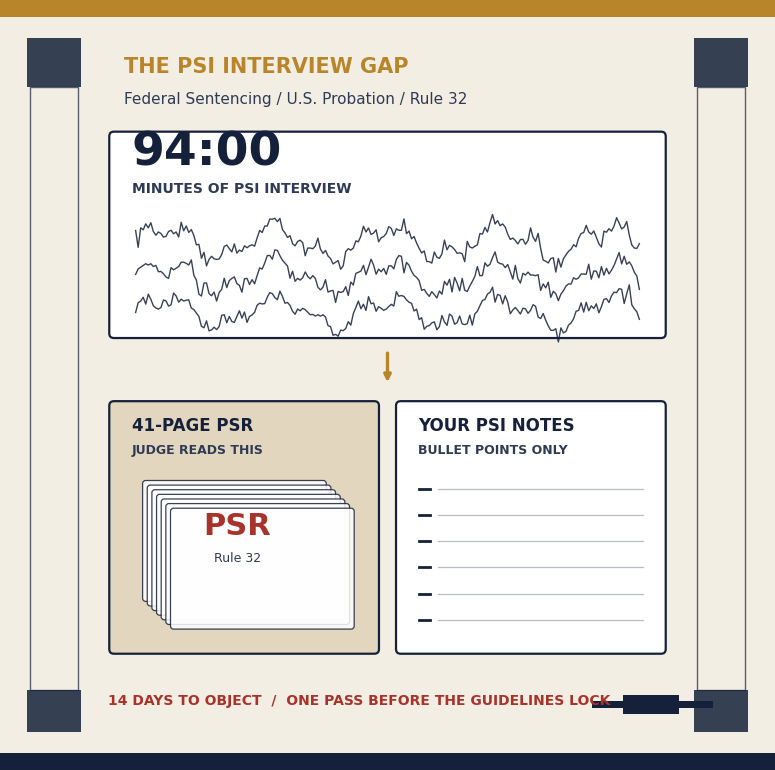
Your client just sat through a presentence interview with U.S. Probation. You were in the room. The officer worked from a structured questionnaire and improvised every fourth question. The interview ran 94 minutes. You took 23 bullet points on a yellow legal pad. Three weeks later the draft Presentence Report arrives by email. Forty-one pages. The role-in-the-offense paragraph does not match what your client actually said. Rule 32(f) gives you 14 days to file written objections. You have your notes.
This is the documentation gap that quietly drives federal sentencing outcomes. The PSR is the operative document at the lectern. The interview is the source. Everything that happens between them is reconstruction, and reconstruction is exactly what the rules give you the least time to do.
The 94-Minute Interview That Decides Years
Federal sentencing runs on the Presentence Report. The Sentencing Guidelines calculation, the criminal history category, the acceptance-of-responsibility reduction, every 3553(a) factor the judge weighs at the lectern: all of it lives in a document the probation officer drafts from one long interview.
The interview covers a lot of ground. Offense conduct in the defendant’s own words. Substance use history with dates, frequencies, and treatment attempts. Mental health disclosures. Education and employment timeline. Family ties, financial picture, restitution capacity, victim contact, immigration status. Officers follow up wherever an answer is interesting. Ninety minutes is normal. Two hours is not unusual.
The defendant rarely remembers what they said by the time the draft arrives. Counsel attended, but counsel was also listening, watching the client, and deciding when to interject. The yellow pad shows topic headings, not transcripts. By the time the draft PSR lands in your inbox, the only people with reliable recall are the probation officer who took typed notes during the interview and the AUSA who will read the final report at sentencing.
Why Handwritten PSI Notes Fall Short
Attention is split four ways. You are tracking the officer’s questioning, your client’s answers, your client’s body language, and whether to step in. Your hand finishes the prior bullet two questions late. The note you wanted to make about the officer’s tone on a particular follow-up never gets written.
No verbatim quotes survive. The officer writes that your client “minimized his role.” You remember him saying he was a courier, not a leader, but you cannot prove the exact phrasing. The PSR characterization stands unless you can quote the transcript back.
Substance use turns granular fast. Frequency, last use, programs attended, gaps between relapses. Each becomes a guideline footnote or a 5K2.0 variance argument. Bullet points cannot hold a timeline. The officer’s summary becomes the timeline by default.
Acceptance language is worth months. A USSG 3E1.1 reduction of two or three offense levels can shift a sentencing range by 18 to 24 months. The reduction turns on exact words about responsibility and remorse. You either captured them or you did not. The judge does not credit a paraphrase weeks later.
The 14-day clock is not negotiable. Under Rule 32(f) of the Federal Rules of Criminal Procedure, written objections to the draft PSR must be filed within 14 days of receipt. Most districts enforce that deadline tightly. Argumentative objections without record support routinely lose. Objections backed by exact quotes from the interview routinely win — or at least force probation to revise.
What Effective PSI Capture Looks Like
A defense attorney records the full 94 minutes on the phone in their suit pocket. AmyNote transcribes through OpenAI’s latest Speech API. Federal sentencing vocabulary lands clean: criminal history category, downward variance, safety valve, USSG 5K1.1, acceptance of responsibility, Fast Track, proffer agreement, Rule 35.
Speaker identification carries across cases. By the third client interviewed by the same probation officer, the labels just attach. The transcript shows USPO Hernandez and DEFENDANT without manual tagging. That cross-session memory matters more than it sounds: most federal defenders see the same handful of probation officers across a year of cases, and a labeled transcript of one officer’s questioning style becomes a reusable resource.
Anthropic’s Claude Opus produces a structured PSI summary the moment the interview ends. Offense conduct admissions. Substance use timeline with dates. Acceptance language verbatim. Family and community ties. Restitution capacity. Anything the officer pressed on twice.
When the draft PSR arrives, semantic search across the transcript replaces memory. Did my client say he organized the operation or transported for it? Returns the exact 11-second clip with timestamp. Did the officer ask about prior treatment, or did my client volunteer it? Returns the question and the answer. Objections under Rule 32(f) become evidence-backed, not argumentative.
The Objection That Wins Versus The Objection That Loses
An objection that reads “The PSR mischaracterizes the defendant’s role” without a record cite gets a one-sentence response from probation: “Officer’s notes reflect the substance of the defendant’s admission.” The court accepts that, and the role enhancement stays.
An objection that reads “At 1:14:22 of the interview, the defendant stated, ‘I drove the package from Phoenix to Albuquerque, and that is the only thing I did,’ with no follow-up question on organizational involvement” gets a very different response. Probation either revises or escalates the issue to the AUSA for negotiation. Either path is better than the first one.
That is the practical difference an evidence-backed objection makes, and it is the difference between a yellow pad and a searchable transcript.
Privacy And Privilege
Both OpenAI and Anthropic contractually guarantee zero training on user data. Audio is encrypted in transit; processing copies may be retained to deliver and recover requested features. Transcripts stored locally on device with encrypted transport. No client conversations on a third-party server, no privileged communications feeding a model pipeline. For a defender carrying confidential interview audio on a phone, the architecture matters as much as the accuracy.
Getting Started
AmyNote runs from your jacket pocket through the entire interview. Federal sentencing terminology recognized with high accuracy. PSI summaries auto-generated. Searchable transcripts for the 14-day objection window. 3-day free trial, no credit card required. Try AmyNote before your next presentence interview — the next yellow pad you do not have to write is the next objection that holds.
Originally published as an X Article.