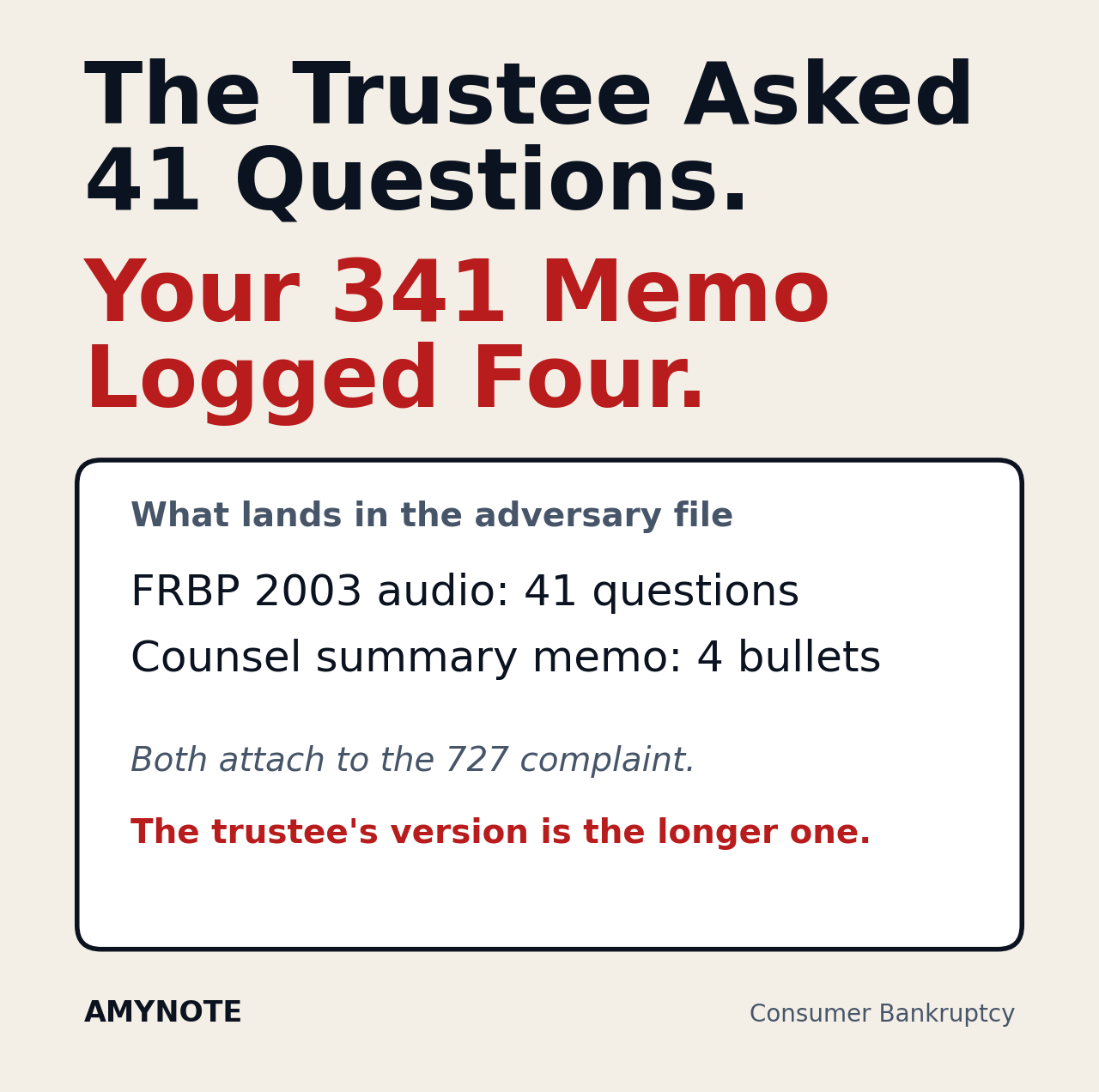
The 341 meeting runs eight minutes. Every answer is sworn testimony under the same oath a witness takes at trial. Fourteen months later, an adversary complaint quotes your client back to you, and you cannot say whether the quote is accurate. The trustee has the audio. You have a half-page memo dictated in the elevator.
That gap is not paperwork friction. It is the structural problem of consumer bankruptcy defense: the side with the verbatim record controls the factual narrative of every later objection-to-discharge, nondischargeability complaint, dismissal motion, or criminal referral — and the verbatim record almost always belongs to the trustee.
The Problem
A 341 meeting of creditors is a deposition with a trustee instead of opposing counsel. The Bankruptcy Code requires the debtor to appear and submit to examination under oath. The trustee records the audio under Federal Rule of Bankruptcy Procedure 2003, fills out the meeting report, marks the exam concluded or continued, and feeds contemporaneous notes into the trustee report and any later motion practice. The United States Trustee Handbook directs panel trustees to retain the audio for two years.
Debtor's counsel typically leaves with a half-page summary memo, often dictated in the elevator on the way back to the car. Then the file goes quiet for a year. When a Section 727 objection to discharge lands, or a creditor files a Section 523 nondischargeability complaint for a specific debt, the complaint anchors itself in 341 testimony the debtor gave when the meeting felt routine. The trustee can still pull the audio. You cannot reconstruct what your client actually said about the 2023 wire transfer or the assignment of accounts receivable. The trustee's record controls the factual narrative by default.
Why the Asymmetry Matters
A 341 meeting is not a court proceeding, but its factual record gets used like one. The transcript or audio of the exam ends up cited in nearly every contested matter that arises later in the case:
- Section 727(a) objections to discharge. The most common subsections — (a)(2) concealment of assets, (a)(4) false oath, and (a)(5) failure to explain loss of assets — all turn on what the debtor said about specific transfers, specific accounts, and specific values. The trustee's notes and the audio are the contemporaneous record of those statements.
- Section 523 nondischargeability adversary proceedings. Creditors bringing 523(a)(2) actual-fraud claims will quote a single 341 answer about when the debtor knew a credit line was unpayable. Without the full exchange, the quoted answer often reads worse in isolation than it sounded in context.
- Section 707(b) bad-faith dismissals. Means-test edge cases and "ability to pay" arguments lean on what the debtor described about income, expenses, and lifestyle during the meeting.
- US Trustee criminal referrals under 18 USC 152. Concealment-of-assets and false-statement referrals do not require a conviction to damage a case; the referral itself reshapes settlement leverage. The factual basis is almost always 341 testimony.
By the time any of these motions or complaints lands, the trustee's record has been in the file for a year. Your client's recollection has drifted. Your memo, however careful, was never written to rebut a quoted answer. The trustee's audio was.
Why Current Solutions Fail
Three common workarounds, each broken in a different way.
- Order the audio from the trustee after the fact. Most districts will release the recording on request, but turnaround runs two to three weeks, sometimes longer, and a per-CD or per-file fee applies in many districts. The recording disappears after the two-year retention window. Adversary proceedings under Section 727 and 523 file routinely in month thirteen or later. By the time you get the audio, you are already drafting an answer with an incomplete picture, and the deadline to respond does not pause for an audio request.
- Send a paralegal to take notes from the gallery. Hybrid and telephonic 341s are standard in most districts now, and the gallery is often just a Zoom tile. Even when the meeting is in person, typing speed caps coverage at roughly 60 percent of spoken content, and the paralegal cannot caucus with you about a follow-up question without losing the next answer the trustee asks. The result is selective notes that look complete until they are the only thing standing between you and a quoted answer in an adversary complaint.
- Ask the trustee to restate or repeat questions on the record. The trustee will not, except for genuine inaudibility. Any visible scramble — "wait, can you read that back to my client?" — raises an inference the trustee will note: the debtor is supposed to know the answer, not be coached toward one. Doing this routinely costs you credibility with that trustee for the rest of your career.
The deeper issue is that none of these methods produce a record on the same scale as the trustee's. A half-page memo cannot rebut a forty-minute audio file, regardless of how careful the bullets are.
What Actually Works
The fix is your own verbatim record of the examination, captured in real time and searchable before the trustee adjourns. Most districts permit debtor's counsel to make a parallel audio recording with notice to the trustee at the opening of the meeting; a one-sentence statement on the record is usually sufficient. The procedural barrier is low. The practical barrier is that nobody wants to leave a 341 with a forty-minute audio file to transcribe by hand or pay a court reporter to type out.
An AI-assisted record changes that calculation. The marginal cost of producing a searchable, speaker-labeled transcript of the exam has dropped to near zero. The trustee's audio is still going to exist. Now your record exists too — and yours has the exact question, the exact qualifier, and the exact answer, indexed by speaker and timestamp, ready for the file the same afternoon.
Where AmyNote Fits
AmyNote runs on counsel's phone or laptop during the examination, transcribes in real time using OpenAI's Whisper-class Speech API, and assigns speaker labels using Anthropic's Claude Opus. By the time the trustee files the meeting report, counsel has a searchable, timestamped transcript of every question and every answer, indexed by speaker. Both OpenAI and Anthropic contractually guarantee zero training on user data. Audio is encrypted in transit; processing copies may be retained to deliver and recover requested features. Transcripts are stored locally on the device with encrypted transport.
When the Section 727(a)(4) complaint arrives fourteen months later alleging a knowing and fraudulent false oath, you search the transcript for the exact phrase the complaint quotes. Where the complaint says "the debtor testified that no transfers occurred in the year preceding the petition," the transcript shows the actual question, the actual qualifier the debtor added ("other than the routine payments to the household checking account"), and the actual follow-up the trustee did or did not ask. That is the difference between a summary judgment loss and a Rule 12(c) motion that closes the adversary in your client's favor.
The same record reshapes settlement conversations with Chapter 7 trustees and US Trustee field attorneys. Negotiations over a Section 707(b) dismissal or a stipulation to dismiss a Section 727 complaint shift the moment counsel can quote a specific exchange, with timestamp, and offer to email the audio clip. Trustees respond to verbatim records. They do not respond to "we recall it differently."
Getting Started
Confirm your district's practice on counsel-side recording before the meeting. Most chapters and most trustees take no position on a debtor-side recording so long as the trustee's own audio remains the official record; a one-sentence notice on the record at the start of the 341 is sufficient. Bring a second device as a backup, especially for hybrid meetings where bandwidth drops or a Zoom tile freezes. Run AmyNote in airplane mode if the case touches sensitive financial detail, then sync after the meeting; on-device transcription works without a network connection. Archive the transcript inside the matter file the same day, while the discharge clock is still running and the file is fresh.
The point is not to challenge the trustee. The point is that when the Section 727 complaint, the Section 523 adversary, or the 18 USC 152 referral lands a year later, the factual record is yours too — word for word, indexed and searchable — and the adversary is not litigating against a half-page memo.
Originally published as an X Article.