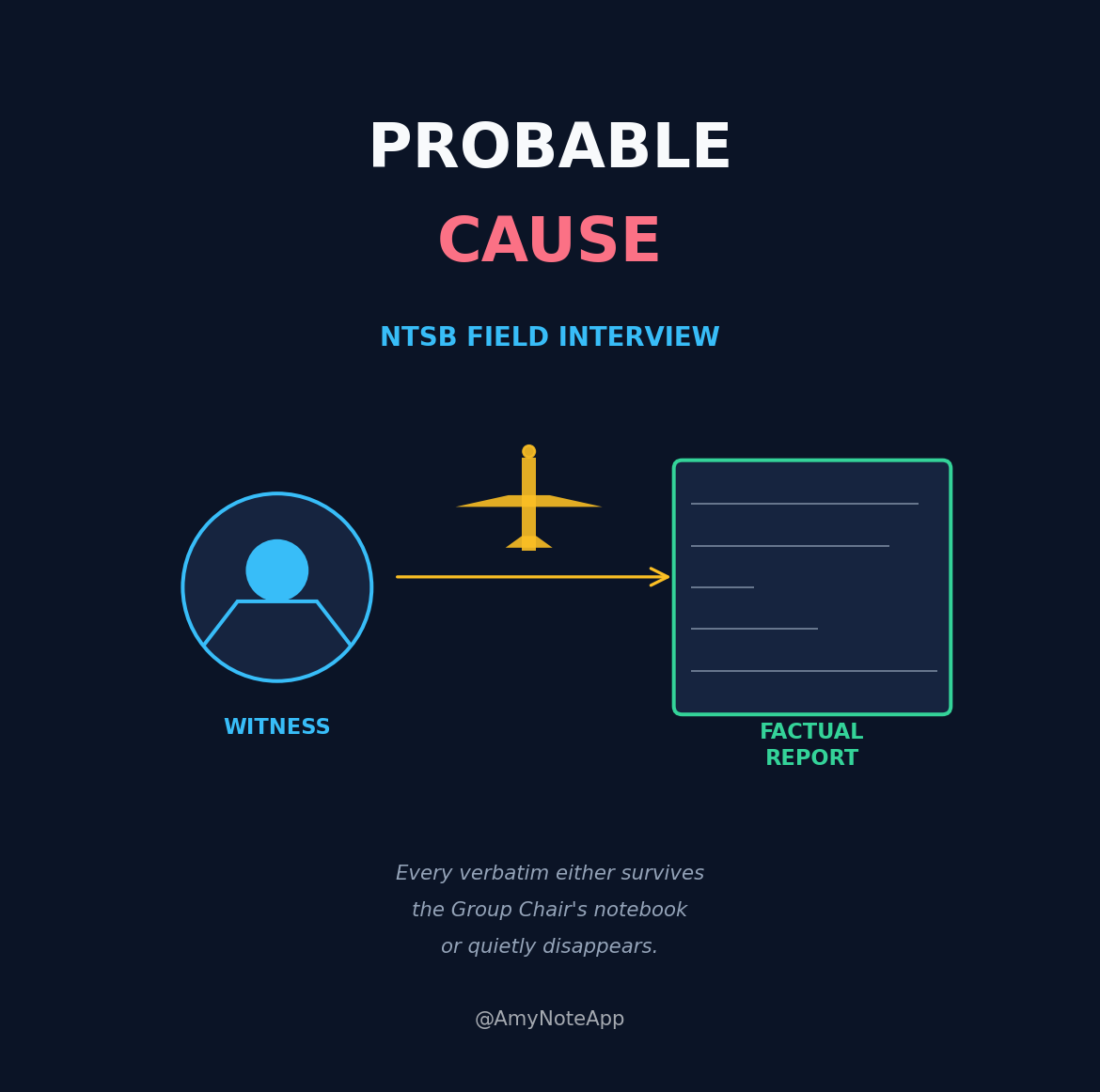
A line crew technician is the first witness the NTSB Operations Group Chair interviews two days after the runway excursion. He saw the captain's hands inches off the throttles as the jet crossed the threshold and uses one phrase to describe it: coupled in. By the time the Group Chair Factual Report lands in the public docket eighteen months later, "coupled in" has become "autopilot engaged". The case is the same. The probable cause finding is not.
This is the gap that aviation accident investigators know exists and cannot quite close with interview forms. The clock is unforgiving. The handoffs are unavoidable. And the one thing that determines whether a verbatim aviation phrase survives or quietly disappears is whether the witness's exact words make it into the interview summary on the day of the hangar-floor conversation.
The Factual Report Locks On The Group Chair's Notes
Under 49 CFR Part 831, the NTSB runs every major aviation investigation through a party system led by an Investigator-in-Charge. Each Group Chair (Operations, Survival Factors, Air Traffic Control, Powerplant, Structures) interviews witnesses during the on-scene phase. The Group Chair's interview summary becomes part of the Group Chair Factual Report. That report goes into the public docket alongside the FDR and CVR readouts and the party submissions.
The witness on the call is rarely the same person who later drafts that report. The interview notebook passes from the hangar floor to the Group Chair's hotel desk, then to the IIC, then to peer review, then to the docket release, then to the analysis branch that drafts the probable cause language for the Board. Each handoff strips information. The witness's exact words exist only in whatever the Group Chair typed into the interview summary while the conversation was still fresh.
The seven-to-ten-day on-scene phase compresses everything. The Group Chair runs witness interviews, debriefs the IIC, coordinates with party representatives from the operator, the manufacturer, the union, and the FAA, and writes interim notes the analysis branch will lean on months later. Whatever phrasing the Group Chair did not capture verbatim on day three of the field deployment is almost never recovered, because the witness has gone back to a base of operations halfway across the country and the Group Chair is now writing in a hotel room from a notebook full of paraphrases.
Why Paraphrased Witness Statements Drift Toward The Wrong Probable Cause
"Coupled in" means the autopilot and autothrust are flying the approach together and the crew is hands-off the flight controls. "Autopilot engaged" means only the autopilot is on. The two phrases pick out different crew actions and different lines of inquiry: did the crew disengage on time, did the autothrust hold the approach speed, did the FMA annunciate correctly. A summary that flattens "coupled in" to "autopilot engaged" walks the analysis away from autothrust questions and toward a stick-and-rudder narrative the witness never offered. The Board reads the second version.
Aviation vocabulary is full of these one-word pivots. "Spool symmetric" is not the same as "engines normal". "Wing rock" is not the same as "Dutch roll". "Floated" is not the same as "long landing". Each pair maps to a different category of contributing factor in the NTSB analysis framework. The witness chooses one. The Group Chair's typed bullet captures the other. The probable cause finding follows the bullet, not the witness.
Three to five years later the Board votes on the probable cause language. Party submissions can dispute interpretation. They cannot dispute whether the words in the Group Chair's report were the words the witness used, because the witness recording, if it exists, is not in the docket. The Board reads the summary as the source of truth. The analysis branch reads it the same way.
What The Interview Bullet Cannot Capture
Even the best-trained Group Chair cannot type at the speed of a frightened ramp technician or a captain who has been awake for thirty hours. Three categories of information routinely drop off the interview summary:
- Aviation-specific terminology. "Coupled in", "spool symmetric", "wing rock", "deep stall", "stick shaker followed by pusher". Each one maps to a different mechanical or operational claim, and each carries different implications for the Board's probable cause framework.
- Time and sequence anchors. "Right after gear retraction", "around the time the radar altimeter called fifty", "when the FMA flipped from VNAV PATH to VNAV SPD". Time-to-event is one of the most-disputed details in party submissions, and it is almost always present in the original witness statement.
- Cross-domain claims. A Powerplant witness mentioning a Flight Controls observation, a Survival Factors witness describing crew workload, a controller describing weather. The Group Chair's notebook is organized by domain; the witness's account is not. Claims that cross the Group Chair's own brief tend to drop off the page.
What Actually Works At The Hangar Floor
The fix is not a longer interview form. The fix is a verbatim audio record of every Group Chair interview, transcribed, timestamped, and searchable from the field office back to the Board room.
Witness consent for recording is standard practice for NTSB factual interviews under Title 49 and the parallel ICAO Annex 13 procedures. Once consent is captured, the Group Chair stops paraphrasing under time pressure during the seven-to-ten-day on-scene phase. The Powerplant Group Chair can hear the Operations witness say "spool symmetric" instead of reading a flattened bullet that drops the symmetry observation entirely. The IIC writes a Group Chair Factual Report that links every claim to a transcript timestamp. The party submissions can dispute interpretation, not whether the words were said.
This is where AmyNote fits. The app records the field interview on a laptop or a phone in the hangar, transcribes through OpenAI's Speech API with aviation vocabulary handled cleanly, and produces speaker-attributed, timestamped segments. Open the case six weeks later, search "flaps" or "wobble" or "coupled" and the witness's exact phrasing surfaces with the surrounding minute of context. Claude Opus organizes the transcript into the Group Chair Factual Report skeleton: witness identification, vantage point, sequence observed, mechanical or operational claims, verbatim quotes. The writer edits from real testimony rather than from one bullet.
Both OpenAI and Anthropic contractually guarantee zero training on user data. Audio is encrypted in transit; processing copies may be retained to deliver and recover requested features. Transcripts are stored locally on the device with encrypted transport. The recording lives inside the IIC's investigation file under the same access controls as the rest of the docket.
The Docket Lens
An NTSB Board member or an FAA reviewer reading a Group Chair Factual Report is not looking for perfect prose. They are looking for traceability. They want to see that every operational claim in the summary can be traced back to a specific witness statement, that the technical language reflects what the witness actually said, and that any deviation between bullet and verbatim has a documented basis. A verbatim recording, retained inside the investigation file, gives every reviewer the same source of truth. The interview bullet alone gives them one Group Chair's paraphrase under field-deployment time pressure.
The downstream cost of paraphrase is real. A probable cause finding built on flattened witness statements invites a petition for reconsideration. A petition that succeeds reopens the analysis years after the docket closed. The party that pays the cost is the operator or the manufacturer whose safety actions and operating procedures were rewritten on the basis of the first finding. Getting the verbatim right the first time is cheaper than getting it right the second time.
Getting Started
Confirm your consent script and your retention SOP for field interviews. Run AmyNote on the Group Chair's laptop alongside your existing interview template. Before the Group Chair Factual Report goes to the IIC, sweep the transcript for every verbatim the bullet flattened and paste the exact phrasing into the report. That is where the wrong probable cause hides.
Two days on the hangar floor. Eighteen months to the docket. The bridge between them is whatever record of the witness's actual words still exists. Build that bridge once, and the rest of the aviation safety workflow runs on real testimony instead of Group Chair paraphrase.
Originally published as an X Article.