The recorded statement is the most consequential conversation in a first-party claim file. It is also the one most likely to be paraphrased into something the audio does not say. That mismatch is not a documentation problem until the file becomes a bad faith suit, an SIU fraud referral, or a Department of Insurance market conduct examination. Then it is the whole problem.
Every plaintiff bad faith attorney in the country knows how to set this trap. They subpoena the audio. They commission a clean transcript. They place that transcript next to the carrier's claim notes and walk a jury through every place the two diverge. The adjuster, eighteen months removed from a call they no longer remember, has to explain on the stand why the note says one thing and the recording says another. There is rarely a good answer.
The Problem
A first-party claims adjuster carries 80 to 120 open files at any given time. A recorded statement of a claimant or witness runs 30 to 90 minutes. The adjuster listens, asks the standard questions about prior injuries, prior claims, sequence of events, mechanism of loss, and damages. Then writes a summary into the claim system: "Claimant denied prior back injuries. Confirmed not at fault. Damages consistent with reported impact."
That summary is wrong. Not deliberately, just inevitably. Under file pressure, the adjuster paraphrases. They drop the hesitation in the answer about prior injuries. They smooth out the contradiction between the claimant's first description of impact speed and the third one. They convert "I think it was around 35" into "claimant reported impact speed of 35 mph." Each compression is small. The cumulative effect is a record the audio will not support.
When the file becomes a bad faith suit, an SIU fraud referral, or a DOI market conduct examination, the audio gets pulled. Plaintiff counsel transcribes it themselves — or pays a court reporter to. Every difference between what was actually said and what the adjuster wrote becomes evidence that the adjuster either failed to investigate the claim or actively misrepresented it. The carrier's defense gets harder by the minute.
What Plaintiff Counsel Actually Does With The Audio
The discovery motion lands and the recorded statement audio comes out of the file. The plaintiff bad faith team builds two columns. Left column: the adjuster's contemporaneous note, exactly as it appeared in the claim system. Right column: the verbatim transcript, with timestamps. Every meaningful divergence becomes a deposition exhibit.
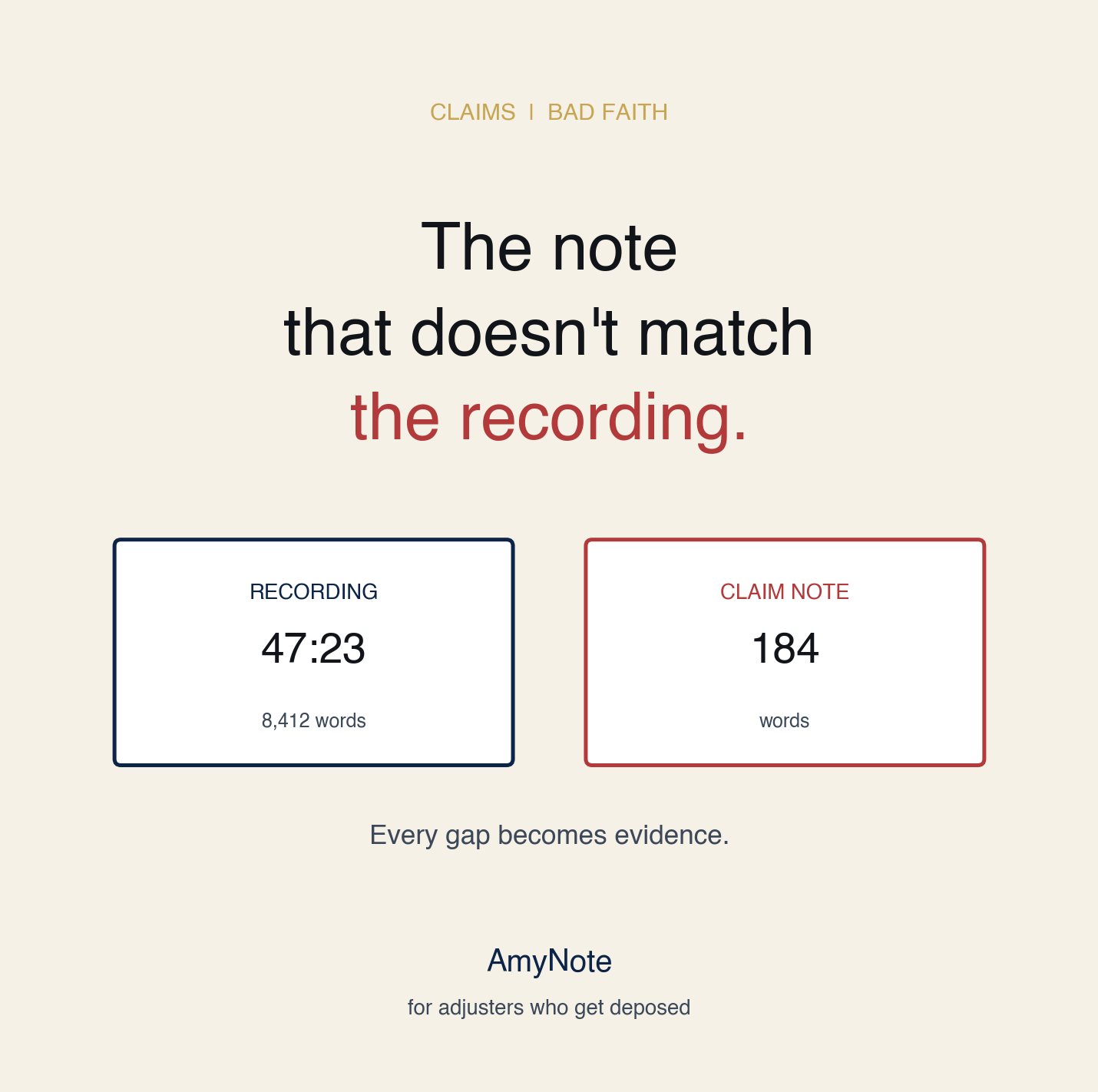
The questions that follow are scripted from a playbook. "Adjuster, your note says the claimant denied prior back injuries. Can you read the timestamp 22:14 line from the transcript? Would you agree that 'I had a tweak a few years back but it cleared up' is not the same as 'denied prior back injuries'?" Multiply that by ten or fifteen divergences across a 47-minute call. The deposition video that results becomes the centerpiece of a bad faith motion or a closing argument at trial.
The damages model in a bad faith case sits on top of those divergences. The argument is not that the adjuster lied; it is that the carrier's claim handling failed because the record of what was investigated did not match what was investigated. Extracontractual damages, punitive exposure, and bad faith verdicts all leverage that gap.
Why Current Solutions Fail
The standard tools do not solve this. The recording sits in the claim system as an audio file no one will listen to again until litigation. The adjuster's summary is the only searchable record. Generic transcription services dump a wall of unlabeled text without speaker turns, without structure, and without quoted admissions tagged for later use.
Carrier-mandated note templates make it worse, not better. The "recorded statement summary" template asks for closed answers to a list of questions, and the template format itself drives the paraphrasing problem. Adjusters who try to quote verbatim get pushback from supervisors for note length. The note that protects the file in litigation is the same note that gets flagged as inefficient by the productivity dashboard.
Outsourced transcription has its own failure mode. Turnaround of 24 to 72 hours means the transcript arrives after the adjuster has already filed their summary and moved on. By the time the verbatim text exists, the contemporaneous note in the system is the one that controls what supervisors and reserve reviewers see. The transcript sits in a file share no one opens until subpoenaed.
What Actually Works
The note that survives litigation is the one that mirrors the recording instead of compressing it. That means verbatim transcription with speaker turns identified, structured extraction of every fact the claimant or witness stated, every quoted admission flagged with timestamp, and contradictions surfaced for follow-up before the file moves to the next reserve review.
AmyNote runs alongside the recorded statement on the adjuster's phone or laptop. The transcription pipeline uses speaker diarization tuned for two-party interviews on phone-line audio. The structured output separates claimant statements from adjuster questions, pulls out every factual assertion the claimant made, and tags admissions and prior-statement contradictions for the file. Each fact carries a timestamp that maps directly back to the audio.
The adjuster reviews and approves before saving. The note that lands in the claim system is a contemporaneous, quote-supported record of the conversation, not a paraphrase. When the file becomes contested eighteen months later, the adjuster's note matches the audio because it was generated from the audio. The plaintiff transcript and the carrier transcript say the same thing, and the discrepancy attack disappears.
What The Structured Statement Note Captures
The summary that lands in the claim system after a recorded statement reads the way a defense attorney would build it from scratch if given a clean transcript:
- Speaker-attributed turns. Every question the adjuster asked and every answer the claimant gave, in order, with timestamps tied back to the source audio.
- Verbatim admissions. When the claimant says something that materially affects coverage or liability — an admission of prior injury, a description of speed, an acknowledgement of policy condition — the exact words are preserved in quotes.
- Internal contradictions. When the claimant describes the mechanism of loss one way at minute 12 and a different way at minute 38, both versions are surfaced side by side for the adjuster to address before closing the call.
- Open follow-ups. Questions the claimant did not answer, or answered with "I don't remember," are flagged so the file owner knows what investigation remains.
- Coverage-trigger language. Specific phrases that bear on policy condition, exclusions, or notice provisions are tagged for legal review.
- Damages claims. Each loss the claimant described, with the language they used — "the leak started three weeks ago," "I haven't been able to work since," "the value of the items was around five thousand" — preserved rather than smoothed.
Privacy, BAA, And The Compliance Conversation
Carrier compliance teams are not going to approve a transcription tool that puts policyholder PII on a third-party server with a generic terms of service. Recorded statements regularly contain Social Security numbers, medical history, banking detail, and named-witness information. The privacy posture has to answer that head on.
Both OpenAI and Anthropic contractually guarantee zero training on user data. Audio is encrypted in transit; processing copies may be retained to deliver and recover requested features. Transcripts are stored locally on the adjuster's device with encrypted transport. The recorded statement audio never leaves the carrier's custody chain. For carriers that require a Business Associate Agreement framework or equivalent vendor due diligence, the providers' enterprise terms cover the necessary contractual ground.
The chain of custody is short and auditable, which is what risk management and outside coverage counsel actually need to see. The audio exists where the recording was made. The transcript exists on the same device. If the file closes and the retention clock runs out, the file is deleted by the same hand that created it.
Getting Started
AmyNote installs on iOS, macOS, and Windows. Adjusters can run it on a personal device alongside the carrier's recording line, or it can sit inside the carrier's recorded statement workflow. The first claim file you save with verbatim quotes and timestamp-anchored fact lists takes about the same time to write up as the old summary. The difference shows up the first time that file gets pulled for litigation.
Run it on the next ten recorded statements and put those notes next to the carrier's standard summary template. The added specificity is what defense attorneys, SIU coordinators, and DOI examiners have been asking adjusters to produce for years — and the productivity dashboard, once it stops counting note length, finally stops penalizing the documentation that actually protects the file.
Originally published as an X Article.