A patient calls your drug safety hotline at 4:47 PM on a Friday. She has been on your oral oncology agent for nine weeks. She describes what she felt in her chest at 2 AM with one word: crushing. By Monday morning that call is an ICSR narrative on its way to FAERS. By the time a medical officer at FDA reads it, "crushing" has become "chest discomfort". The case is the same. The signal is not.
This is the gap that pharmacovigilance teams know exists and cannot quite close with intake forms. The clock is unforgiving. The handoffs are unavoidable. And the one thing that determines whether a serious cardiovascular signal survives or quietly disappears is whether the reporter's exact phrasing makes it into the narrative field on the day of the call.
The Fifteen-Day Clock Starts When She Hangs Up
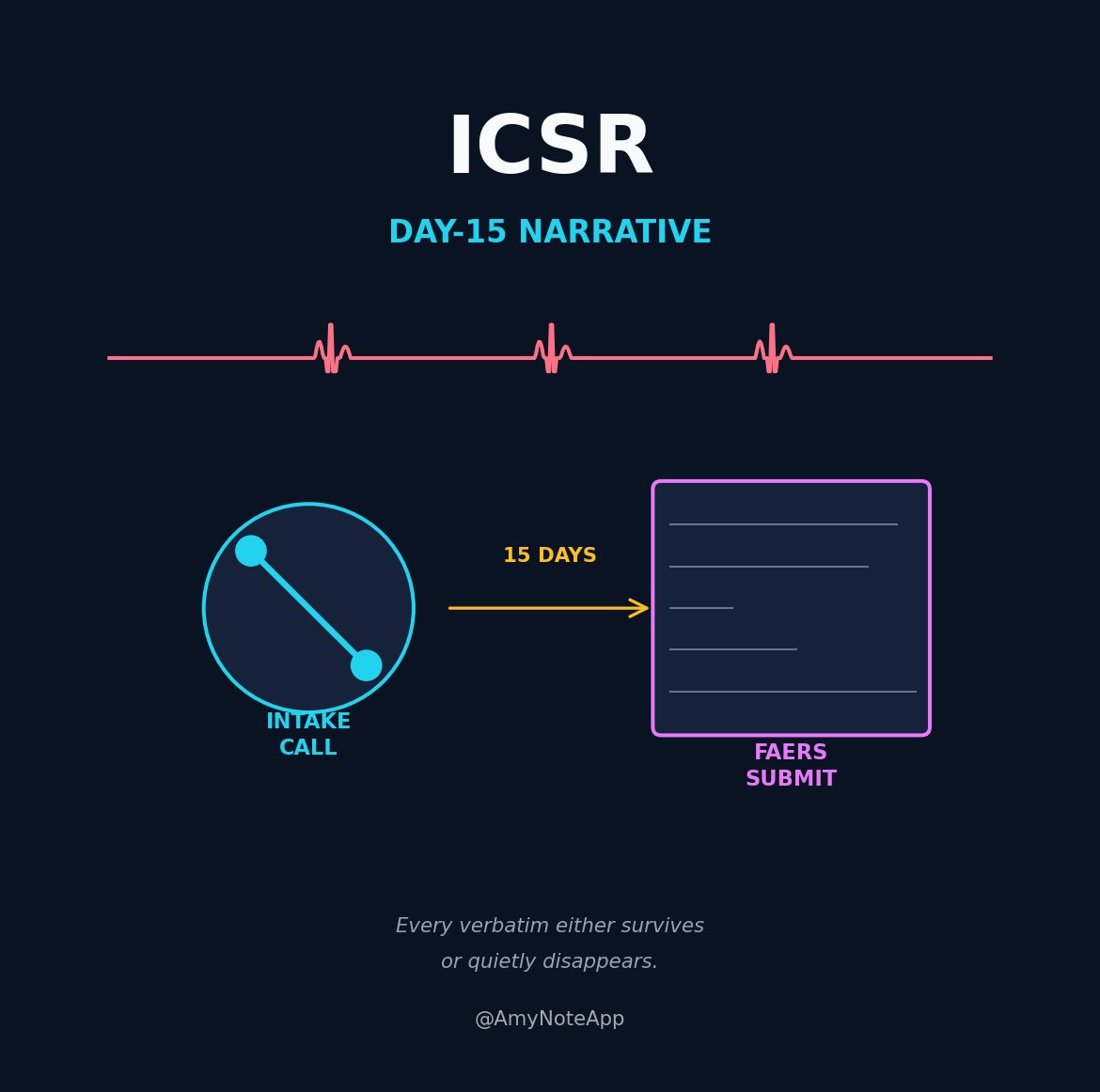
Day zero of an Individual Case Safety Report is the moment a sponsor or its agent becomes aware of the four minimum criteria: an identifiable reporter, an identifiable patient, a suspect product, and an adverse event. Under 21 CFR 314.80 and ICH E2D, serious unexpected events go to FAERS within fifteen calendar days. Fatal or life-threatening cases trigger the same fifteen-day expedited window, with a follow-up report cycle behind it. EudraVigilance runs on the same clock.
The intake operator on the call is rarely the same person who writes the narrative. The intake form passes to a triage queue, then to a case processor, then to MedDRA coding, then to medical review, then to QC, then to electronic submission as an E2B(R3) file. Each handoff strips information. The reporter's exact words exist only in whatever the intake operator typed into the verbatim field while the patient was still on the line.
Fifteen days sounds like enough time. It is not. The actual writing window for the case processor is closer to seventy-two hours once you back out triage, medical review, QC, regulatory upload, and the local-language translations the EU side requires. Whatever phrasing was lost on the call is almost never recovered downstream, because no one downstream has access to the patient.
Why Paraphrased Verbatims Sink The Case
The triage operator hears "crushing" and reaches for the nearest MedDRA Lowest Level Term the system will accept. "Chest discomfort" is an LLT. "Crushing chest pain" is not, but "Myocardial infarction" is, and the seriousness criteria pivot on which one the coder chooses. The reporter never used the second phrase. The coder cannot tell that from the form.
Two weeks later FDA sends an Information Request: provide reporter verbatim for the chest event, provide concomitant medications as reported, clarify time to onset. The case is reclassified incomplete. The clock does not stop. The sponsor logs an aggregate metric for cases reopened on signal-relevant fields and presents it to the regulator at the next inspection.
The downstream cost is not just one Information Request. Once a sponsor accumulates a pattern of cases that fail on verbatim fidelity, the regulator starts asking about the intake process itself. The next PSUR will need to address it. The next pre-approval inspection will sample intake recordings, if any exist, against submitted narratives. A 483 observation that names verbatim quality as the root cause is much harder to remediate than a single case correction, because the remediation has to touch every intake script in every contact center the sponsor uses.
What The Intake Bullet Cannot Capture
Even the best-trained intake operator cannot type at the speed of a frightened patient. Three categories of information routinely drop off the form:
- Symptom descriptors. "Crushing", "stabbing", "pressure that radiates", "felt like an elephant". Each one maps to a different MedDRA term, and each carries different seriousness implications. The patient uses one. The form often records none of them verbatim.
- Time anchors. "Right after the second tablet on Tuesday", "around 2 AM", "the day my husband came back from his trip". Time to onset is one of the most-requested clarifications in FDA Information Requests, and it is almost always present in the call audio.
- Concomitant medications and conditions. Patients answer "what else are you taking" with brand names, generic names, and supplements all mixed together. The intake bullet captures what the operator can identify; the audio captures everything the patient said.
What Actually Works For Day-Zero Capture
The fix is not a longer intake form. The fix is a verbatim audio record of the call, transcribed and timestamped, available to every downstream role that touches the case.
Reporter consent for recording is the standard for pharmacovigilance contact centers. Once consent is on tape, the intake operator stops paraphrasing under time pressure. The case processor pulls the actual quoted phrasing into the E2B(R3) narrative field. The MedDRA coder hears the context around the symptom rather than guessing from one bullet. The QC reviewer can audit any field against the source recording before the case goes to FDA.
This is where AmyNote fits. The app records the intake call on the operator workstation, transcribes through OpenAI's Speech API with pharmacovigilance vocabulary handled cleanly, and produces speaker-attributed, timestamped segments. When the case processor opens a case three days later, search "chest" or "onset" or "concomitant" and the patient's exact phrasing surfaces with the surrounding minute of context. Claude Opus organizes the transcript into the ICSR narrative skeleton: event description, time to onset, action taken with suspect product, outcome, reporter causality. The narrative writer edits from real verbatim, not from a flattened intake bullet.
Both OpenAI and Anthropic contractually guarantee zero training on user data. Audio is encrypted in transit; processing copies may be retained to deliver and recover requested features. Transcripts are stored locally on the device with encrypted transport. The recording lives inside the sponsor's case file under the same retention and access controls as the rest of the safety database.
The Inspection Lens
An EU QPPV or a FDA inspector reading a sample of cases is not looking for perfect prose. They are looking for traceability. They want to see that the narrative field reflects what the reporter actually said, that MedDRA coding decisions are auditable, and that any deviation between intake bullet and narrative has a documented basis. A verbatim recording, retained inside the case file, gives every reviewer the same source of truth. Intake bullet alone gives them one operator's paraphrase under time pressure.
Getting Started
Confirm the consent script and the record-retention SOP. Run AmyNote on the intake workstation alongside the case management system. Before any expedited submission, sweep the transcript for every verbatim the intake bullet flattened and paste the exact phrasing into the E2B(R3) narrative field. That is where the Information Request hides.
Day zero is one phone call. Day fifteen is a FAERS submission. The bridge between them is whatever record of the patient's actual words still exists. Build that bridge once, and the rest of the pharmacovigilance workflow runs on real verbatim instead of operator paraphrase.
Originally published as an X Article.