FDA gives you sixty minutes on a Q-Submission teleconference. The review team speaks in conditional, hedged language: we would generally recommend, depending on the predicate, consider whether, if your tissue contact category does not change. Three months later your regulatory team drafts the actual 510(k) and tries to remember if FDA said should or must.
That memory gap is where most preventable Additional Information requests are born. The Q-Sub call is the single highest-leverage hour in a 510(k) program, and the cost of mishearing one conditional clause shows up six months later as an FDA hold letter, an extra biocompatibility study, or a clinical performance comparison the sponsor never planned to run.
The Sixty Minutes That Set Your Submission
A Pre-Submission, commonly called a Q-Sub, is the only structured chance to align with the CDRH review division before your 510(k) lands in the queue. The sponsor files a Q-Sub package with specific questions. FDA returns written preliminary responses. Then a sixty-minute teleconference closes the loop.
The room on FDA's side is not one person. It is the lead reviewer for the relevant Office of Device Evaluation division, often a biocompatibility expert from the materials branch, sometimes a statistician brought in for clinical performance questions, and a Pre-Sub coordinator running the meeting on the FDA side. Each one speaks in carefully bounded language because their feedback is non-binding and subject to change at the final 510(k) review.
That bounded language is not bureaucratic hedging. It is exactly what the agency is allowed to say. A reviewer who tells you "we would generally recommend ninety-day testing if you stay with the current predicate" is making three commitments and zero promises. The commitments are: ninety days is the testing duration their division usually accepts for this risk class, the predicate device on file matches what they expect, and the tissue contact category they have understood is the one you will submit on. The non-promise is: nothing here binds the final 510(k) reviewer if anything changes.
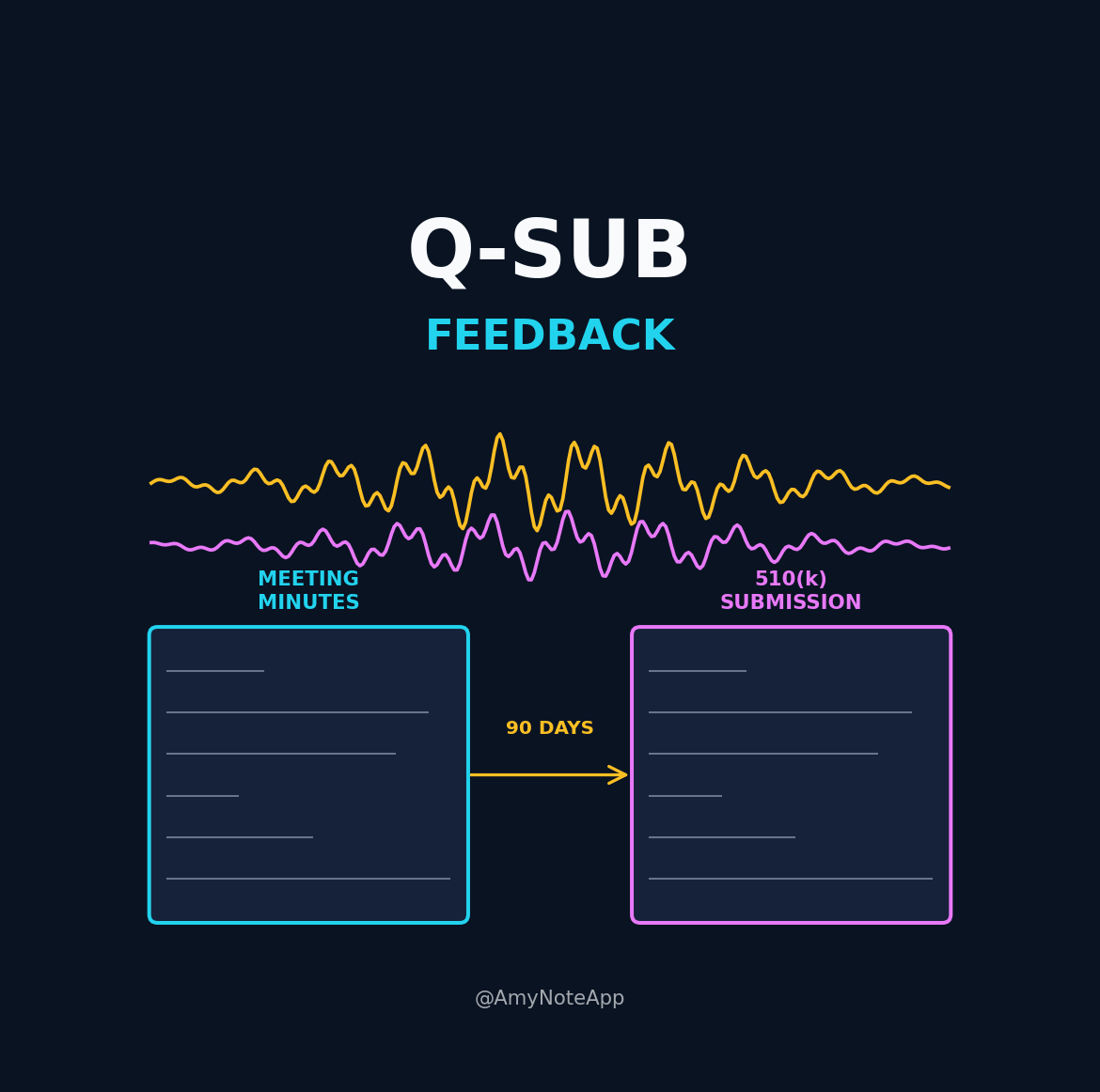
The sponsor side carries the burden of capturing what was said. Meeting minutes are due to FDA within fifteen calendar days. The actual 510(k) draft does not get written until sixty to one hundred eighty days later, and sometimes longer if a clinical sub-study slips. The notes are the bridge between a one-hour conversation and a multi-volume regulatory submission, and the bridge has to carry conditions, not just conclusions.
Why Bullet Notes Lose The Case
The failure mode is consistent across regulatory teams. The notetaker writes "FDA recommends 90-day biocompat". The verbatim was "we would generally recommend ninety-day testing if you stay with the current predicate and the tissue contact category does not change". Three conditions disappear into a four-word bullet.
By the time the 510(k) draft reaches the QA review three months later, no one in the room remembers the conditions. The submission claims FDA blessed an approach FDA never categorically blessed. The result is an Additional Information request, a 510(k) hold, and a six-month delay that pushes the launch into the next fiscal year.
The same pattern repeats across every common Q-Sub topic:
- Predicate device selection. "FDA agreed our predicate is appropriate" becomes the QA team's reading. The verbatim was usually closer to "the predicate appears reasonable based on what you have shared today, but a final assessment requires the complete intended-use comparison in the 510(k)."
- Biocompatibility testing strategy. "FDA accepts ISO 10993-5 cytotoxicity is sufficient" papers over the conditional: "for this contact category and contact duration, cytotoxicity is generally the right starting test; additional ISO 10993-10 sensitization may be needed if your material changes."
- Sample sizes for clinical performance. "FDA agreed on N=60" loses "we would not object to N=60 if your endpoint remains the same and your inclusion criteria do not narrow further."
- Software level-of-concern classification. "FDA confirmed moderate LOC" loses "based on the hazard analysis as described; if the hazard analysis changes during V&V, the LOC may need to be revisited."
- Comparative testing scope. "FDA does not require a head-to-head" loses "we would generally not require comparative testing for this indication if the technological characteristics match the predicate within the bounds we discussed."
In each case the meeting minutes flatten a clause-rich sentence into a categorical claim. The 510(k) writer, working months later from those minutes, repeats the categorical claim in the submission. The 510(k) reviewer, who was not in the Q-Sub call and has a different reading of the predicate or the contact category, treats the categorical claim as an overreach and sends an AI request asking the sponsor to substantiate or revise.
What Actually Works In A Regulated Workflow
The fix is not more elaborate minutes. The fix is a verbatim audio record of the Q-Sub teleconference, speaker-tagged by reviewer role, searchable by topic months after the call.
Sponsors are permitted to record their own side of the call as a matter of internal practice. Notify FDA at the start of the meeting as a professional courtesy and note it in the minutes. Record on the sponsor side. Take parallel bullet notes for the fifteen-day minutes deliverable. Keep the audio and the transcript for the 510(k) draft phase, archived under the same document controls as the rest of the design history file.
This is where AmyNote fits. The app records the teleconference on device, transcribes via OpenAI Whisper with medical and regulatory vocabulary handled cleanly, and produces speaker-attributed segments. When the 510(k) writer searches "ISO 10993-5" or "sample size" or "predicate" three months later, the exact conditional phrasing surfaces with the surrounding context. Claude organizes the transcript into topic clusters by FDA reviewer comment so the regulatory lead can audit the meeting minutes against the verbatim source before they go out the door at day fifteen.
That audit step is the highest-yield use of a fifteen-minute review window. The regulatory lead reads each bullet in the draft minutes, searches the transcript for the topic, and either confirms the bullet matches what was said or rewrites the bullet to preserve the conditions FDA actually attached. The transcript stays in the file for the 510(k) draft phase, the AI request response phase, and any pre-decisional teleconference that follows.
What Changes When The 510(k) Writer Has The Transcript
The submission text shifts from claims to acknowledgments. Instead of "FDA agreed that ninety-day biocompatibility is sufficient," the draft reads "In the Q-Sub teleconference of [date], FDA indicated that ninety-day biocompatibility would generally be acceptable provided the predicate and tissue contact category remained unchanged from the Q-Sub package. Both conditions are met in this submission, as documented in Section X."
That second framing is what a CDRH reviewer wants to read. It mirrors the agency's own conditional language. It cites the date of the discussion. It explicitly acknowledges both conditions and demonstrates they hold. The reviewer who was not in the Q-Sub call now has a paper trail that aligns with the division's institutional habit of speaking in conditions, and the path to substantial equivalence shortens.
Privacy And The Design History File
Both OpenAI and Anthropic contractually guarantee zero training on user data. Audio is encrypted in transit; processing copies may be retained to deliver and recover requested features. Transcripts stored locally on device with encrypted transport. The audio file and transcript stay inside the sponsor's records under the same controls as the rest of the design history file, which matters because Q-Sub content can include proprietary device specifications, unpublished test data, and pre-decisional FDA feedback that a public cloud transcription service would be the wrong place to store.
For regulatory teams already operating under 21 CFR Part 820 and the Quality System Regulation, this is the correct privacy posture. Audio in. Transcript out. cloud processing disclosed in our Privacy Policy. No model-training feedstock. Local storage under the company's existing controlled-document procedures.
Getting Started
Confirm your internal recording policy and notify FDA at the start of the call. Run AmyNote on the device joining the bridge. Keep the parallel bullet notes for the fifteen-day minutes deliverable. Before the 510(k) draft locks, sweep the transcript for every conditional phrase the minutes flattened, and rewrite the submission text to preserve the conditions. That is where the next AI request hides, and it is the one preventable cycle in a 510(k) timeline.
AmyNote offers a 3-day free trial with no credit card required. The next Q-Sub on your calendar is the one to test it on.
Originally published as an X Article.