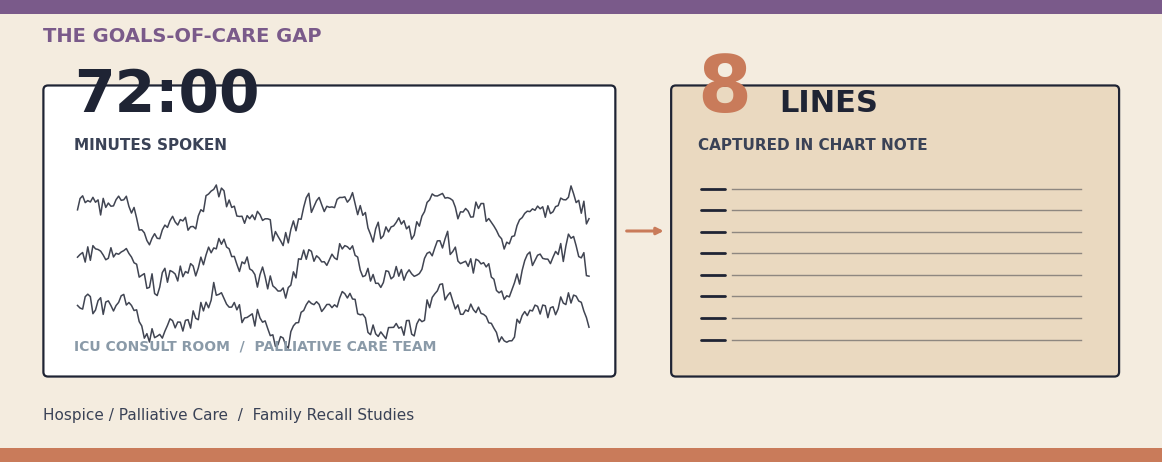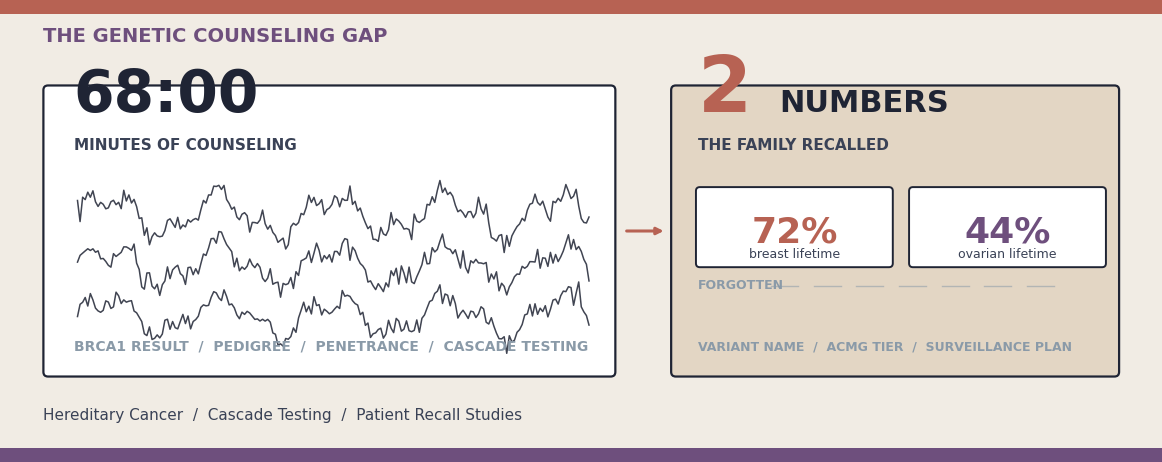
A young woman sits in a genetic counseling clinic with a positive BRCA1 report from a multi-gene panel. The counselor spends sixty-eight minutes walking through penetrance, surveillance options, prophylactic surgery, insurance protections, and cascade testing for her sister and mother. She leaves with a printed summary letter. Three weeks later she calls back. What was the ovarian number again? My sister wants to know if she should test.
The Problem
Genetic counseling sessions for hereditary cancer, prenatal testing, and rare disease diagnosis run 60 to 90 minutes. A single visit covers pedigree construction across three generations, ACMG variant classification on a five-tier scale, age-specific penetrance, prophylactic versus surveillance pathways, GINA protections, insurance preauthorization, psychological referral, and the logistics of cascade testing for first-degree relatives.
The counselor’s post-visit summary letter is the operative document. It takes 90 to 180 minutes to draft. It becomes the artifact the patient forwards to her oncologist for a risk-reducing mastectomy consult, the artifact her sister’s primary care doctor uses to order targeted testing, and the artifact a future surgeon references before scheduling a salpingo-oophorectomy.
Patient recall studies from the National Society of Genetic Counselors put accurate retention of risk percentages at 25 to 30 percent four weeks out. Recall of specific variant nomenclature drops further when the result is a variant of unknown significance or a moderate-penetrance gene the patient has never heard of. The conversation that should drive a family’s next ten years of medical decisions collapses into two or three half-remembered numbers.
Why The Summary Letter Alone Is Not Enough
Pre-printed brochures cover BRCA in general terms and miss the patient’s specific variant, family history, and reproductive timeline. The summary letter arrives ten to fourteen days after the visit, well after the patient has already had to explain the result to her sister, her mother, and her partner from memory.
Hospital patient portals release the chart note but not the texture of the counseling itself. EHR ambient scribes focus on the clinical SOAP note for billing, not the long counseling narrative the family actually needs. Recording on a personal phone feels intrusive and most patients do not know they are allowed to ask.
The result is a quiet, predictable failure mode. The counselor delivers an excellent visit. The patient leaves grateful and overwhelmed. The summary letter, when it arrives, is well-written and accurate. Four weeks later the family is making decisions on partial information, and the counselor is fielding follow-up calls that should not have been necessary.
Why Cascade Testing Is The Real Stakes
A BRCA1 pathogenic variant carries roughly a 55 to 72 percent lifetime risk of breast cancer and a 39 to 44 percent lifetime risk of ovarian cancer. Identifying carriers in the proband’s family is the single most leveraged intervention in cancer genetics. Each first-degree relative who tests has a 50 percent chance of carrying the same variant, and a positive result moves that relative into a screening or risk-reduction pathway that materially changes their outcome.
Cascade testing uptake in families where the proband retains accurate variant information runs roughly twice the rate of families relying on the four-page letter alone. The penetrance of a BRCA1 mutation does not change. The penetrance of information about the mutation changes everything.
What Actually Works
A capture tool the patient runs on her own device, with consent obtained out loud at the start of the visit. The audio stays on the patient’s phone. The transcript is searchable by variant name, by relative, by risk percentage, by free text. Nothing flows into the hospital system. The counselor is unburdened. The patient walks out with a record her family can actually use.
AmyNote runs on iOS and macOS. Audio is transcribed via OpenAI Whisper and structured via Anthropic Claude. Both OpenAI and Anthropic contractually guarantee zero training on user data. Audio is encrypted in transit; processing copies may be retained to deliver and recover requested features. Transcripts stored locally on device with encrypted transport.
When the patient’s sister calls a month later, the patient pulls up the encounter, searches for ovarian risk, and reads back the counselor’s exact phrasing in fifteen seconds. When she meets her oncologic surgeon, she opens the segment on prophylactic options and lets the surgeon hear what was already explained. When her mother asks whether she should test, the patient forwards a clipped excerpt rather than a paraphrase she cannot quite remember.
What The Patient Searches For Later
From the patient’s perspective the transcript becomes a private medical reference. The most common search patterns we see in this use case map onto the moments the family actually needs the information:
- “Ovarian risk by age 50” — for the salpingo-oophorectomy timing conversation with the gynecologic oncologist.
- “What test does my sister need” — for the targeted single-site testing order, not another multi-gene panel.
- “Insurance and GINA” — for the long-term care insurance question that arrives a year later, after GINA’s scope has been forgotten.
- “Variant classification” — for the second-opinion clinician who wants to know whether the lab called this pathogenic, likely pathogenic, or VUS, and on which evidence.
- “Surveillance schedule” — for the annual breast MRI plus mammogram cadence the patient needs to defend when a referral falls through a gap.
None of these are exotic queries. They are the questions the counselor already answered in the visit. The transcript turns them into 15-second lookups instead of 15-day callbacks.
Getting Started
Install AmyNote on the patient’s phone before the genetic counseling appointment. Ask the counselor for consent to record at the start of the visit. Most counselors welcome this, since it reduces the volume of follow-up calls about details the patient forgot. The transcript belongs to the patient. The variant belongs to the family. The record finally matches the conversation that actually happened.
Originally published as an X Article.