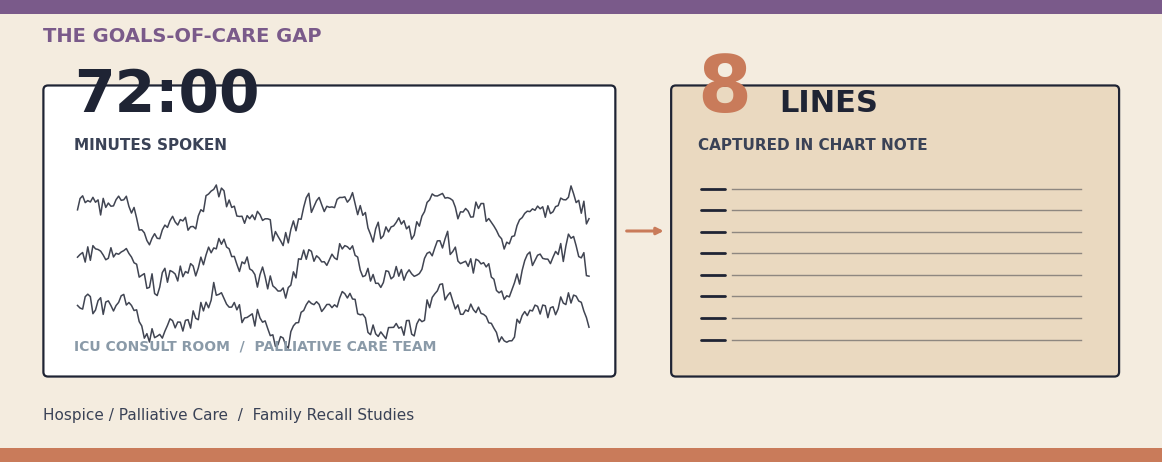
The palliative attending sits with a family in an ICU consult room for seventy-two minutes. They cover prognosis, mechanical ventilation, artificial nutrition, MOLST signing, hospice eligibility, and bereavement resources. The family is exhausted and grief-stricken. The chart note becomes the operative record of what was decided. The family remembers almost none of it.
The Problem
Goals-of-care conversations are the most consequential meetings in modern medicine. A single 60 to 90 minute session can determine whether a patient receives vasopressors, dialysis, or comfort-focused care. The conversation happens in an ICU consult room, a hospice admission visit, or a SNF family conference. It happens once. There is rarely a second sitting.
The palliative team types a structured note afterward. REMAP framework headers, ePrognosis values, a one-line summary stating “patient and surrogate verbalize understanding of prognosis, agree to DNR/DNI.” That note travels with the chart. It is read by the night-shift hospitalist who responds to a rapid-response call at 3 AM. It is read by the on-call attending who reconciles the MOLST against the active resuscitation order. It is read by the ethics consultant six weeks later when a sibling who was not at the meeting calls to dispute hospice enrollment.
The family that actually had the conversation has nothing. No transcript, no recording, no structured handout. Surrogate decision-maker studies find recall rates below 30 percent for key prognostic numbers within 48 hours. By the time the patient deteriorates, the family is renegotiating decisions they thought were already made — or worse, watching a different attending honor a DNR they no longer remember signing.
Where the Gap Shows Up Clinically
The mismatch surfaces in three predictable places, each of which compounds the next.
- The 3 AM rapid response. A different attending is on call. The MOLST is in the chart. The family at bedside asks for “everything to be done.” The attending reads “patient and surrogate agreed to comfort-focused care” in the structured note. There is no record of the seven-minute exchange where the palliative team explained what comfort-focused care actually means for this patient.
- The follow-up family meeting three days later. A sibling who was not in the room arrives. The clinical situation has changed. The original family meeting’s decisions are being relitigated, and no one in the room can quote what the palliative attending actually said about feeding tubes versus IV hydration. The new meeting takes another 60 minutes and produces a new structured note that may contradict the first.
- The bereavement period. Six weeks after the death, the surviving spouse cannot remember whether the doctor offered to call back or whether the team explained why the patient stopped responding to vasopressors. Complicated grief outcomes correlate with the gap between what the family thought was said and what the family later wishes had been said.
None of these failure modes are clinician errors. The palliative team did its job. The chart note is well-structured. The MOLST is signed. What is missing is the family-side copy of the conversation that produced those documents.
Why Current Solutions Fail
Several reasonable-looking alternatives all miss the moment.
- Pre-printed brochures. Useful for general orientation, useless for a specific clinical situation. The brochure cannot say what dose of comfort medication the team is recommending or whether this particular patient is eligible for inpatient hospice this week.
- Post-meeting summary letters. Take days to dictate and arrive after the next decision point has already passed. By the time the letter reaches the family, the patient has either improved past it or deteriorated past it.
- EHR patient-portal note release. Gives the family the clinician’s framing of the meeting, not their own questions and the answers they actually received. The note is the team’s document, not the family’s.
- Recording on a personal phone, ad hoc. Feels intrusive. Requires consent the family does not know to ask for. Produces a 70-minute audio file that no one will ever play back unless they know exactly which minute holds the sentence they need.
The palliative care team does not need another documentation tool. The family needs a parallel record that does not change clinician workflow and does not flow into the hospital system.
What Actually Works
A locally-running capture tool that the family controls. Consent obtained out loud at the start of the meeting. Audio captured on the family’s own device. Transcription handled outside the hospital’s network. Nothing uploaded to the hospital, nothing visible to the care team unless the family chooses to share.
AmyNote runs entirely on the family member’s phone or tablet. It uses the OpenAI Speech API for transcription and Anthropic Claude for summarization. Both OpenAI and Anthropic contractually guarantee zero training on user data. Audio is encrypted in transit; processing copies may be retained to deliver and recover requested features. Transcripts stored locally on device with encrypted transport. Nothing about the recording or its analysis enters the hospital chart unless the family chooses to share it.
The family walks out of the conference room with a verbatim transcript they can review with siblings who could not attend. They can search “what did the doctor say about feeding tubes?” and find the exact sentence. When the rapid-response call comes at 3 AM and a different attending asks whether the patient agreed to comfort-focused care, the family has the answer in their own pocket, in the clinician’s own words.
Bereavement counselors benefit too. Six weeks after the death, the family revisits the recording and finds words of compassion the clinician offered that they could not absorb in the moment. Complicated grief outcomes improve when surviving family members have access to the actual conversation rather than reconstructed memory. The chaplain or social worker who supports the family through the first year of grief now has a document to refer back to instead of asking the family to retell what was already painful to hear once.
Getting Started
- Install AmyNote on a family member’s device before the goals-of-care meeting. The 3-day free trial does not require a credit card. Test it on a one-minute clip the night before so the family member is not learning the app at the same time they are processing prognosis.
- Ask the palliative team for consent to record at the start of the conversation. Most teams welcome this, since it reduces follow-up calls about points the family forgot. State recording-consent rules vary; most are one-party, a handful require all parties. Either way, asking openly turns the recording from an awkward secret into a shared tool.
- Place the phone face-down on the table. The clinical workflow is unaffected. The recording captures both sides of the exchange, including the questions the family asked that prompted each clinician answer.
- Within 24 hours, review the transcript while the meeting is fresh. Tag the moments that matter: prognostic numbers, hospice eligibility, MOLST scope, who the on-call clinician is, what to call about and what not to call about. Share the relevant excerpts with siblings who were not in the room.
- Revisit the recording before each subsequent decision point. When the clinical situation changes, the family does not have to renegotiate from memory. They can quote the palliative attending back to themselves and to the next clinician on the case.
The Bottom Line
The goals-of-care conference is the most important conversation in modern medicine and the one with the worst documentation asymmetry. The clinical team walks out with a structured note. The family walks out with eight sentences and grief. By the time the patient deteriorates, the gap between what was said and what was remembered is the source of the family’s second-worst day.
The transcript belongs to the family. The decisions belong to the patient. The record finally matches the meeting that actually happened. AmyNote runs on the iPhone, captures the conference in 120-plus languages with real-time translation for families whose first language is not English, keeps the transcript on the device, and guarantees the audio never trains a model. Try the 3-day free trial at amynote.app, no credit card required.
Originally published as an X Article.