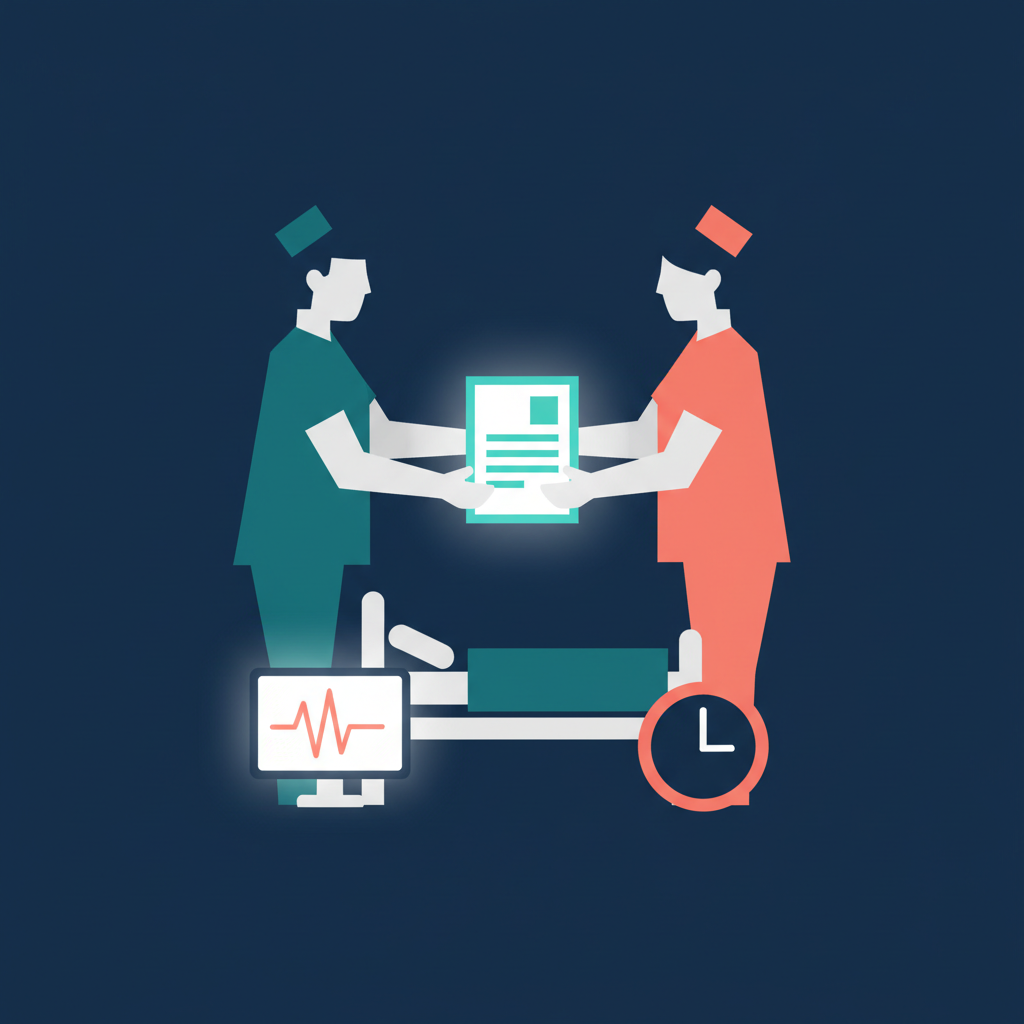
It is 6:58 a.m. on a step-down unit. The night nurse has a few minutes to hand off five patients before her replacement takes over and she finally goes home after twelve hours on her feet. She talks fast: the new admit in bed 12, the pending troponin on bed 14, the family that still needs a call about bed 11's code status.
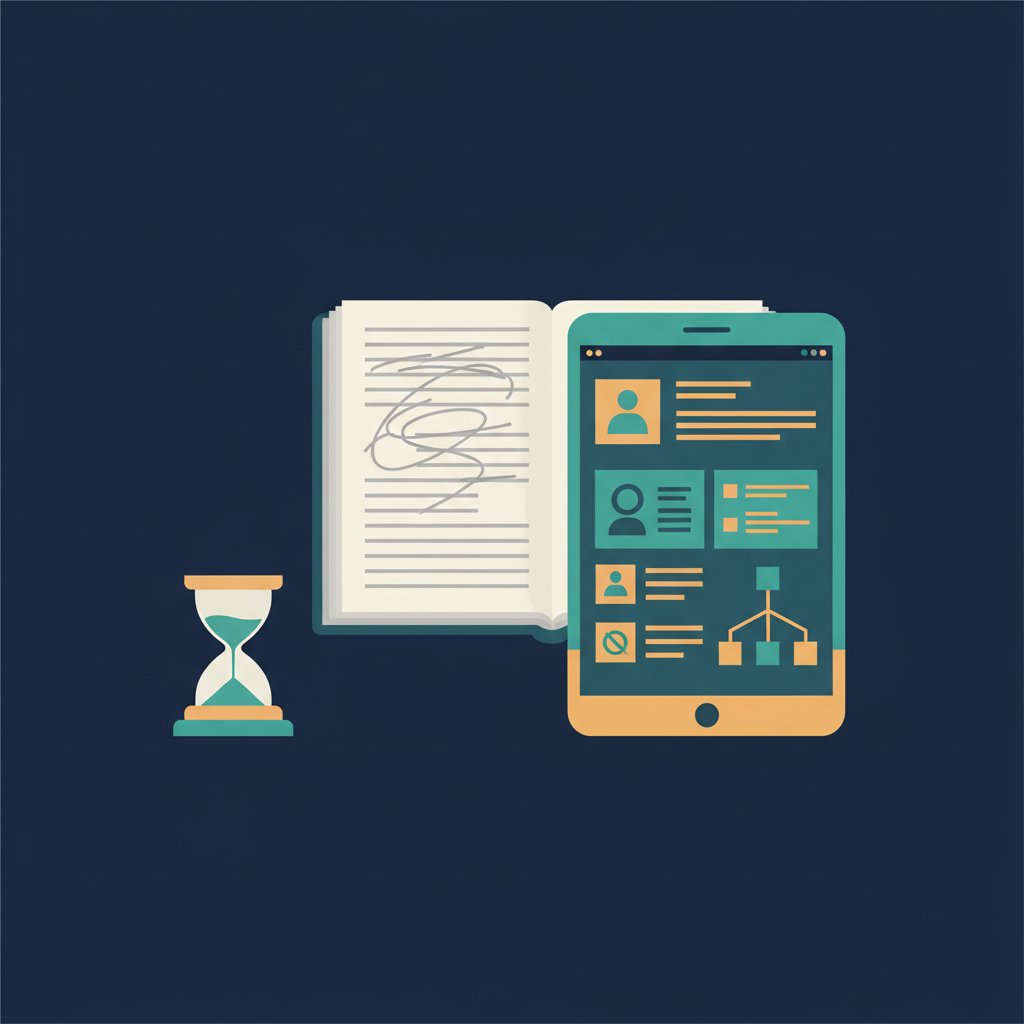
The day nurse scribbles on a folded worksheet. By 9 a.m. half of it is illegible, and the one detail that mattered — that bed 14's chest pain returned at 4 a.m. — never made it onto paper. This is the handoff gap, and it is where patient safety quietly breaks.
The Handoff Problem
Shift change is the most dangerous few minutes in the hospital. It is the moment when responsibility for a human being transfers from one person's memory to another's, and most of what passes between them is spoken, not recorded.
A medical-surgical nurse may hand off five or six patients two or three times a day. An ICU handoff covers drips, vent settings, pending labs, and the reasoning behind every titration. Research on transitions of care has long tied a large share of serious adverse events to communication breakdowns at exactly this moment. The problem is not that nurses are careless — it is that the handoff is built to evaporate.
The information loss is structural, not careless:
- Verbal-only details vanish. "Watch his potassium, the 4 a.m. draw was borderline" gets said, not charted, and the next nurse never follows up.
- Pending items fall through. A pending CT read, a held medication, a callback to the family. Handoff is where these get dropped.
- The reasoning disappears. Why a patient is NPO, why a pressor is being titrated down — the logic that should guide the next twelve hours is gone by the time it matters.
- Continuity breaks across shifts. What day shift learned about a patient's baseline is lost to night shift, then relearned at the bedside hours later.
Each of those losses is small in isolation. Stacked across five patients, three handoffs a day, and a unit that turns over staff every twelve hours, they compound into the single most reliable source of preventable harm in inpatient care.
Why Current Solutions Fail
The brain sheet is a disposable scratchpad. The personal worksheet each nurse carries is shorthand, abbreviated, and thrown in the shred bin at end of shift. Nothing persists, and nothing transfers cleanly. The next nurse rebuilds her own version from scratch, and whatever context did not survive the verbal report is simply gone.
The EHR holds orders, not conversation. Epic and Cerner store the chart — labs, orders, flowsheet values, the medication administration record. They do nothing for the spoken nuance that never fits a structured field: the hunch, the "keep an eye on this," the family dynamics that change how you deliver news.
Standardized formats rely on memory. SBAR and I-PASS structure what should be said. They do not capture what was actually said, and under time pressure steps get skipped. A framework is only as good as the thirty seconds someone has to follow it at 7 a.m.
Generic meeting bots are a HIPAA non-starter. You cannot send bedside patient audio to a consumer transcription vendor that may retain recordings or train models on them. The compliance exposure alone takes the obvious off-the-shelf tools off the table for any unit handling PHI.
What Actually Works
Effective handoff capture needs three things together: accurate transcription of clinical speech, secure capture that respects patient privacy, and AI that turns raw audio into the brief the next nurse actually needs. Miss any one of the three and the tool fails the unit.
Transcription that handles clinical vocabulary
General transcription chokes on the words that carry the clinical weight. AmyNote uses OpenAI's latest Speech API, which gets terms like titrating norepinephrine, telemetry, Braden score, PRN hydromorphone, contact precautions, and NPO after midnight right the first time — because a handoff record that mangles the drug or the dose is worse than no record at all.
Speaker identification across the care team
AmyNote's cross-session speaker memory tags the charge nurse, the off-going RN, and the oncoming RN consistently across shifts, so the record knows who reported what and who owns each follow-up. When a question surfaces three shifts later — who said the family was updated? — the answer is in the record, attributed.
Structured AI summaries built for handoff
Anthropic's Claude Opus generates a per-patient brief with the structure nurses need: active problems, pending labs and reads, held or titrated medications, code status, open callbacks, and follow-up timing. Search across a patient's whole stay surfaces every prior mention of a symptom or order, so the oncoming nurse inherits the full arc rather than a single shift's snapshot.
Privacy architecture a hospital can defend
Both OpenAI and Anthropic contractually guarantee zero training on user data. Audio is encrypted in transit; processing copies may be retained to deliver and recover requested features. All transcripts and recordings are stored locally on the nurse's device with encrypted transport. Cloud processing copies are handled under the controls described in AmyNote’s Privacy Policy. No PHI feeding model-training pipelines. This is the difference between a tool a compliance officer signs off on and one that never makes it past the first security review.
Getting Started
AmyNote runs on a nurse's phone. Record the handoff with the team's knowledge, get a structured per-patient brief in minutes, and search any prior shift by patient, problem, or speaker. There is no bot to join the room, no hardware to provision, and no calendar to wire up — just the device already in a scrub pocket.
Free 3-day trial, no credit card. It is worth a single shift change to see whether the next nurse inherits the full picture instead of half a worksheet. The handoff that used to live for thirty seconds and then disappear becomes a record the whole care team can stand behind.
Originally published as an X Article: The Handoff Gap on X.