A radiology resident sits in a tumor board meeting. Eight specialists discuss 14 cases in 90 minutes. Three attendings disagree on staging for a pancreatic mass. The resident scribbles as fast as possible — and still misses the oncologist's reasoning for recommending neoadjuvant therapy over upfront surgery.
Two weeks later, that reasoning matters. The resident can't reconstruct it. Neither can anyone else who was in the room.
This is the clinical conference problem. Grand rounds, M&M conferences, tumor boards, case presentations — the highest-density learning environments in medicine — produce the worst documentation. The knowledge generated in these sessions is enormous. The knowledge retained is a fraction of it.
The Documentation Gap in Multi-Speaker Medical Settings
Clinical conferences are uniquely difficult to document. Unlike a one-on-one patient encounter, a tumor board might have 8–12 speakers contributing in rapid succession. A grand rounds presentation involves audience Q&A where the most valuable teaching moments happen off-script.
The core issue is speaker density. When an attending challenges a diagnosis, a pathologist clarifies a finding, and a surgeon explains their approach — all within two minutes — no one is capturing that exchange accurately.
Most institutions rely on one of three approaches:
- Designated note-taker — one person writes while everyone else talks. The notes reflect one perspective, miss nuance, and vary wildly in quality depending on who drew the short straw.
- Post-meeting summary — someone reconstructs the discussion from memory hours later. Key disagreements get smoothed over. Minority opinions disappear.
- No documentation at all — surprisingly common. The conference happens, learning occurs in the moment, and nothing persists.
None of these capture what actually matters: who said what, why they disagreed, and how the group reached a decision.
The Hidden Cost of Lost Conference Knowledge
The consequences extend beyond individual learning. When a tumor board discusses 14 cases and the only record is a checklist of decisions made, the reasoning behind those decisions evaporates. Six months later, when a similar case presents, the team has no institutional memory to draw from.
For residency programs, the cost is particularly steep. Clinical conferences are a core pillar of graduate medical education. The ACGME requires programs to demonstrate that conferences contribute to resident competency. But when the only evidence of learning is attendance sheets, programs struggle to show that conferences are actually achieving their educational purpose.
There's also a quality improvement dimension. M&M conferences exist to learn from adverse outcomes. If the nuanced discussion about what went wrong and why gets reduced to a brief summary, the learning loop closes incompletely. The same mistake becomes more likely to recur.
Why Standard Transcription Tools Fall Short
General-purpose transcription was not built for clinical settings. The failure modes are specific:
- Medical terminology accuracy — "methylprednisolone" becomes "methyl prednisone." "Cribriform pattern" becomes gibberish. When the transcript is wrong on the terms that matter most, trust collapses fast.
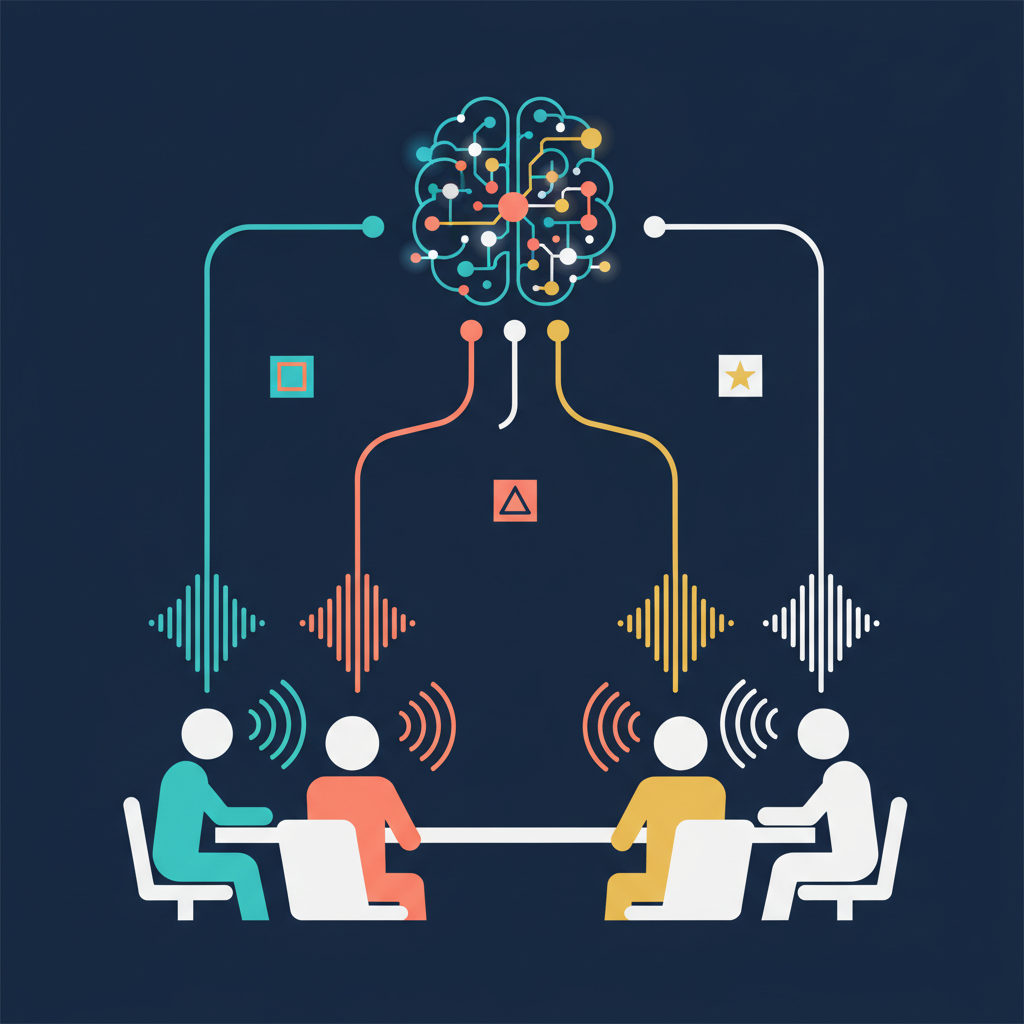
- Speaker attribution in large groups — most tools handle two speakers reasonably well. Put eight physicians in a room and you get "Speaker 1" through "Speaker 8" with frequent misattribution. Useless for learning who held which position.
- HIPAA exposure — uploading patient case discussions to a cloud transcription service that trains on user data is a compliance nightmare. Most institutions won't even consider it.
- No semantic understanding — keyword search finds "pancreatic mass" but can't answer "what was Dr. Chen's argument against neoadjuvant chemo?" The most valuable information in a clinical conference is reasoning, not terminology.
What Actually Works for Clinical Conference Documentation
The gap between general transcription and clinical-grade documentation comes down to three capabilities.
Domain-Specific Transcription
AmyNote uses OpenAI's latest Speech API, which handles medical terminology with accuracy that makes transcripts actually trustworthy. Terms like "cribriform," "neoadjuvant," and "immunohistochemistry" come through correctly — not approximated. When your transcript gets the hard words right, the entire document becomes a reliable reference rather than something you have to double-check against memory.
Persistent Speaker Identification
This is the feature that changes clinical conferences. AmyNote learns speaker voices across sessions. After your first tumor board, it knows Dr. Chen from Dr. Patel from the pathology resident. Every subsequent conference starts with speakers already identified.
The practical impact is significant. You can search across six months of tumor boards and find every case where Dr. Chen recommended watchful waiting. You can trace how the radiology department's approach to a particular finding has evolved over time. You can pull up a specific disagreement between two attendings and see exactly what each of them said — attributed correctly.
AI-Powered Analysis
Built on Anthropic's Claude Opus, the AI doesn't just transcribe — it structures. Ask it to summarize the points of disagreement in a case discussion. Ask it what the group consensus was. Ask it to compare how the team approached similar cases across three different conferences. This turns passive recordings into searchable institutional knowledge.
For program directors, this opens up new possibilities for education. Review how residents' questions evolve over the academic year. Identify which attendings' teaching styles generate the most engagement. Track whether conference discussions are actually influencing clinical practice.
Privacy That Passes Compliance Review
Both OpenAI and Anthropic contractually guarantee zero training on user data. Audio is encrypted in transit; processing copies may be retained to deliver and recover requested features. Transcripts stay on the device with encrypted transport. Cloud processing copies are handled under the controls described in AmyNote’s Privacy Policy. No clinical discussions feeding into model training pipelines.
This architecture means clinical conference recordings — even those that reference specific patient cases — stay within a framework that institutional compliance teams can approve.
Before and After: Conference Documentation Compared
| Before | After | |
|---|---|---|
| Speaker attribution | Guesswork or absent | Automatic, persistent across sessions |
| Medical terminology | Frequent errors in general tools | Domain-accurate transcription |
| Searchability | Keyword only (if any) | Semantic search across all conferences |
| Knowledge retention | Individual memory | Institutional knowledge base |
| HIPAA compliance | Risky with most tools | Zero-training, no data retention |
Choosing the Right Tool for Clinical Conferences
Not every transcription tool is built for the demands of medical education. When evaluating options for your program or department, these are the criteria that matter:
- Medical terminology accuracy — test with actual conference recordings. If "immunohistochemistry" doesn't come through clean, the tool isn't ready for clinical use.
- Multi-speaker support — two-speaker tools are insufficient. You need reliable attribution with 8+ participants.
- Speaker memory — re-identifying speakers every session defeats the purpose. The tool should learn voices over time.
- Zero-training guarantees — your AI providers must contractually commit to never using clinical data for model training.
- encrypted transport — both at rest and in transit. No exceptions for medical discussions.
- Semantic search — keyword search can't find reasoning. You need natural language queries across your full archive.
- Institutional scalability — can multiple departments use it independently while maintaining compliance standards?
Originally published as an X Article.