A charge landed at the Regional Office three weeks ago. An employee was discharged during an organizing campaign, and the charge alleges the discharge violated Section 8(a)(3).
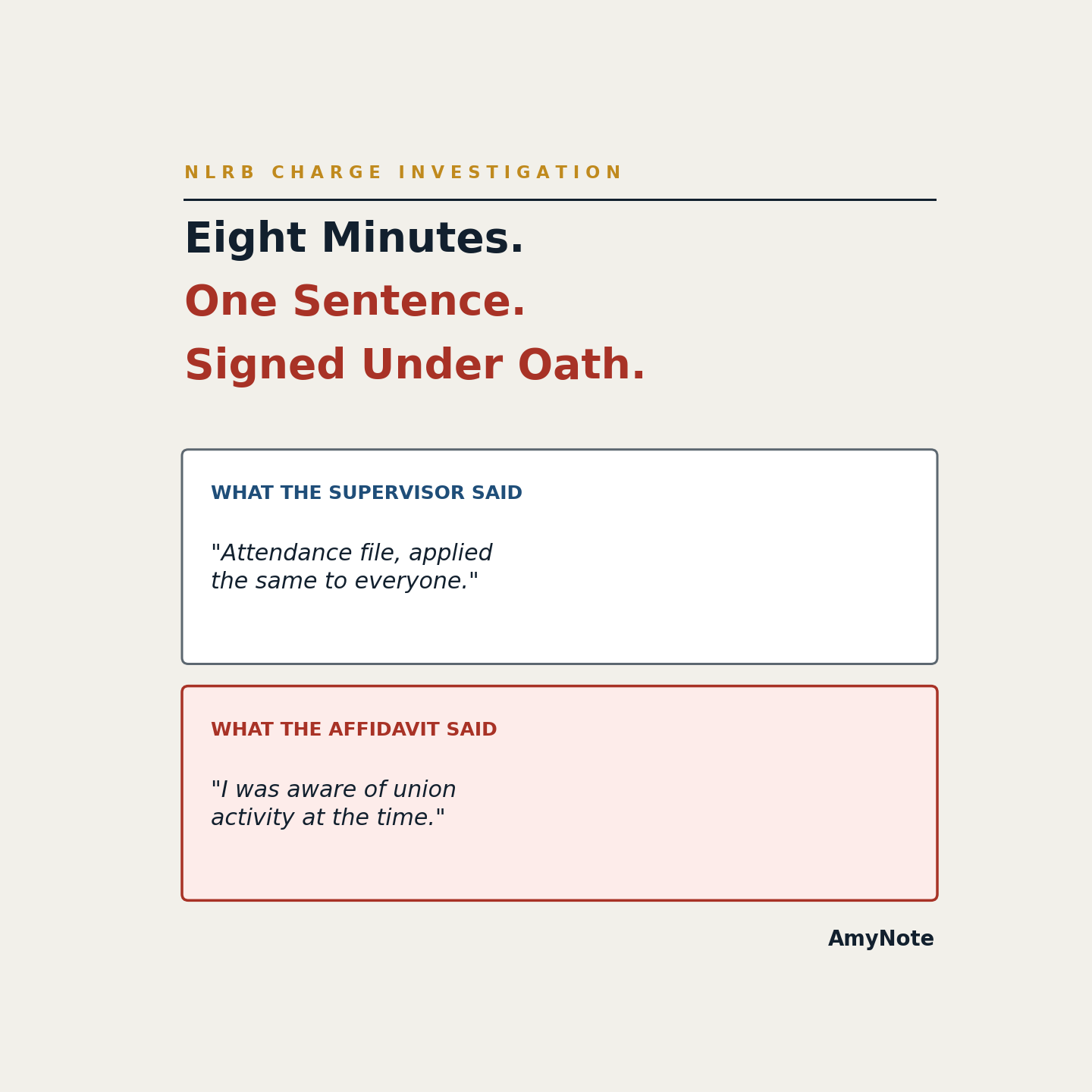
Your second-shift supervisor spent eight minutes with the Board agent explaining the termination. He walked through the attendance write-ups, the final no-call no-show, and the Thursday the decision actually got made — the sequence, in order, the way it happened.
The affidavit that came back is a page and a half in the first person. One sentence in it now supplies an element of the General Counsel's case. Nobody lied. Nobody was careless. The answer simply did not survive the compression, and the compressed version is the one that got signed.
The Affidavit Is Their Summary, Written in Your Voice
A Board agent affidavit is not a transcript. That single fact is the one most employers get wrong about how a ULP investigation works, and it is where the exposure begins.
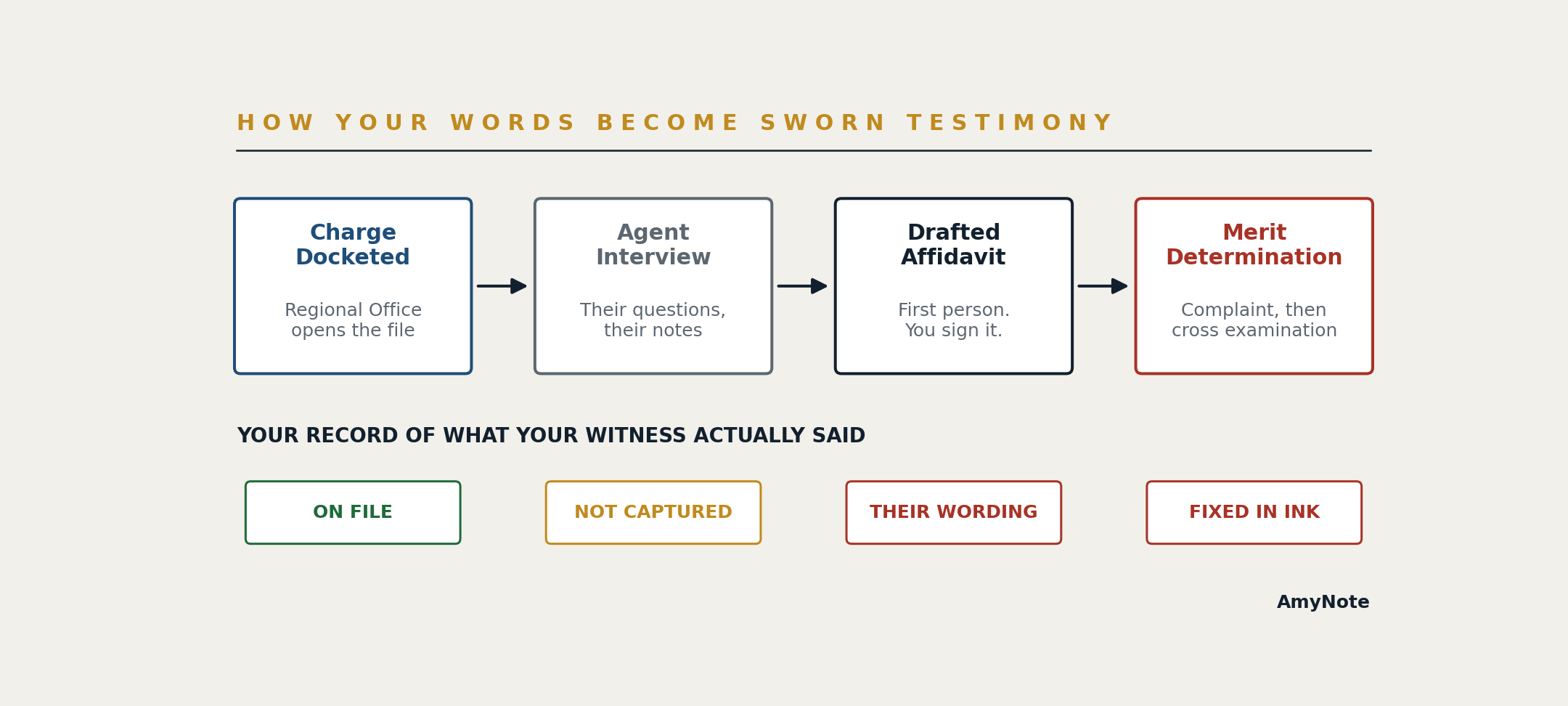
The agent investigating the charge asks the questions, takes the notes, and drafts the statement. It comes back in the first person — written as though your supervisor sat down and composed it himself. The witness reads it, initials any corrections, and signs it under oath. From that moment it is his sworn statement, not the agent's summary, no matter who chose the words.
Then it goes to work. It lands in the investigative file. It informs whether the Regional Director finds merit and issues a complaint. And once the witness has testified at hearing, it is produced to the other side, where it becomes material for cross-examination.
Notice what your side actually holds at each stage of that chain. The personnel file is yours. The write-ups are yours. The attendance policy is yours. But the conversation that explains all three — the one that turns a stack of documents into a coherent account of why someone was fired — is written down by the other side of the table, in summary form, and then handed back for signature.
How Eight Minutes Becomes One Sentence
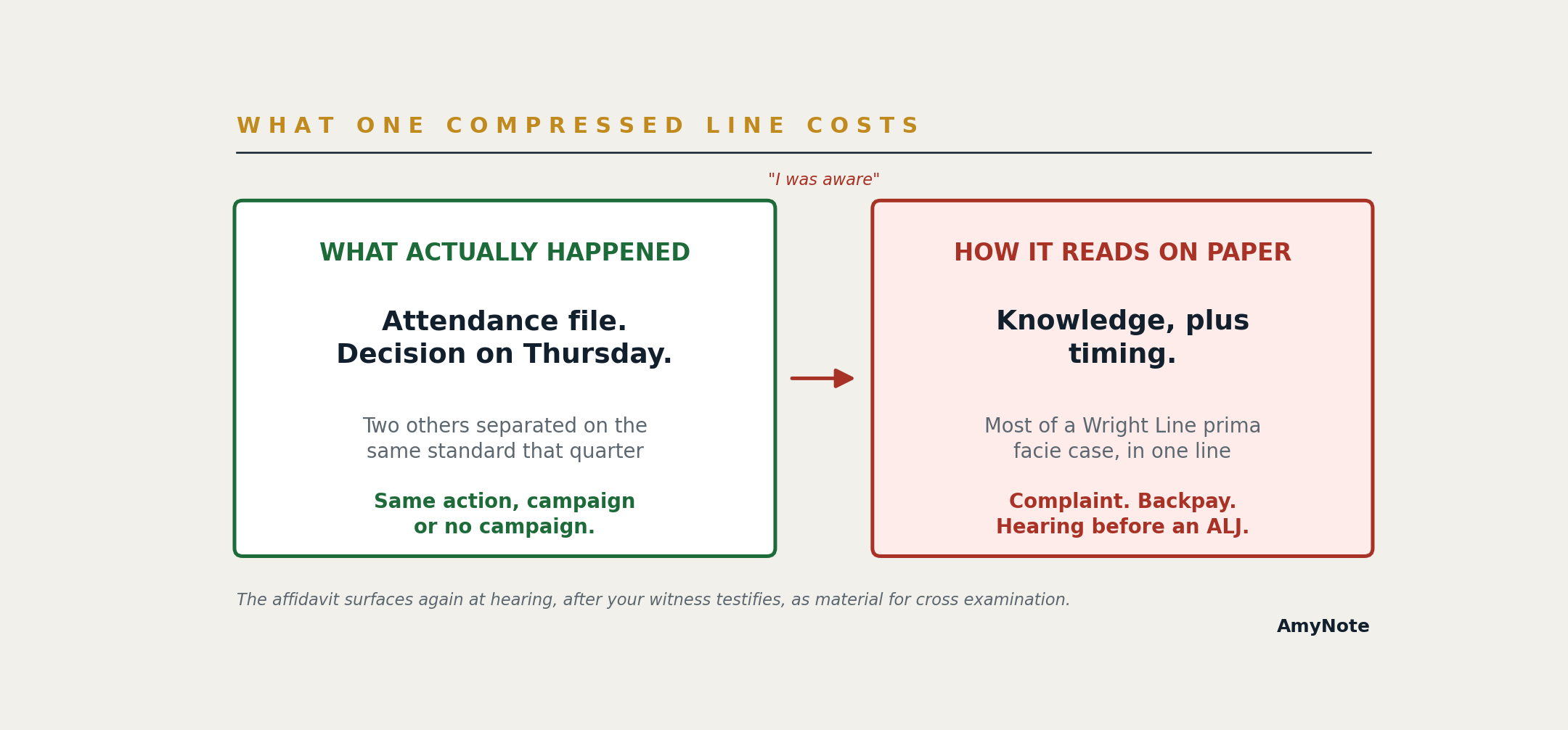
Your supervisor explained the whole sequence. The organizing drive was general knowledge on the floor by spring — everybody knew, including him. The write-ups were issued in January and February, before any of it started. The final incident was a no-call no-show. And two other employees were separated on the same attendance standard that same quarter, neither of them connected to the campaign in any way.
That is a documented, consistently applied attendance decision that happened to occur during a campaign. The distinction between that and an unlawfully motivated discharge is the entire case.
What the affidavit says is: "I was aware of union activity at the facility at the time I decided to terminate."
Read that sentence cold, the way a reviewer three steps removed from the room will read it. It is accurate. Your supervisor was aware. He said so, and he said it as one clause inside a much longer answer whose entire point was that awareness had nothing to do with the decision.
But under Wright Line, that clause is knowledge. Knowledge plus timing is most of what the General Counsel needs to carry the initial burden — before anything shifts back to you to show you would have taken the same action regardless. The two other separations that quarter are your best evidence on that second half, and they are nowhere in the document. The consistent application got compressed out. The awareness survived.
Why Preparing the Witness Does Not Close This Gap
You do prepare, and you should. You brief the supervisor. You pull the personnel file and walk him through the dates so he is not reconstructing them under pressure. Your counsel sits in, which the Region generally permits for supervisors and managers because they are your agents rather than statutory employees.
All of that is worth doing. None of it produces a record of what was said.
The person in the room cannot also be the record. They are tracking which allegation is in play, which documents were promised, which follow-up requests just landed, and who is up next. Nobody follows an eight-minute answer about a discharge timeline and captures it accurately at the same moment. By the second witness, the notes are a handful of bullets and an action item.
Rehearsal runs into the same wall from the other direction. Preparing your supervisor to give a complete, contextual answer is exactly right — and the more complete the answer, the more of it there is to lose on the way into a page-and-a-half summary. Coaching him to explain the two comparable separations does not guarantee the comparators appear in the affidavit.
And you cannot backfill it later the way you would in any other investigation. Johnnie's Poultry safeguards limit how you question employees about protected activity, so your own fact-gathering is narrower than the Region's by design. Meanwhile, you will not see that affidavit again until your witness has already testified — at which point it is a cross-examination exhibit, not a draft you can annotate.
By the time the document is in front of you, you are not arguing about facts. You are arguing about a paraphrase, from memory, months later, and the other side has it in writing and under oath.
Keep Your Own Record of the Same Conversation
The fix is not adversarial, and it is not recording the Board agent. The Region does not allow that, and attempting it would be a serious mistake. The fix is capturing your own side of the process: the internal investigation interviews, the witness preparation session, and the debrief in the parking lot right after — while your supervisor still remembers what he actually said and how the question was framed.
AmyNote runs on the phone already in your pocket, so there is no bot joining a call and no device to clear through the front desk. It records the audio, transcribes it with the OpenAI Speech API, and runs the analysis through Anthropic's Claude Opus to surface the dates, decision points, names, and sequence that came up — the specifics that make an account verifiable instead of merely plausible.
That record earns its keep at three specific moments.
- When the draft affidavit is in front of your supervisor. He gets one read-through to catch what got compressed, and he is doing it against a conversation that happened hours ago under pressure. A same-day record tells him exactly what he said, so the corrections he initials are the right ones — before he signs.
- When you draft the position statement. The timeline you submit to the Region matches the account your witnesses actually gave. Inconsistency between your written position and a signed affidavit is its own problem, entirely separate from the merits.
- Eleven months later at hearing. When the affidavit surfaces under cross-examination, your witness is anchored to a contemporaneous record instead of a recollection. Explaining what a sentence left out is a very different task when you can show what the full answer was.
Privacy is the first question in labor relations, so here is the architecture. Both OpenAI and Anthropic contractually guarantee zero training on user data. Audio is encrypted in transit and not retained after processing. Transcripts are stored locally on device with end-to-end encryption. That matters when the conversation covers discipline decisions, named employees, and strategy your counsel treats as privileged — the category of detail you would never hand to a vendor that reserves the right to learn from it.
Getting Started
Do not wait for a charge to be docketed. By then the conversations that mattered most have already happened, and the habit you needed is one you do not have.
- Start with the conversations that happen anyway. The discipline decision meeting, the investigatory interview, the call with counsel about a handbook rule. None of these involve the Board, and all of them build the muscle — and the contemporaneous record of why a decision was made.
- Confirm your policy and the consent rules first. Check your company's recording policy and applicable state consent law with counsel before recording anything. Where recording is not appropriate, capture a spoken debrief within minutes of the conversation ending, while exact phrasing is still recoverable.
- Summarize the same day. Pull out every date, every decision point, every name, and every comparator that came up — while the details are fresh and nobody is reconstructing anything.
- File it with the personnel record. When the draft affidavit arrives, or the position statement is due, comparing your record against the summary takes minutes instead of memory.
Tell people they are being recorded, follow your own policy on where the file lives, and keep it. AmyNote takes about a minute to set up, and amynote.app offers a 3-day full trial with no credit card.
A charge can reach back six months, and a complaint can put a backpay period and a bargaining order in play. None of that usually begins with a discovered violation. It begins with a complete, accurate, eight-minute answer that got written down as one sentence by the only person in the room keeping a record — and then signed under oath by the person who gave it. Your supervisor's full answer is worth considerably more than that sentence, but only if somebody kept it.
Originally published as an X Article by @AmyNoteApp.