A Department of Labor Wage and Hour Division investigation feels, from the employer's side of the table, like a records audit. Payroll registers, time cards, tip pool records. But the records are only half the file. The other half is built from conversations — and that half is the one you never get to check.
The Investigation Is Built on Conversations
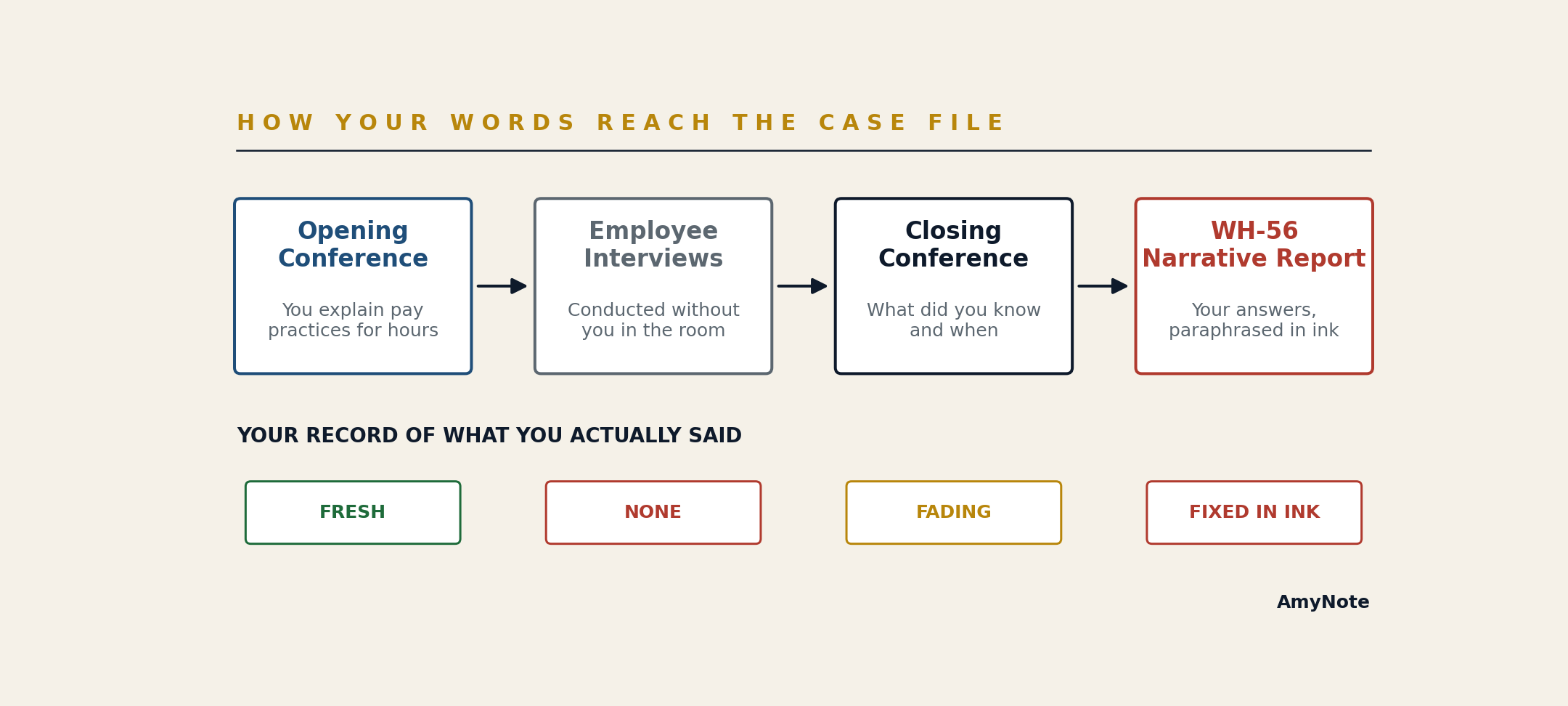
A WHD investigation follows a predictable arc. It starts with an opening conference, where the investigator explains the scope and you explain your pay practices: how you compute overtime, whether you take a tip credit, who you classify as exempt and why. Then come employee interviews, conducted in private, that you never attend and never see transcribed. It ends with a closing conference, where the investigator walks through the findings and asks the questions that matter most: what you knew about the rules, and when you knew it.
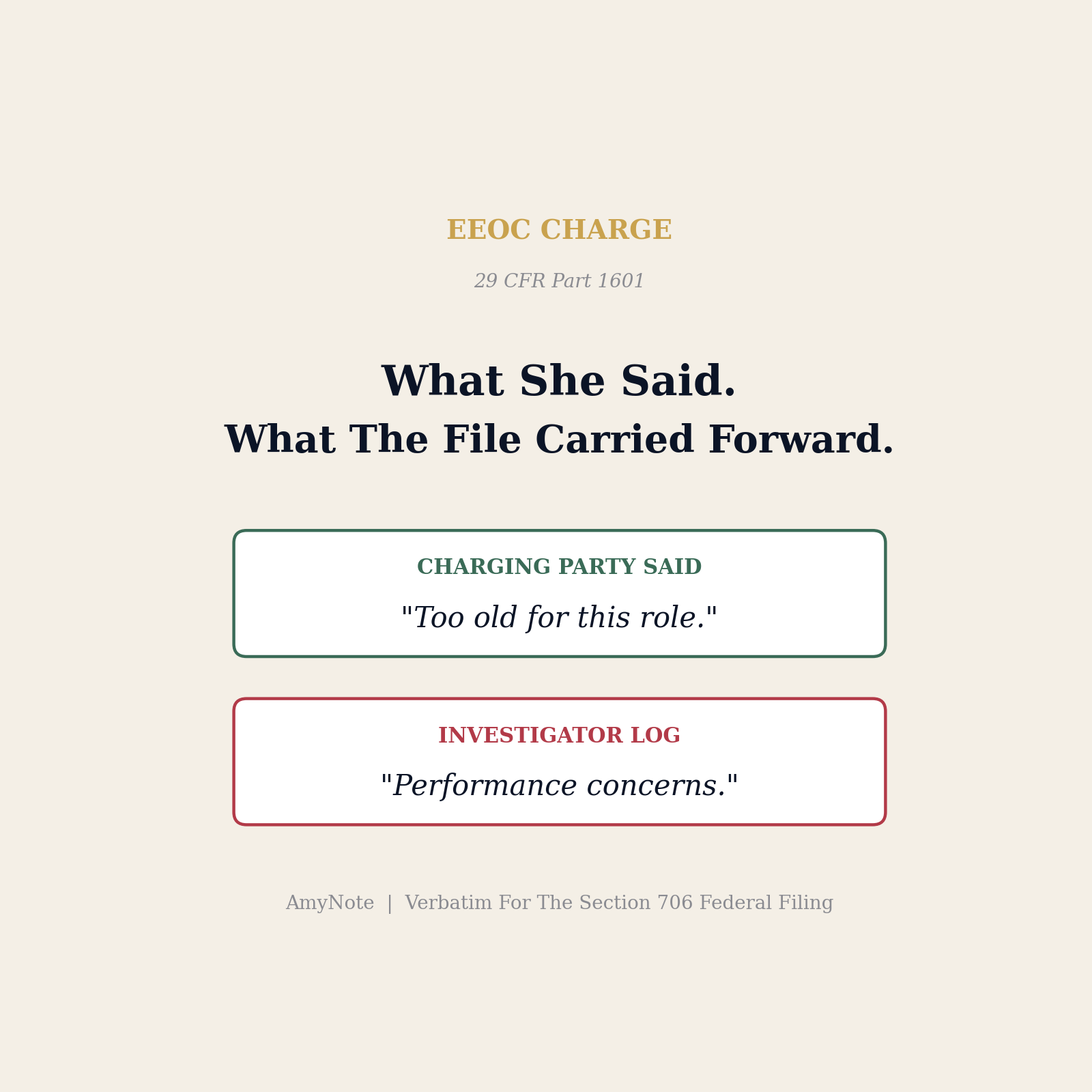
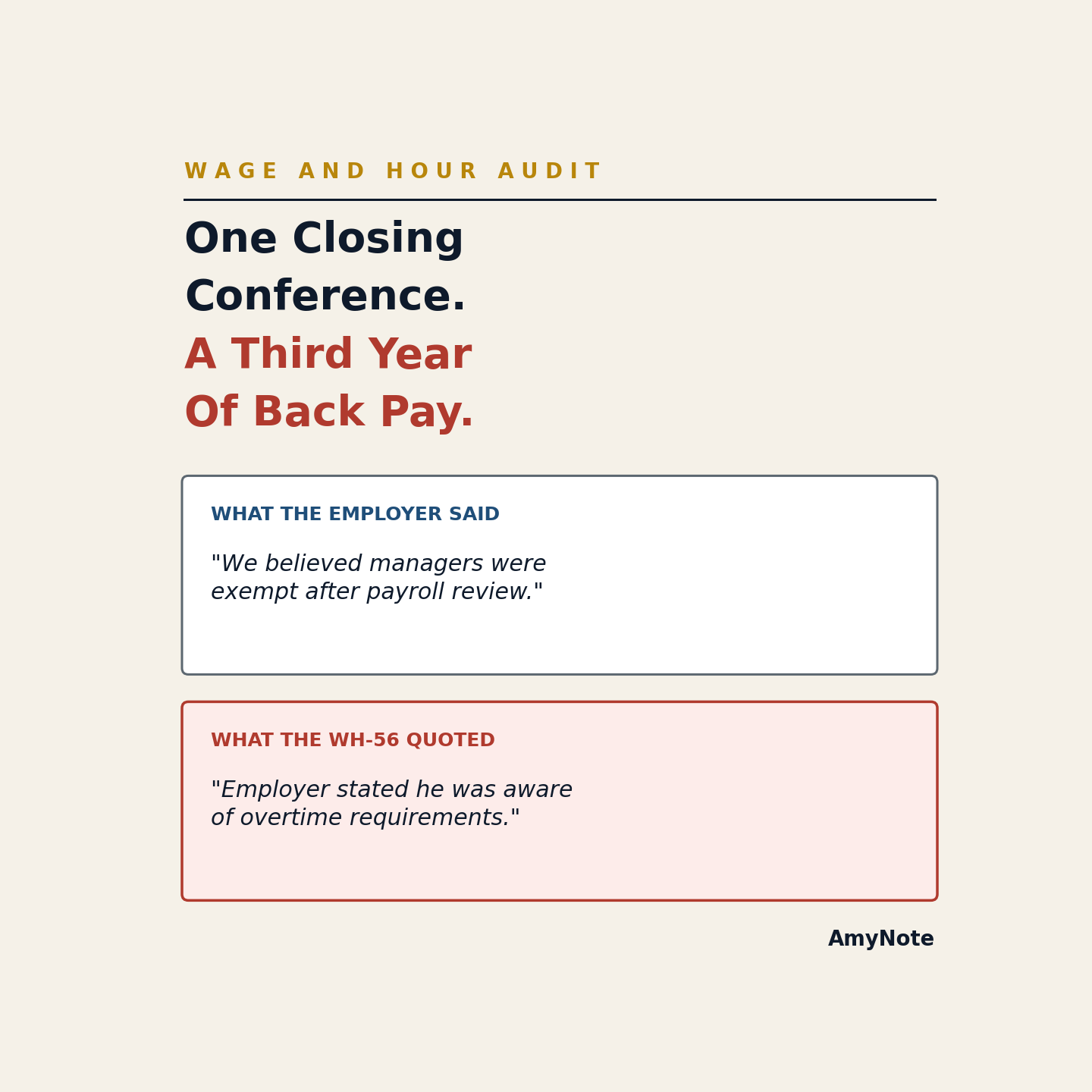
Through all of it, the investigator takes notes. Those notes feed the WH-56 narrative report — the internal document that frames every conclusion in your case. You are quoted in it, but almost never verbatim. Your ten-minute explanation of how you handle comp time, with all its context and qualifiers, becomes two paraphrased sentences chosen by the person building the case.
Why One Paraphrase Costs Six Figures
That paraphrase carries enormous legal weight, because willfulness is the hinge the whole liability calculation swings on.
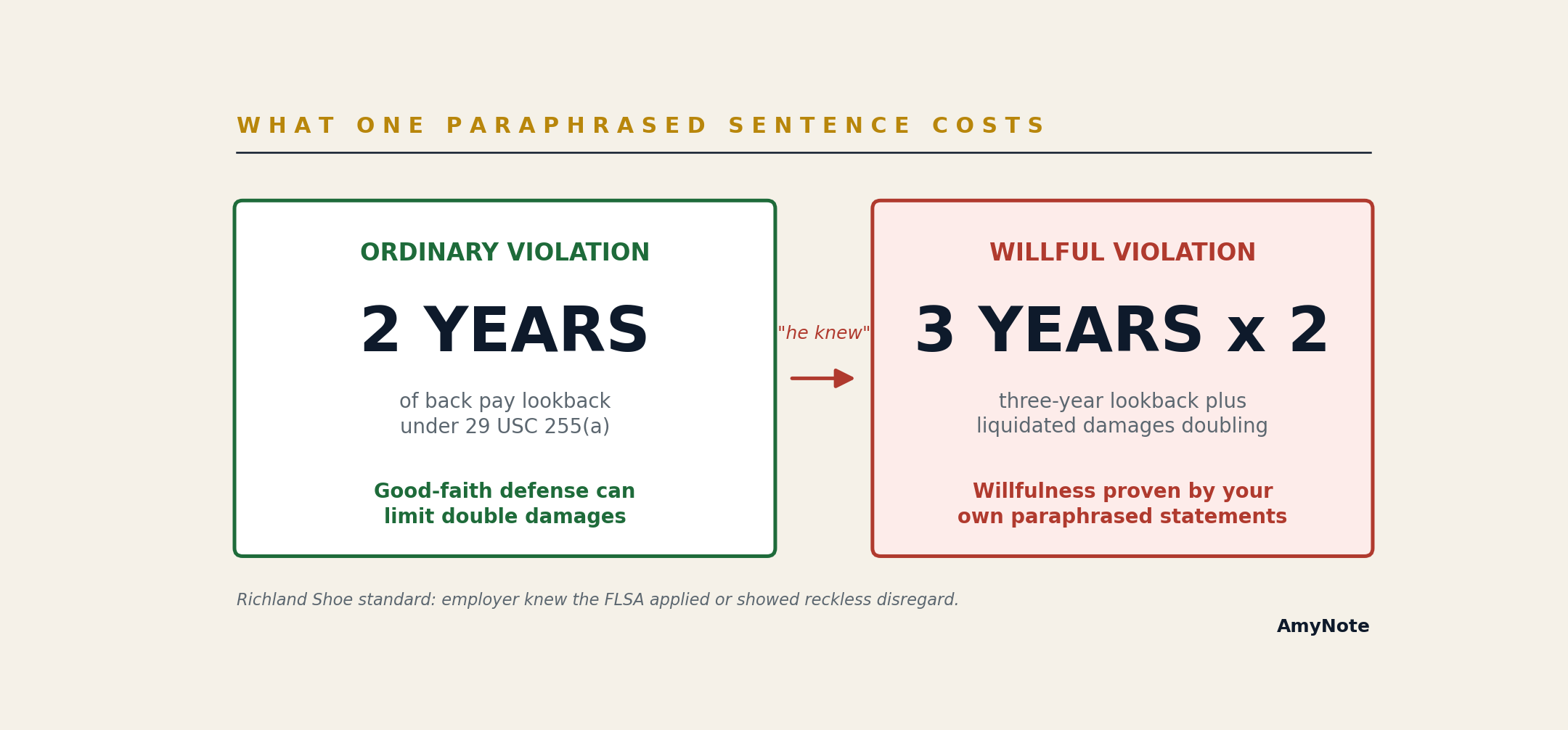
Under 29 USC 255(a), an ordinary FLSA violation reaches back two years. A willful violation reaches back three. The Supreme Court's standard from McLaughlin v. Richland Shoe defines willful as either knowing the FLSA applied or showing reckless disregard for whether it did. Notice what kind of evidence that standard runs on: not what your payroll records show, but what you knew. And the government's best evidence of what you knew is what you said in those conferences — as the investigator wrote it down.
A note that reads "employer stated he was aware of overtime requirements" is exactly the sentence the willfulness standard needs. It does not matter that what you actually said was longer, more qualified, and more careful. You never receive a transcript of the conference. There is no recording. When you dispute the characterization later, it is your memory against the government's file, and the government's file was written contemporaneously by a federal investigator.
The arithmetic stacks quickly from there. Willfulness adds a third year of back pay. 29 USC 216(b) layers liquidated damages on top, doubling the award. And the escape hatch — the good-faith defense under 29 USC 260 — requires you to affirmatively prove honest intent and reasonable grounds, which is hard to do when the only detailed record of your statements says you knew the rules and broke them anyway. The difference between a two-year and a three-year lookback, doubled, is routinely six figures. The evidence deciding it is often one sentence of paraphrase.
Why the Usual Defenses Fail
Memory fails first. A two-hour closing conference produces maybe a page of notes from your side — written while you were also trying to answer questions, read the room, and not say anything that made things worse. Six months later, when the findings letter arrives, you cannot reconstruct which qualifier you attached to which answer. The investigator's notes, whatever their flaws, were written that day.
Attorney notes are partial. Even when counsel attends the conferences, they capture themes and turning points, not your exact words. But willfulness disputes turn on precise phrasing — the difference between "I knew overtime rules existed" and "I believed our comp time policy satisfied them" is the difference between reckless disregard and good faith. A thematic summary cannot win that argument.
Cloud meeting bots do not fit. These are in-person, high-stakes, sensitive conversations. Nobody is inviting a notetaker bot into a federal investigation, and shipping audio of your statements to a federal investigator onto a server that trains on user data would create a second problem while solving the first.
So most employers walk out of the closing conference with nothing but recollection — and the only detailed record of what they said belongs to the agency building the case against them.
What Actually Works: Own Your Own Record
The employers who survive willfulness fights have their own contemporaneous record of every conference and every internal follow-up meeting. Not a summary written from memory that evening. A verbatim record, timestamped, made while the words were being said.
This is where AmyNote fits. It runs on your own phone and captures in-person conversations directly — no bot joining anything, no one else notified, no hardware on the table. Transcription runs through the OpenAI Speech API, and analysis runs on Anthropic's Claude models, which can pull out every question the investigator asked, every answer you gave, and every commitment made in the closing conference, the same day it happened.
The privacy architecture matters in exactly this scenario. Both OpenAI and Anthropic contractually guarantee zero training on user data. Audio is encrypted in transit and not retained after processing. Transcripts are stored locally on your device with end-to-end encryption — so your record of a federal investigation stays yours, not a vendor's.
Why owning the record changes outcomes:
- Paraphrase versus quote. When the narrative report says you "admitted" knowing the rules, your verbatim transcript shows the qualifier the note dropped. That is no longer your memory against the file; it is a contemporaneous record against a compression of one.
- The good-faith defense needs evidence. Under 29 USC 260, avoiding double damages requires proving honest intent and reasonable grounds for believing you complied. A transcript of you asking clarifying questions, flagging uncertainty, and committing to fixes is that proof.
- Follow-through gets documented. Transcribed internal meetings about correcting pay practices — reclassifying employees, fixing the tip pool, changing the overtime calculation — show the opposite of reckless disregard, dated and in your own words.
Getting Started
Start before the opening conference, not after the findings letter. Use AmyNote to capture your prep meetings with counsel and managers, then every conference where the law allows, and have it summarize questions, answers, and commitments the same day. File the transcripts alongside the payroll records the investigator copied.
When the narrative report comes back with your words rearranged — and the willfulness finding hanging on the rearrangement — you will be the rare employer holding a better record of the conversation than the government's.
Originally published as an X Article by @AmyNoteApp.