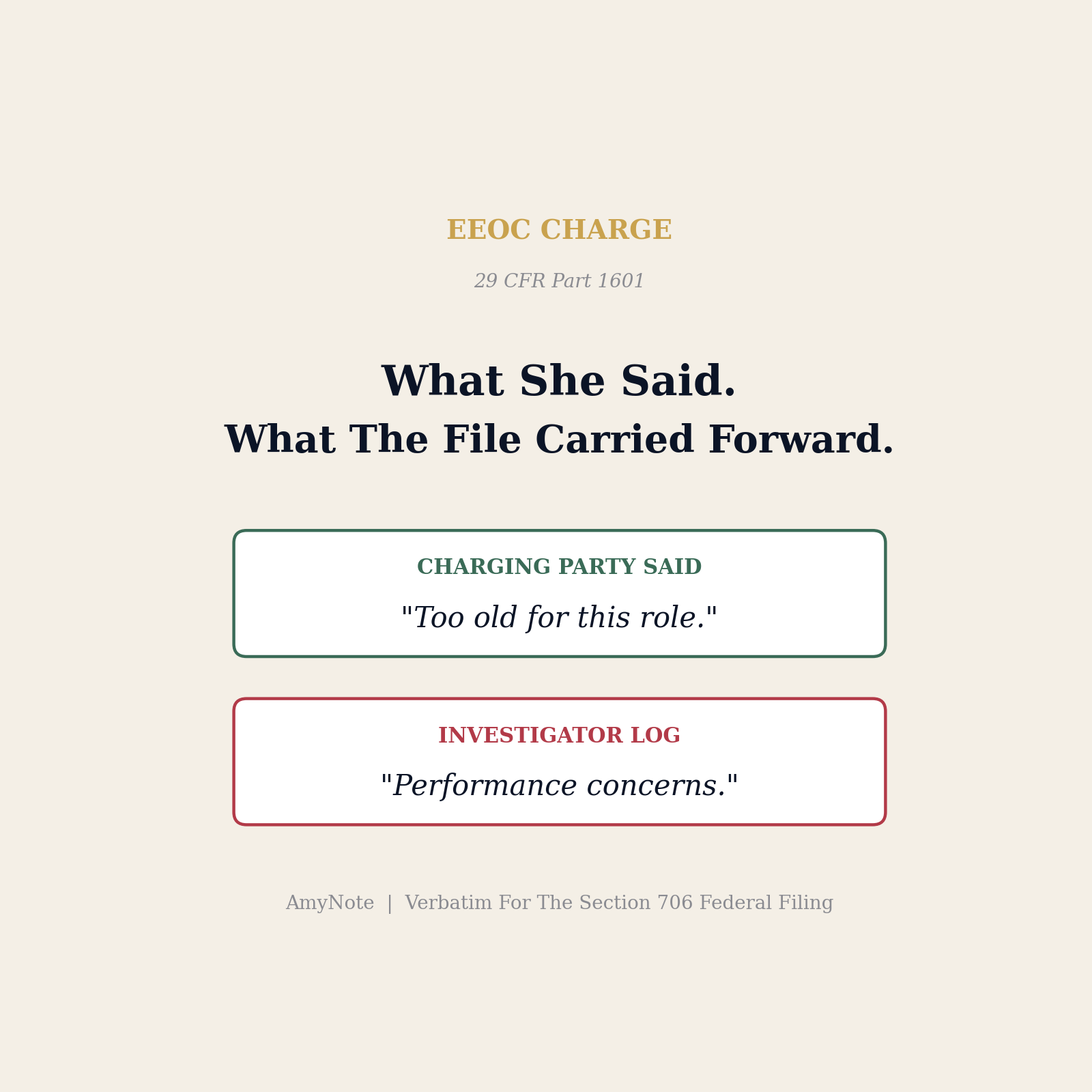
An EEOC investigator at a regional field office calls a charging party on a Wednesday afternoon. The charge alleges age discrimination under the ADEA: a fifty-eight-year-old marketing director, twenty-two years at the company, replaced after a reorganization by a thirty-one-year-old from a different team. The intake interview runs forty-five minutes. The charging party describes, in careful chronological order, three separate comments her director made over the prior eight months. One of them, in front of a witness, was: "You're probably too old for this role going forward." The investigator types contact log notes that afternoon. The IMS file ends up with three lines under "alleged adverse comments," none of which contain the actual sentence.
Five months later, a Letter of Determination arrives in the mail. The investigator could not find reasonable cause to believe a violation occurred. The letter cites the respondent's Position Statement and notes that the charging party's allegations "centered on general performance feedback." A Notice of Right to Sue is enclosed. The charging party has ninety days to file in federal court. She drives to a plaintiff-side employment firm. The lawyer asks for the EEOC file. The lawyer files a FOIA request. The investigative file arrives three months later. The 90-day clock has been ticking the whole time. By the time counsel reads the contact log, half the runway to file the complaint is gone — and the contact log says nothing about "too old for this role."
This is not a rare bureaucratic accident. It is the structural shape of how a substantial slice of EEOC charges get documented in 2026. The intake call is the moment the case is built. The IMS contact log is the agency's working record. The verbatim adverse-comment quote, the witness name, the precise date, the exact phrasing — they live in the charging party's memory and nowhere else. Defense counsel will read the EEOC's paraphrase first, the position statement second, and the deposition transcript last. The order is the case.
The Problem: Three Lines Carry the Charge
EEOC investigators handle the intake and merits phases of every charge under 29 CFR Part 1601. They interview charging parties by phone or in the field office, take handwritten or typed contact log notes, and feed those notes into the Integrated Mission System investigative file. That file drives the Letter of Determination under Section 1601.21: either reasonable cause and a referral to conciliation, or dismissal with a Notice of Right to Sue under Section 1601.28.
EEOC closed roughly 88,000 charges in FY 2024. Most regional offices do not audio-record the intake interview. The investigator paraphrases on the fly, smooths the timeline, and compresses comparator evidence into one sentence. Two adverse-comment quotes get merged into "alleged ageist remarks." The actual words, the date, the witness present, the exact phrasing — all disappear into a summary line that the next reader treats as the agency's contemporaneous record of what the charging party said.
Six months later, the charging party has ninety days from the Notice of Right to Sue to file in federal court under Section 706(f)(1) of Title VII or Section 7(e) of the ADEA. Defense counsel will Rule 26(a) the EEOC file and read those three lines back to the charging party at deposition. "You told the EEOC investigator about ‘performance concerns,’ correct? Not about a specific age-related comment?" The deposition is now about a memory four months stale, against a typed paraphrase the agency entered the day of the call.
Why Current Solutions Fail
Investigators are not court reporters. The EEOC's strategic enforcement plan pushed intake throughput targets that left less time per charge, not more. Pen-and-paper notes capture buzzwords and drop context. Charging parties calling in from a job site, a parked car, or a noisy break room cannot dictate slowly enough to be captured verbatim, and most intake interviews happen on the charging party's only available lunch hour.
Most regional offices do not enable audio recording of intake interviews. 29 CFR 1601.22 treats charge investigation files as confidential during the pendency of the charge. The charging party cannot see the contact log until after the determination issues, by which point the FOIA queue runs three to six months at most field offices. The 90-day federal court clock is calibrated to a world in which the charging party already knows what is in the file. In practice, the charging party does not know until the clock is almost out.
Plaintiff-side employment firms running on contingency cannot afford to docket a federal complaint blind. They need the verbatim record before they sign the engagement. Defense firms know this. Their Position Statement is built to give the EEOC investigator a clean, paraphrasable summary that aligns with the respondent's litigation theory. When the charging party's record is memory and a one-line agency summary, the Position Statement wins the documentation contest before the case ever reaches a federal judge.
What The Federal Complaint Actually Turns On
The complaint under Title VII or the ADEA does not survive a Rule 12(b)(6) motion on generalities. The plaintiff has to plead specific facts giving rise to an inference of discriminatory motive. "Performance concerns" is not that fact. "Too old for this role", spoken on a specific date, in front of a named witness, by the manager who signed the reorganization memo — that is that fact.
If the EEOC file already paraphrases the quote out of existence, the plaintiff's lawyer is rebuilding the verbatim record from memory months after it was spoken. Defense counsel will impeach the plaintiff's federal deposition with the EEOC's typed summary every time. "You sat with an EEOC investigator for forty-five minutes. You had every chance to tell her about this specific comment. The agency wrote ‘alleged ageist remarks.’ You're telling this court today, two years later, that the comment was actually a specific sentence?"
The deposition is not won at the deposition. It is won at the intake interview — if the verbatim record of the intake interview still exists.
What Actually Works
The charging party, or counsel representing the charging party, records the EEOC intake and follow-up interviews with notice to the investigator. On-device transcription captures the exact phrasing of the adverse-action allegation, the comparator names, the dates, and the witness list. When the Letter of Determination later reads "performance concerns" instead of "too old for this role," the charging party has the contemporaneous transcript to anchor the federal complaint and the response to any subsequent Rule 12(b)(6) motion.
AmyNote runs the audio through Whisper Large v3 with speaker diarization, and the summary layer through GPT-4.1 or Claude Sonnet 4.6. Both OpenAI and Anthropic contractually guarantee zero training on user data. Audio is encrypted in transit; processing copies may be retained to deliver and recover requested features. Transcripts are stored locally on device with encrypted transport. The recording never sits on a third-party server and never appears in any subprocessor's discovery production.
The same record supports the Section 83 file request after a Notice of Right to Sue issues. Plaintiff's counsel files a Rule 26(a)(1) disclosure pointing to a paginated, timestamped, searchable transcript. Defense counsel deposing the charging party cannot impeach with the EEOC summary alone, because the underlying record is on the page. The factual record is no longer the investigator's three-line paraphrase. It is the verbatim audio of the original intake call, with a defensible chain of custody from the charging party's device into the litigation file.
The Documentation Pattern That Holds Up at Trial
A defensible charging-party workflow has four properties.
- The charging party has the audio. Most U.S. jurisdictions permit a party to record a conversation to which they are a party. The charging party should confirm consent on the audio under the applicable state's one-party or two-party rule and let the recorder run for the entire intake interview.
- The transcript is contemporaneous. The transcript is generated within minutes of the call, before memory blurs, and saved with timestamps that match the audio. Every adverse comment is captured in the speaker's own words, not in the investigator's paraphrase.
- The complaint is grounded. Every factual assertion in the federal complaint — the comment, the date, the witness, the comparator — cites the transcript by minute and second. There is no "plaintiff recalls saying". There is only "plaintiff said, at 17:42 of the intake recording."
- The privacy posture matches the discovery posture. Charging-party records are among the most sensitive documents a plaintiff produces. The transcription pipeline must be contractually zero-training, the audio must not be retained by third parties, and the transcripts must be encrypted at rest on the charging party's device.
Charging parties who adopt this pattern do not change EEOC throughput targets or move the FOIA queue. They eliminate the specific category of dismissal that turns on the gap between the investigator's typed paraphrase and the actual words spoken at intake — the category that converts otherwise meritorious ADEA, Title VII, and ADA claims into no-cause findings before a federal judge ever sees them.
Getting Started
Open AmyNote before the EEOC investigator's call. Confirm consent on the audio under your state's one-party or two-party rule. Let it run through the intake interview and any follow-up rebuttal call after the respondent's Position Statement. When the Notice of Right to Sue arrives, hand counsel a verbatim record instead of a memory. The 90-day clock does not get longer. The record does not have to get shorter.
Originally published as an X Article.