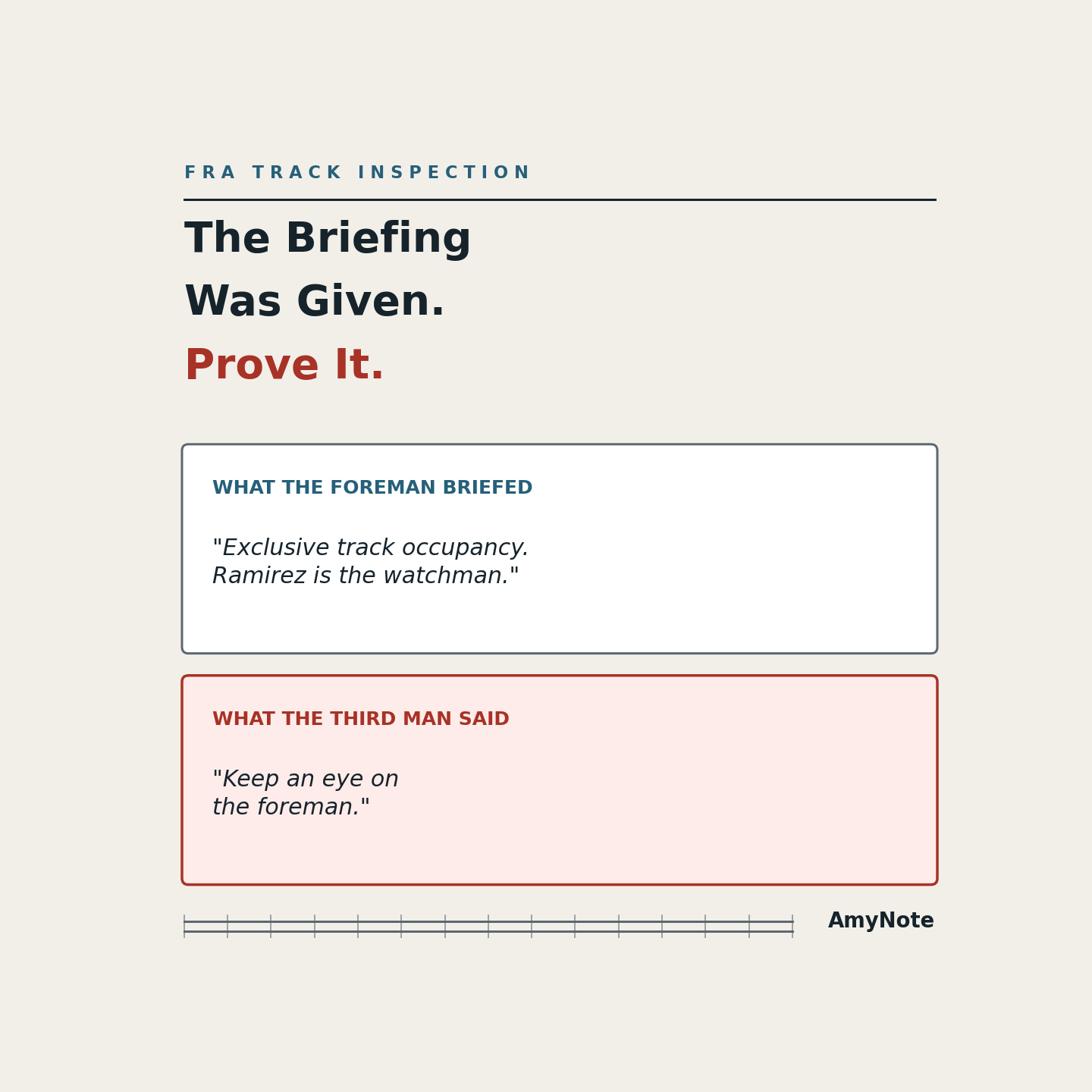
The FRA inspector parks on the access road and walks up on your gang mid shift. He does not start with the roadway worker in charge. He picks the third man down the rail and asks what protection he is working under and who is watching for trains.
The answer comes back a little short. The next man phrases it differently. The briefing was given that morning, correctly, by a foreman who has done it ten thousand times.
Nobody wrote down what he said. Six weeks later, that omission — not the briefing, not the protection, not anything anyone did wrong on the track — is what costs you a system wide procedure rewrite.
The Briefing Was Given. Proving It Is the Problem.
The job briefing rule is a rule about what each worker understood. Before anyone fouls the track, the roadway worker in charge has to inform every roadway worker of the on track safety procedures in use and the limits that apply, and each worker has to acknowledge it. The obligation is not satisfied by the foreman knowing the plan. It is satisfied by each person on the ballast knowing it.
That distinction is easy to nod at and hard to prove. A briefing that was delivered perfectly and a briefing that was delivered carelessly leave behind exactly the same evidence: nothing. The rule is written around a state of mind distributed across four or five people, and states of mind do not sign forms.
So the inspector tests it the only way it can be tested. He separates people and asks. What are your working limits. Who is your watchman. Where is your place of safety. He is not trying to trip anyone up; he is trying to observe the one thing the paperwork cannot show him.
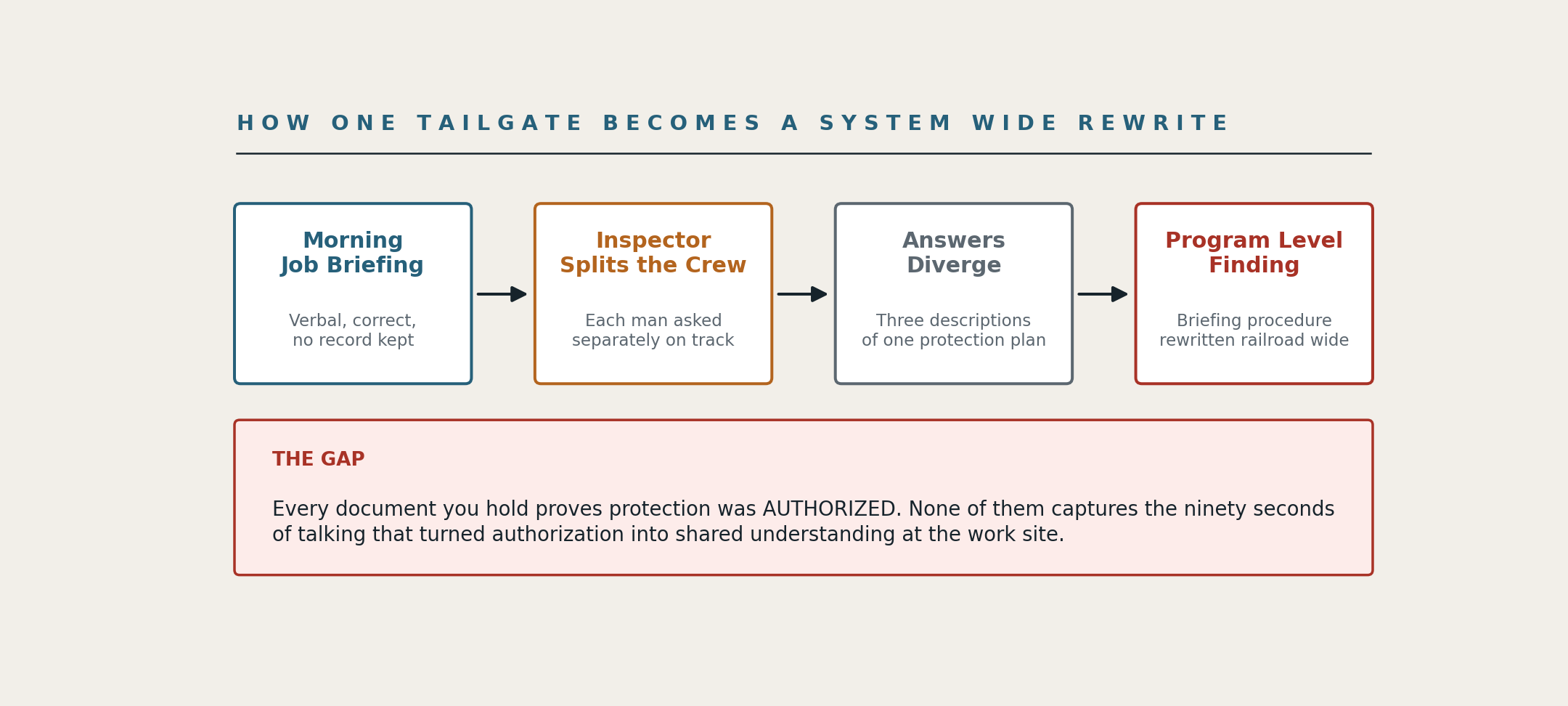
Three plausible answers become one finding. The first man says exclusive track occupancy. The second describes train approach warning. The third says he was told to watch the foreman. That spread does not read as three men remembering a good briefing imperfectly. It reads as a briefing that never conveyed one plan.
And notice how the subject of the inquiry shifts. Nobody is writing up the third man for a weak answer. The divergence itself is the evidence, and the thing it is evidence about is your briefing procedure — a program, not a person. One morning on one subdivision becomes a statement about how your railroad briefs every gang on every district.
The inspector carries away his own summary on the inspection report. You carry away a foreman certain he covered all of it and a crew that is now unsure — because being questioned separately, on the track, by a federal inspector is itself an event that reshapes what people believe they remember.
Why Your On Track Safety Records Do Not Cover This
You have the paperwork the regulation asks for. The on track safety program, the track authority, the foul time, the watchman qualification records, the operational testing logs from your own efficiency tests. This is not an argument that your documentation is thin.
Every one of those documents proves that protection was authorized. None of them captures the ninety seconds of talking that turned authorization into shared understanding at the work site. They are different artifacts answering different questions, and only one of those questions is in dispute when a finding lands.
| What you hold | What it proves | What it cannot show |
|---|---|---|
| Track authority / foul time | Protection was granted for those limits | Whether the crew heard the limits the same way |
| Watchman qualification records | The watchman was qualified to serve | Whether the crew knew who he was that morning |
| On track safety program | The written procedure is adequate | Whether this briefing followed it out loud |
| Operational testing logs | You test compliance on your own | What was said at this tailgate, on this day |
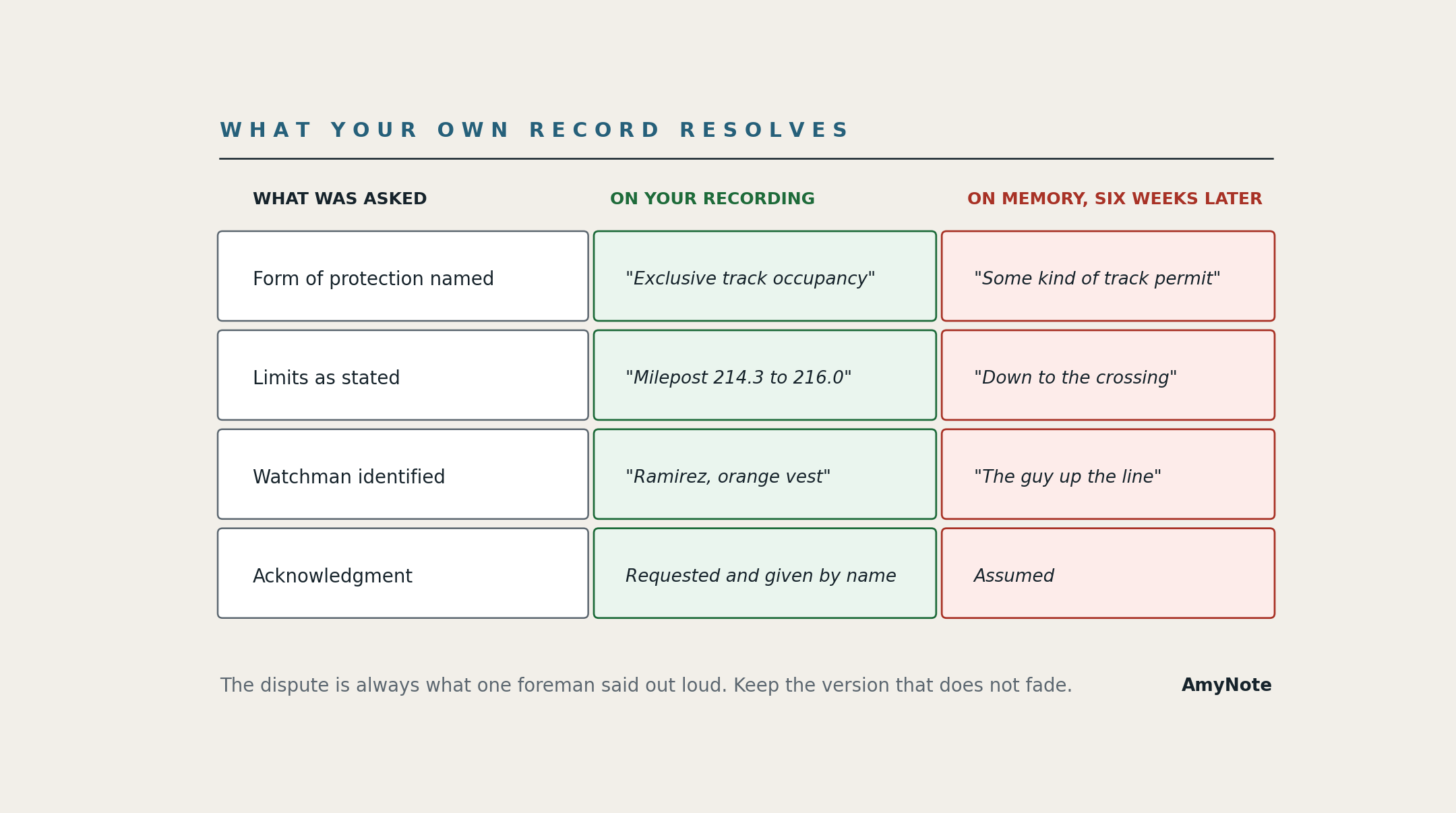
The reconstruction problem is exact. Drafting the response, you need to know whether the foreman named the watchman or pointed at him, stated the limits by milepost or by landmark, asked for acknowledgment or assumed it.
Those are not shades of the same answer. Naming a watchman and gesturing at one are different acts under a rule about what each worker understood, and the difference between “milepost 214.3 to 216.0” and “down to the crossing” is the difference between a limit a man can repeat back and a landmark he has to interpret. Your entire response turns on which version happened.
Nobody recalls at that resolution six weeks later, least of all a crew whose memory is now colored by having been questioned. This is not carelessness. Human memory does not store a routine tailgate conversation at the granularity a regulatory response requires, and the tailgate was routine right up until it wasn't.
So the railroad concedes and rewrites the briefing procedure system wide, pulling every gang into a retraining cycle over one morning on one subdivision. The rewrite is usually broader than the finding required, because a narrow response you cannot substantiate costs more time than a broad one that gets accepted.
There is a second cost that shows up later. The procedure you rewrote under uncertainty becomes your file. When job briefings come up in the next inspection cycle, the record says you overhauled the briefing procedure railroad wide — which reads as an admission that the briefing procedure was the problem. The concession that closed one finding becomes the history you are held to in the next one.
Keep Your Own Record of the Briefing and the Debrief
This is not about recording the inspector. Do not. His inspection is his activity, and taping it converts a technical dispute into a conduct problem you will lose — and one that will color every interaction with that inspector for years.
It is about two conversations you already have. The briefing itself at the tailgate, and the debrief in the truck twenty minutes after the inspector leaves, when the foreman and the roadmaster reconstruct what was asked and what each man answered.
Both already happen at every railroad, every day, and right now both dissolve into recollection. The window on the second one is short: the foreman can still reproduce his own phrasing twenty minutes out, and cannot at six weeks. The period in which an accurate record is even possible is measured in minutes, and it closes while everyone is still deciding whether the inspection went well.
AmyNote runs on the phone already in the foreman's pocket, so nothing new goes to a remote work site and there is no meeting bot — no device to badge in, nothing that changes what the inspection team sees on your right of way. It captures the audio, transcribes it with the OpenAI Speech API, and runs the analysis through Anthropic's Claude Opus to surface the form of protection named, the watchman identified, the limits as stated, and whether acknowledgment was requested and given.
That record earns its keep at three moments.
- The same shift. A gap in what one man understood can still be corrected on the ballast, before it is anything but a gap. This is the only one of the three where the record prevents the problem rather than answering it.
- At the exit briefing. A misunderstanding can be resolved before it becomes written. Resolving it requires knowing precisely what was said that morning — the one thing you do not have if the tailgate went unrecorded.
- Inside the response window. The whole dispute is what one foreman said out loud to four men, and the alternative to a contemporaneous record is their memory of it, taken after they were separated and questioned.
Privacy is the first question on a railroad, so here is the architecture. Both OpenAI and Anthropic contractually guarantee zero training on user data. Audio is encrypted in transit and not retained after processing. Transcripts are stored locally on device with end to end encryption. Follow your own labor agreement and company policy on where the file lives and who may hear it — the same discipline you already apply to operational testing records.
Getting Started
Do not wait for the next violation report. The habit you need with an inspector on the property is not one you can adopt on the day an inspector is on the property.
- Start with the conversations that already happen. The morning job briefing, the change in protection when the plan shifts, the debrief after an inspector drives off. None of these involve an open finding, and all of them build the workflow.
- Clear it against your own agreement first. Follow your labor agreement and company recording policy, and tell the crew they are being recorded. Where recording the briefing itself is not appropriate, capture a spoken debrief within minutes of it ending.
- Summarize the same day. Pull out the form of protection named, the limits as stated, the watchman identified, and whether acknowledgment was requested and given — while nobody is reconstructing anything.
- File it with your on track safety documentation. When a finding arrives, comparing your record against it takes minutes instead of memory.
Build the habit while nothing is riding on it, so it is automatic when something is. AmyNote takes about a minute to set up, and amynote.app offers a 3-day full trial with no credit card.
A system wide rewrite can trace back to ninety seconds at a tailgate. Your foreman may well have briefed it perfectly. The only question is whether anyone on your side kept it — and three men's six week old recollections are not keeping it.
Originally published as an X Article by @AmyNoteApp.