From the carrier's side of the table, an FMCSA compliance review looks like a data audit. ELD logs, driver qualification files, drug and alcohol testing records, maintenance files. But the records are only half of what goes into the case file. The other half is built from conversations — and that half is the one you never get to check.
The Compliance Review Is Built on Conversations
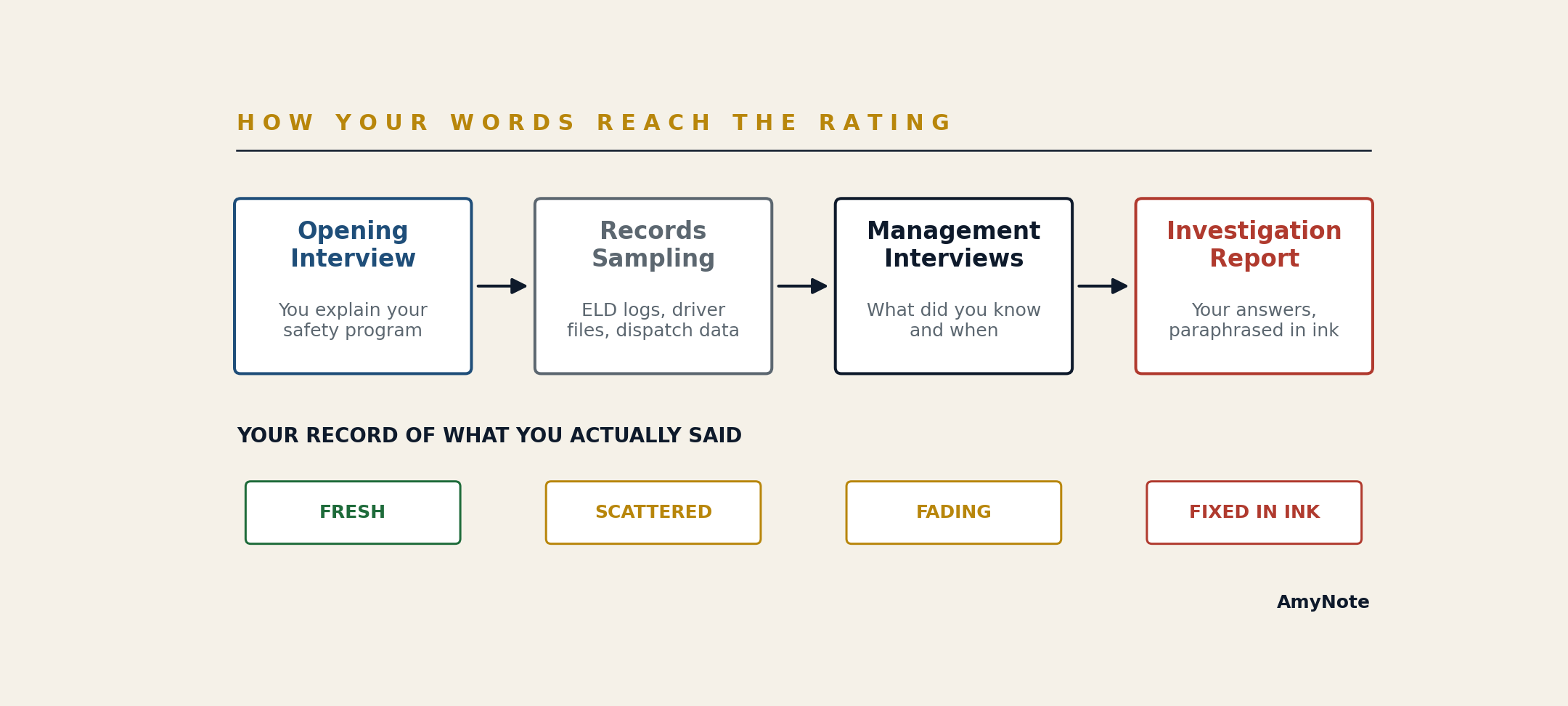
An on-site compliance review follows a predictable arc. A safety investigator sits down with your safety director, your dispatchers, and your drivers, and asks the questions the records alone cannot answer: what you knew about hours-of-service violations, when you knew it, and what you did about it. How dispatch assigns loads when a driver is close to running out of hours. Whether anyone has ever been disciplined for falsifying a log. What happens when a customer's delivery window collides with a driver's available drive time.
The investigator takes notes through all of it. Those notes feed the investigation report that supports your safety fitness determination under 49 CFR Part 385. You are quoted in that report, but almost never verbatim. Your safety director's twenty-minute explanation of how he audits ELD logs — the exception reports he runs, the drivers he has coached, the dispatcher he overruled — becomes two paraphrased sentences chosen by the person building the file.
Drivers and dispatchers are interviewed separately, often without anyone from management present. You never see those notes either. By the time the review closes, the agency holds a written record of a dozen conversations about your safety culture, and you hold whatever your people can remember saying.
Why One Paraphrase Decides the Rating
That paraphrase carries enormous weight, because carrier knowledge is the hinge the safety fitness determination swings on.
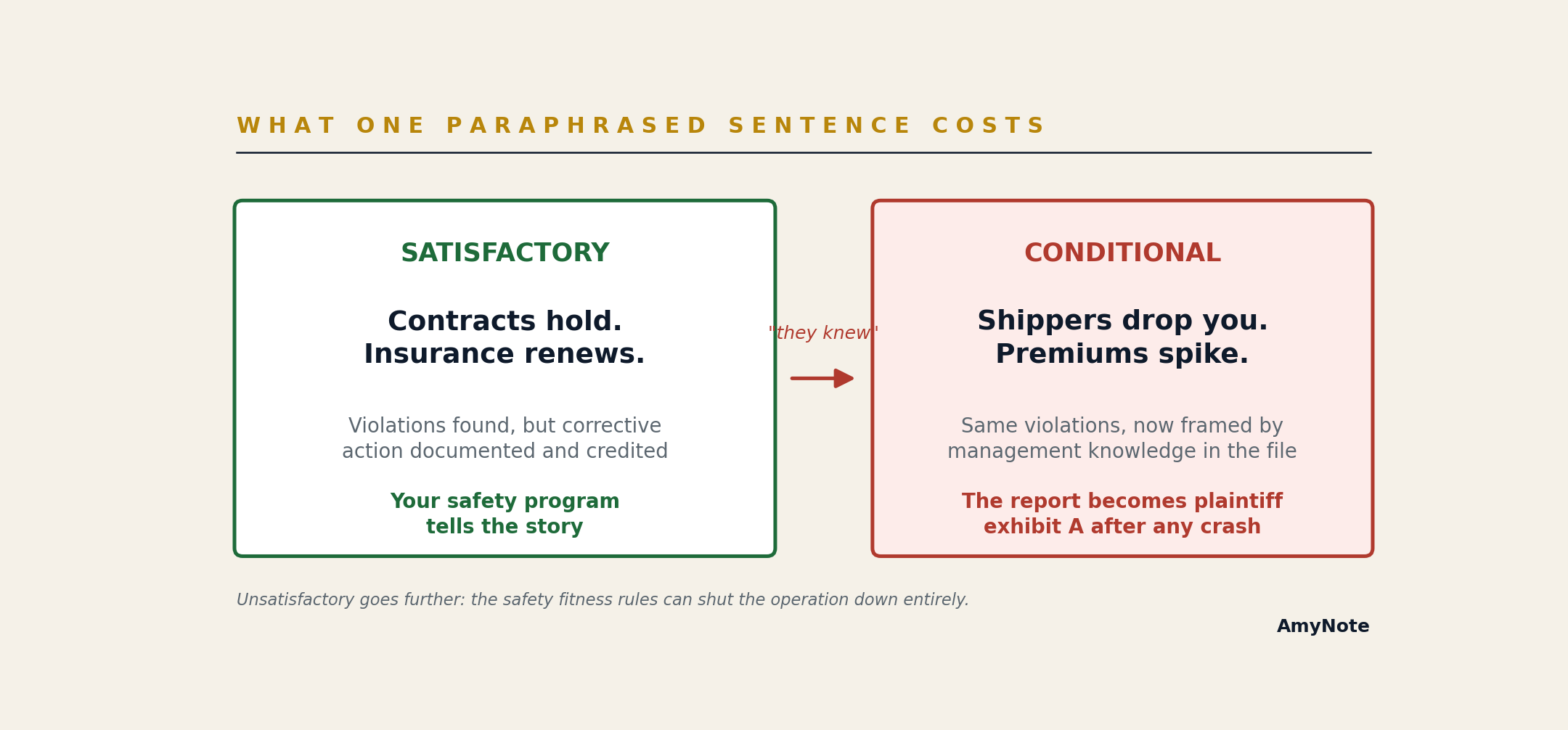
Part 385 sorts violations into acute and critical categories. Acute violations are ones so severe that a single instance demands immediate action. Critical violations — the hours-of-service patterns, the log falsification — are indicators of a breakdown in management controls. And that is the phrase that matters: management controls. A pattern of violations plus evidence that management knew about it and let it ride is what separates a Satisfactory rating from a Conditional one.
Conditional is the rating shippers and insurers read as a warning label. Brokers filter on it. Insurance underwriters reprice on it. An Unsatisfactory rating goes further: under the safety fitness rules, it can shut the operation down entirely.
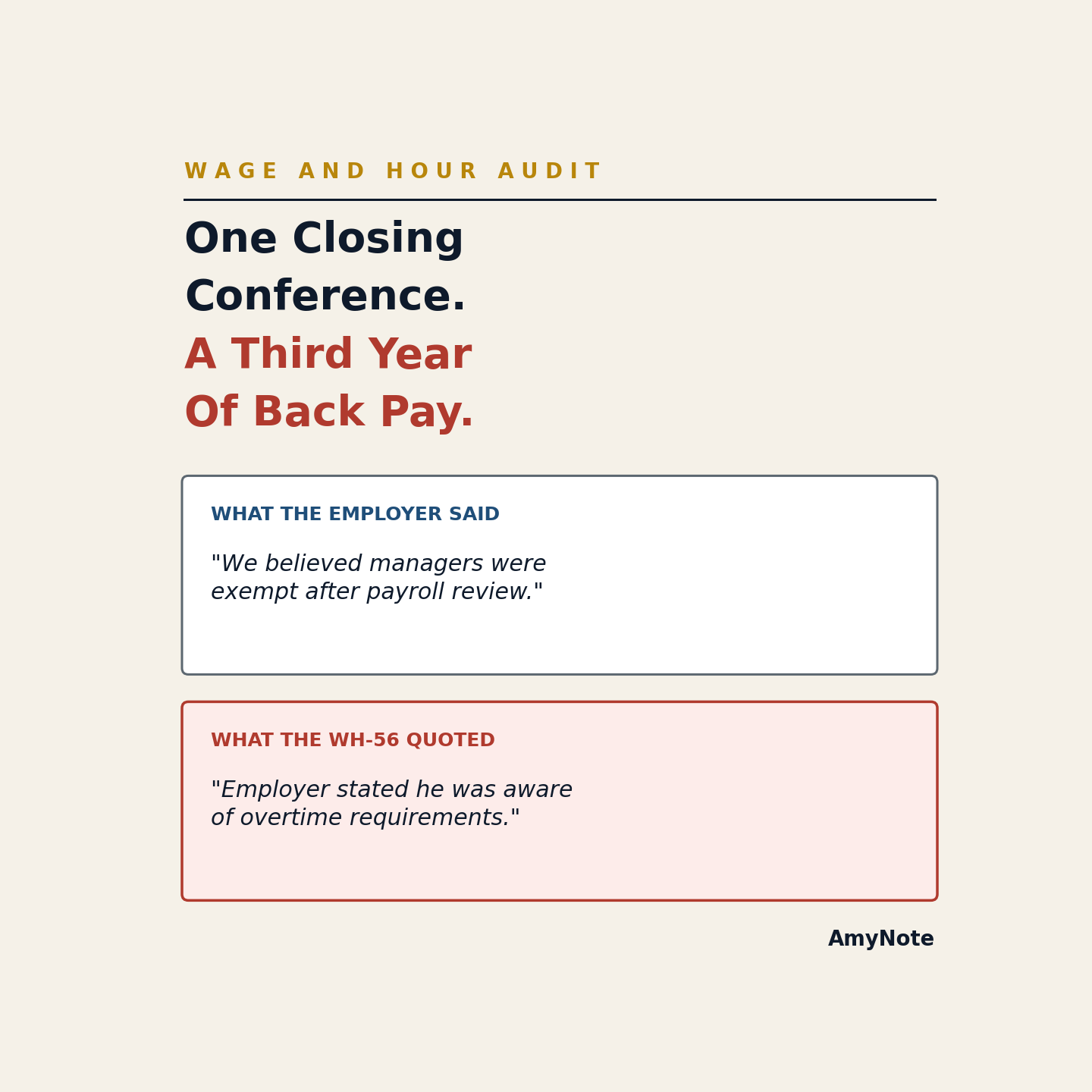
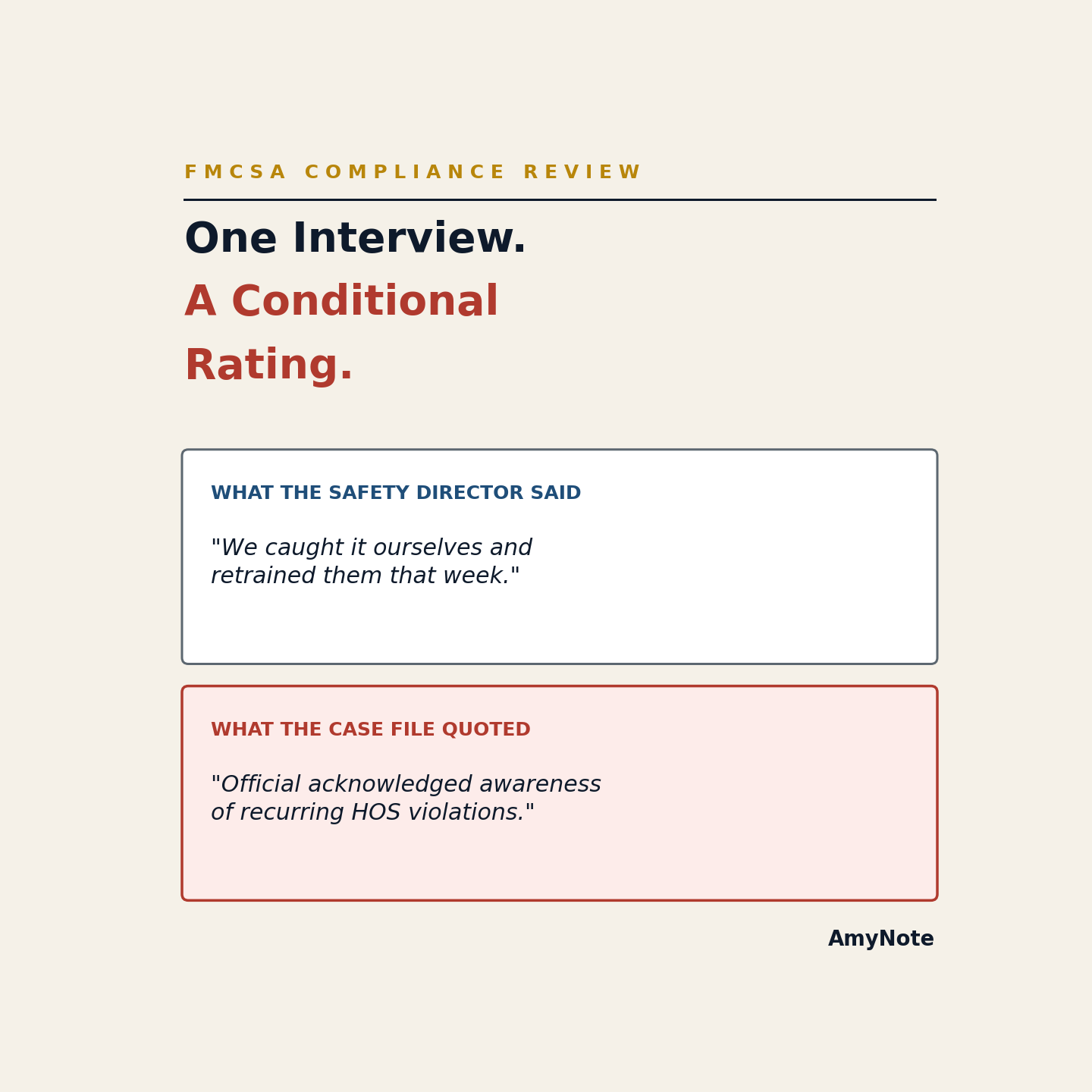
A note that reads "safety director acknowledged the company was aware drivers exceeded hours-of-service limits" is exactly the sentence the determination needs. It does not matter that what he actually said was longer, more qualified, and more careful — that he described the audit process, the corrective actions, the drivers who were retrained. You never receive a transcript of the interviews. There is no recording. When you dispute the characterization later, it is your memory against the government's file, and the government's file was written contemporaneously by a federal investigator.
Why the Usual Defenses Fail
Memory fails first. A three-day review produces dozens of exchanges across multiple rooms and multiple people. Your safety director was answering questions, not documenting them — reading the investigator, managing the moment, trying not to make things worse. Eight weeks later, when the rating letter arrives, nobody can reconstruct which qualifier was attached to which answer on day two.
Attorney notes are partial. Even when counsel attends the interviews, they capture themes and turning points, not exact words. But rating disputes and litigation turn on precise phrasing — the difference between "we knew violations happened and were fixing them" and "we knew about the violations" is the difference between a documented safety program and documented indifference. A thematic summary cannot win that argument.
Cloud meeting bots do not fit. These are in-person conversations in your terminal office. Nobody invites a notetaker bot into a federal investigation, and shipping audio of your statements to a server that trains on user data would create a second problem while solving the first.
So most carriers finish the closing conversation with nothing but recollection — and the only detailed record of what they said belongs to the agency that wrote the rating.
What Actually Works: Own Your Own Record
The carriers who survive rating fights have their own contemporaneous record of every investigator conversation and every internal safety meeting. Not a summary written from memory that evening. A verbatim record, timestamped, made while the words were being said.
This is where AmyNote fits. It runs on your own device and captures in-person conversations directly — no bot joining anything, no one else notified, no hardware on the table. Transcription runs through the OpenAI Speech API, and analysis runs on Anthropic's Claude models, which can pull out every question the investigator asked, every answer given, and every corrective action promised, the same day it happened.
The privacy architecture matters in exactly this scenario. Both OpenAI and Anthropic contractually guarantee zero training on user data. Audio is encrypted in transit and not retained after processing. Transcripts are stored locally on your device with end-to-end encryption — so your record of a federal review stays yours, not a vendor's.
Why owning the record changes outcomes:
- Paraphrase versus quote. When the report says your safety director "admitted" knowing about violations, your verbatim transcript shows the context and the corrective steps the note dropped. That is no longer your memory against the file; it is a contemporaneous record against a compression of one.
- Rating upgrades need evidence. A petition to upgrade a Conditional rating rests on proving corrective action. A same-day record of every commitment made during the review — and transcribed internal meetings showing each one carried out — is that proof, dated and in your own words.
- Litigation defense. After a crash, plaintiff lawyers build company-knowledge arguments from the government file, and a Conditional rating with a "they knew" narrative is exhibit A. Your transcript of the same conversation is the counterweight — the full answer, not the paraphrase.
A Conditional rating routinely costs carriers their best shipper contracts and their insurance renewal pricing. The evidence deciding it is often one sentence of paraphrase.
Getting Started
Start before the investigator arrives, not after the rating letter. Use AmyNote to capture your prep meetings with counsel and managers, then every review conversation where the law allows, and have it summarize questions, answers, and commitments the same day. File the transcripts alongside the records the investigator copied.
When the investigation report comes back with your words rearranged — and the rating hanging on the rearrangement — you will be the rare carrier holding a better record of the conversation than the government's.
Originally published as an X Article by @AmyNoteApp.