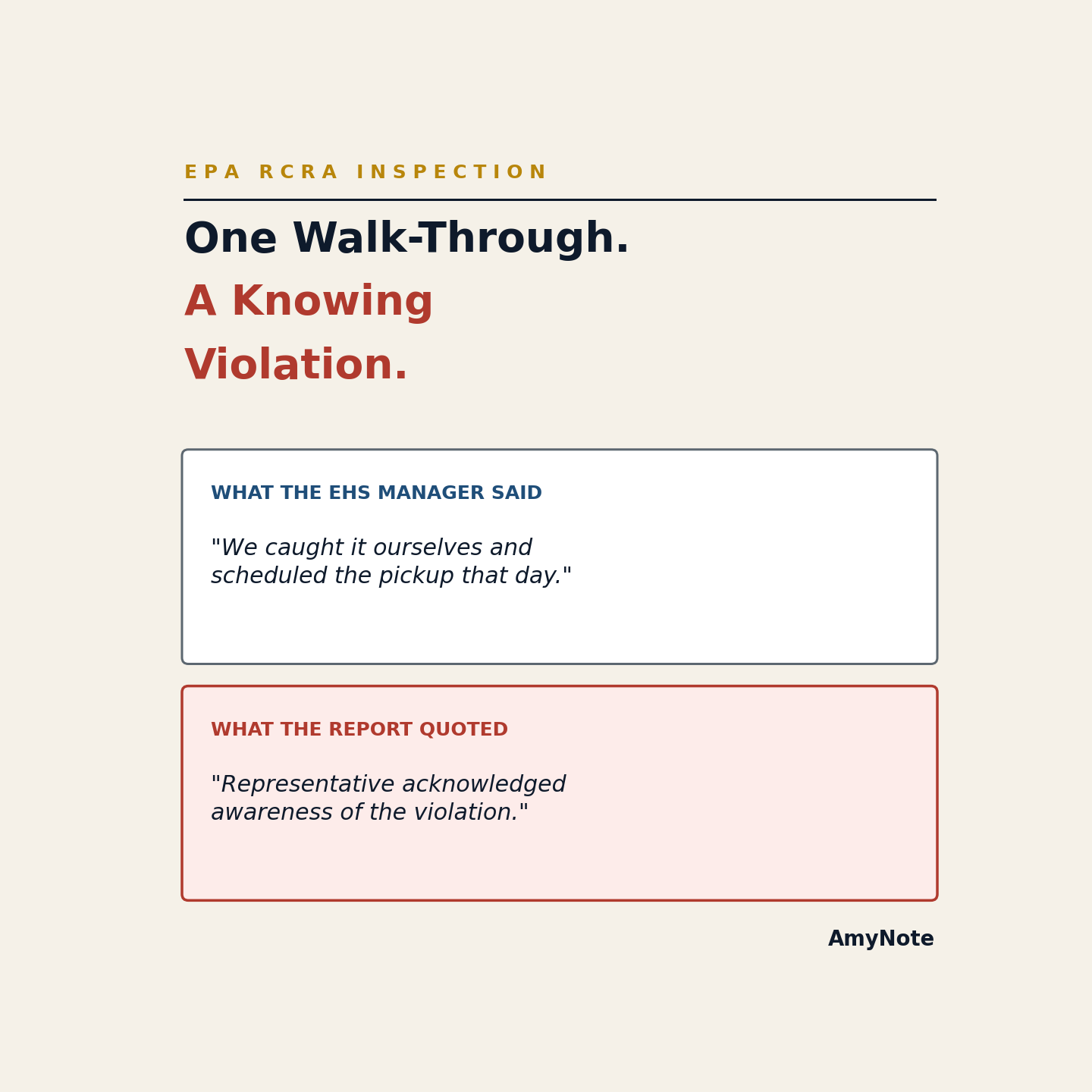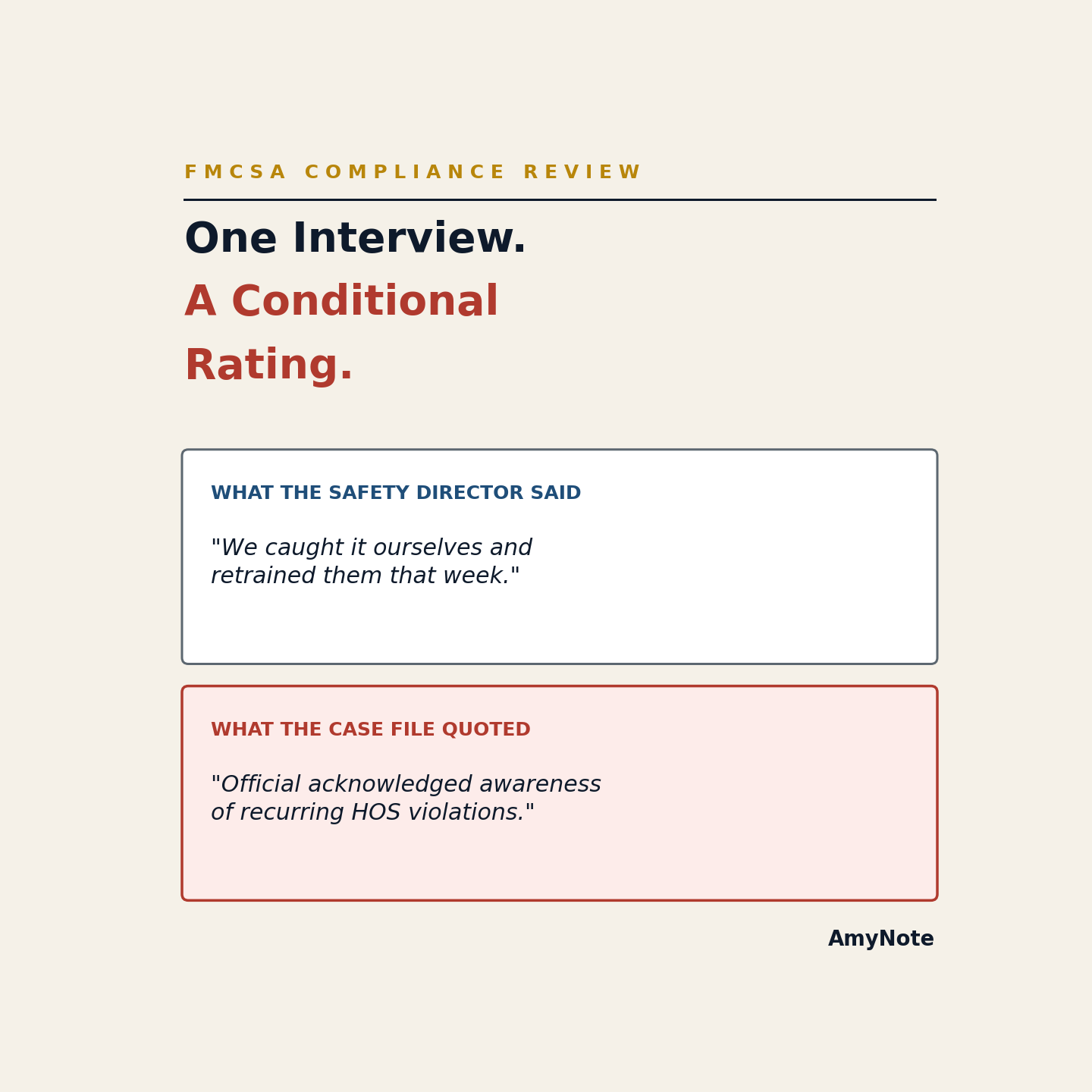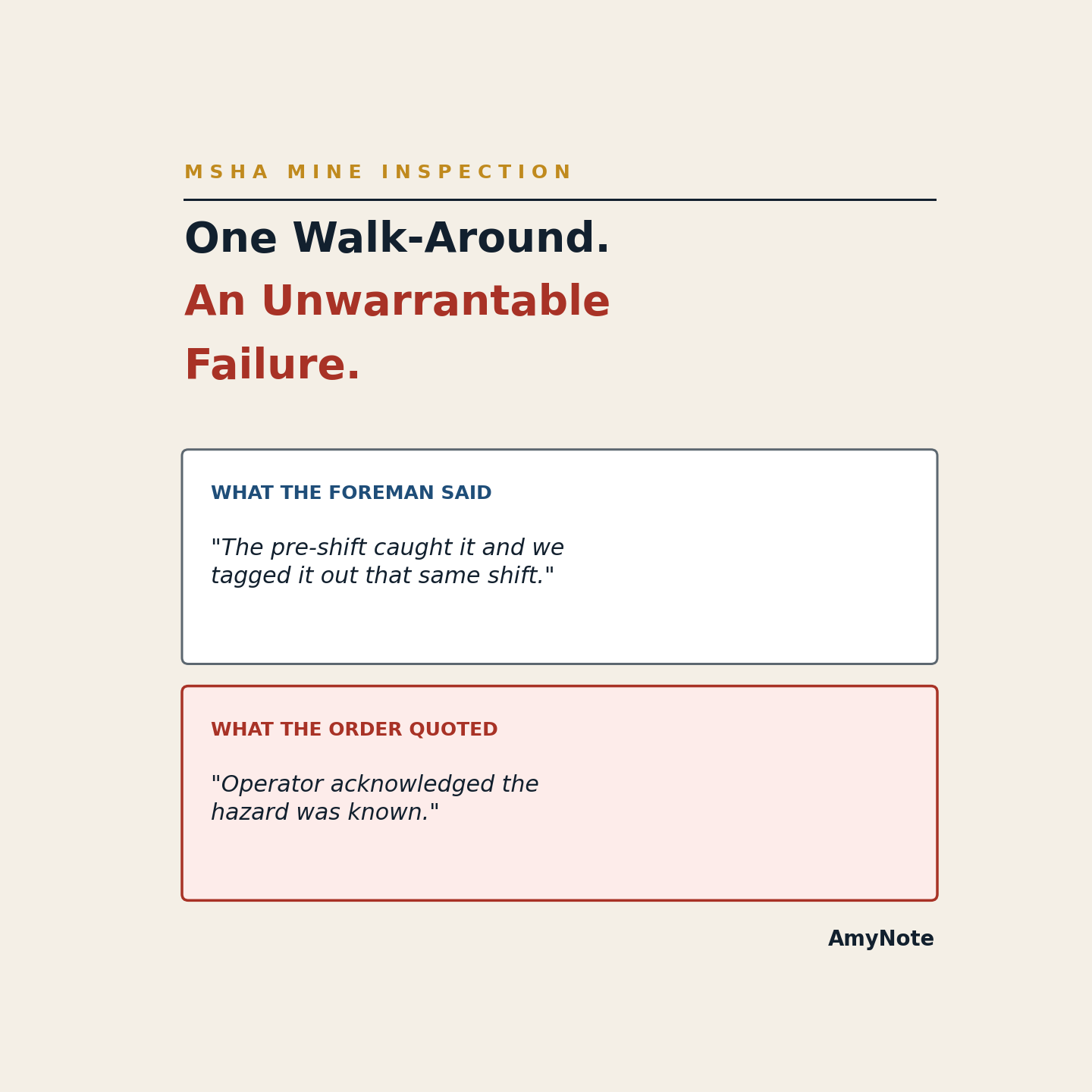
The inspection took an afternoon. The inspector arrived unannounced, walked the working sections, checked the guarding, and asked your foreman about the pre-shift exam and the last time anyone flagged the conveyor. Your foreman answered every question openly, because openness is what a good safety culture looks like. Everyone signed off at the closeout conference. Weeks later the citation arrives — and it quotes "the mine" acknowledging that the hazard was known before the shift started. The order that follows treats that one sentence as proof of aggravated conduct.
Nobody at your operation remembers putting it that way. But nobody can prove otherwise, because the only detailed record of that afternoon belongs to the government.
The Problem: An Inspection Built on Conversations
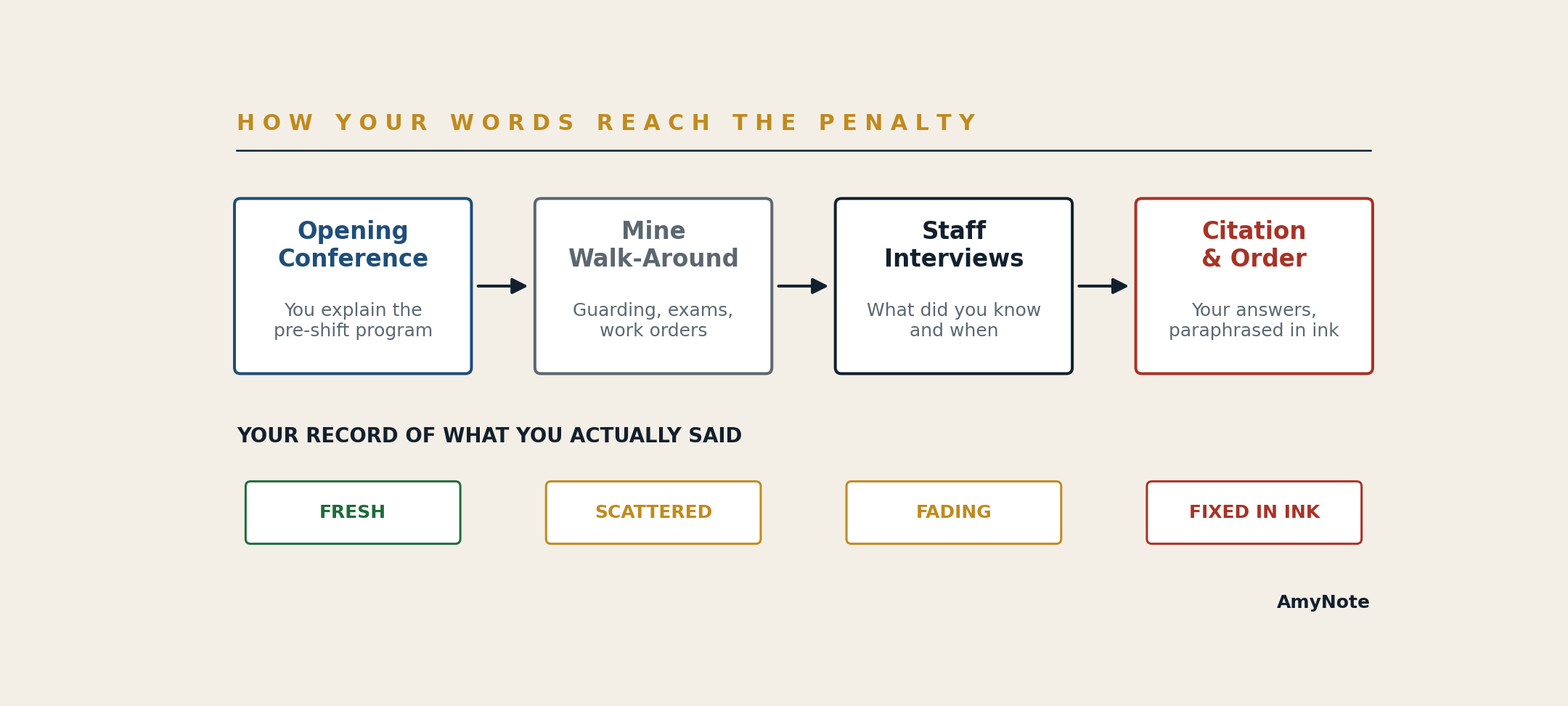
An MSHA inspection is built on conversations. Under Section 103 of the Mine Act, the inspector arrives unannounced, walks the working sections, and interviews your foremen, miners, and the operator. The questions circle a single theme: what did you know about that hazard, when did you know it, and what was done about it before the shift began.
After a reportable accident, the questions get sharper and the stakes get higher. Now the inspector is not just documenting conditions — they are building a record of knowledge and timing, the two elements that decide how hard the enforcement lands.
The inspector writes field notes through all of it. Those notes feed the inspection report behind every 104(a) citation and 104(d) unwarrantable-failure order, and they drive the penalty assessment. You are quoted in that report, but almost never word for word. Your foreman's five-minute account of the pre-shift examination — the route, the sign-off, the one belt that got flagged and scheduled for repair — becomes one paraphrased line chosen by the person building the case.
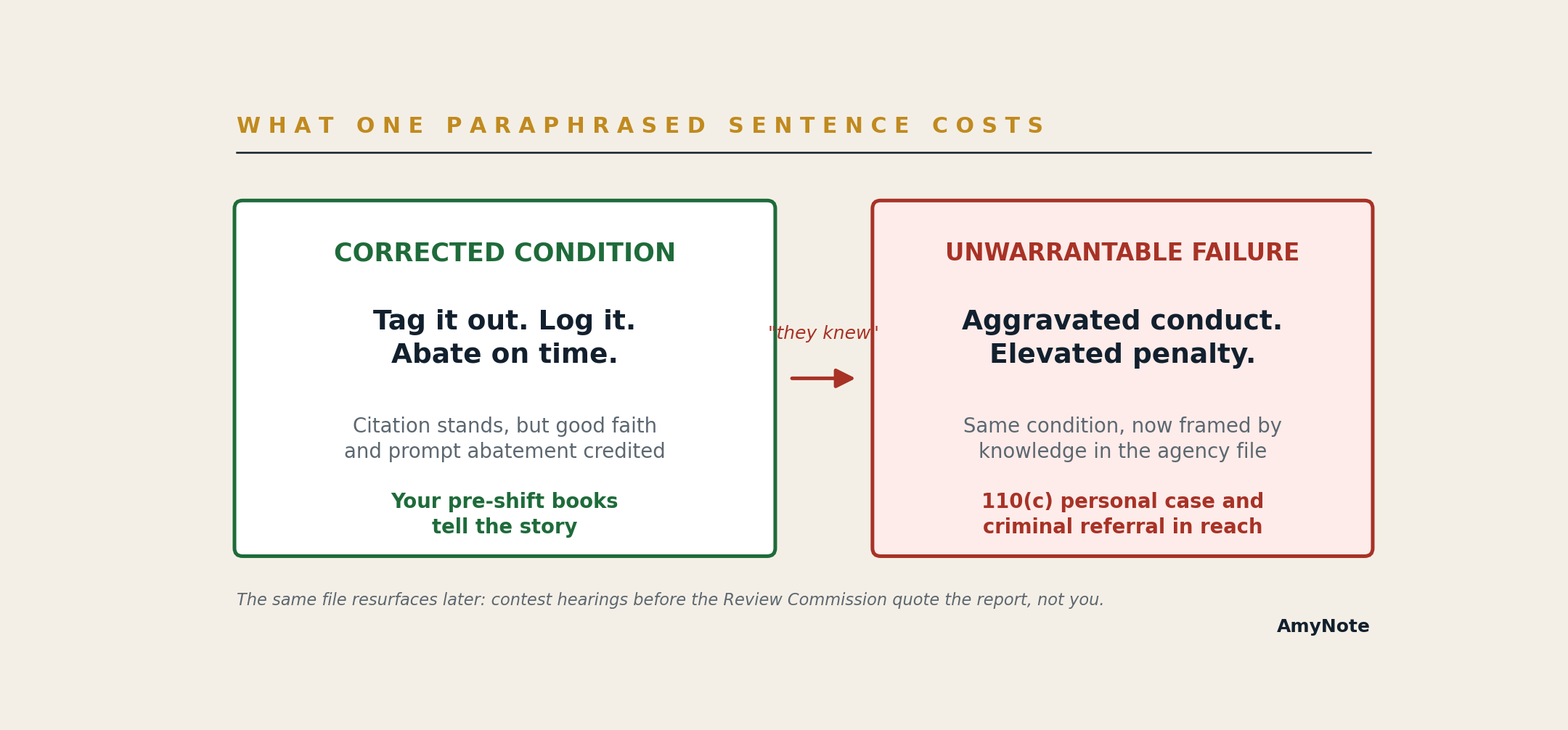
That line carries enormous weight. It is the difference between an ordinary citation and an unwarrantable failure, the aggravated-conduct finding that raises penalties and opens the door to Section 110(c) individual liability for the agent who supposedly knew. Under 110(c), the exposure stops being the company's alone and lands on a named person — a foreman, a superintendent, a mine manager.
You never receive a transcript. There is no recording. When you contest the characterization later, it is your memory against the agency file.
Why Current Solutions Fail
Memory fails first. An inspection or accident interview covers dozens of exchanges across the pit, the shop, and the office. Your foreman was answering questions, not documenting them — and under the pressure of a federal inspection, precise recall gets worse, not better. Days later, when the memory matters, it has already blurred.
Attorney notes are partial. Even when counsel attends, they capture themes and warning flags, not exact words. Penalty fights turn on precise phrasing about knowledge and timing — the difference between "we found the loose guard and tagged it for the next maintenance window" and "we knew the guard was off" is the difference between reasonable diligence and aggravated conduct.
Cloud meeting bots do not fit. This is an in-person walk-around of an active mine. Nobody invites a bot to a federal inspection, and shipping that audio to a server that trains on it creates a second problem while you are still trying to solve the first.
So most operators finish the closeout conference with nothing but recollection, and the only detailed record of what was said belongs to the government.
What Actually Works: Your Own Contemporaneous Record
The operators who survive contest proceedings have their own contemporaneous record of every inspector conversation and every internal safety meeting. Not a summary written from memory three days later — a verbatim record made while the words were being said.
This is where AmyNote fits. It runs on your own device and captures in-person conversations directly, with no bot joining anything and no one else notified. Transcription runs through the OpenAI Speech API, and analysis runs on Anthropic's Claude models, which can surface every question the inspector asked, every answer given, and every corrective action promised — the same shift, while you can still act on them.
The privacy architecture matters in exactly this scenario. Both OpenAI and Anthropic contractually guarantee zero training on user data. Audio is encrypted in transit and not retained after processing. Transcripts are stored locally on your device with end-to-end encryption, so your record of a federal inspection stays yours.
Why this changes outcomes:
- Paraphrase versus quote. When the report says your foreman "admitted" the hazard was known, your verbatim transcript shows the pre-shift entry, the work order, and the timeline the note dropped.
- Penalty math rewards proof. Negligence and good-faith abatement drive the assessment. A same-shift record of every commitment made during the inspection is that proof — not an assertion, a record.
- Contest defense. The inspection file resurfaces before the Federal Mine Safety and Health Review Commission, sometimes many months later. Your transcript of the same conversation is the counterweight.
An unwarrantable-failure framing can turn a fixable condition into elevated penalties, a personal 110(c) case, and a criminal referral. The evidence deciding it is often one sentence of paraphrase — a sentence you never saw written, about a conversation you can no longer reconstruct.
Getting Started
A practical sequence most operations can adopt this quarter:
- Capture your safety and pre-shift meetings. Record the internal walk-throughs and toolbox talks where your crew describes conditions and corrective actions, so everyone tells the same story consistently under pressure.
- Record inspection conversations where the law allows. Check your consent rules with counsel first; in many settings your own participation in the conversation is enough.
- Summarize the same shift. Have the AI pull out every question the inspector asked, every answer given, and every corrective action promised while the details are fresh and the abatement clock is still on your side.
- File the record with the inspection documents. When the citation or order arrives weeks later, the comparison takes minutes, not memory.
Start before the inspector reaches the portal, not after the order issues. Use AmyNote to capture your safety and pre-shift meetings, then every inspection conversation where the law allows, and have it summarize the commitments the same shift. When the report comes back with your words rearranged, you will be the rare operator holding a better record than the government's. AmyNote at amynote.app offers a 3-day full trial with no credit card.
Originally published as an X Article by @AmyNoteApp.