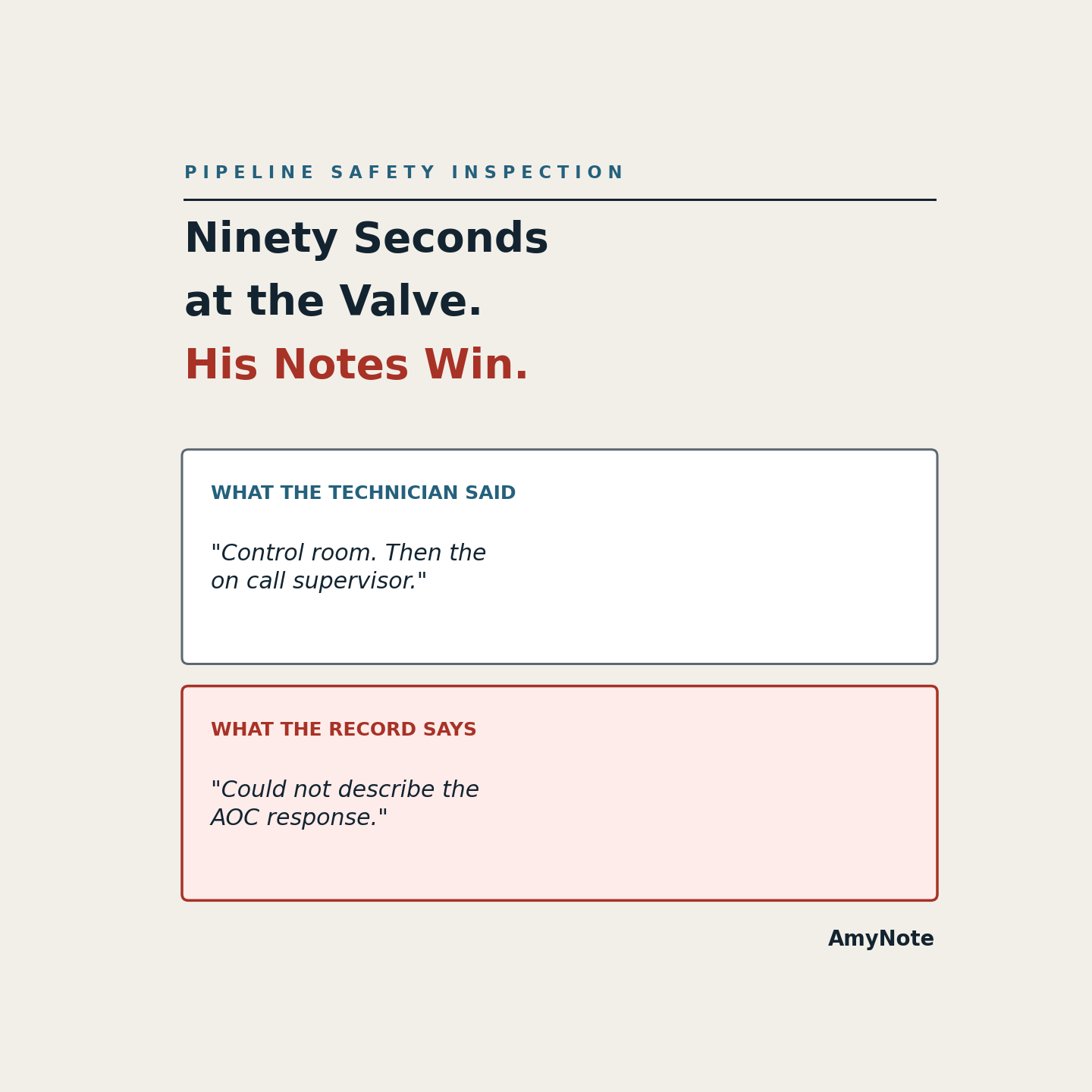
The inspector meets your technician at a regulator station, mid task. He asks what the technician would do if pressure kept climbing past the setpoint, and who he would call first.
The technician answers in about ninety seconds. He is right about the action and vague about the notification order. The inspector writes his own summary in his field notes.
Your side writes nothing. Weeks later, that summary is the only surviving account of the conversation — and it belongs to the regulator.
The Question Was About One Man. The Finding Is About Your Program.
An operator qualification field evaluation is an oral exam with no answer sheet. The inspector picks a covered task, watches it performed, and asks the individual to describe how he would recognize and react to an abnormal operating condition. No script, no form the technician fills out, no copy of what he said. That is deliberate — a rehearsed answer would prove nothing about whether the qualification program works.
Then the answer changes scope, and this is the part that surprises operators. A single vague response does not get written up as one technician needing a refresher. It gets written up as evidence that the qualification program itself does not verify the ability to recognize and react to abnormal operating conditions, which is a program requirement, not a personnel one.
That jump is not an overreach by the inspector. It follows directly from what he is there to assess. He is not grading your technician; he is sampling your program through your technician. One man's ninety seconds is the evidence, and the program is the subject.
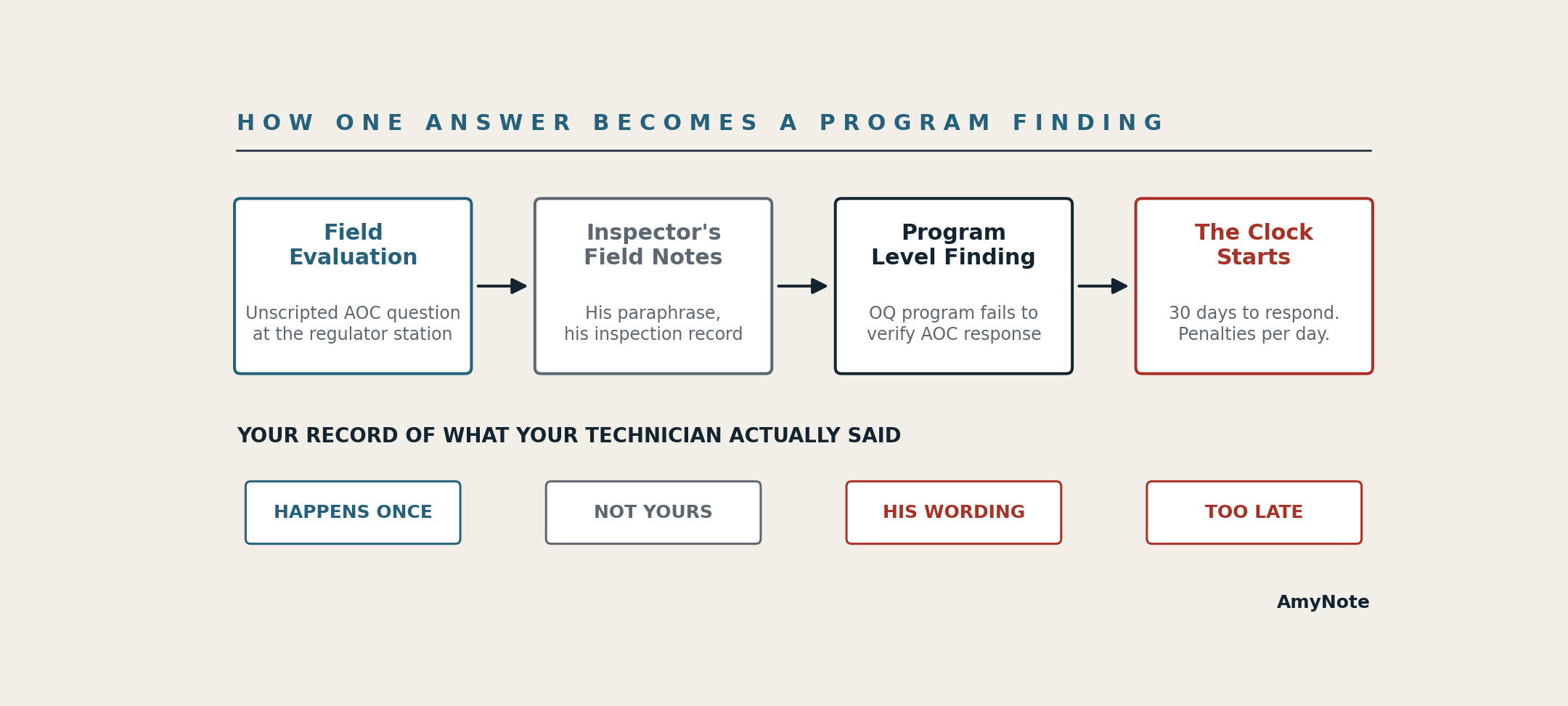
What follows arrives in writing weeks later. A Notice of Amendment says your written OQ program is inadequate and gives you thirty days to respond. A Notice of Probable Violation carries the same clock plus civil penalties that run past a quarter million dollars per violation per day, with a related series cap in the millions.
Read that sequence again, because the compression is the whole problem. A ninety-second exchange at a valve becomes two sentences in a field note, which becomes a program-level finding, which becomes a thirty day clock with penalties attached. Each step is defensible on its own. The chain as a whole rests on a conversation nobody wrote down except the person on the other side of it.
Why Your Qualification Records Do Not Cover This
You have the documentation the rule asks for. Covered task lists, the four part task analysis, evaluation records, span of control, requalification intervals, abnormal operating condition lists. This is not an argument that your program is thin.
All of it proves the technician was qualified on paper. None of it captures the sentence he actually said standing at a valve with an inspector holding a notebook. Those are different artifacts answering different questions, and only one of them is in dispute when a finding lands.
The reconstruction problem is precise. Drafting the response, you need to know whether he said “I would call the control room” or “I would call the control room, then the on call supervisor, then log it.” One is an incomplete answer. The other is a complete answer delivered out of order by a man being watched. Your entire response turns on which one it was.
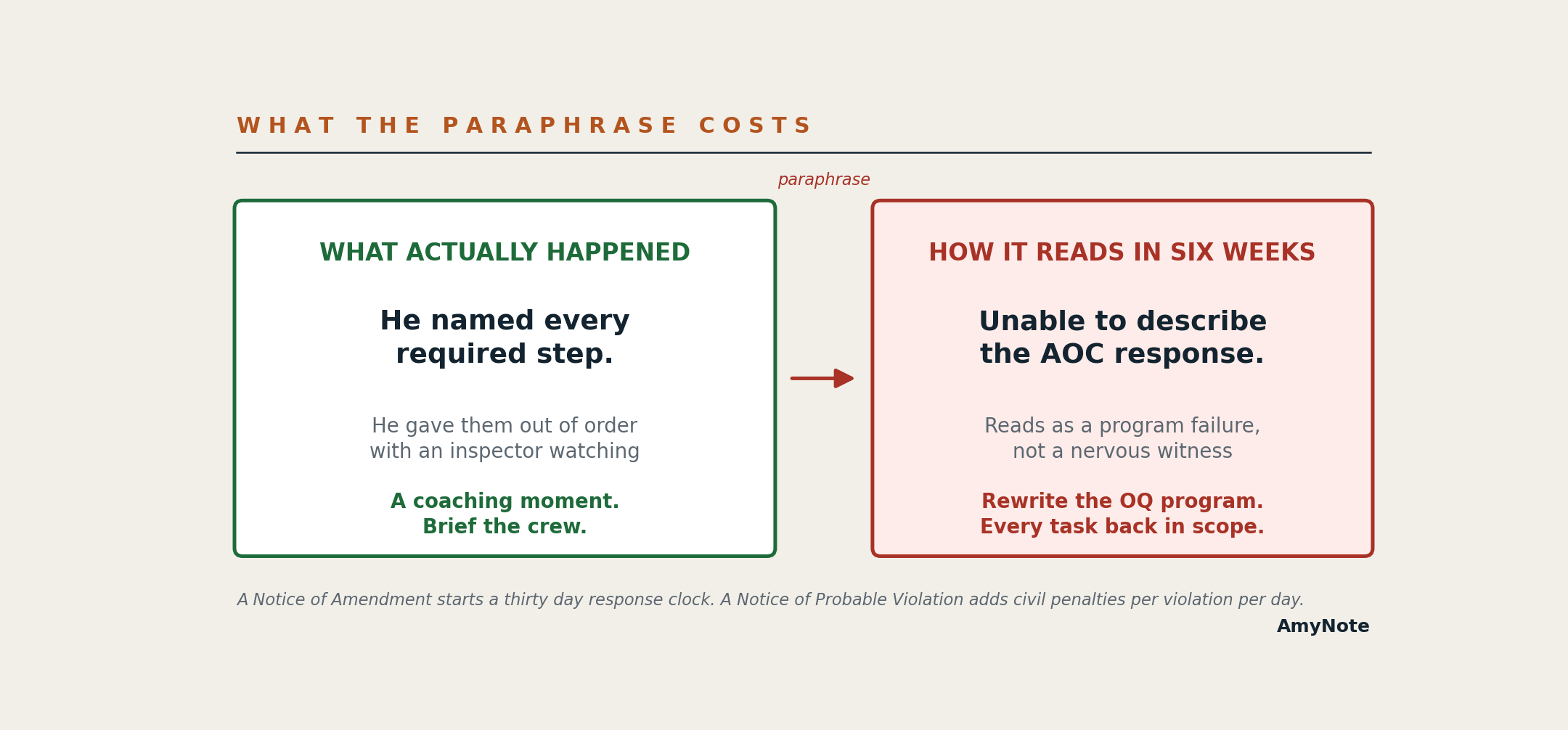
Nobody remembers at that resolution three weeks on. Not through carelessness — human memory simply does not store a ninety-second field exchange at the granularity a regulatory response requires. The technician remembers being asked. He does not remember his own clause order, and he is the only person who was ever in a position to.
So you concede the point. You rewrite the OQ program more broadly than the finding required, because you cannot prove the narrower version is the true one, and a narrow response that gets rejected costs more time than a broad one that gets accepted. That pulls every covered task and every evaluator back into scope.
There is a second cost that arrives later. The program rewrite you made under uncertainty becomes your file. When the same area comes up in the next inspection cycle, the record says you overhauled operator qualification — which reads as an admission that operator qualification was the problem. The concession you made to close one finding becomes the history you are held to in the next one.
Keep a Contemporaneous Record of Your Own
This is not about recording the inspector. Do not. The field evaluation is the regulator's activity, and taping it turns a technical disagreement into a conduct problem — one that will color every interaction you have with that inspector for years.
It is about the conversation twenty minutes later in the truck, when the OQ program manager and the area supervisor ask the technician what he was asked and what he answered. That debrief already happens. It happens after nearly every field evaluation, at nearly every operator, and right now it dissolves into a phone call and two people's recollections.
That debrief is where the real detail lives, and the window is short. The technician can still reproduce his own phrasing twenty minutes out. He cannot at three weeks. The period in which an accurate record is even possible is measured in minutes, and it closes while everyone is still deciding whether the evaluation went well.
AmyNote runs on the phone already in the supervisor's pocket, so nothing new gets introduced at a remote site and there is no meeting bot — no device to clear, no vendor to badge in, nothing that changes what the inspection team sees on your right of way. It captures the debrief, transcribes it with the OpenAI Speech API, and runs the analysis through Anthropic's Claude Opus to surface the covered task, the abnormal operating condition named, the question as the technician heard it, and the order he gave his answer in.
That record earns its keep at three moments.
- The same day. You need to know whether the other technicians got asked the same question — while there is still time to look, and before a single sample turns into a pattern finding.
- At the exit briefing. A misunderstanding can still be corrected there, before it becomes written. Correcting it requires knowing precisely what was said, which is the one thing you do not have if the debrief went into a phone call.
- Inside the thirty day window. The entire dispute is what one person said out loud. Thirty days is not enough time to reconstruct a conversation — it is barely enough to assemble what you already have. The alternative to a contemporaneous record is his memory of ninety seconds.
Privacy is the first question on a pipeline, so here is the architecture. Both OpenAI and Anthropic contractually guarantee zero training on user data. Audio is encrypted in transit and not retained after processing. Transcripts are stored locally on device with end to end encryption. Keep debriefs to covered tasks, notification sequences, and process, and follow your own control room and site security policy on where the file lives — the same discipline you already apply to your operating records.
Getting Started
Do not wait for the next inspection notice. The habit you need with an inspector on site is not one you can adopt on the day an inspector is on site.
- Start with the conversations that happen anyway. The tailgate before a covered task, the debrief after an evaluation, the call after a state inspector drives off. None of these involve an open finding, and all of them build the workflow.
- Confirm your own policy first. Check your recording policy and applicable state consent law, and tell people they are being recorded. Where recording is not appropriate, capture a spoken debrief within minutes of the exchange ending, while exact phrasing is still recoverable.
- Summarize the same day. Pull out the covered task, the abnormal operating condition named, the question as the technician heard it, and the order of his answer — while nobody is reconstructing anything.
- File it with your OQ documentation. When a Notice of Amendment arrives, comparing your record against the finding takes minutes instead of memory.
Build the habit while nothing is riding on it, so the workflow is automatic when something is. AmyNote takes about a minute to set up, and amynote.app offers a 3-day full trial with no credit card.
A Notice of Amendment, a thirty day clock, and a rewritten qualification program can all trace back to ninety seconds at a regulator station. Your technician may well have given a good answer. The only question is whether anyone on your side kept it — and the inspector's paraphrase is not keeping it.
Originally published as an X Article by @AmyNoteApp.