The auditor arrives unannounced. She walks the floor, stops at a systems engineer's desk, and asks him what he is working on right now. Then she asks what charge number he put against yesterday's eight hours.
He answers in about forty seconds. He is right, mostly. He mentions a task order he moved onto Tuesday, hedges slightly on which line the hours landed against, and goes back to work. She writes her version of that answer in her own working papers.
You write nothing. Six weeks later, that memo is the only record anyone has of the conversation — and it is the government's.
The Government Keeps the Only Transcript of Your Own Employees
A labor floor check is a memory test given without warning. The auditor selects employees, confirms they are physically where the timecard says they are, and asks what work they are performing and against which cost objective. It is one of the mandatory annual audit requirements, and it is deliberately unscripted. That is the point — a rehearsed answer proves nothing about whether your timekeeping system works.
The answers are technical, and the stakes are invisible to the person giving them. An engineer splitting time across three task orders will describe his work accurately and still name the charge number loosely, because to him the difference between a base task and an option exercised last month is paperwork. He is thinking about the design problem on his screen. He is not thinking about how a hedged clause reads in a workpaper.
That loose phrasing is what gets recorded. The auditor documents the exchange in her working papers, in her own words, at her own level of detail. Nobody is acting in bad faith. She is doing exactly what the audit program tells her to do: capture what the employee said and assess whether it supports the labor charges on the timecard. But her memo is a paraphrase written by someone who heard the answer once, and it becomes the government's evidence of what your employee said.
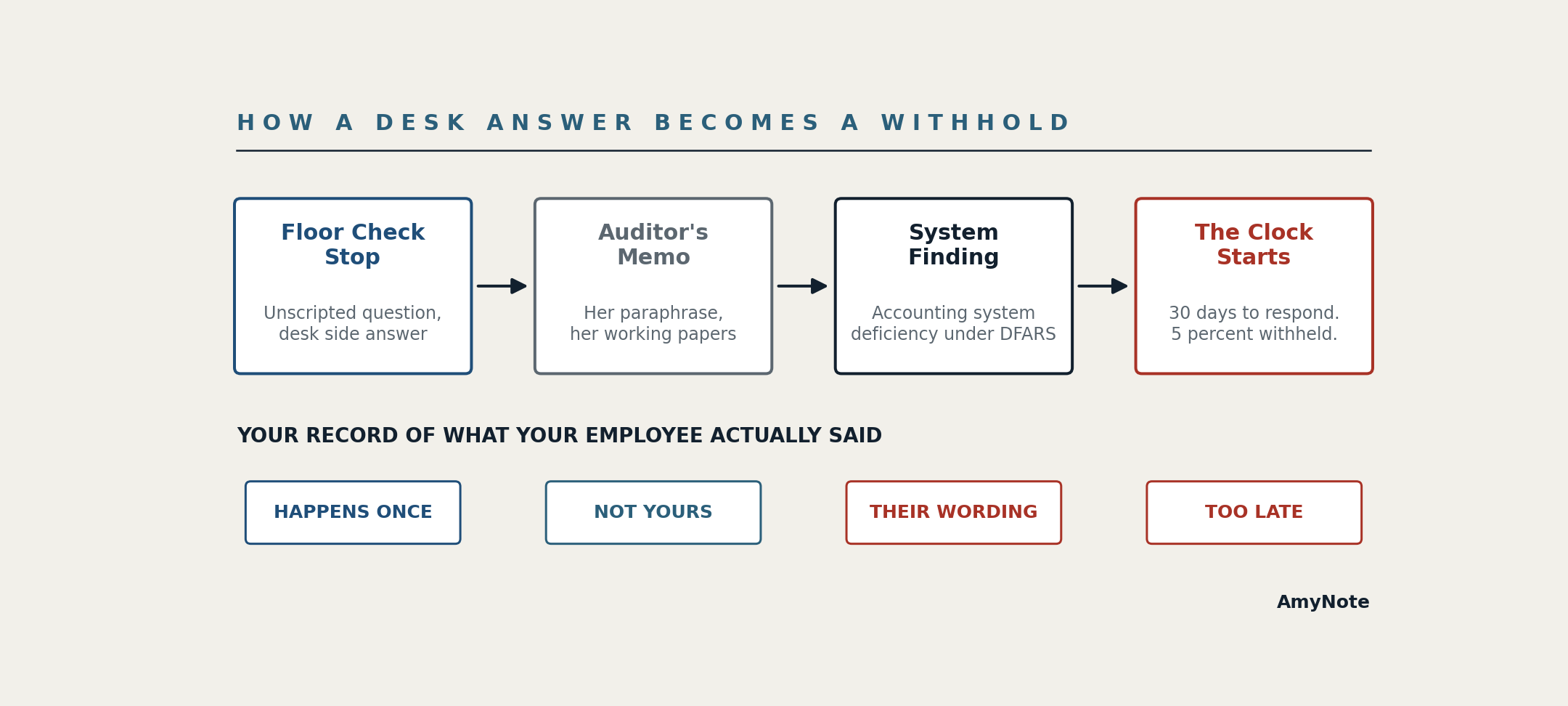
Labor charging observations then feed the accounting system audit under the Defense Federal Acquisition Regulation Supplement. If the contracting officer issues an initial determination of significant deficiencies, you get thirty days to respond, and payments on covered contracts can be withheld at up to five percent while the system stays disapproved.
Read that sequence again, because the compression is the whole problem. A forty-second exchange at a desk becomes two sentences in a workpaper, which becomes a labor charging observation, which becomes a system-level finding, which becomes a withhold against every covered contract you hold. Each step is defensible on its own. The chain as a whole rests on a conversation nobody wrote down except the person on the other side of it.
How Forty Seconds Becomes a System Deficiency
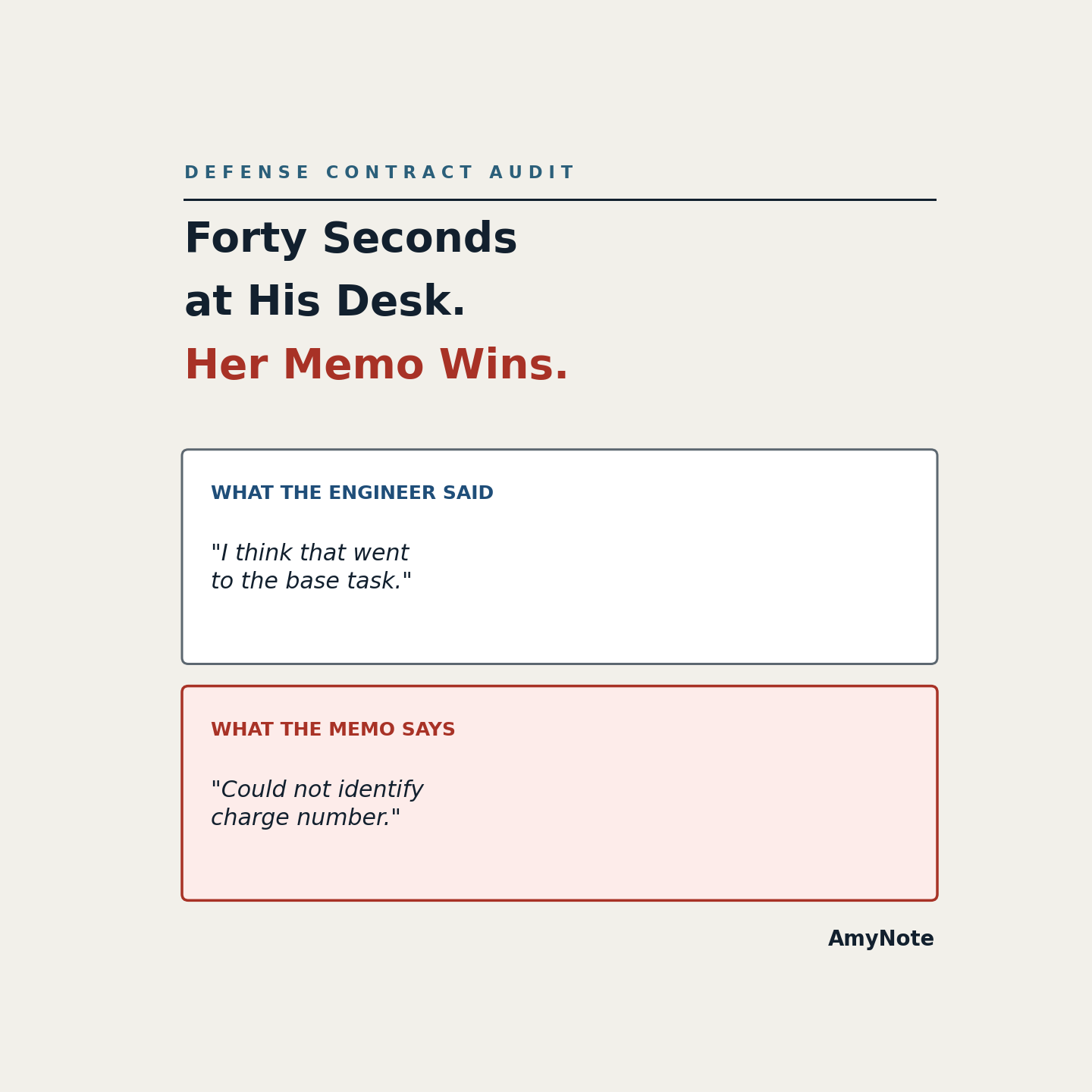
Put the two versions side by side and the gap is obvious in a way it never is in the moment.
What happened is that the hours were charged correctly. The engineer knew what he worked on. He hedged on the name of the task order, not on the work — the sort of imprecision that comes from a person who thinks in systems rather than in contract line items. If that is the true version, you have a training gap and the fix is a briefing.
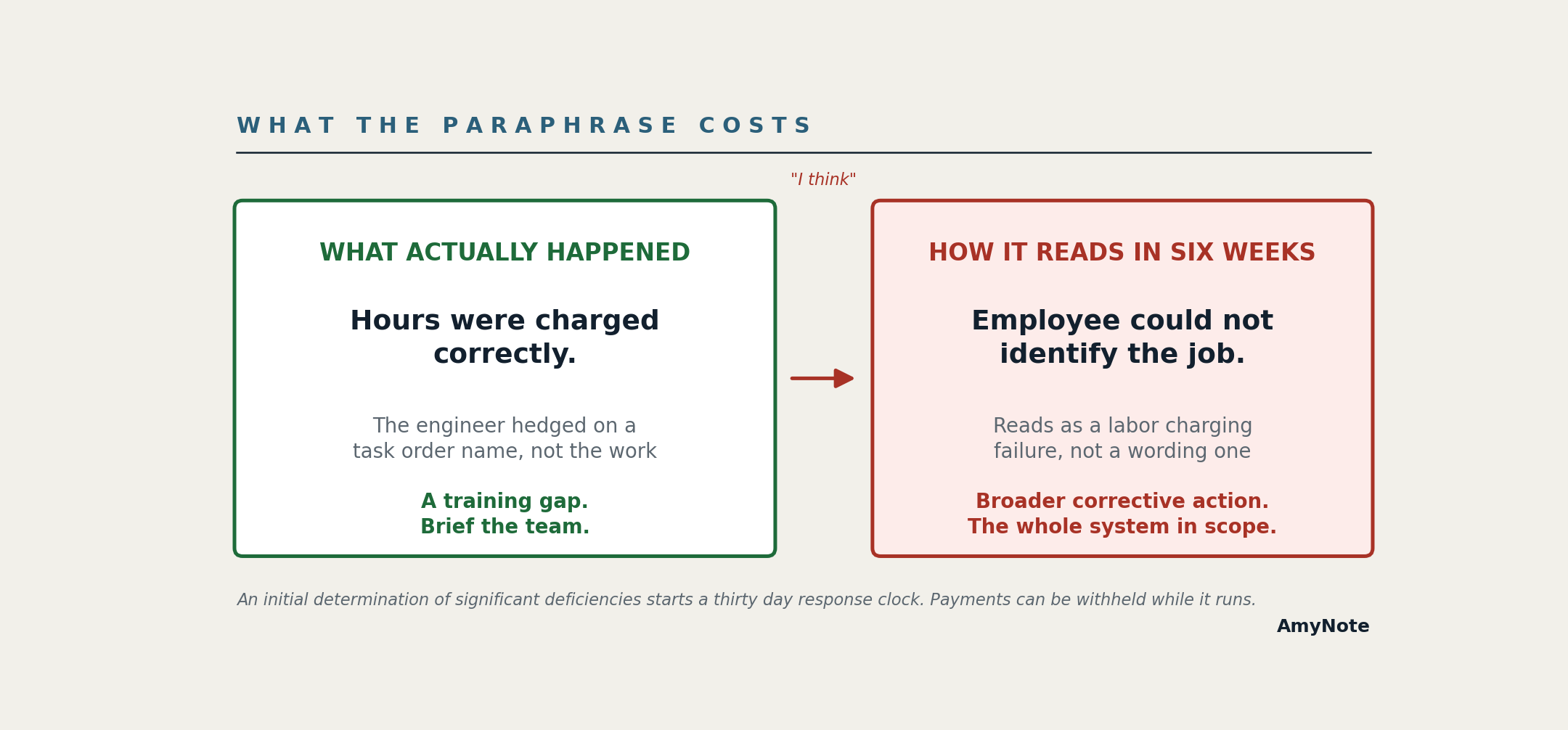
What the memo can just as easily support is that the employee could not identify the job. That is not a wording problem. That is a labor charging failure, and it puts your timekeeping controls in scope rather than one engineer's vocabulary.
Two readings of the same forty seconds, separated by a hedge. And the hedge is exactly the kind of detail that does not survive six weeks in anyone's memory.
Why Your Compliance Program Does Not Cover This
You already do the training. Timekeeping policy, annual labor charging certification, supervisor approval on every timecard, an ethics hotline, a readiness briefing before every audit cycle. On paper your controls are in good shape, and this is not an argument for adding another layer to them.
All of that is preparation. None of it is a record. Training tells the engineer what to say. It does not capture what he actually said with an auditor standing at his cube, and those are different problems — only one of which can be solved in advance.
The reconstruction problem is specific. Six weeks later you are drafting a response to an initial determination and you need to know whether he said “I think that went to the base task” or “that went to the base task.” One is an employee being careful. The other is a labor charging error. Your entire response hinges on which one it was.
Nobody remembers at that resolution. Not because anyone was careless, but because human memory does not store a forty-second hallway exchange at the granularity a regulatory response requires. The engineer remembers being asked. He does not remember his own clause structure.
So you concede the point. You write a corrective action plan broader than the finding required, because you cannot prove the narrower version is the true one, and a narrow plan that gets rejected costs you more time than a broad one that gets accepted. That puts your whole timekeeping system under scrutiny it did not earn.
There is a second cost that arrives later. The corrective action plan you wrote under uncertainty becomes your file. When the same area comes up in the next audit cycle, the record says you overhauled timekeeping — which reads as an admission that timekeeping was the problem. The concession you made to close one finding becomes the history you are held to in the next one, and it follows your proposals into every pricing action for years.
Keep a Contemporaneous Record of Your Own
This is not about recording the auditor. Do not. The interview is the government's proceeding, and taping it is a fight you will lose before the audit even starts — and it will color every interaction you have with that audit team for the life of the engagement.
It is about the conversation that already happens twenty minutes later, when the program manager and the compliance lead pull the engineer into a room and ask what he was asked and what he answered. That debrief already exists. It happens on every floor check, at every contractor, and right now it evaporates into a Slack thread and two people's recollections.
That debrief is where the real detail lives. The engineer can still reproduce his own phrasing twenty minutes out. He cannot at six weeks. The window where an accurate record is even possible is measured in minutes, and it closes while everyone is still deciding whether the floor check went well.
AmyNote runs on the phone already in the compliance lead's pocket, so there is no meeting bot and nothing new introduced into a controlled facility — no device to badge in, no vendor to clear, nothing that changes what the audit team sees on your floor. It captures the audio, transcribes it with the OpenAI Speech API, and runs the analysis through Anthropic's Claude Opus to surface the employee, the contract, the charge numbers named, and the sequence of what was asked and answered.
That record earns its keep at three moments.
- The same day. You need to know whether the same confusion showed up in the other four interviews — while there is still time to look, and before the auditor's sample turns into a pattern finding.
- At the exit conference. A misunderstanding can still be corrected there, before it becomes a written finding. Correcting it requires knowing precisely what was said, which is the one thing you do not have if the debrief went into a Slack thread.
- Inside the thirty day window. The whole question is what your employee actually said. Thirty days is not enough time to reconstruct anything — it is barely enough time to assemble what you already have. The alternative to a contemporaneous record is his memory of a forty-second exchange.
Privacy is the first question on a cleared program, so here is the architecture. Both OpenAI and Anthropic contractually guarantee zero training on user data. Audio is encrypted in transit and not retained after processing. Transcripts are stored locally on device with end-to-end encryption. Keep debriefs unclassified, keep them to charge numbers, task orders, and process, and follow your facility policy on where the file lives — the same discipline you already apply to your incurred cost workpapers.
Getting Started
Do not wait for the next audit notice. The habit you need when an auditor is on the floor is not one you can adopt on the day an auditor is on the floor.
- Start with the conversations that happen anyway. The timekeeping refresher, the incurred cost submission walkthrough, the debrief after a contracting officer call. None of these involve an auditor, and all of them build the workflow.
- Confirm your own policy first. Check your recording policy and applicable state consent law, and tell people they are being recorded. Where recording is not appropriate, capture a spoken debrief within minutes of the exchange ending, while exact phrasing is still recoverable.
- Summarize the same day. Pull out the employee, the contract, the charge numbers named, and the sequence of question and answer — while nobody is reconstructing anything.
- File it with your audit documentation. When the initial determination arrives, comparing your record against the finding takes minutes instead of memory.
AmyNote takes about a minute to set up, and amynote.app offers a 3-day full trial with no credit card.
A disapproved accounting system, a five percent withhold, and the credibility of every proposal you submit next year all trace back to what a few people said at their desks on an ordinary Wednesday. Your engineer gave a good answer. The only question is whether anyone kept it — and the auditor's version of it is not keeping it.
Originally published as an X Article by @AmyNoteApp.