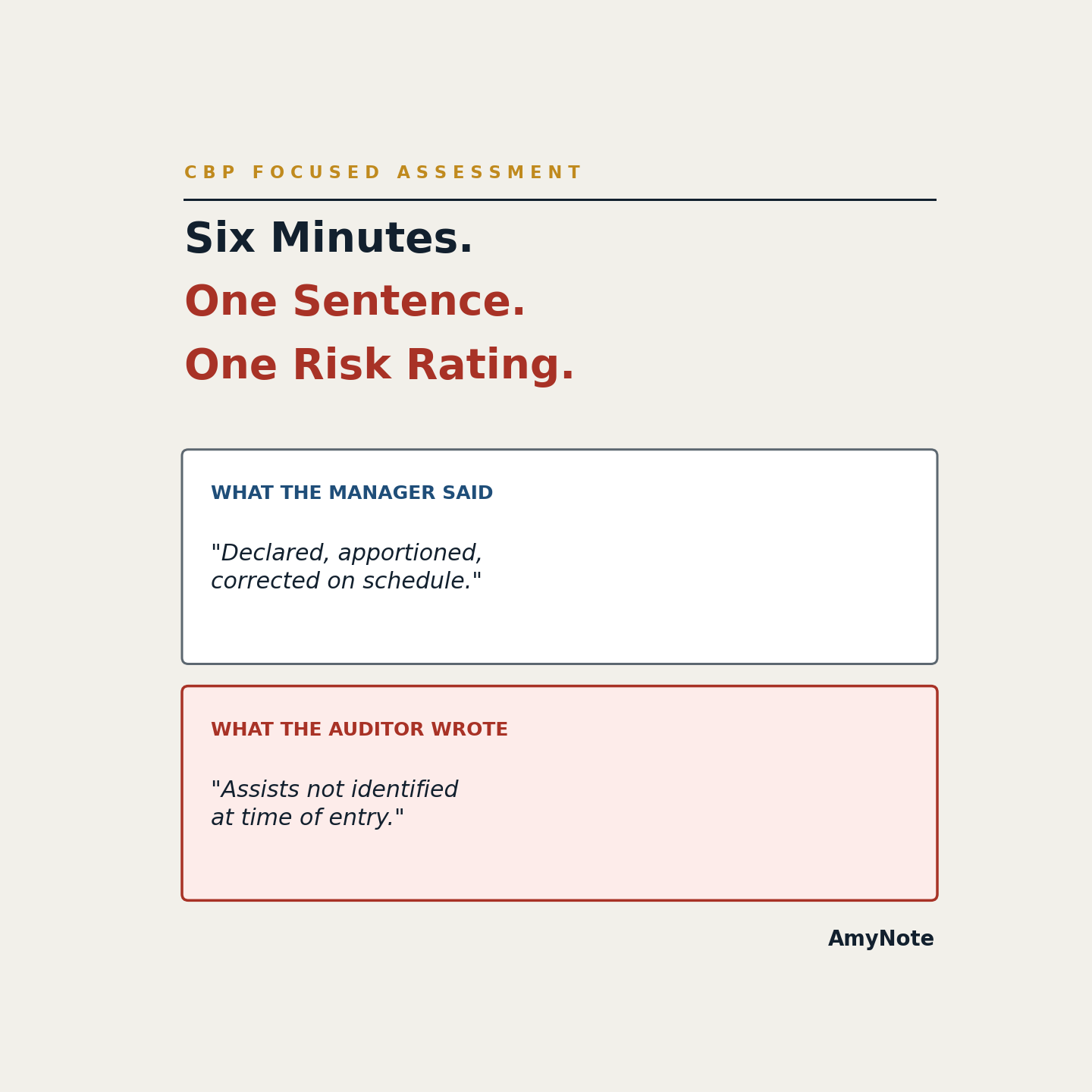
The Regulatory Audit team was on site for the Pre-Assessment Survey. Your trade compliance manager answered one question about how tooling paid to a foreign supplier was handled, and the answer ran six minutes across three departments — engineering, purchasing, and her own group.
What went into the auditor's workpapers was a single sentence. That sentence is now the reason your internal controls are rated unacceptable.
Nobody lied. Nobody was careless. The nuance simply did not survive the compression into one line, and that line is what everyone downstream reads.
A Focused Assessment Is Not a Document Review With People Attached
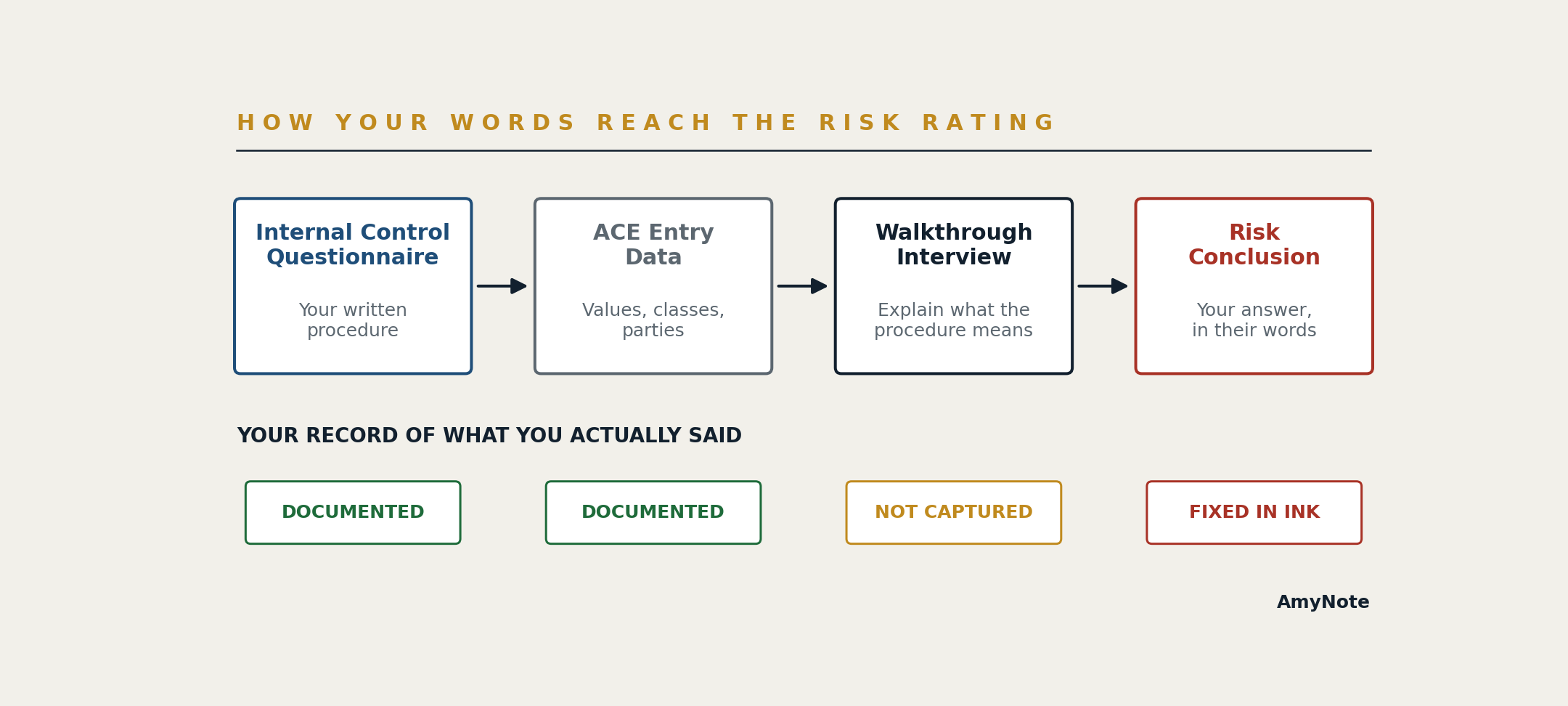
It is easy to prepare for a Focused Assessment as though it were a paperwork exercise. CBP Regulatory Audit sends the internal control questionnaire ahead of time, pulls your entry data from ACE, and asks for your written procedures. All of that is documentary, and all of it is the part importers over-prepare.
Then the team walks through your process with people. The trade compliance manager, the classification analyst, someone from purchasing, someone from accounts payable, and whoever actually talks to your customs broker. The interview is where your written procedure gets its context — where a policy stops being a document and becomes a description of what your company really does, in the words of the person who does it.
That is also where the record stops being yours. Your procedures you keep. Your entry data you can pull. But the conversation that explains both is written down by the other side of the table, in summary form, hours later.
Your Answer Gets Compressed Before It Gets Recorded
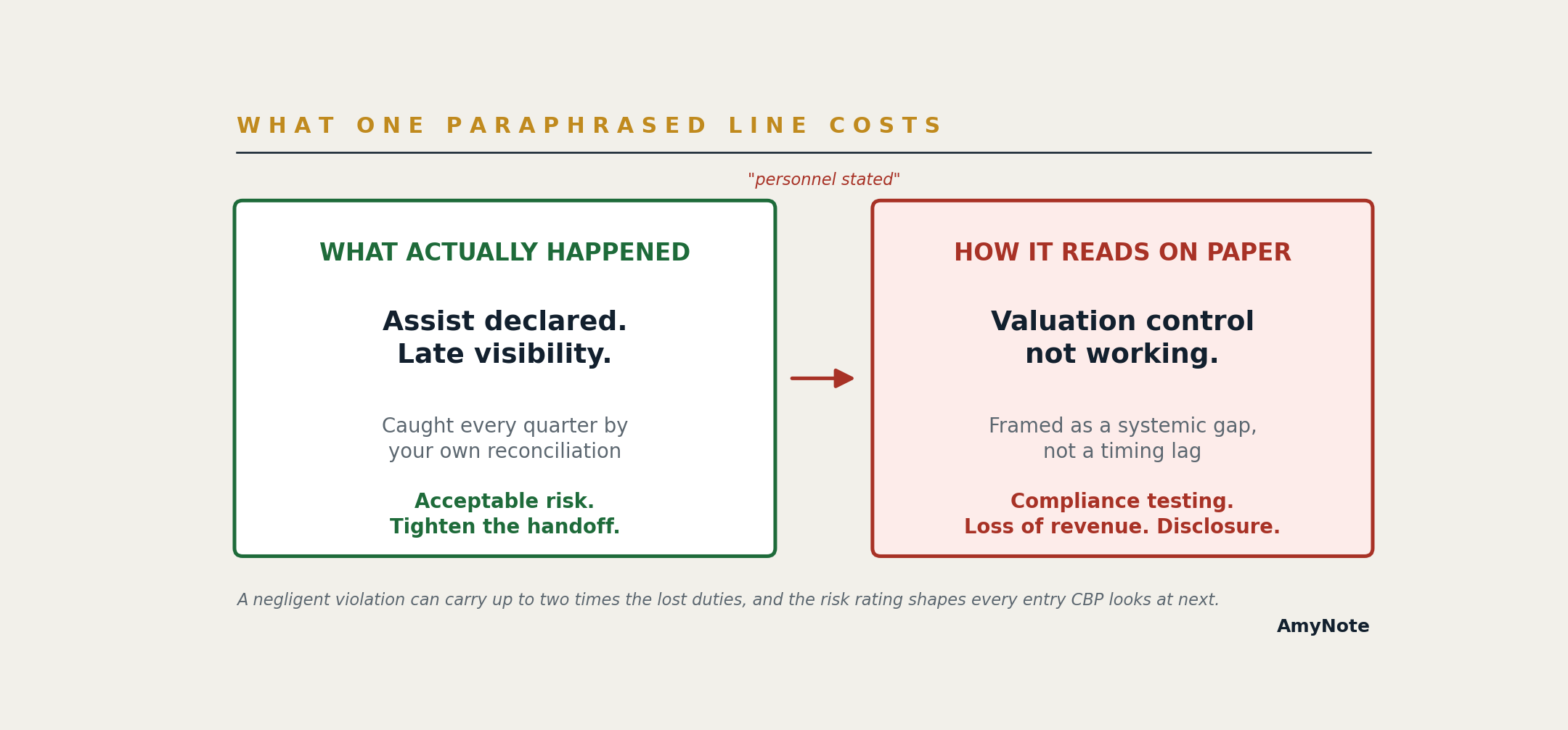
Take the tooling question. Your manager explains the whole thing: the tooling was treated as a dutiable assist, apportioned across the first production run, and declared on a post summary correction once the supplier invoice cleared. The three-week lag exists because engineering books tooling to a capital account that trade compliance does not see until quarter close, and the reconciliation catches it every time.
That is a visibility lag with a working correction mechanism, not an undeclared assist. The distinction is the entire difference between a control observation and a finding of unacceptable risk.
What the auditor writes down is: "Company personnel stated that assists are not consistently identified at the time of entry."
Read that line cold, the way a reviewer three steps removed from the room will read it. It describes a company that does not know when it owes duty. It says nothing about apportionment, nothing about the post summary correction, and nothing about the quarter-close reconciliation that closes the loop every single time. The correction mechanism — the whole reason this is a timing issue rather than a revenue issue — is the part that got compressed out.
Why One Sentence Carries So Much Weight
A single unfavorable line in a workpaper would not matter if it stayed a line in a workpaper. It does not.
The Pre-Assessment Survey exists to produce a risk determination for each area under review — valuation, classification, assists, related-party transactions, special trade programs. An unacceptable determination in an area is not a scolding; it is a scoping decision. It routes that area into Assessment Compliance Testing, where CBP samples entries and quantifies what the control weakness actually cost the government. That quantification becomes the loss of revenue calculation.
From there it reaches the decision your counsel actually cares about: whether to file a prior disclosure under 19 U.S.C. 1592(c)(4), and how broadly to scope it. That decision turns on an honest read of your own exposure, and an honest read requires knowing what your people actually told the auditors — not what the workpapers say they told the auditors.
The stakes at the far end of that chain are not abstract. A negligent violation can carry a penalty of up to two times the lost duties. A fraudulent one reaches the domestic value of the merchandise. Between those two outcomes sits a question about your state of mind and the adequacy of your controls, and that question gets answered largely out of interview summaries.
Why the Usual Preparation Does Not Close This Gap
Every importer prepares. You run a mock audit, you refresh the compliance manual, you rehearse the walkthroughs, and you put someone in the room to take notes during every interview. All of that is worth doing. None of it produces a record of what was said.
The person taking notes cannot do the job. They are simultaneously pulling entry summaries the audit team asked for, tracking which risk area is being covered, and managing a schedule that slipped an hour before lunch. Nobody can follow a six-minute answer about assist apportionment and transcribe it accurately at the same time. By the third interview of the day, the notes are four bullets and a follow-up item.
Rehearsal has the same limit. A mock audit trains your people to give complete answers, which is exactly right and does not help at all with the compression problem. The more complete the answer, the more of it gets dropped on the way into a one-line summary. Preparing your manager to explain the reconciliation in detail does not guarantee the reconciliation appears in the workpaper.
And you do not get the auditor's record. You get the draft findings, weeks later, after the risk conclusion is already framed and worded. These interviews are generally not recorded by CBP, and where any record exists, it is not yours. The only account of what your manager actually said is what your manager can remember weeks after the fact — against a written document that will always look more authoritative than a recollection.
By the time you are drafting a response to draft findings, you are not arguing about facts. You are arguing about a paraphrase, from memory, and the other side has it in writing.
Capture Your Own Side of Every Interview
The fix is not adversarial. It is just symmetric. They keep a record of the conversation. You should keep one too.
AmyNote runs on the phone already in your pocket, so there is no bot joining a call and no hardware to clear through a visitor badge. It records the audio, transcribes it with the OpenAI Speech API, and runs the analysis through Anthropic's Claude Opus to surface the commitments, dates, entry numbers, part numbers, and process details that came up — the specifics that make an answer verifiable instead of merely plausible.
That record earns its keep at three specific moments.
- During fieldwork. When a follow-up request lands on an interview topic, you answer the same day with the qualifier the auditor missed — before the risk conclusion is drafted, while it is still a working assumption rather than a written determination.
- At the exit conference. Your response cites the actual answer rather than a recollection of it. "Our manager described the quarter-close reconciliation and gave the correction interval" is a different statement when you can point to where she said it.
- If the exposure turns out to be real. An accurate transcript lets you scope it correctly, which is what drives whether you file a prior disclosure and how you calculate the loss of revenue. Guessing wide is expensive; guessing narrow is worse.
Privacy is the first question in this industry, so here is the architecture. Both OpenAI and Anthropic contractually guarantee zero training on user data. Audio is encrypted in transit and not retained after processing. Transcripts are stored locally on device with end-to-end encryption. That matters when the conversation covers supplier pricing, royalty terms, first-sale structures, and related-party transactions your legal team treats as confidential business information — the category of detail you would never hand to a vendor that reserves the right to learn from it.
Getting Started
Do not wait until the entry conference is on the calendar. The habit is what makes the record useful, and the habit takes a few weeks to form.
- Start with the conversations that happen all year. Broker reviews, supplier onboarding calls, classification discussions, ruling strategy sessions, and the internal walkthroughs that become your audit trail. None of these involve CBP, and all of them build the muscle.
- Confirm your policy first. Check your company's recording policy and the applicable consent rules with counsel before recording anything involving outside parties. In many settings your own participation in the conversation is sufficient; where it is not, capture a spoken debrief within minutes of the conversation ending, while exact phrasing is still recoverable.
- Summarize the same day. Have the AI pull out every question asked, every answer given, and every process fact stated — while the details are fresh and your response window is still open.
- File it with the audit documents. When the draft findings arrive, comparing your transcript against the agency's summary takes minutes instead of memory.
Tell people they are being recorded, follow your own policy on where the file lives, and keep it. AmyNote takes about a minute to set up, and amynote.app offers a 3-day full trial with no credit card.
An unacceptable risk rating does not usually begin with a discovered violation. It begins with a complete, accurate, six-minute answer that got written down as one sentence by the only person in the room keeping a record. Your manager's full answer is worth considerably more than that sentence — but only if somebody kept it.
Originally published as an X Article by @AmyNoteApp.