Most people pick a meeting note-taker on accuracy and price. Six months later they meet the third question, usually because someone in legal asks it: where does the recording actually go, and whose law applies once it gets there.
Circleback, tl;dv and AmyNote give three genuinely different answers to that question, and the differences are not marketing noise. One is a US company that leans on audited certifications. One is a German company that leans on jurisdiction. One is a single-user iPhone app that leans on not having a fleet at all. Every price and quote below was read on the vendor’s own pages in September 2026.
Quick Verdict
Choose Circleback if you want the deepest audited compliance package and a free plan generous enough to evaluate it on before you spend anything.
Choose tl;dv if European data residency is a requirement rather than a preference. It is a German company and every data centre is in the EU, which is a structural answer rather than a certificate.
Choose AmyNote if you are one person with an iPhone who wants a flat 99 dollars a year and a library that stays on the device.
What We Compared
Circleback is an automatic note-taker that writes and assigns action items, then pushes them into other tools. tl;dv is a meeting recorder built around video, clips and coaching. AmyNote is an iOS app for capturing conversations in the room.
For each one we read the pricing card, the plan comparison table underneath it, the privacy policy and the security or trust page — and where those four disagreed, we said so rather than quoting the flattering one. That method matters here more than usual, because residency and training commitments are exactly the claims that get stated confidently on a marketing page and qualified, or simply omitted, in the document your legal team will actually be handed.
Circleback: Strengths and Weaknesses
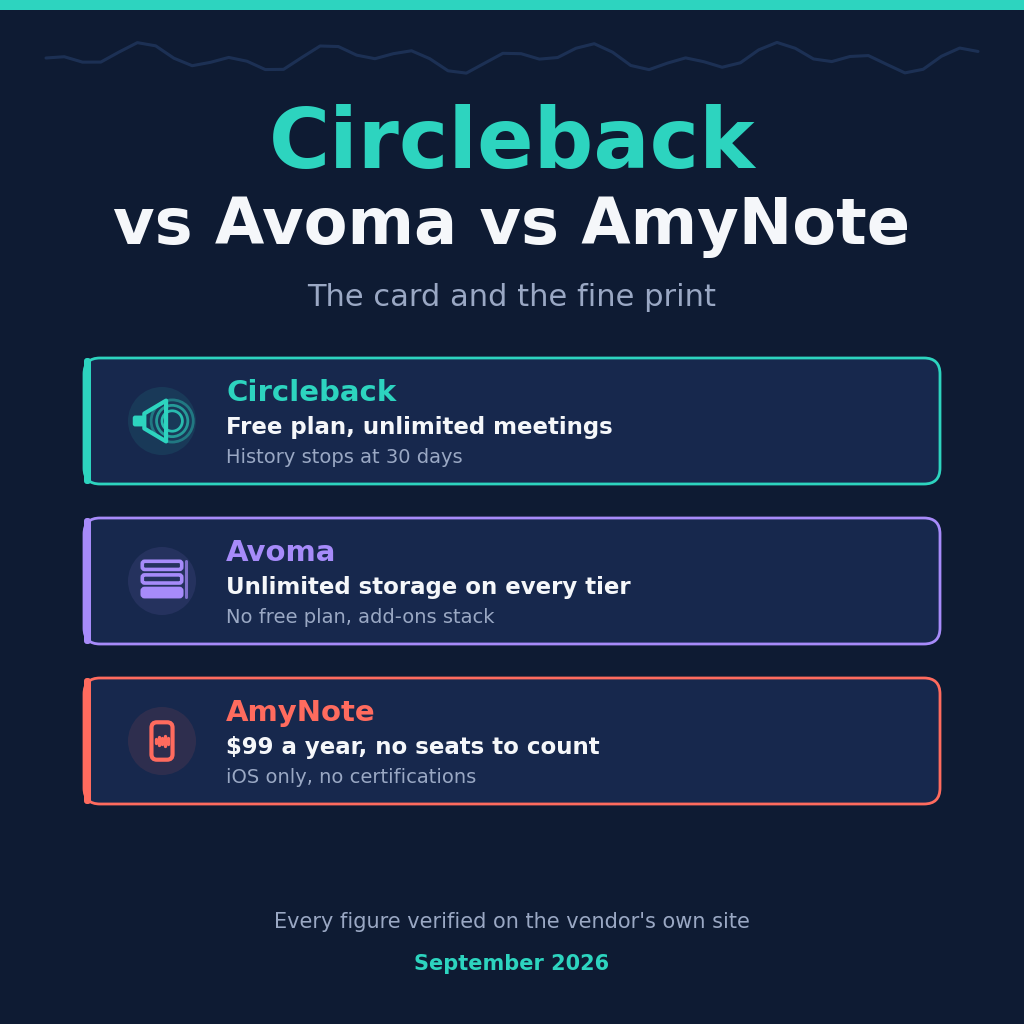
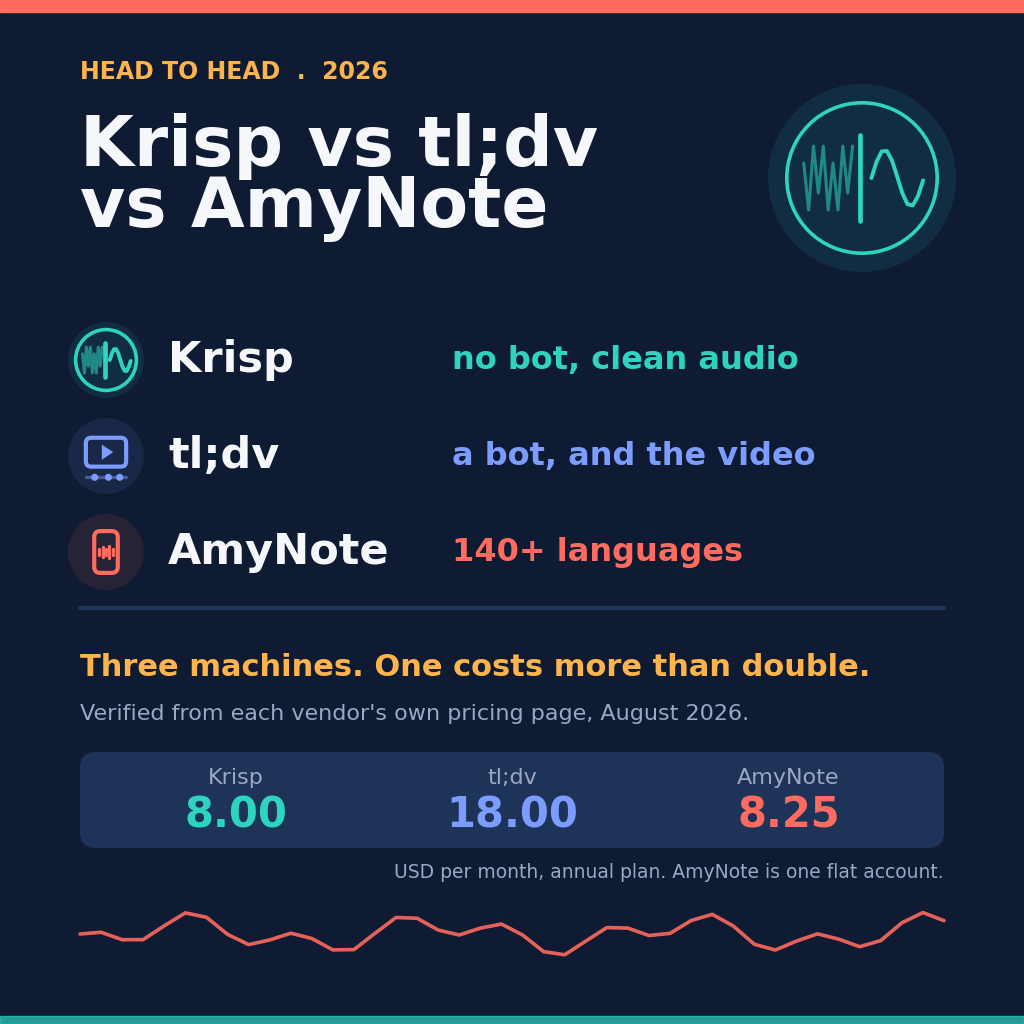
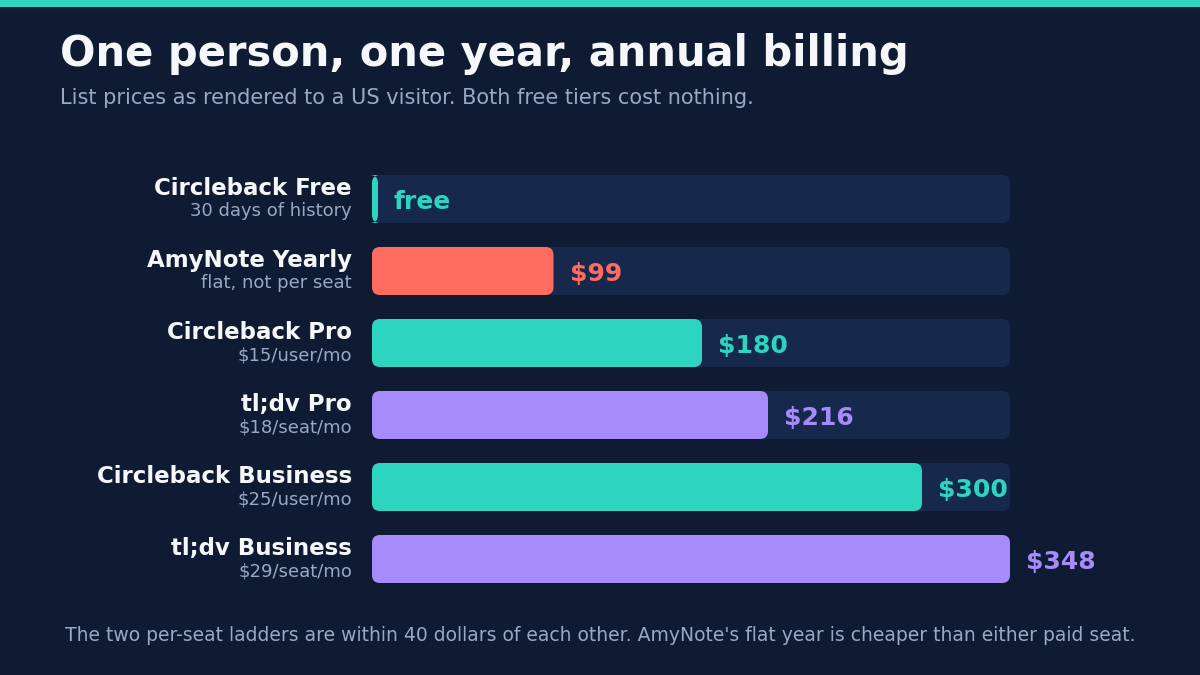
Strengths. The free plan is real and generous: unlimited meetings and unlimited members, the bot-free desktop app, and full API, MCP and CLI access. Paid tiers are 15 dollars per user per month on annual billing for Pro, 25 for Business and 35 for Enterprise, with monthly options at 18 and 29.
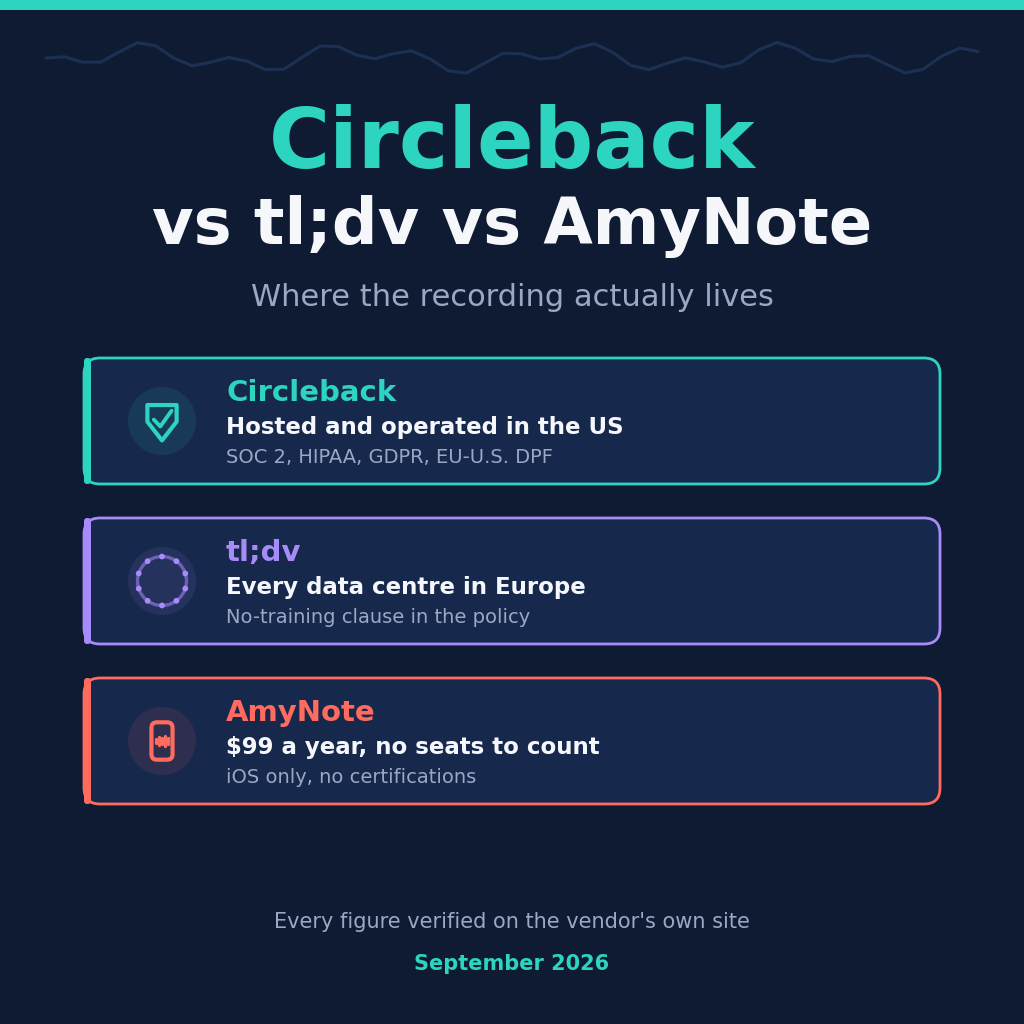
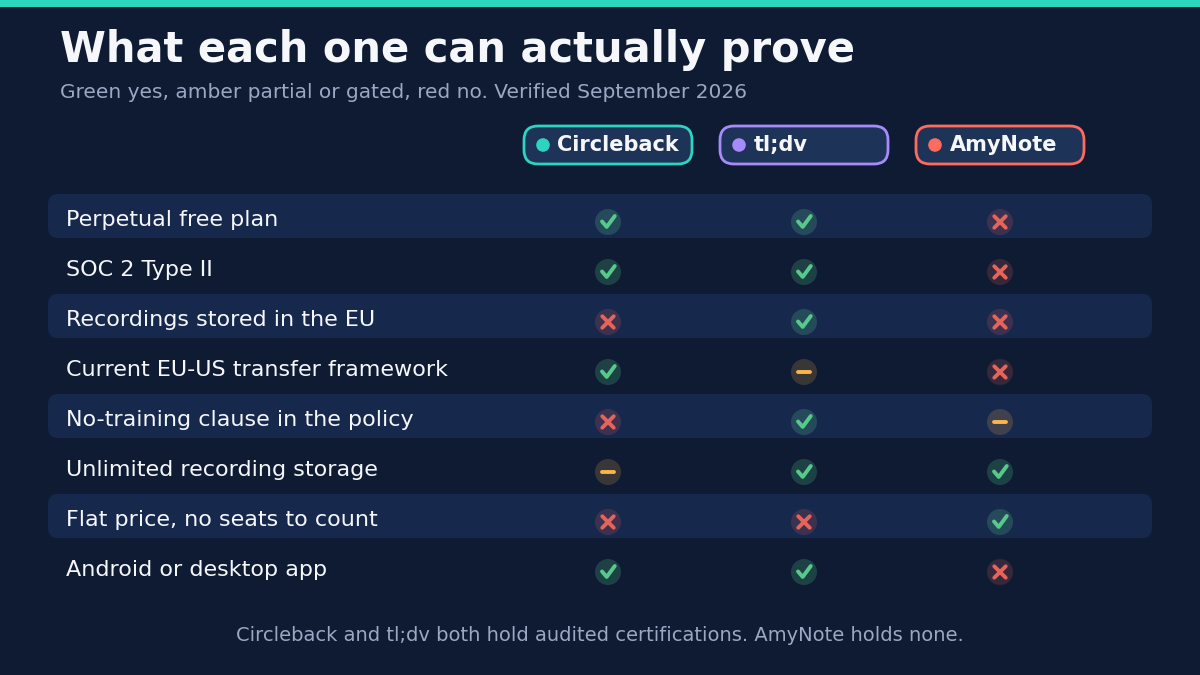
Its trust centre reports SOC 2 Type 2, HIPAA, GDPR and EU-U.S. Data Privacy Framework compliance, with a SOC 2 Type II report covering May to July 2025 available on request. That is a deeper paperwork stack than either rival brings, and the DPF registration matters specifically because it is the current transfer mechanism rather than a retired one.
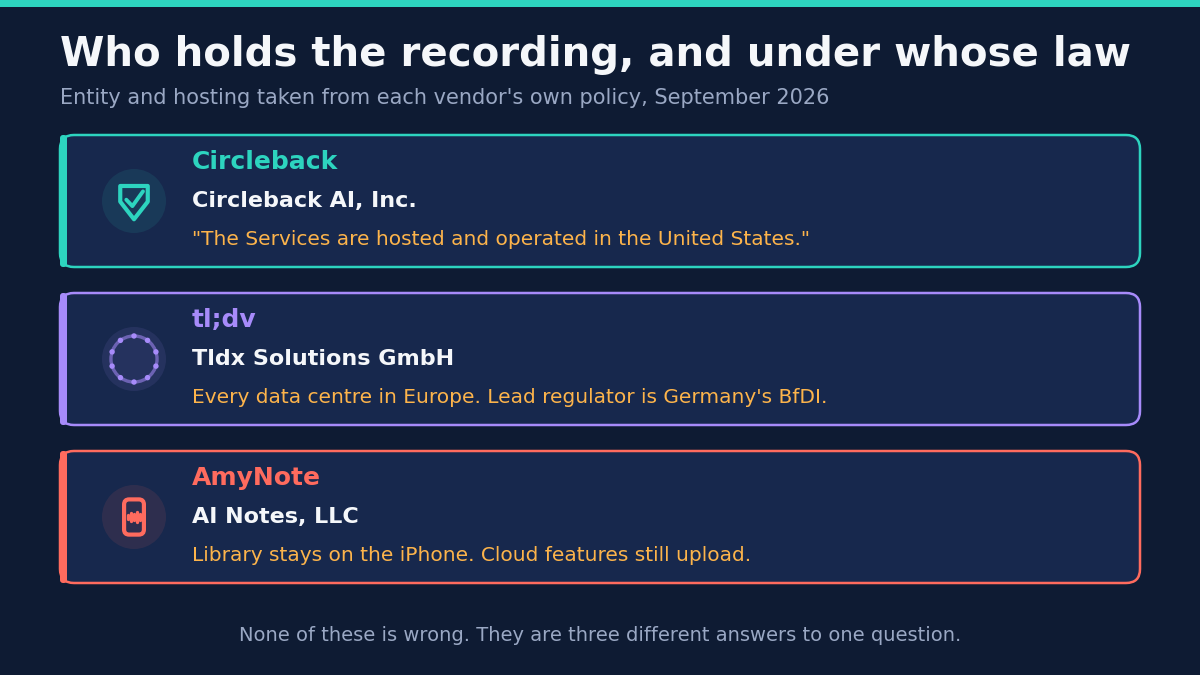
Weaknesses. Circleback AI, Inc. is a US company, and its privacy policy says plainly that the Services are hosted and operated in the United States. If your requirement is residency rather than certification, no certificate answers it. This is the distinction that trips up procurement most often: SOC 2 describes how controls are operated, not where the bytes sit.
Storage is rationed by tier: 30 days of history on Free, one year on Pro, two on Business, and unlimited only on Enterprise. The cheapest plan is therefore the one most likely to have lost the meeting you eventually need, which is a real constraint on using Free as anything more than an evaluation.
And its most quoted line has a placement problem. “No. We don’t train AI models on customer data.” is unambiguous, but it lives in the home page FAQ. The word “train” appears zero times in the 3,296 word privacy policy. It is a published commitment, not a contract term — not nothing, since a public representation carries reputational weight, but not the sentence a reviewer can point to in an agreement. If it matters to you, ask for it in writing; the answer to that request tells you more than the FAQ does.
tl;dv: Strengths and Weaknesses
Strengths. tl;dv answers the jurisdiction question head on. Tldx Solutions GmbH is a German company, its lead supervisory authority is Germany’s federal data protection commissioner, and it states that all of its data centres are located in Europe, across Google Cloud, AWS and Hetzner. You can also choose whether your AI processing runs in Europe or the US. It reports SOC 2 Type II and GDPR compliance and advertises EU AI Act compliance.
Its no-training language is the strongest of the three, and it is in the right document. The privacy policy carries a dedicated section titled AI Model Training stating that tl;dv does not use Customer Content — including meeting recordings, transcripts, notes and files — to train, fine-tune or improve foundation models or large language models, and it extends that undertaking to its third-party AI providers. That last clause is the one most vendors leave out, and it is the one that closes the loop.
The free plan is the most generous here: unlimited video recordings, unlimited transcription in 30 plus languages, unlimited recording storage on every tier, and both iOS and Android apps. Pro is 18 dollars a seat annually and 29 monthly; Business is 29 and 39.
Weaknesses. It sends a bot to web meetings, and there is no bot-free desktop option, so every participant sees that a recorder joined. Every plan caps a single recording at three hours, Enterprise included, which is a hard stop for all-day workshops and depositions. Free retention is three months, and free usage is metered hard: AI notes on 10 meetings, five Ask AI queries, five uploads.
One detail is worth knowing before you cite the security page in a review. Its badge strip still names the EU US Privacy Shield, a transfer framework struck down in 2020 and replaced in 2023. The page underneath it is genuinely strong; the badge is stale. It is a maintenance failure rather than a substantive one, but a reviewer who spots it first will discount everything below it.
AmyNote: Strengths and Weaknesses
Strengths. AmyNote charges a flat account price rather than a per-seat one: 12.99 dollars a week, 19.99 a month, or 99 a year after a three day trial. It transcribes 140 plus languages and translates into 100 plus, with tuning for East Asian and Arabic. Recording, playback and export work with no network at all, which is the practical difference in a basement conference room or on a plane. Transcription runs on OpenAI and analysis on Anthropic’s Claude, and AmyNote states that it does not use your data to train AI models.
Weaknesses, and they are real. AmyNote is iOS only. No Android, no desktop, no web app, which rules it out for most teams before any other consideration applies. There are no CRM integrations, no video recording and no team features.
It also publishes no certifications at all: no SOC 2, no ISO, no HIPAA, no GDPR page, while both competitors hold audited ones. To its credit, its own security page is candid about the rest. It states that local-first does not mean local-only, that processing copies may be retained on its cloud infrastructure so requests can be completed and recovered, and it explicitly declines to call TLS transport encryption end-to-end encryption. That is more precision than most vendors volunteer, and it is the reason the comparison above can be made honestly at all.
Side by Side
| Circleback | tl;dv | AmyNote | |
|---|---|---|---|
| Entity and hosting | Circleback AI, Inc., United States | Tldx Solutions GmbH, Germany, EU data centres | AI Notes, LLC, library on the device |
| Entry price per year | 0, or 180 for Pro | 0, or 216 for Pro | 99 flat |
| Free plan limits | Unlimited meetings, 30 days of history | Unlimited storage, 3 month retention, 10 AI-noted meetings | No free plan, 3 day trial |
| Certifications | SOC 2 Type 2, HIPAA, GDPR, EU-U.S. DPF | SOC 2 Type II, GDPR, EU AI Act | None published |
| No-training commitment | Home page FAQ only | In the privacy policy | On the security page |
| Platforms | Web, desktop, bot-free | Web with a bot, iOS and Android | iOS only |
Which Question Are You Actually Asking
The table above is only useful once you know which row is the one that can disqualify a tool for you, and in practice there are three versions of that.
“Can you show me an audit?” This is the procurement question, and Circleback answers it best: four compliance regimes, a named report period, and a free tier you can run a real pilot on before anyone signs anything. tl;dv is close behind and stronger on the no-training clause specifically.
“Does this leave Europe?” Only tl;dv can say no. A US-hosted service with a DPF registration is answering a different question — it is describing a lawful transfer mechanism, not the absence of a transfer. If your policy is written in terms of residency, the certificate does not substitute for the data centre.
“Who else is on this recording?” This one gets asked less often and matters more than its billing weight suggests. Circleback and AmyNote can both capture without putting a visible bot in the meeting; tl;dv cannot. In client work, sensitive interviews and anything happening in a physical room, that is frequently the deciding row rather than price.
The Bottom Line
These are three answers to the same question, and the right one depends on which version of it your organisation is actually asking. If the question is “can you show me an audit”, Circleback wins outright and gives you a free plan to test on first. If the question is “does this leave Europe”, tl;dv is the only one of the three that can say no, and it backs that with a policy clause rather than a marketing line.
If the question is smaller, which for a lot of people it is, then neither certification nor residency matters much to one person recording client calls on a phone. That is the case AmyNote makes at amynote.app: a flat 99 dollars a year, no seats, a library that lives on your device, and a security page that tells you exactly where the exceptions are. It is the weakest of the three on paperwork, and it says so itself. Check the platform row before anything else — iOS only is a real constraint, and it is the one that ends the conversation for most teams.
Originally published as an X Article by @AmyNoteApp.