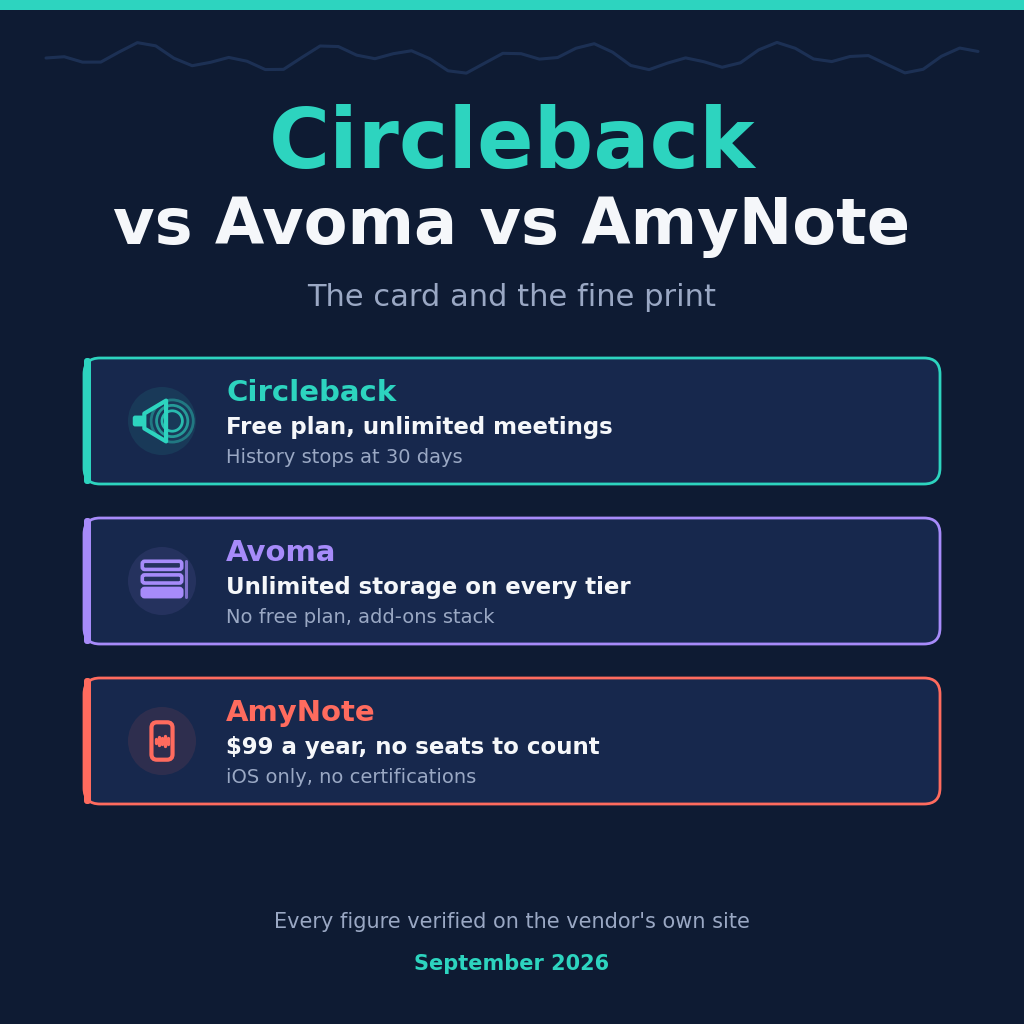
Every meeting tool sells itself on one number or one sentence. Circleback leads with a free plan and a flat refusal to train AI on your data. Avoma leads with a 19 dollar seat. AmyNote leads with local-first storage. All three claims are true, and all three are also qualified somewhere else on the same website, usually one page deeper, and the qualification is what decides whether the tool actually fits you.
This comparison reads that second page. Every price and quote below was checked on the vendor’s own site in September 2026.
Quick Verdict
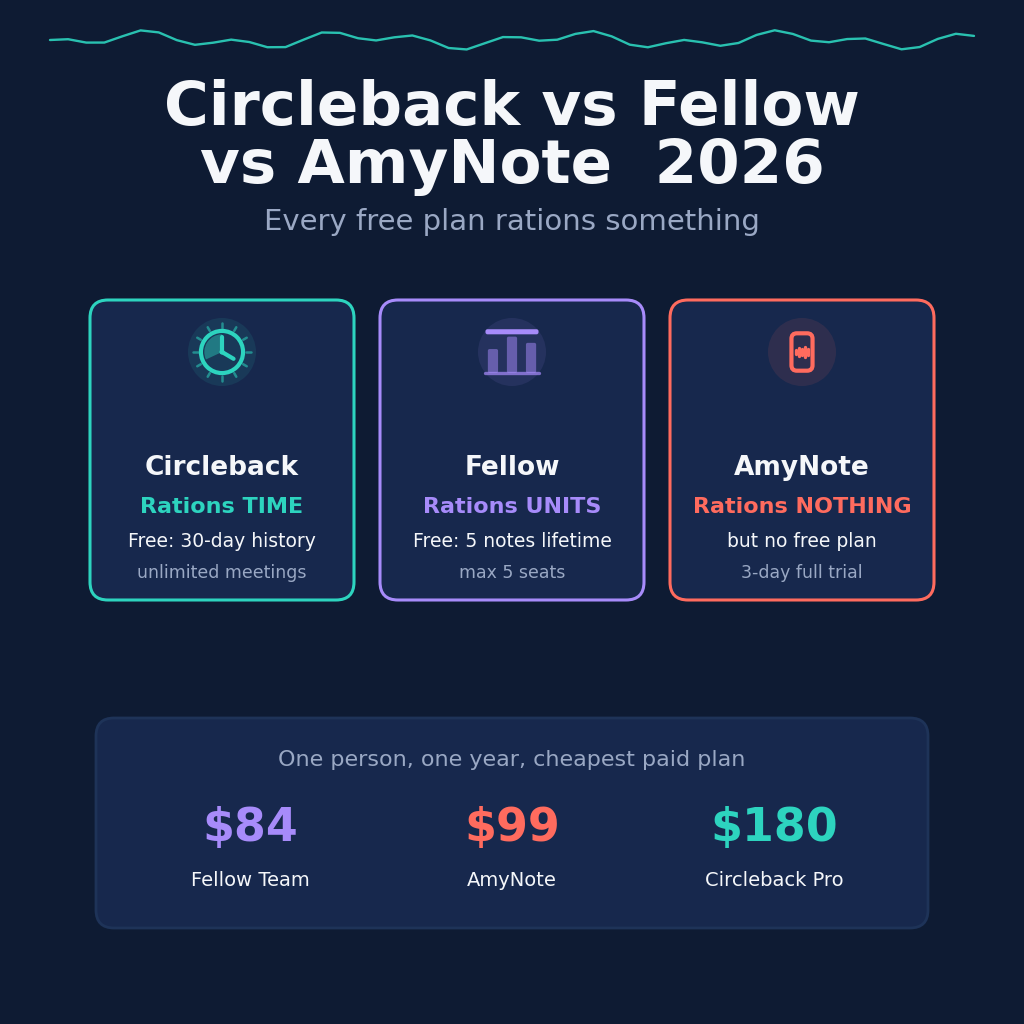
Choose Circleback if you want to evaluate a bot-free note-taker without paying first. It is the only one of the three with a perpetual free plan, carrying unlimited meetings and unlimited members.
Choose Avoma if you are running a revenue team and the meeting notes are raw material for coaching and forecasting.
Choose AmyNote if you are one person on an iPhone who wants recordings that stay on the device, and you would rather pay a flat 99 dollars a year than count seats.
What We Compared
Circleback is an automatic note-taker that writes and assigns action items, then pushes them into other tools. Avoma is a revenue intelligence platform that begins with a recording. AmyNote is an iOS app for capturing conversations in the room.
For each one we read the pricing card, the plan comparison table underneath it, the privacy policy and the security or trust page. Where those sources disagreed, we noted it rather than picking the flattering one.
That method matters, because the disagreements are not random. In every case the headline lives where a buyer will see it in five seconds and the qualification lives where a buyer will see it only if they are already looking. That is ordinary marketing, not misconduct. It does mean the tool you think you are buying and the tool you are buying are different documents.
Circleback: Strengths and Weaknesses
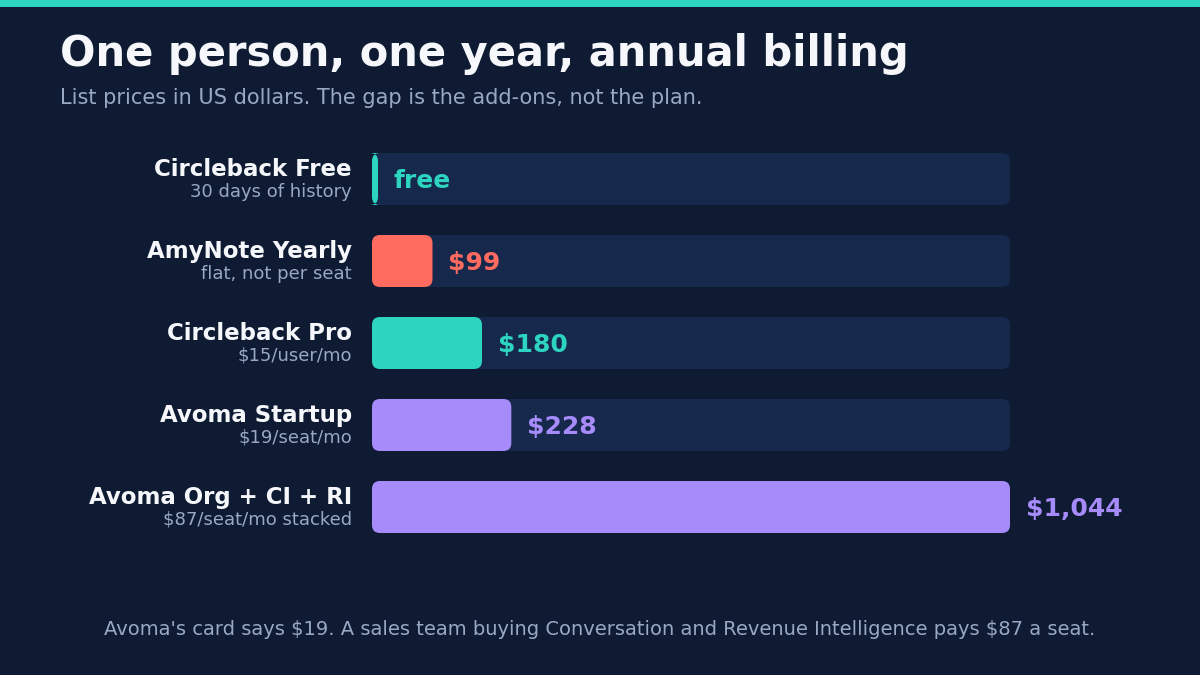
Strengths. The free plan is genuinely free and genuinely useful: unlimited meetings and unlimited members, speaker-labeled transcripts, online and in-person capture, the bot-free desktop app, and API, MCP and CLI access. Paid tiers run 15 dollars per user per month on annual billing for Pro, 25 for Business and 35 for Enterprise, with monthly options at 18 and 29.
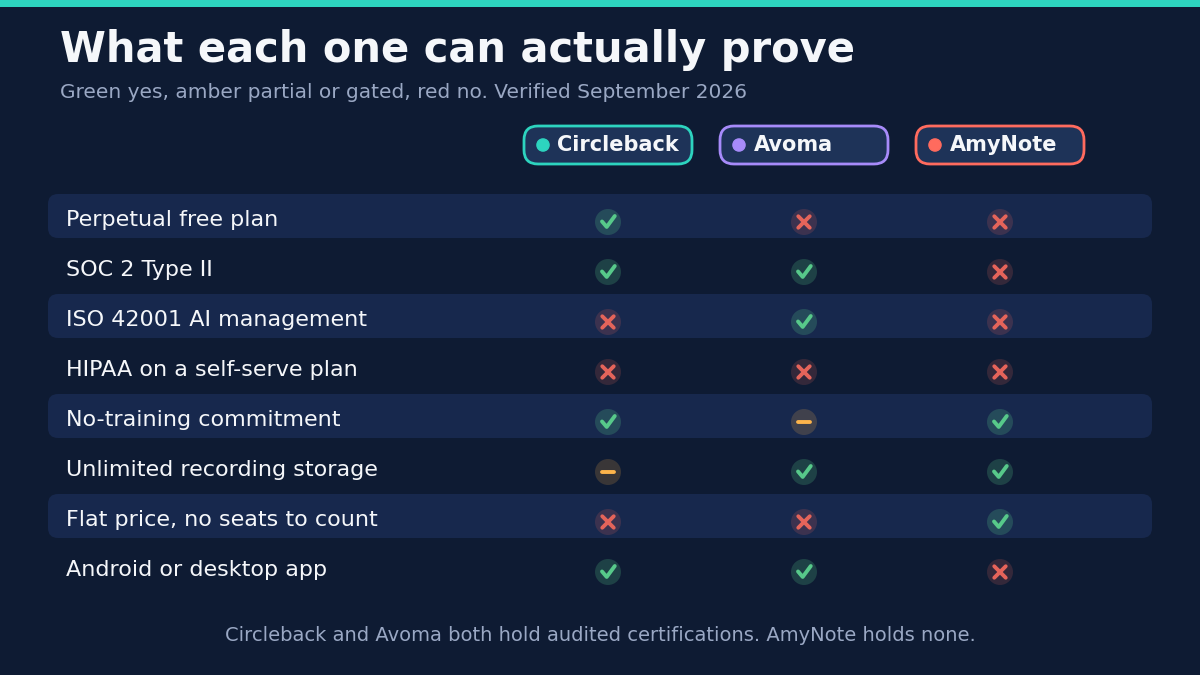
Its trust center is stronger than its marketing suggests. Circleback reports SOC 2 Type 2, HIPAA, GDPR and EU-U.S. Data Privacy Framework compliance, with an audit report available on request.
Weaknesses. The free plan keeps only 30 days of meeting and recording history. Storage extends to one year on Pro and two on Business, and only Enterprise is unlimited, so the cheapest plan is the one most likely to lose the meeting you need.
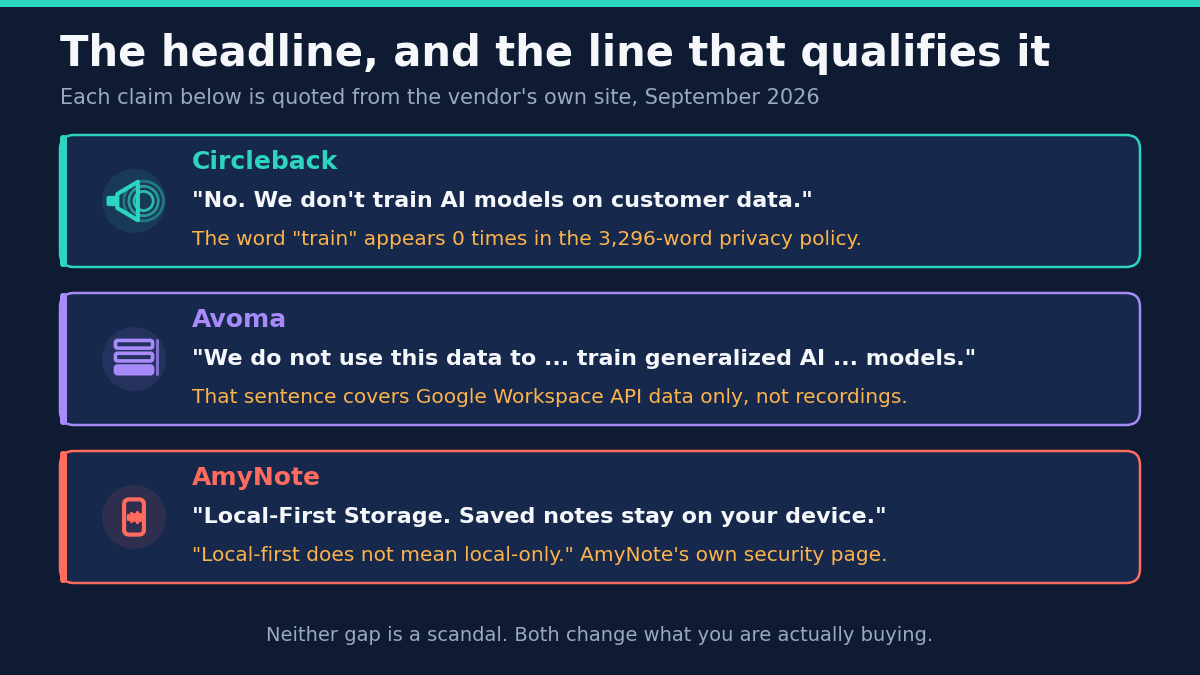
And the famous promise has a placement problem. “No. We don’t train AI models on customer data.” is unambiguous, but it lives in the home page FAQ. The word “train” appears zero times in the 3,296 word privacy policy. It is a published commitment, not a contract term.
That distinction is worth being precise about, because it is easy to overstate in both directions. A published FAQ answer is not nothing — it is a public representation a company can be held to reputationally, and Circleback states it more plainly than most. It is simply not the document your legal team will be handed when they ask what the vendor is contractually bound to do. If that gap matters to your procurement process, ask for it in the agreement; the answer to that request tells you more than the FAQ does.
Avoma: Strengths and Weaknesses
Strengths. Avoma does something neither rival does: unlimited recording storage on every tier, including the 19 dollar Startup plan, alongside unlimited transcription minutes. It records with or without a bot and keeps viewers and collaborators free so you pay only for people who record. The 14 day trial is an unrestricted Organization plan with every add-on on, no credit card.
Its compliance sheet is the deepest here. Avoma holds SOC 2 Type II and ISO/IEC 42001:2023, the international standard for AI management systems, which no other tool we track has earned.
Weaknesses. There is no free plan. More importantly, the 19 dollar headline is rarely the bill. Conversation Intelligence and Revenue Intelligence cost 29 dollars per seat each on top of the plan, so a sales org on Organization with both pays 87 dollars per seat per month, or 1,044 dollars a year. Translation is gated to Organization. HIPAA, SSO, SCIM and signed DPAs all require Enterprise, which has a 10 seat minimum.
Its no-training language is narrower than it reads. The privacy policy says Avoma does not use data to “develop, improve, or train generalized AI or machine learning models”, but that sentence is scoped to data obtained through Google Workspace APIs. It is the disclosure Google requires, not a blanket promise about your recordings.
None of that makes Avoma the weakest option here. On the two questions a compliance reviewer actually asks — who audited you, and against what standard — Avoma answers better than either competitor. The catch is that its strongest features and its strongest guarantees sit on different tiers than its advertised price.
AmyNote: Strengths and Weaknesses
Strengths. AmyNote charges a flat account price rather than a per-seat one: 12.99 dollars a week, 19.99 a month, or 99 a year, after a 3 day trial. It transcribes 140 plus languages and translates into 100 plus, with tuning for East Asian and Arabic. Speaker identification persists across meetings, so naming someone once carries forward. Recording, playback and export all work with no network at all. Transcription runs on OpenAI and analysis on Anthropic’s Claude Opus, and AmyNote states plainly that it does not use your data to train AI models.
Weaknesses, and they are real. AmyNote is iOS only. There is no Android app, no desktop app and no web app, which rules it out for most teams. It has no CRM integrations, no video recording and no team or enterprise features.
It also publishes no certifications at all: no SOC 2, no ISO, no HIPAA and no GDPR page, while both competitors hold audited ones. That is the clearest point against it here. To its credit, AmyNote’s own security page is unusually candid about the rest: it states that “local-first does not mean local-only”, that processing copies may be retained on its cloud infrastructure so requests can be completed and recovered, and it explicitly declines to call TLS transport encryption end-to-end encryption.
Candour is not a substitute for an audit, and it should not be read as one. If your buyer needs a SOC 2 report attached to a security questionnaire, AmyNote does not have one to send and the evaluation ends there. What the candour does tell you is that the marketing page and the security page describe the same product, which is not universally true in this category.
Side by Side
| Circleback | Avoma | AmyNote | |
|---|---|---|---|
| Entry price per year | 0, or 180 for Pro | 228 for Startup | 99 flat |
| Realistic loaded cost | 300 for Business | 1,044 with both intelligence add-ons | 99 |
| Recording history | 30 days free, unlimited only on Enterprise | Unlimited on every tier | Unlimited on your device |
| Languages | 100 plus | 70 plus, translation gated to Organization | 140 plus, translation into 100 plus included |
| Audited certifications | SOC 2 Type 2, HIPAA, GDPR, EU-U.S. DPF | SOC 2 Type II, ISO 42001 | None |
| No-training commitment | Flat yes, in its FAQ | Google Workspace data only | Flat yes, on its security page |
| Platforms | Desktop, iOS, Android | Desktop, iOS, Android | iOS only |
Which One Fits You
A revenue team of ten or more. Avoma, and price it with the add-ons included from the start. Unlimited storage on every tier removes the one variable that quietly breaks note-taking rollouts, and ISO 42001 is the answer to an AI governance question your security reviewer is going to ask within the year.
A team that wants to try before it pays. Circleback. Unlimited meetings and unlimited members on a perpetual free plan is the most generous evaluation path here by a wide margin. Watch the 30 day history window during the trial, because that limit is the one most likely to bite after you have already standardised on it.
An individual on an iPhone who meets people in rooms. AmyNote. The seat math never applies, translation and cross-session speaker memory are in the base price rather than a tier, and the recordings live on the device. The cost of that fit is the entire platform list and the empty certifications row.
The Bottom Line
None of these gaps is a scandal, and both competitors are stronger on compliance than their marketing bothers to say.
The lesson is that the pricing card is an advertisement and the comparison table is the product. Read the second one. If you need seats, CRM writeback and a compliance package, Circleback and Avoma are the serious options, and Avoma is the one to beat on storage and AI governance.
If you are a single professional who mostly records people in a room, the seat math never applies to you, and 99 dollars a year for unlimited recordings in 140 plus languages is a different kind of offer. AmyNote is at amynote.app, with a 3 day trial and no credit card required. Check the platform list first: iOS only is a real constraint.
Originally published as an X Article by @AmyNoteApp.