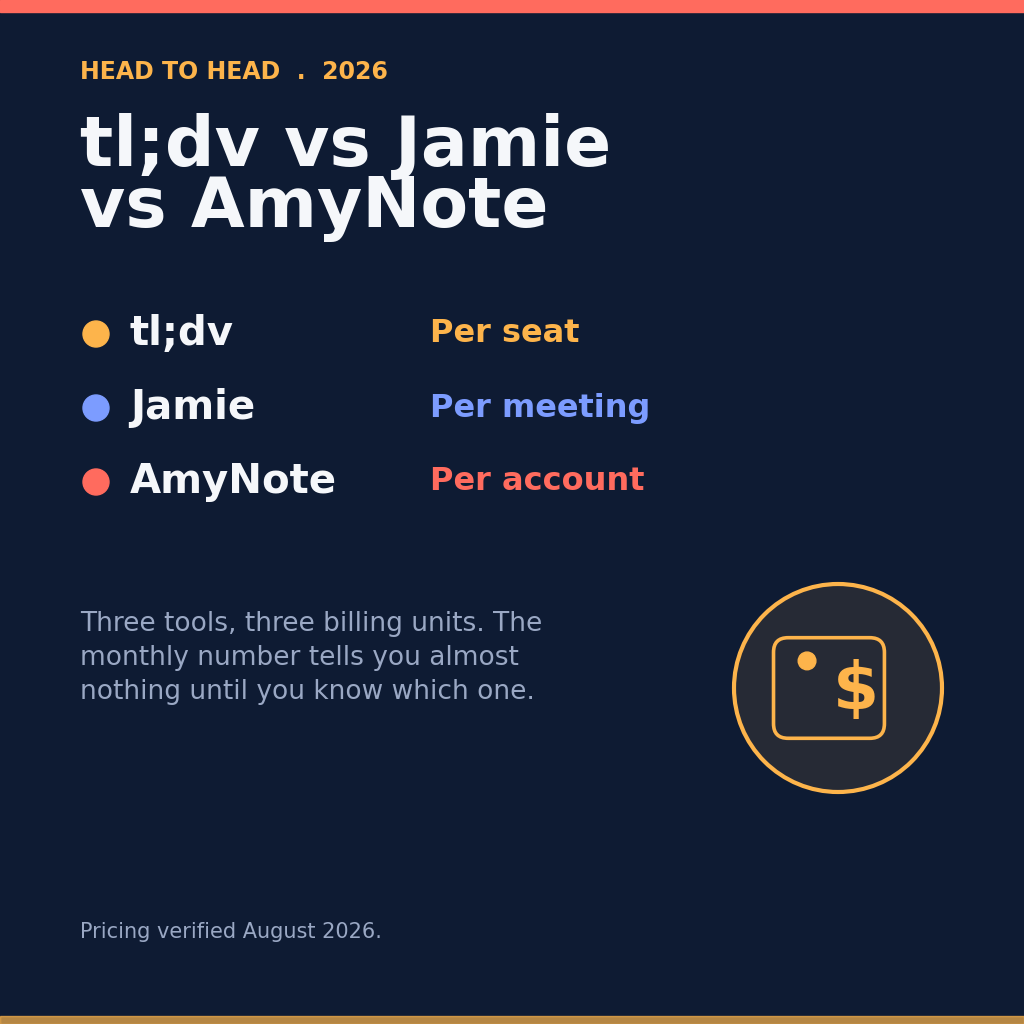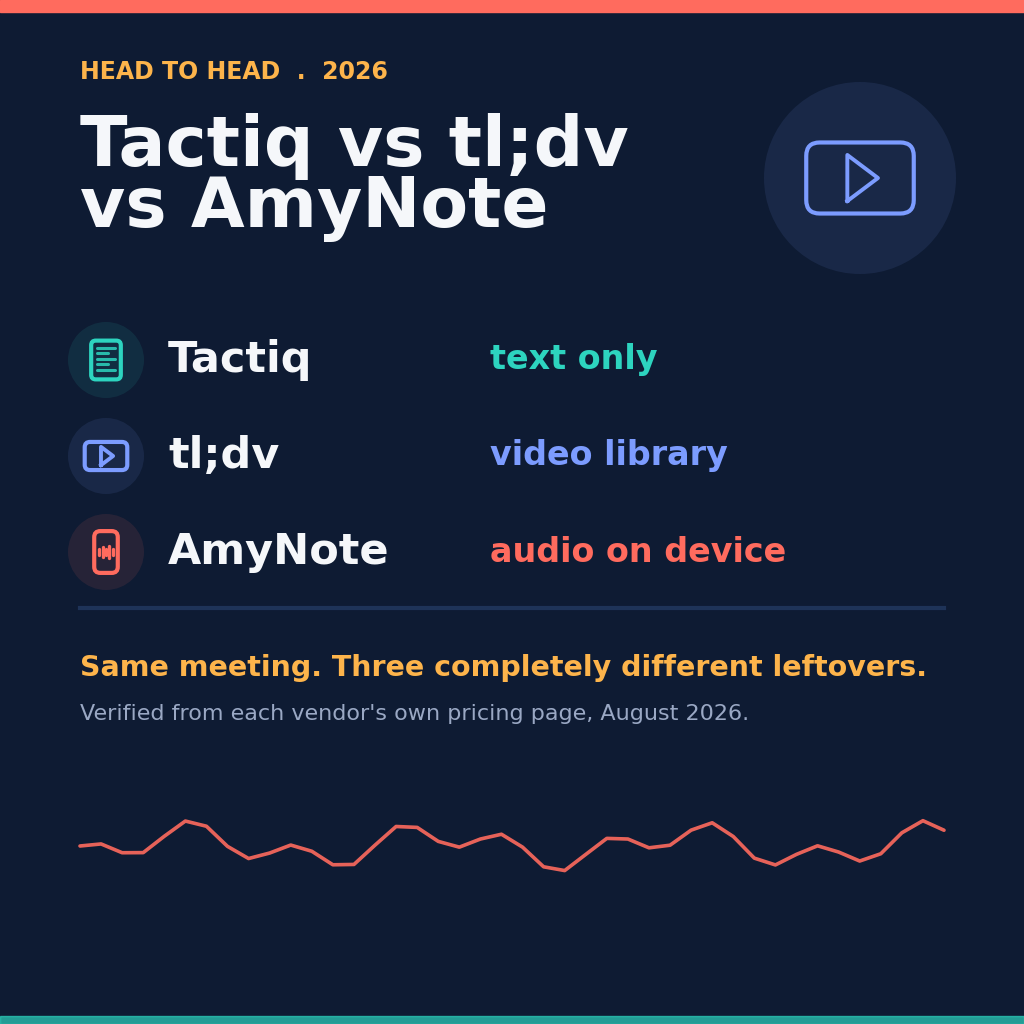
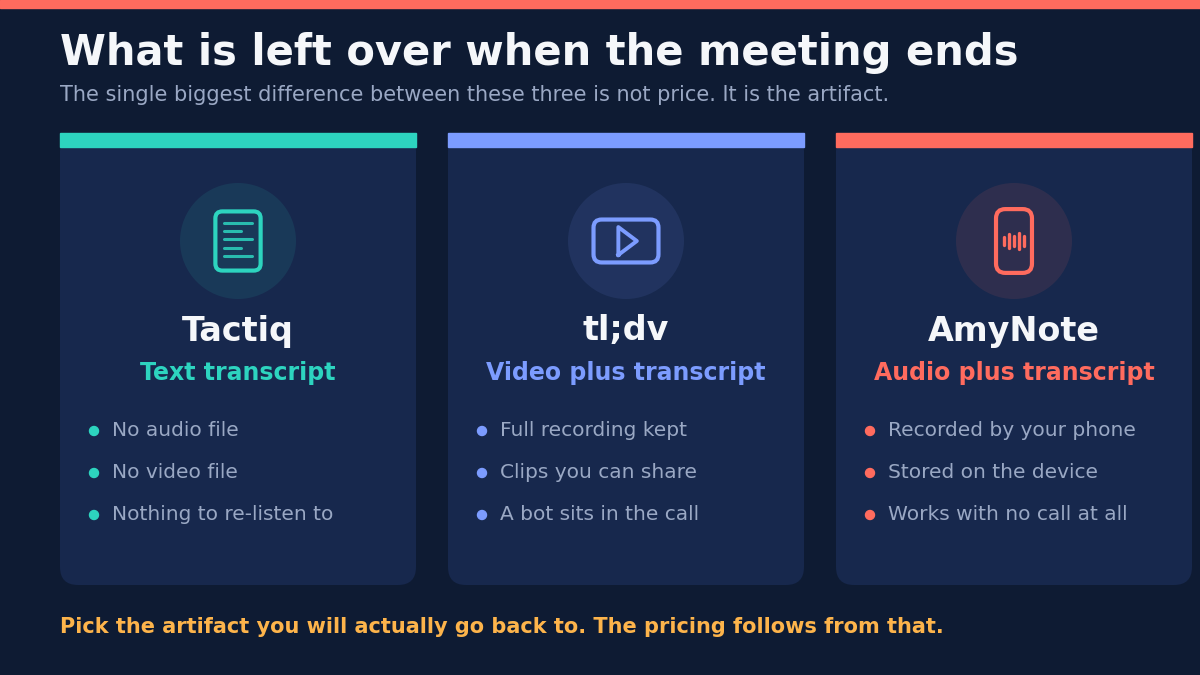
Three people leave the same one hour call. One has a text transcript and nothing else. One has a video file and a clip ready to drop into Slack. One has an audio recording sitting on their phone that never touched a meeting platform at all.
Those are three different products of the same sixty minutes, and the price difference between them tells you almost nothing about which one you should buy. Decide which artifact you will actually go back to, and the pricing question mostly answers itself.
All figures below were verified in August 2026 against each vendor’s own pricing page. All three price in US dollars, and where annual and monthly rates differ, both are given.
The Quick Verdict
Pick Tactiq if your meetings live in a browser and the transcript is all you need. Free forever at low volume, no bot in the room, and nothing to install beyond a Chrome extension.
Pick tl;dv if you need to rewatch the meeting, not just reread it. Unlimited video recording on a free plan is genuinely unusual in this category, and no one else here gives you shareable clips.
Pick AmyNote if the conversation happens away from a screen, or not in English. It records in person from a phone, covers the widest language list here, and charges a flat account price rather than per seat.
What We Compared
Capture method, the artifact you are left with, plan caps, language coverage, and platform availability. Those five decide whether a tool fits at all, and they are the five things vendors are least eager to line up next to each other.
There is deliberately no accuracy score here. Transcription quality in 2026 depends far more on your microphone, your room, and the accents in it than on which of these three engines processes the audio. A single benchmark number would not survive contact with your actual meetings. What can be compared honestly is what each tool will and will not do, and what it charges to do it.
Tactiq: A Browser Tab That Reads the Captions
Tactiq is a Chrome extension that reads the meeting live in Google Meet, Zoom, or Microsoft Teams. No bot joins the participant list, and the transcript is visible only to you unless you choose to tell the room.
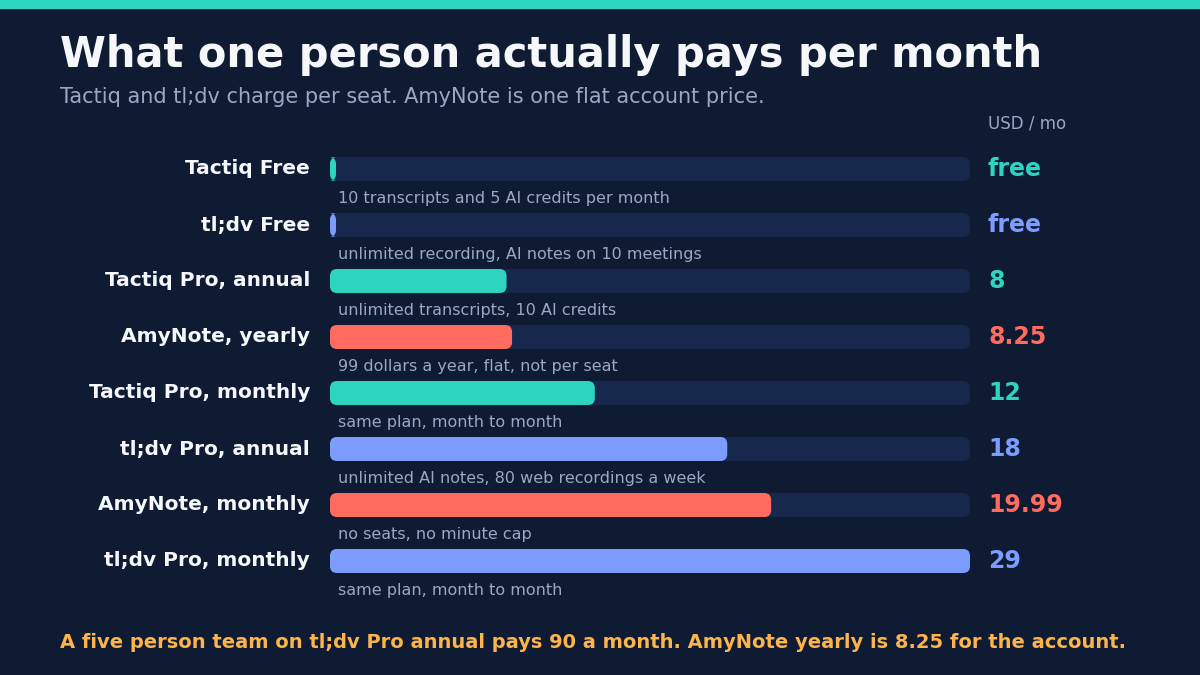
The free plan never expires. No credit card, no time limit, 10 transcripts and 5 AI credits a month. That is a real free tier, not a trial wearing a free tier’s clothes — a distinction worth more than most feature-list entries in this category.
It is the cheapest paid option here. Pro is 8 dollars per user per month billed annually, or 12 month to month, with unlimited transcripts. Team is 16.67 annually for 1 to 20 users with unlimited AI credits. Business is 29.17 for 20 to 200 users and adds SAML SSO and advanced data retention. With over a million Chrome extension installs, it is also the most widely deployed tool in this comparison.
The weaknesses all trace back to a single architectural decision, which is the fair way to read them. These are not oversights. They are the cost of being a browser extension.
It never records anything. Tactiq captures words. There is no audio file and no video file, so there is nothing to re-listen to when the transcript garbles a name, mangles a number, or drops the half-sentence that turns out to matter. If that possibility bothers you, it is disqualifying rather than merely inconvenient.
It needs a browser, and it cannot capture a room. The native Mac app is beta and handles Zoom desktop calls only; Tactiq’s own download page says it cannot yet do Google Meet or Teams. There is no iOS or Android app, and in-person support appears nowhere on the site. The client lunch, the site visit, and the hallway decision are all outside its reach.
AI is rationed separately from transcription. One credit equals one AI action. Hitting the cap on Free or Pro stops summaries and questions until the month resets, while transcription keeps running — so the failure mode is a pile of raw transcripts you cannot summarize.
tl;dv: A Video Library With a Bot Attached
tl;dv sends a bot to your web meetings and keeps the recording. It is the only tool here that treats a meeting as video first and text second, and that single choice explains both its best and worst attributes.
The free plan is the most generous here by a distance. Unlimited video recordings, unlimited transcription in 30 plus languages, unlimited viewers and storage, and mobile apps on iOS and Android. Nothing else in this comparison gives away video at all.
You can rewatch and share. Clips, live highlights, speaker detection, and global transcript search. When someone asks what a customer actually said, you send the 40 seconds instead of a paraphrase — which changes how much weight a meeting note can carry in a decision.
Paid tiers are fair for what they include. Pro is 18 dollars per seat per month annually, or 29 monthly, with unlimited AI notes plus MCP server, API, and webhooks. Business is 29 annually or 39 monthly and adds premium transcript quality and custom vocabulary. Data is hosted in the EU, with GDPR, SOC2, and EU AI Act compliance — the strongest compliance story of the three.
The fine print is where the free plan gets interesting.
A bot joins the call, and everyone sees it. Pro even sells custom bot appearance, which tells you the vendor knows this is a friction point. That is fine for a recurring internal standup or a demo. It is a different matter in a sensitive one to one, a candidate interview, or a first conversation with a client who did not expect a fourth participant.
The free plan has caps the headline does not mention. AI notes on up to 10 meetings, Ask AI limited to 5 queries, data retention up to 3 months, and 40 web recordings a week. Mobile recording capacity is unlimited on every tier, which is a genuinely nice touch. But three month retention means the free plan is a working buffer, not an archive.
30 plus languages is the narrowest list here, multi-language meetings are gated to the Business tier, and every plan caps a single recording at 3 hours.
AmyNote: A Recorder in Your Pocket
AmyNote is a phone app that records the conversation directly. No bot, no extension, no meeting platform in the loop — so an online call, a hybrid room, and a table in a coffee shop all work exactly the same way.
It is the only one here built for in-person conversations. Tactiq needs a browser tab. tl;dv needs a meeting to send a bot to. AmyNote needs a phone on the table. If a meaningful share of your important conversations happen in rooms, that is not a feature comparison, it is a threshold test the other two do not pass.
It covers 140 plus languages and translates into 100 plus, more than double Tactiq’s 60 plus and over four times tl;dv’s 30 plus, with particular attention to East Asian and Arabic languages where this category is weakest.
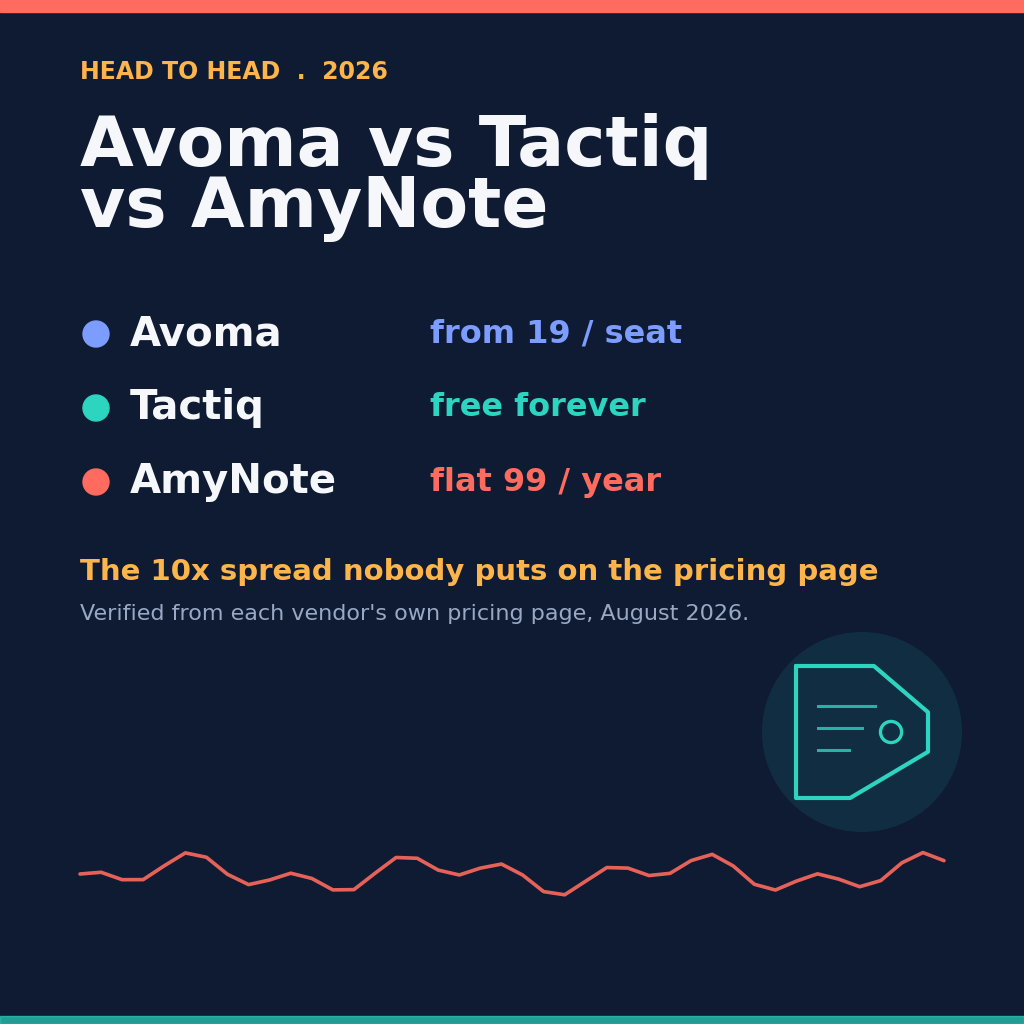
Pricing is flat, not per seat. 12.99 a week, 19.99 a month, or 99 a year — about 8.25 a month — with no minute caps and no AI credit meter. The arithmetic diverges quickly with headcount: five people on tl;dv Pro annual is 90 a month, while AmyNote yearly stays at 8.25 for the account.
The privacy architecture is the strongest claim in the product. Transcription runs through OpenAI’s Speech API and analysis through Anthropic’s Claude models. Both contractually guarantee zero training on user data. Audio is encrypted in transit and not retained after processing, and transcripts are stored locally on the device with end to end encryption.
The limitations are real and worth stating plainly.
It is iOS only. No Android app, no desktop app. If your team is on Android or Windows, both alternatives above are simply better choices.
There is no free tier, only a 3 day trial with no limits and no credit card. Tactiq and tl;dv both let you stay free indefinitely, and for a light user that is a decisive advantage.
There is no video, no CRM integration, no team or admin features, and no shareable clip. For a sales organization running on pipeline reporting, tl;dv wins outright and it is not close.
Side by Side
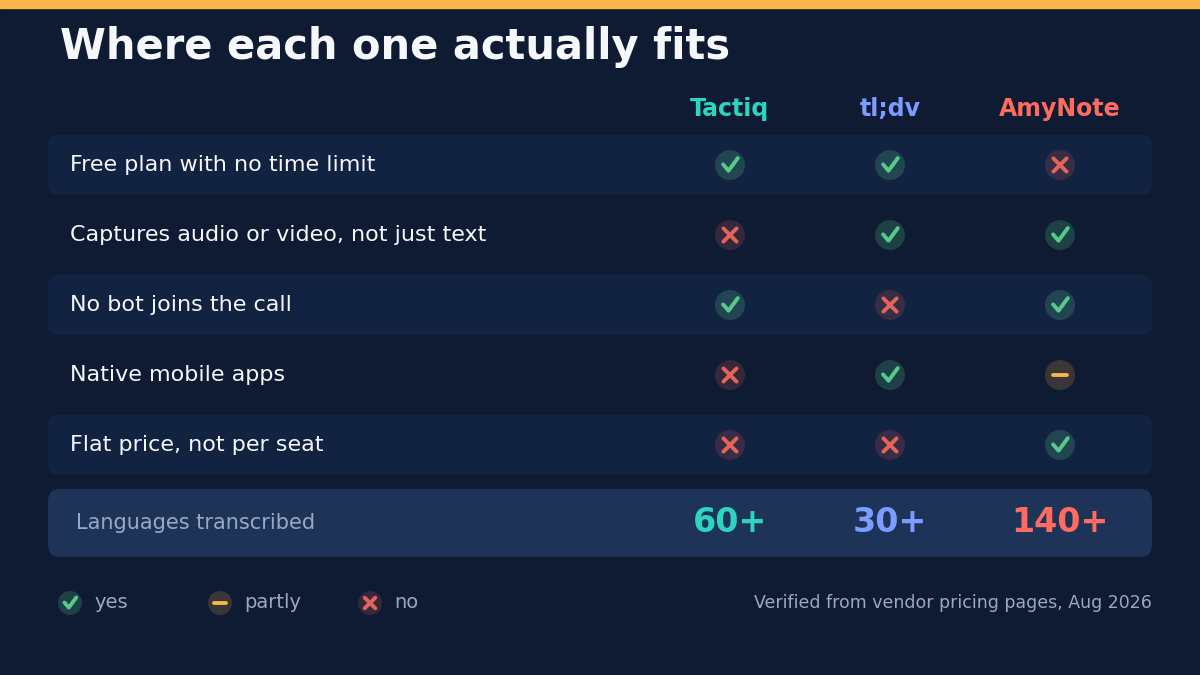
- Free plan that never expires. Tactiq yes, tl;dv yes, AmyNote no.
- Captures audio or video, not just text. Tactiq no, tl;dv yes, AmyNote yes.
- No bot joins the call. Tactiq yes, tl;dv no, AmyNote yes.
- In-person meetings. Tactiq no, tl;dv through its mobile app, AmyNote yes.
- Native mobile apps. Tactiq none, tl;dv iOS and Android, AmyNote iOS only.
- Languages transcribed. tl;dv 30 plus, Tactiq 60 plus, AmyNote 140 plus.
- Entry paid price. Tactiq 8 a seat annually, tl;dv 18 a seat annually, AmyNote about 8.25 flat for the whole account.
- CRM and team reporting. Only tl;dv.
Three Teams, Three Answers
Feature grids read more clearly as scenarios, so here are three, with the arithmetic done from the published prices above.
A support team that lives in Google Meet all day. Tactiq Free covers 10 transcripts a month at no cost, and Pro at 8 a user removes the cap. Nothing joins the call, the transcript stays private by default, and there is no procurement conversation to have. If the meetings never leave the browser and nobody ever needs to re-listen, paying more buys capability this team will not use.
A five person sales team that reviews calls. tl;dv Pro annual is 18 a seat, or 90 a month for five, and it is the only option here that produces a clip you can paste into a deal thread. Tactiq Team would cost about 83 a month for the same five people and leave them with text they cannot replay. That is not a price comparison so much as a different purchase.
A two person consultancy meeting clients in person, in two languages. Neither Tactiq nor tl;dv advertises true in-person capture from a browser, so the deciding constraint settles before price enters the conversation. AmyNote is about 8.25 a month for the account rather than per person, and covers 140 plus languages. The catch is iOS: if either consultant carries an Android phone, this scenario needs a different answer.
The Bottom Line
These three are not competing for the same job, which is why the price gap between them says so little on its own.
Tactiq is right when meetings are browser-shaped, the transcript is the deliverable, and the budget is zero. tl;dv is right when the recording has value after the meeting ends and a visible bot is an acceptable trade for that. AmyNote is right when the conversation refuses to stay inside a browser — rooms, site visits, interviews, and multilingual conversations, which are exactly the cases the other two handle badly or not at all.
Pick the artifact first. The pricing follows from that, and it follows quickly. AmyNote is at amynote.app with a 3 day free trial, no credit card required.
Originally published as an X Article by @AmyNoteApp.