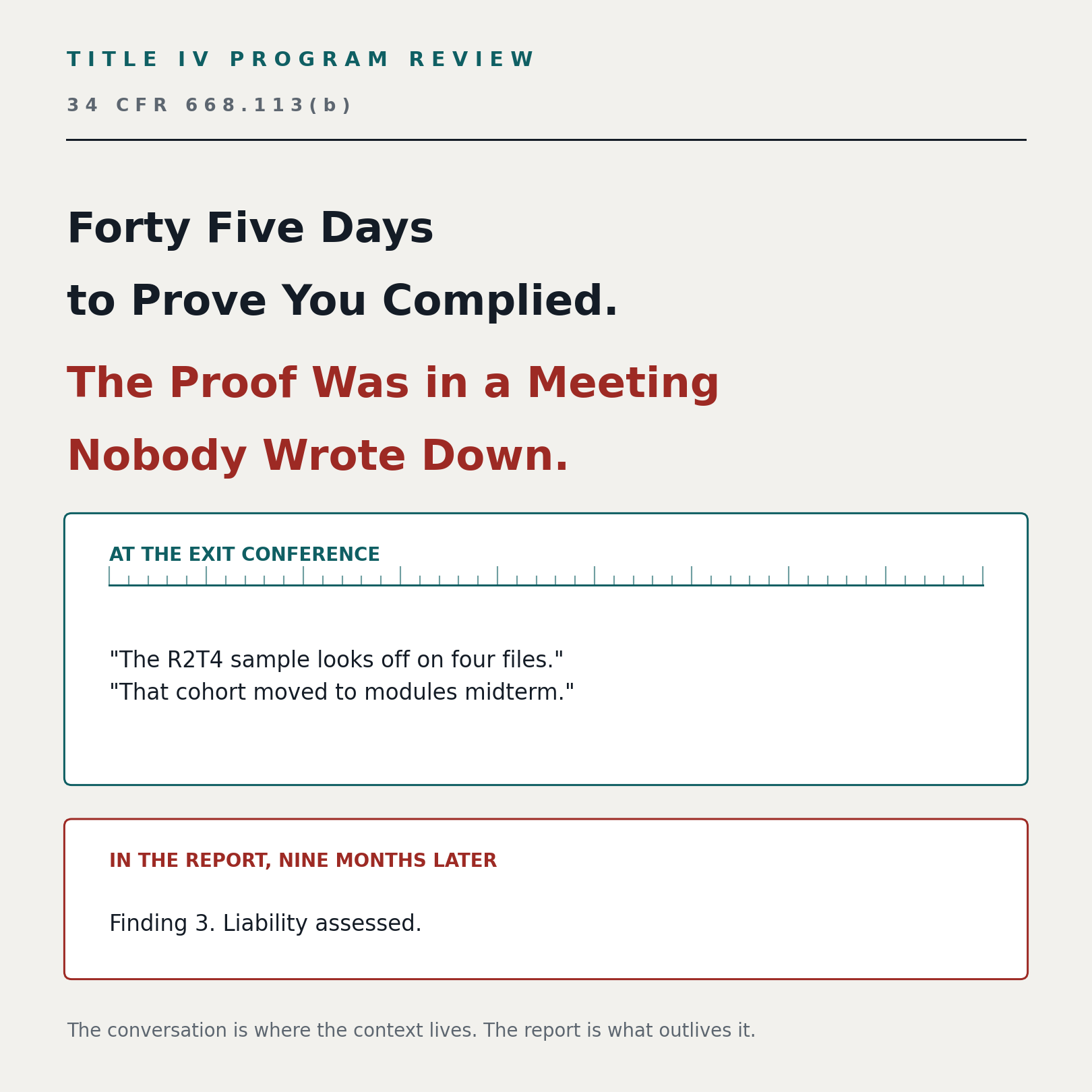
The reviewer flags four files. Your financial aid director explains, out loud, in a conference room, that the cohort moved to a module structure midterm and that the withdrawal date the reviewer is working from is not the date the regulation points to. The reviewer writes something down. Everyone shakes hands.
Nine months later the program review report arrives. Finding 3 is intact. The word modules does not appear anywhere in it.
The Exit Conference Is Not the Record
A program review does not end when the reviewer packs up. It ends with a program review report, then your written response, then a final program review determination. Every one of those steps is written by somebody working from notes.
The question is whose notes. The Department writes from its own review work papers — contemporaneous, structured, and built for exactly this purpose. You write from memory of a conversation that happened three seasons ago, about award years that may be six years old, with staff who may have left in the meantime.
That asymmetry is not anyone’s fault. It is a property of how the process is shaped. A program review is a sequence of steps, and at each step the amount of context that survives gets smaller, while the formality of what remains gets higher.
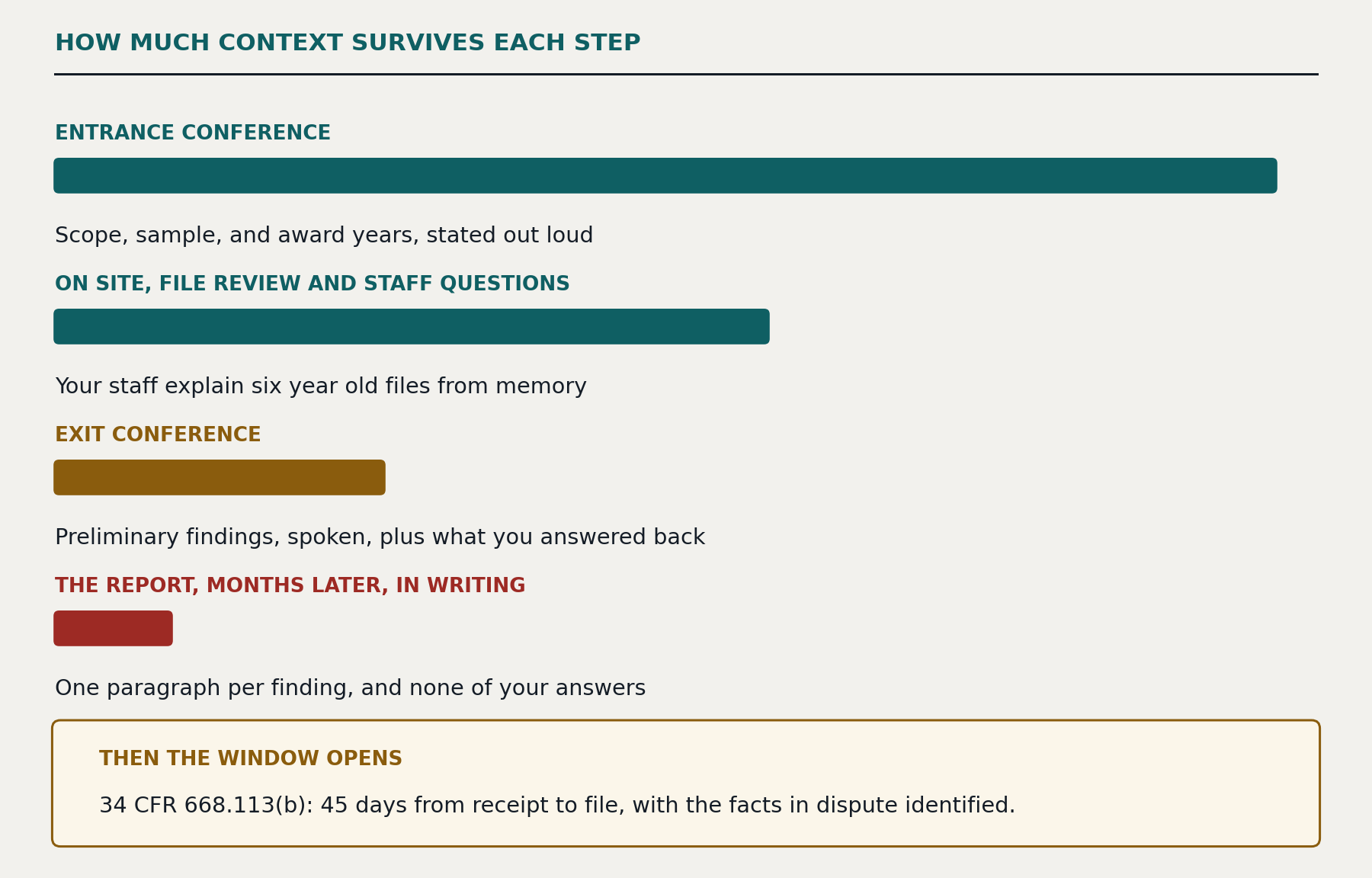
Notice where the explanations live. The entrance conference sets scope out loud. The file review is your staff answering questions about their own decisions, out loud. The exit conference is preliminary findings delivered out loud, plus whatever your team said back. Only the last box — the report — is a document, and it is a document written by the other side.
Forty Five Days, and the Burden Is Yours
Under 34 CFR 668.113(b), an institution has 45 days from the date it receives the final program review determination to file a request for review. Under 668.113(c), that filing has to identify the issues and facts in dispute and state the institution’s position, together with the pertinent facts and reasons supporting it.
Read those two together and the shape of the deadline changes. It is not 45 days to disagree. It is 45 days to name specific facts and support them. Forty five days is plenty of time to write. It is not enough time to reconstruct what was said.
And the burden sits entirely on your side of the table. Under 668.116(d), the institution has to prove that questioned or disallowed expenditures were proper and that it complied with program requirements. The reviewer proves nothing. Under 668.116(b) the hearing is normally decided on written briefs, which means whatever you cannot put on paper, you cannot argue at all.
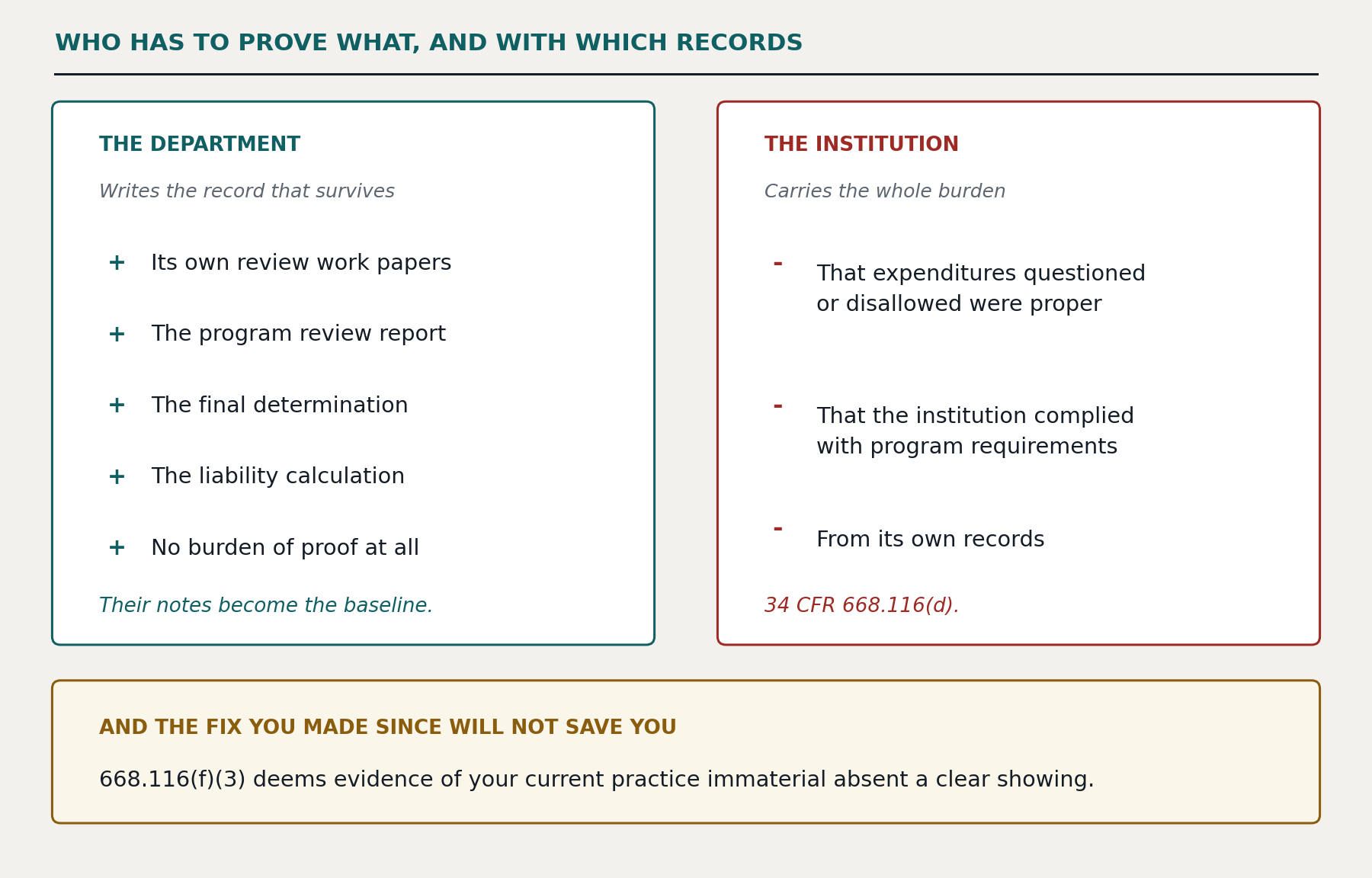
This is why the exit conference matters more than it feels like it does at the time. It is the last moment when the institution’s explanation and the Department’s finding are in the same room. After that, they travel separately, and only one of them is written down.
Why the Usual Habits Do Not Hold Up
Aid offices are not careless. They are working against a process built to outlast their memory, with the habits that work fine for everything else in the job.
- Handwritten exit conference notes. One person writes them, from one seat, while also answering questions and tracking which finding the reviewer is on. What survives is what that person thought mattered at the time — which is not the same as what turns out to matter nine months later.
- A response file that starts too late. Reconstruction begins when the report lands. By then the counselor who coded the withdrawal date may be gone, and her explanation exists only in what she told a reviewer out loud in a room she no longer works in.
- “We already fixed it.” Under 668.116(f)(3), evidence about your current practice is deemed immaterial absent a clear showing of probative value. Remediation is good administration. It is not an answer to the finding.
- Hoping the error gets cured. Under 668.113(d)(2), the Secretary permits cure of an administrative, accounting, or recordkeeping error only when it is not part of a pattern and shows no evidence of fraud. Proving “not a pattern” is an evidentiary claim about your own operations, not a reassurance you can offer.
There is a common thread. Each of these habits assumes the response gets written from what people remember. The regulation assumes it gets written from what the institution can show.
Do Not Record the Reviewer’s Interviews
Start with what not to do, because the obvious move here is a trap.
Do not condition the reviewer’s access to your staff on recording them. 34 CFR 668.24(f)(3)(iii) treats an institution as having failed to provide reasonable access if it permits interviews with personnel only if the institution tape records those interviews. That is a finding you can manufacture by trying to prevent one — and an access finding is a worse position than the R2T4 finding you were trying to answer.
If Department staff are in the room and you want a record of that specific conversation, ask, follow whatever answer you get, and move on. Nothing in this article is a reason to push on that point.
The distinction worth holding onto is simple: the reviewer’s interviews are the Department’s process. Your internal conversations are yours.
Record Your Own Side of the Process
Your own side is fully within your control, and it is where the context actually lives. Three conversations carry most of it.
The internal debrief the hour after the exit conference, while four people still remember what was asked, which files were named, and what your director said back about the module structure. This is the single highest value recording in the entire review, and it is one that nobody outside your institution has any interest in.
The working sessions where someone reconstructs a coding decision — why a census date was set the way it was, how the professional judgment file got documented, what the office understood the module calendar to mean in that award year. These sessions happen anyway. They are just not written down.
The calls where you decide what goes into the response, including the arguments you considered and set aside. When the response is filed and someone later asks why a particular finding was conceded rather than contested, the reasoning exists in a meeting, not in the file.
AmyNote is built for exactly those conversations. Transcription runs on OpenAI’s latest Speech API, which holds up on the vocabulary these sessions actually use: R2T4, Pell LEU, professional judgment, verification tracking groups, ISIR, census date, the 90/10 calculation. Generic transcription turns those into noise; the response you file six months later depends on them being right.
Speaker identification carries across sessions, which matters more than it sounds. Six months on, you need to know which of your three counselors described the module structure, not merely that somebody in the room did. When 668.113(c) asks you to state the pertinent facts, attribution is part of the fact.
Analysis runs on Anthropic’s Claude Opus, and it works across every session in the review at once rather than one recording at a time. Ask what was said about the four flagged files, and when it was said, and you get an answer assembled from the debrief, the working sessions, and the response calls together. That turns the 45 day window into a drafting problem instead of an archaeology problem.
On privacy, the architecture matters here more than usual, because these recordings touch student records and candid internal deliberation about your own compliance posture. Both OpenAI and Anthropic contractually guarantee that user data is never used for model training. Audio is encrypted in transit. Transcripts are stored locally on device with end to end encryption. Read the security note at the top of this article and the current Security page, and run the whole thing past your institution’s IT and privacy review before the first session — not after.
Settle the retention question in writing at the same time. Decide up front whether working recordings are kept alongside the response file or destroyed once the response is filed. Either answer is defensible. Having no answer is the position you do not want to be in.
Getting Started
Record the internal sessions, not the reviewer’s interviews. That is the whole rule.
Start with the debrief after your next entrance or exit conference — not a full review, just the hour afterward when the office is comparing notes. Then keep the working sessions where findings get argued out. Within one review cycle you will have something no aid office normally has: a searchable record of the institution’s own explanations, dated, attributed, and available on day 46.
AmyNote runs on a phone that is already sitting on the conference table, so there is nothing to install on institutional hardware and no bot joining anything. There is a 3 day free trial, no credit card, and details are at amynote.app.
The record you want on day 46 is the one you made on day one.
Originally published as an X Article by @AmyNoteApp.