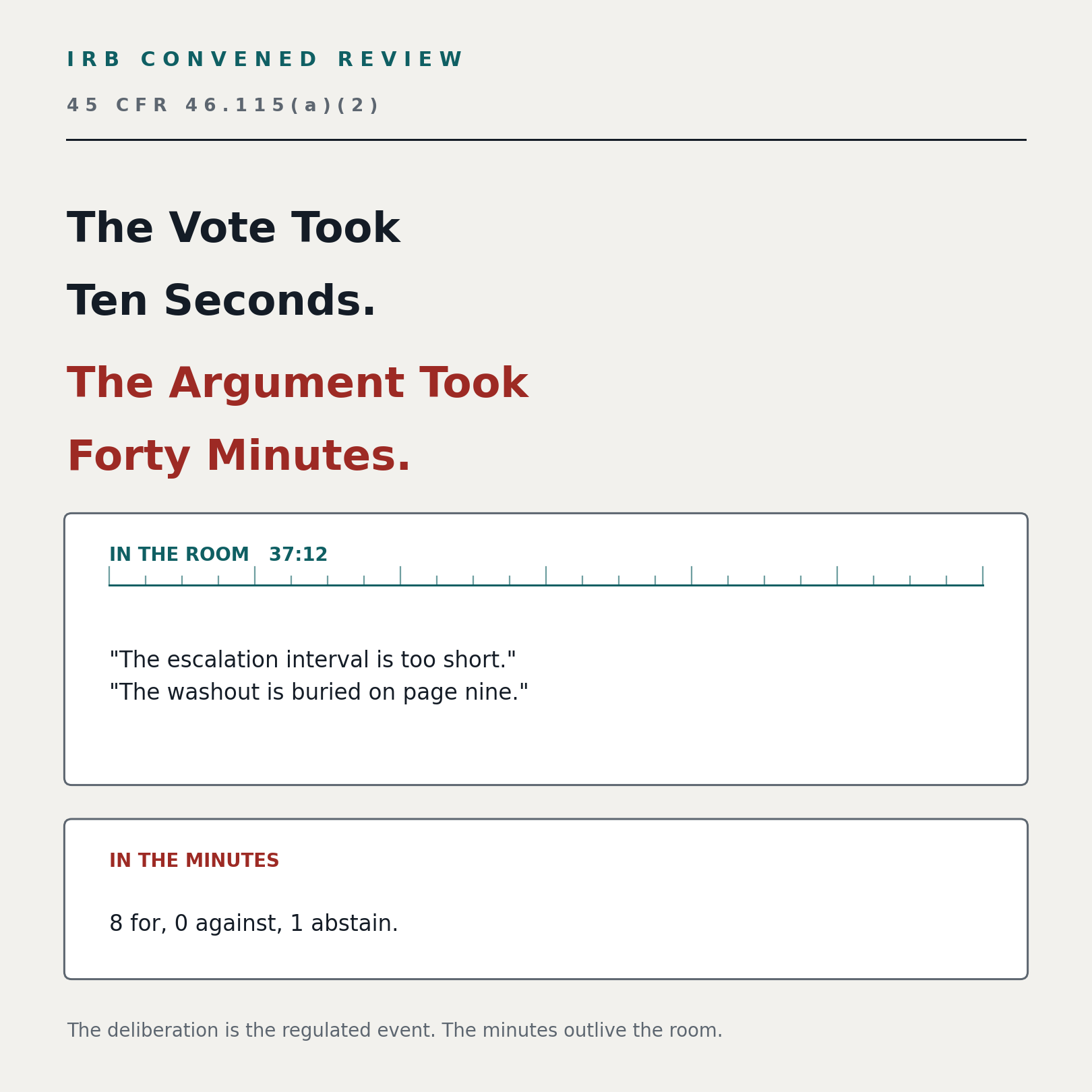
The convened board spends thirty five minutes on a single protocol. Two members think the dose escalation interval is too short. The nonscientist member thinks the consent form buries the washout period on page nine. The chair works the room until there is language everyone can live with, calls the question, and the vote takes ten seconds.
Nine months later a reviewer asks what the disagreement was actually about. The minutes say the board discussed risks and required modifications.
The Rule Asks for the Argument, Not Just the Outcome
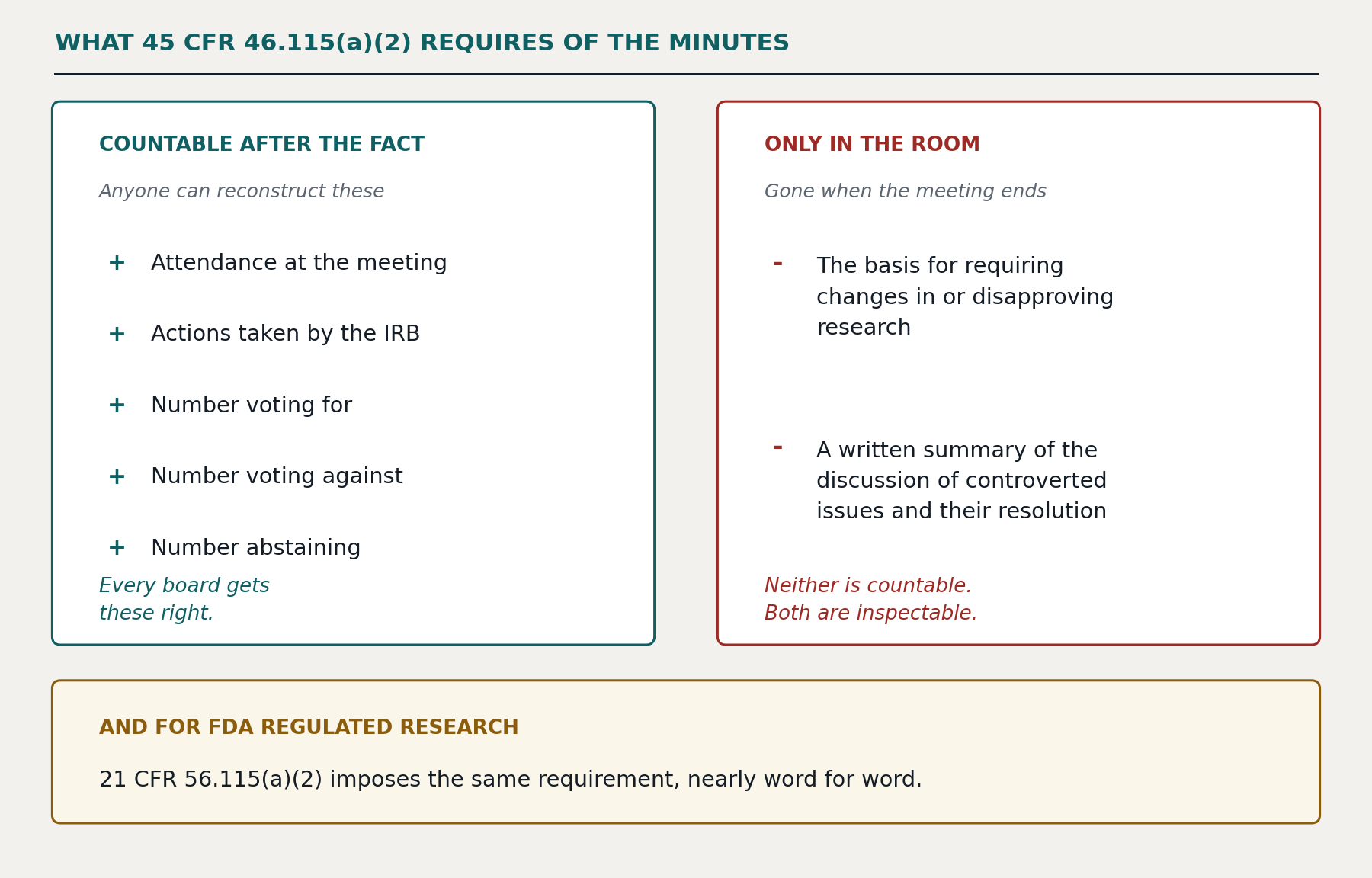
Read what 45 CFR 46.115(a)(2) actually asks of the minutes. They must be in sufficient detail to show attendance at the meetings, actions taken by the IRB, the vote on those actions including the number of members voting for, against and abstaining, the basis for requiring changes in or disapproving research, and a written summary of the discussion of controverted issues and their resolution.
21 CFR 56.115(a)(2) imposes the same requirement, nearly word for word, on boards reviewing FDA regulated research. If your institution reviews both federally funded and FDA regulated studies, you are meeting that standard twice.
Now sort the list by how each item gets produced. Attendance is a sign in sheet. Actions taken are a docket. Vote counts are a tally the chair reads aloud. Every one of those is mechanically reconstructable an hour after the meeting, a day after, a week after, by anyone holding the agenda.
The last two items are different in kind. The basis for requiring a change and the summary of controverted issues exist only inside the thirty five minutes of talk that came before the ten second vote. Nothing on the agenda encodes them. Nothing in the vote count implies them.
And that talk is what makes the meeting a meeting. 45 CFR 46.108(b) and 21 CFR 56.108(c) require research that does not qualify for expedited review to be reviewed at a convened meeting where a majority of the members are present, including at least one member whose primary concerns are in nonscientific areas, with approval by a majority of those present.
That quorum rule is not administrative housekeeping. It exists because the regulation assumes a particular kind of event: several perspectives, present at the same time, arguing. The deliberation is the regulated thing. The minutes are the only trace of it that outlives the room.
Why the Minutes You Write Afterward Do Not Hold
The problem is not that IRB coordinators write bad minutes. It is that the task, as it is normally staffed, cannot be done.
The person taking minutes is usually also running the agenda, watching quorum as members step out to take clinical calls, tracking whether the nonscientist member is still in the room, pulling up the next protocol, and noting who has a conflict and needs to recuse. Capturing a four way disagreement accurately while doing all of that is not a matter of discipline. It is not realistic.
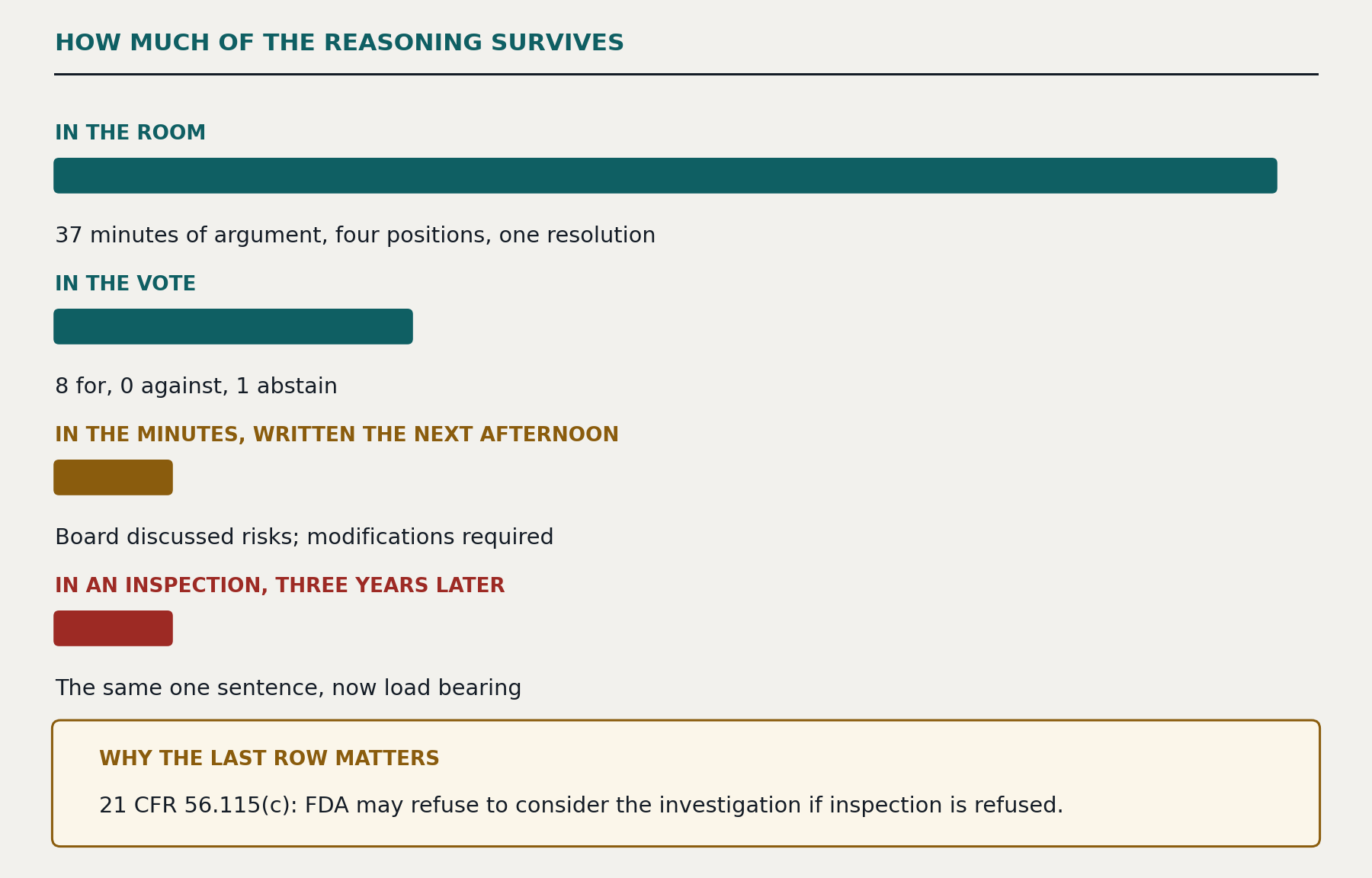
So the minutes get drafted the next afternoon from a legal pad. What survives is one sentence: board discussed risks of the escalation schedule; modifications required.
Look at what that sentence dropped. Who raised the concern — a member’s specialty is often the reason their objection carried weight. What the counterargument was. Which data the response turned on, whether the animal tox, the interim safety report, or the two prior cohorts. And why the board settled where it did rather than one notch more conservative.
Board discussed risks is not a basis. It is a placeholder where the basis used to be.
That placeholder then has to answer questions it was never built to answer.
Under 45 CFR 46.109(d), when an IRB decides to disapprove research it must notify the investigators in writing of its reasons and give the investigator an opportunity to respond in person or in writing. An investigator who wants to contest a disapproval is entitled to know what the board actually objected to. A one line summary gives them nothing to answer — and gives the board nothing to stand on when the response comes back.
Under 21 CFR 56.115(b), the records are retained for at least three years after completion of the research and are accessible for inspection and copying by FDA at reasonable times and in a reasonable manner. Section 56.115(c) adds the sharp edge: FDA may refuse to consider a clinical investigation in support of a research or marketing application if the institution or the IRB refuses to allow that inspection.
So a sentence written from a legal pad on a Tuesday afternoon becomes a document a federal inspector reads years later, in support of a marketing application, long after everyone in that room has forgotten the protocol number.
Controverted Covers More Than a Split Vote
Boards often read controverted issues narrowly, as shorthand for a divided vote. The text does not say that.
A unanimous approval can sit directly on top of a genuinely controverted issue. The most common shape of an IRB meeting is not a split tally — it is a disagreement resolved by a modification, after which everyone votes yes. The controversy was real, and the modification was its resolution. That is precisely the sequence 46.115(a)(2) asks you to write down: the discussion of controverted issues and their resolution.
Which means the meetings most likely to produce thin minutes are the ones that felt like they went well. A contested vote leaves a mark in the tally, so somebody remembers to write more. A forty minute argument that ends eight for, zero against, one abstain leaves no mark at all. On paper it is indistinguishable from a protocol nobody had a question about.
The same asymmetry applies to the basis for requiring changes. The board sends the consent form back; the action line records that modifications were required; the reason the board required them lives with whichever member finally articulated what was wrong with page nine. The requirement is not satisfied by recording that changes were required. It asks for why.
Write the Minutes From a Recording, Not From Memory
The fix is not a longer form or a second scribe. It is to draft the minutes from a record of the meeting rather than from a recollection of it.
A transcript is not the minutes. The regulation never asks for one, and producing a transcript would not satisfy 46.115(a)(2) on its own — minutes are a prepared summary that the board reviews. The transcript is the source you draft that summary from, while the reasoning is still intact.
Nothing in 45 CFR 46 or 21 CFR 56 prevents an IRB from recording its own convened meeting. These are your board’s own proceedings. Tell the members and any guests, follow institutional policy and your state’s consent law, and decide in advance where the recording lives inside the records program you are already required to run.
AmyNote records the meeting on the phone already sitting on the table and transcribes it with the OpenAI Speech API, then runs Anthropic’s Claude models over the transcript to pull out exactly what 46.115(a)(2) asks for: which issues were controverted, who raised them, what the competing positions were, what modification resolved each one, and the stated basis for that modification. Speaker separation matters more here than in most settings, because the rule treats the discussion and the vote as separate items, and because a nonscientist member’s objection is not interchangeable with anyone else’s.
No meeting bot joins anything. For a board that meets in a room, in a hybrid room, or with three members on a video bridge, that is the difference between a workable practice and a standing IT exception.
Semantic search across past meetings answers the other hard question. IRB membership rotates. When a board meets a similar risk two years later — the same escalation design, the same washout ambiguity buried in a consent form — you can find every protocol where the board took a position and read what it said then. Consistency across similar protocols is something reviewers ask about, and institutional memory alone does not deliver it.
Because this becomes a regulatory record, here is the architecture. Both OpenAI and Anthropic contractually guarantee zero training on user data. Audio is encrypted in transit and not retained after processing. Transcripts are stored locally on device with end to end encryption. Run it past your institution’s IT and privacy review before the first meeting, not after.
45 CFR 46.115(b) lets records be retained in printed or electronic form, so settle the lifecycle question in writing up front: whether the working transcript is destroyed once the minutes are approved, or kept alongside them. Either answer is defensible. Having no answer, and then being asked during an inspection whether a recording exists, is the one position you do not want to be in.
It Also Protects the Board
The instinct that a fuller record creates exposure is worth examining, because it usually runs the other way.
Minutes that state the basis for a required modification, name the concern behind it, and show how it was resolved are minutes that document a board doing the job the regulation assigns it. If the study later runs into trouble in the very area a member flagged, the record shows a board that saw the risk and addressed it deliberately. That is the strongest position available.
The version that carries real exposure is the thin one. Board discussed risks says nothing about whether the review was thorough or perfunctory, and it says the same thing either way. Under scrutiny, a record that cannot demonstrate deliberation tends to be read as evidence there was not much.
Getting Started
Do not start with the meeting where the most contentious protocol on the docket is up for review. Start with an ordinary one.
Record the next convened meeting, draft the minutes from the transcript, and set that draft next to the minutes your board would normally have produced for the same agenda. Most research compliance teams see the gap on the first controverted item — not because the old minutes were wrong, but because the new ones contain a paragraph that simply did not exist before.
AmyNote runs on a phone that is already in the room, so there is nothing to install on institutional hardware and no bot joining the call. Setup takes about a minute, and details are at amynote.app.
The minutes your board approves at the next meeting are only as good as the thirty five minutes nobody kept.
Originally published as an X Article by @AmyNoteApp.