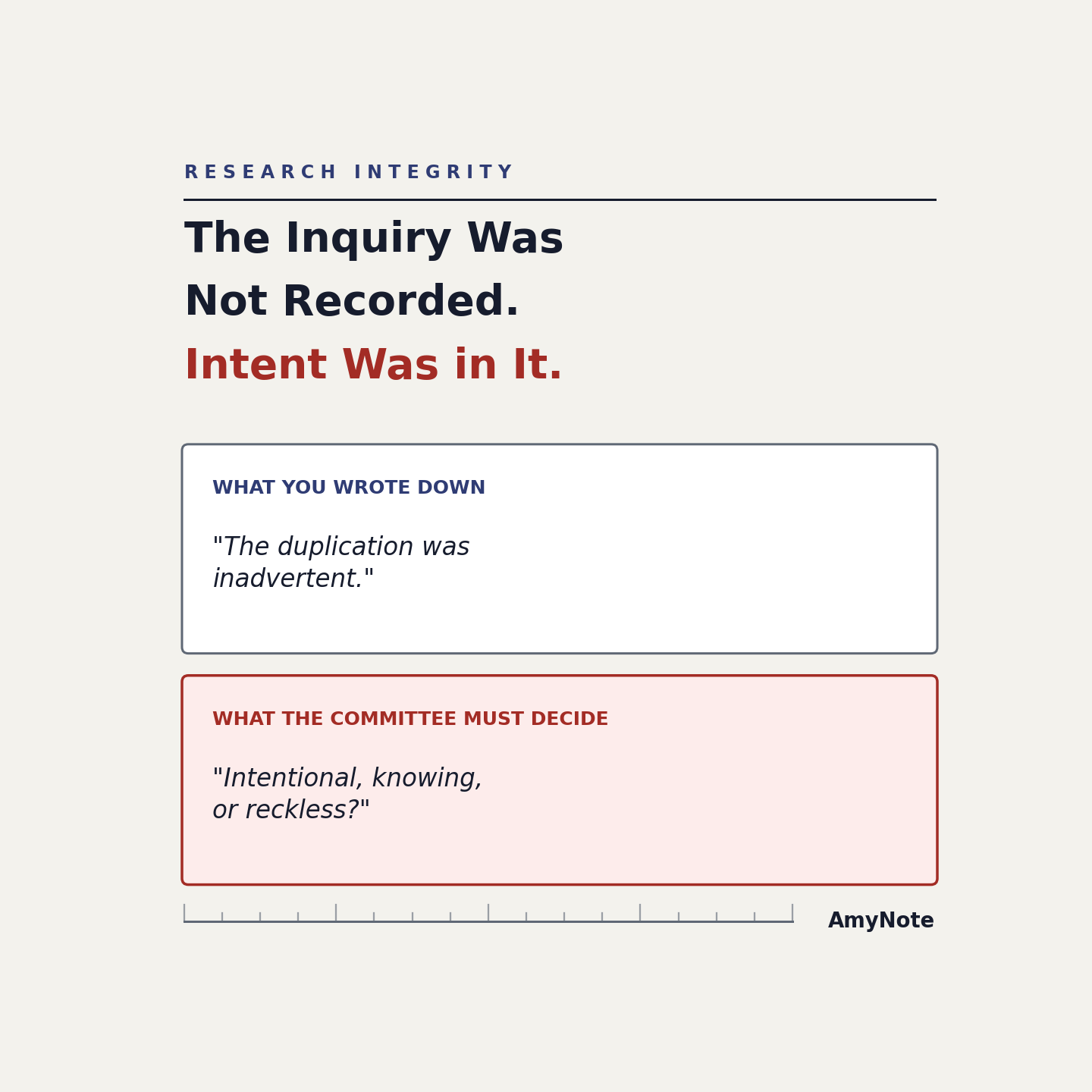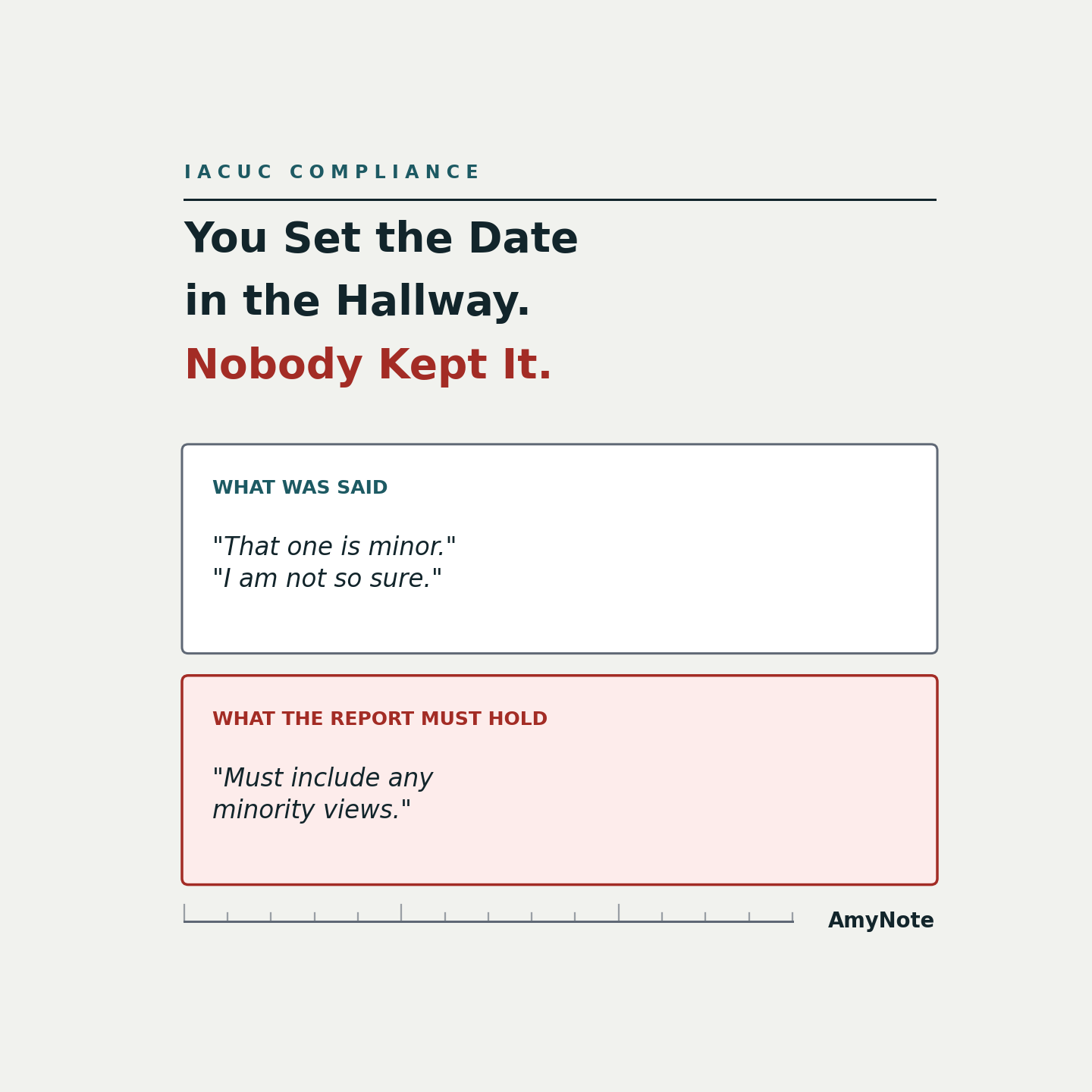
Two committee members, the attending veterinarian, and the facility manager walk the vivarium for three hours. In room 214 somebody points at an expired bottle of anesthetic on the surgery cart. The PI explains how it got there, the facility manager names a date for fixing it, and one member says that this one is minor while another is not so sure.
Nobody writes any of that down. The report is due to the Institutional Official in two weeks.
Your Report Has to State Reasons You Heard Once
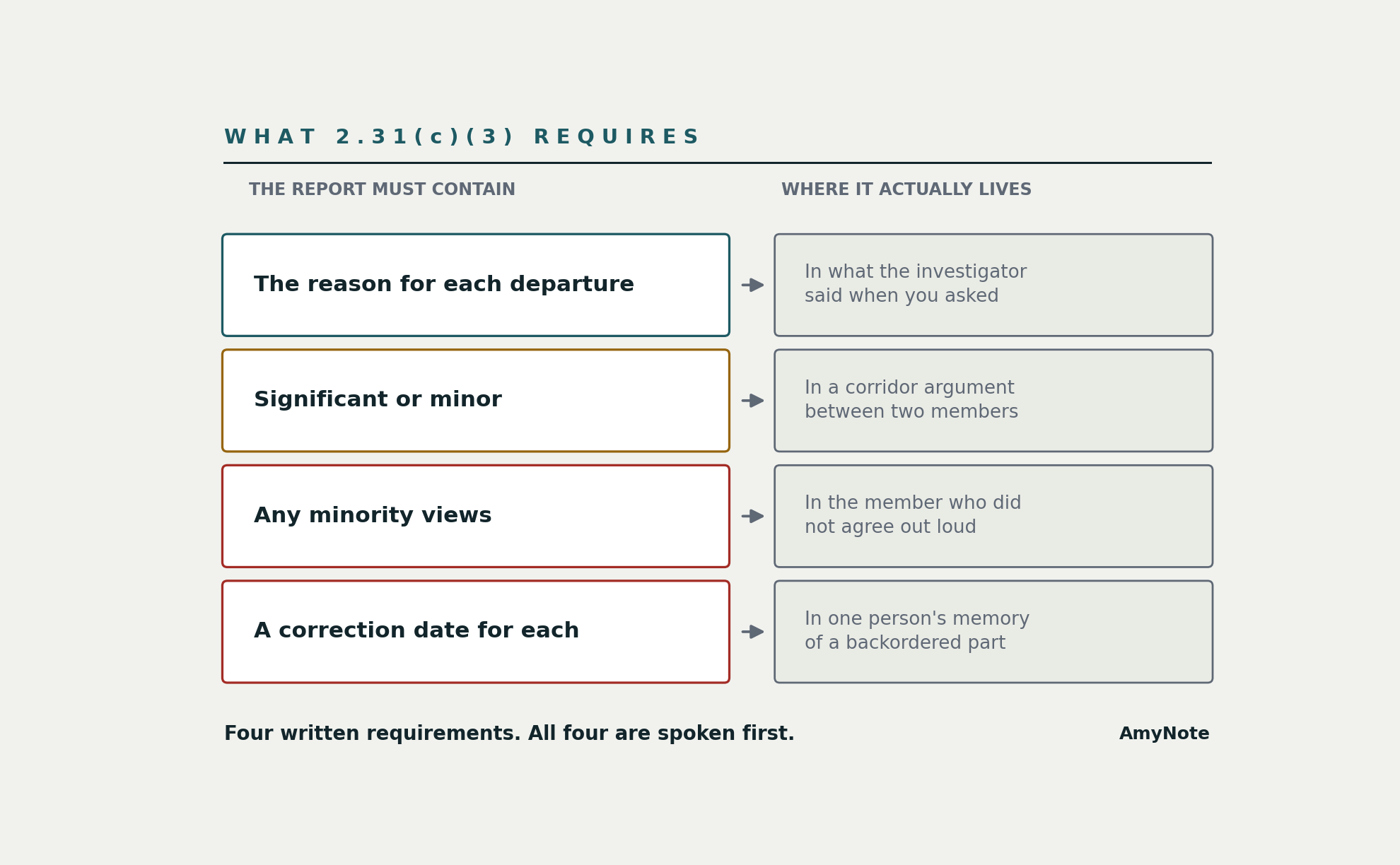
Read what 9 CFR 2.31(c)(3) actually asks of you. The semiannual report “must contain a description of the nature and extent of the research facility’s adherence to this subchapter, must identify specifically any departures from the provisions of title 9, chapter I, subchapter A, and must state the reasons for each departure.”
Reasons. Not findings. The reason a departure exists is almost never visible in the room. A bottle on a cart tells you what happened. It does not tell you whether the cart was staged for a procedure that got cancelled, whether a new tech was never trained on the check, or whether the stock rotation schedule has quietly been failing for a month. That distinction is what the investigator or the facility manager said when you asked.
The rule then asks you to sort them. The report “must distinguish significant deficiencies from minor deficiencies,” and a significant one is defined as a deficiency that, in the judgment of the IACUC and the Institutional Official, “is or may be a threat to the health or safety of the animals.”
Read that definition closely and notice where it locates the decision: in the judgment of the committee. It is not a fact you observe, it is a conclusion the committee reaches. And it gets argued out loud in a corridor, in PPE, between two people standing over the cart — not in the convened meeting six weeks later where the vote is recorded.
And it asks you to commit. Where deficiencies are noted, the report “must contain a reasonable and specific plan and schedule with dates for correcting each deficiency.”
That date came from one person, standing on a wet floor, from memory, about a part on backorder.
The Clipboard Captures the Finding, Not the Conversation
A checklist records what you saw. It does not record what you were told. Your walkthrough form has a line for “expired anesthetic, room 214.” It has no room for the ninety seconds explaining why, and no room at all for the exchange where two members disagreed about whether it threatened animal health.
This is not a flaw in your form. Inspection forms are built to be filled in while wearing gloves and moving between rooms, and they do that job well. The problem is that the regulation asks for two different kinds of content — observations and deliberations — and only one of them fits in a checkbox.
That disagreement is not lost color. Section 2.31(c)(3) requires that the reports “shall be reviewed and signed by a majority of the IACUC members and must include any minority views,” and 2.35(a)(3) makes those minority views a record the facility has to keep.
Consider what actually has to happen for a minority view to reach the report. A member must voice a reservation in a hallway, someone must notice that it was a reservation and not thinking out loud, that person must remember it two weeks later, and must then reconstruct it accurately enough to attribute it. Each of those steps is a place the requirement quietly fails, and none of the failures leave a trace. A report with no minority views recorded looks identical whether the committee genuinely agreed or simply lost the disagreement somewhere between room 214 and the drafting session.
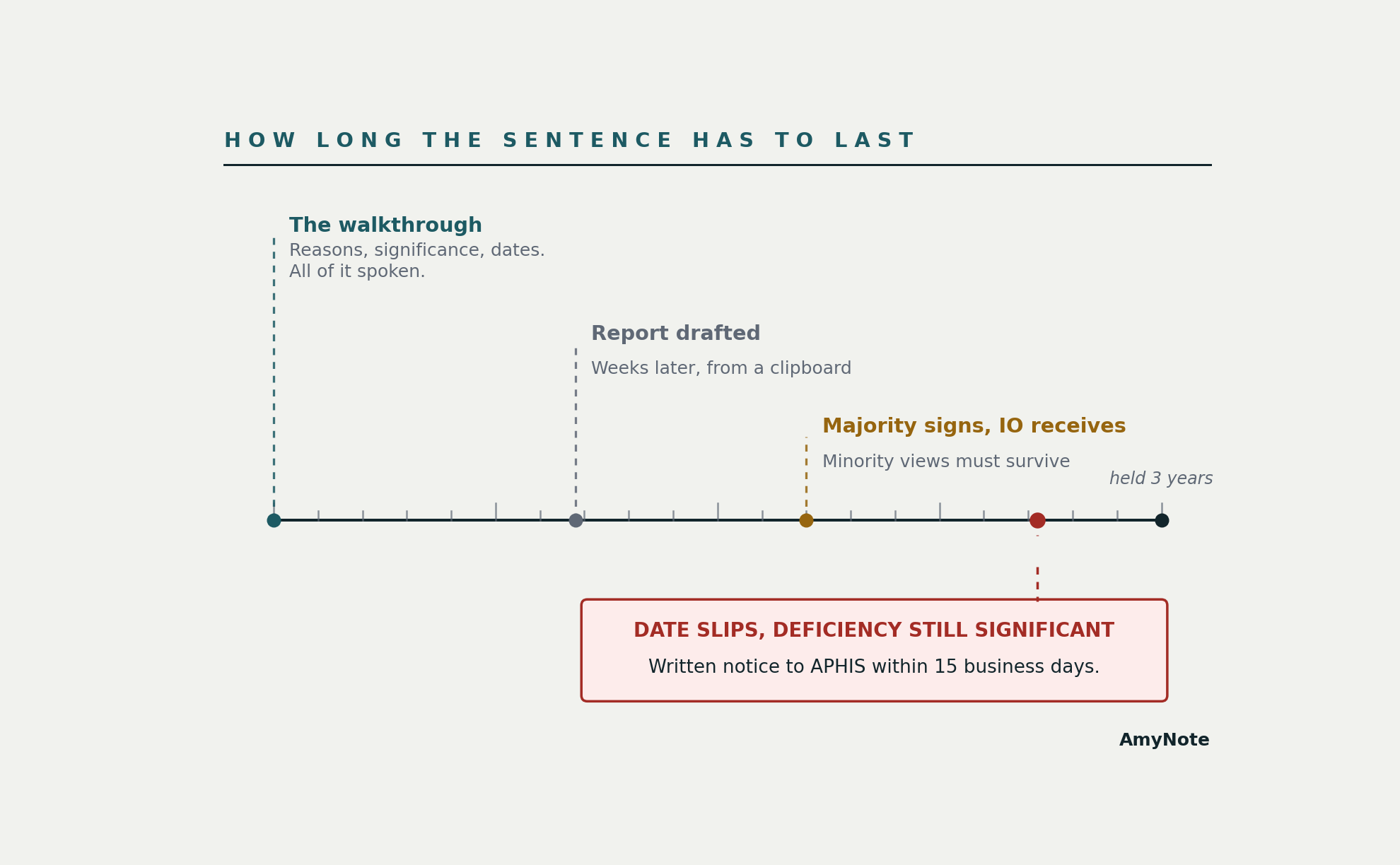
Then the schedule slips. Under 2.31(c)(3), any failure to adhere to the plan and schedule that leaves a significant deficiency uncorrected must be reported in writing, through the Institutional Official, to APHIS and to any federal agency funding that activity within 15 business days.
That provision turns two of the spoken items into a tripwire. The significance call decides whether the reporting duty exists at all, and the correction date decides when it fires. Both were set verbally, and neither is documented anywhere but the report they produced.
Under 2.35(f), the report is held at least three years and is available for inspection and copying by APHIS and funding agency representatives. A sentence spoken in a hallway becomes a document read by a federal inspector, potentially years after everyone in that hallway has forgotten the walkthrough.
Capture the Walkthrough While It Is Still a Sentence
Nothing in Part 2 stops you from recording your own inspection. These are your committee’s own proceedings at your own facility. Tell the people on the walkthrough, follow institutional policy and your state consent law, and file the recording inside the records program that 2.35 already requires you to run.
Read 2.35(a)(1) next to it. You are already required to keep minutes covering “activities of the Committee, and Committee deliberations.” The semiannual walkthrough is committee deliberation that happens to take place in PPE. Nobody would suggest holding a convened IACUC meeting with no minutes; the walkthrough gets a lighter standard mostly because writing during it is impractical, not because it matters less.
The practical constraint is the room itself. A barrier facility is not a place a laptop is going, and a notebook that goes into a containment suite is a notebook with a disposal problem. That is exactly why so much of the semiannual inspection ends up carried out of the building in somebody’s head.
AmyNote runs on the phone already in your pocket, which is the point when the record has to be made somewhere a laptop is never coming in. No meeting bot joins anything and nothing external is invited into the file. It captures the audio, transcribes with OpenAI’s Speech API, and runs the analysis through Anthropic’s Claude models to surface exactly what the report has to contain: each departure, the stated reason for it, the significance call and who dissented from it, and the correction date with the name of the person who gave it.
Because this becomes a regulatory record, here is the architecture. Both OpenAI and Anthropic contractually guarantee zero training on user data. Audio is encrypted in transit and not retained after processing. Transcripts are stored locally on device with end to end encryption. Run it past your institution’s IT and privacy review before the first walkthrough, not after.
It Also Protects the Committee
The instinct that a recording creates exposure is worth examining, because it usually runs the other way.
A report that pins a correction date, names the person who proposed it, and states the reason behind it is a report that documents a committee doing its job. If the date later slips, the record shows a reasonable schedule set on stated grounds rather than a number that appeared from nowhere. If a member dissented on significance and the deficiency later proves serious, the minority view in the file is evidence the committee considered the risk — which is precisely what 2.31(c)(3) asks it to preserve.
The version that carries real exposure is the one where the report is thin, the reasons are generic, and nobody can now say who decided what. That report is not safer. It is simply quieter, until an inspector reads it.
Getting Started
Do not begin with the semiannual inspection itself. Begin with the next routine facility check or post approval monitoring visit, where nothing is due to the Institutional Official and nobody is guarded.
Build the habit while it costs nothing, so that it is automatic in the six month cycle where the report has to hold up. Give notice, follow policy, and file the record where your IACUC office can actually find it. AmyNote takes about a minute to set up, and details are at amynote.app.
The report you sign in two weeks is only as good as the ninety seconds nobody kept in room 214.
Originally published as an X Article by @AmyNoteApp.