An allegation lands about a reused blot panel in an NIH funded paper. You sequester the records, you sit down with the postdoc that week, and you write up what they told you. That part moves fast, and it moves correctly.
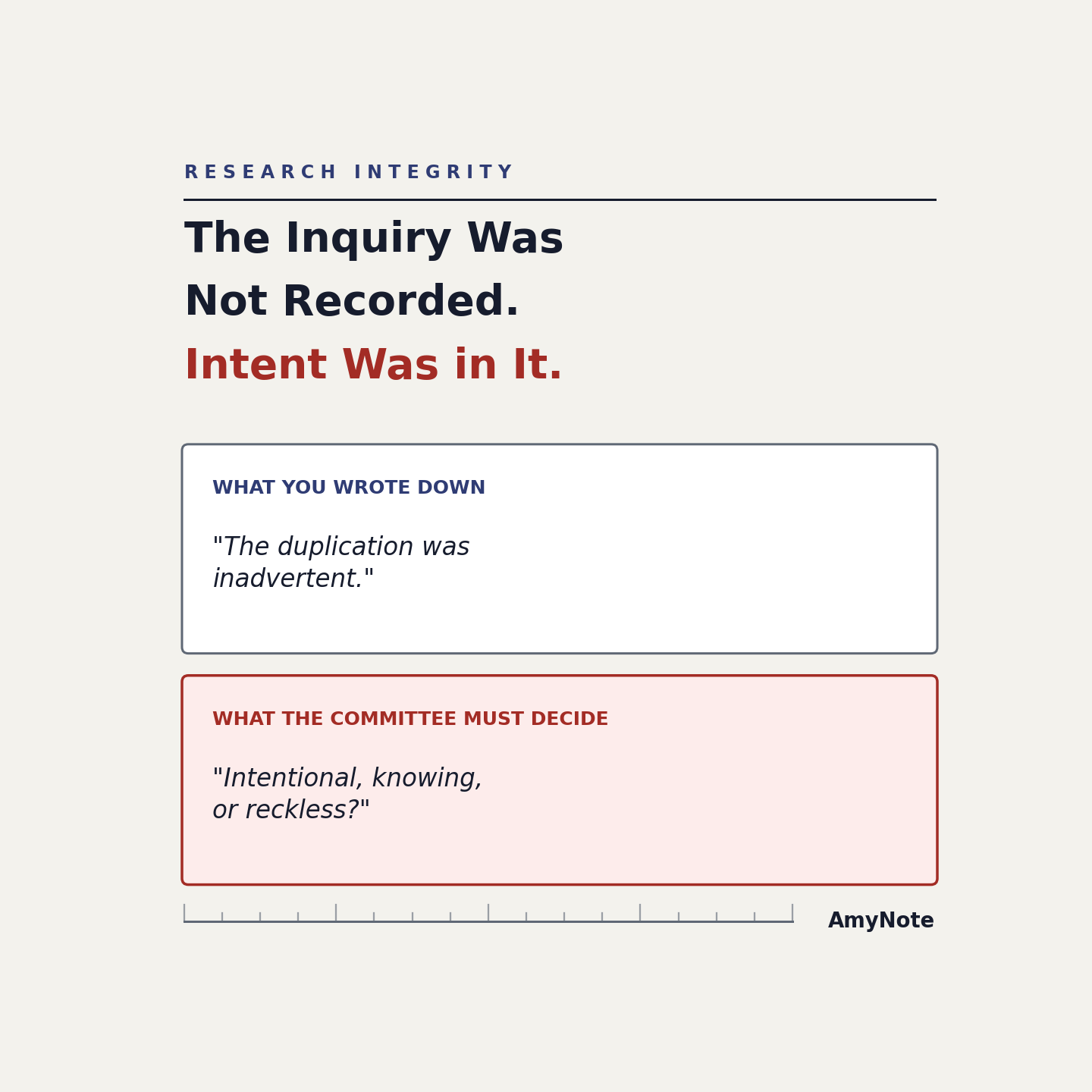
Eight months later an investigation committee has to decide whether the falsification was intentional, knowing, or reckless. The best evidence of that was your first conversation, and all that survives of it is a memo.
Nothing went wrong in February. The sequestration was prompt, the notice went out, the committee was properly seated. What went wrong is that the single most decisive forty minutes of the entire proceeding left behind less evidence than the file server did.
The Inquiry Interview Is Where the State of Mind Lives
A finding under 42 CFR 93.103 requires three things: a significant departure from accepted practices, misconduct committed intentionally, knowingly, or recklessly, and proof by a preponderance of the evidence.
The first element lives in the images and the raw files. The second one does not. Intent almost never appears in the research record. It appears in what the respondent says, early, before counsel, before an account has hardened into a position.
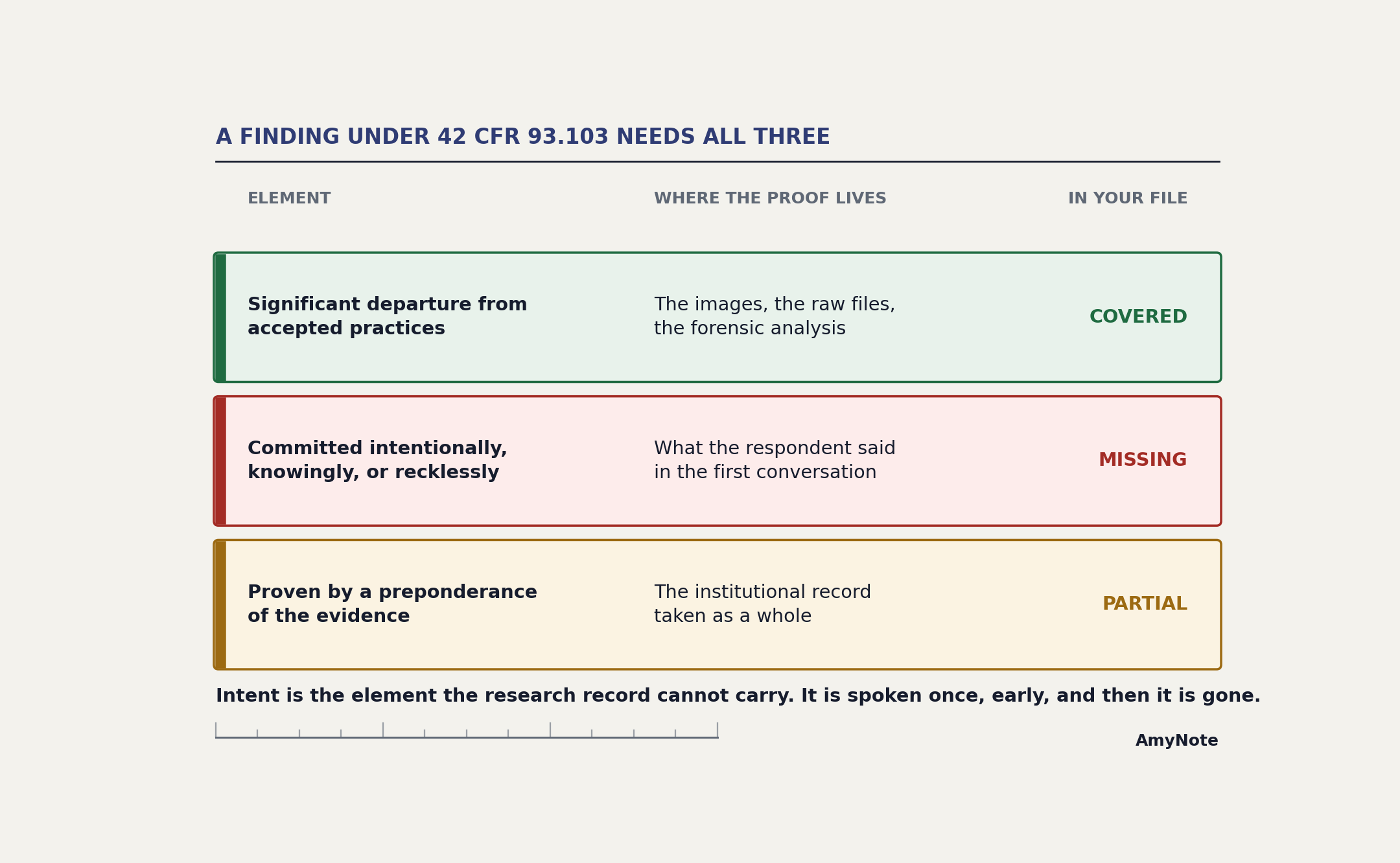
This is the part that catches careful institutions off guard. A research integrity officer who has assembled a flawless technical file can still arrive at the investigation stage holding nothing on the element that decides the case. The forensics can establish beyond argument that a panel was duplicated. They cannot establish whether the person who duplicated it knew.
The Rule Is Asymmetric, and the Asymmetry Costs You
Part 93 is strangely uneven about that conversation. At the investigation stage, 93.310(g) requires that interviews be recorded and transcribed, that any exhibit shown be numbered and referred to by that number, and that each interviewee get the transcript back for correction. At the inquiry stage, 93.307(e)(3) says only that institutions “may interview witnesses or respondents.” Nothing about recording.
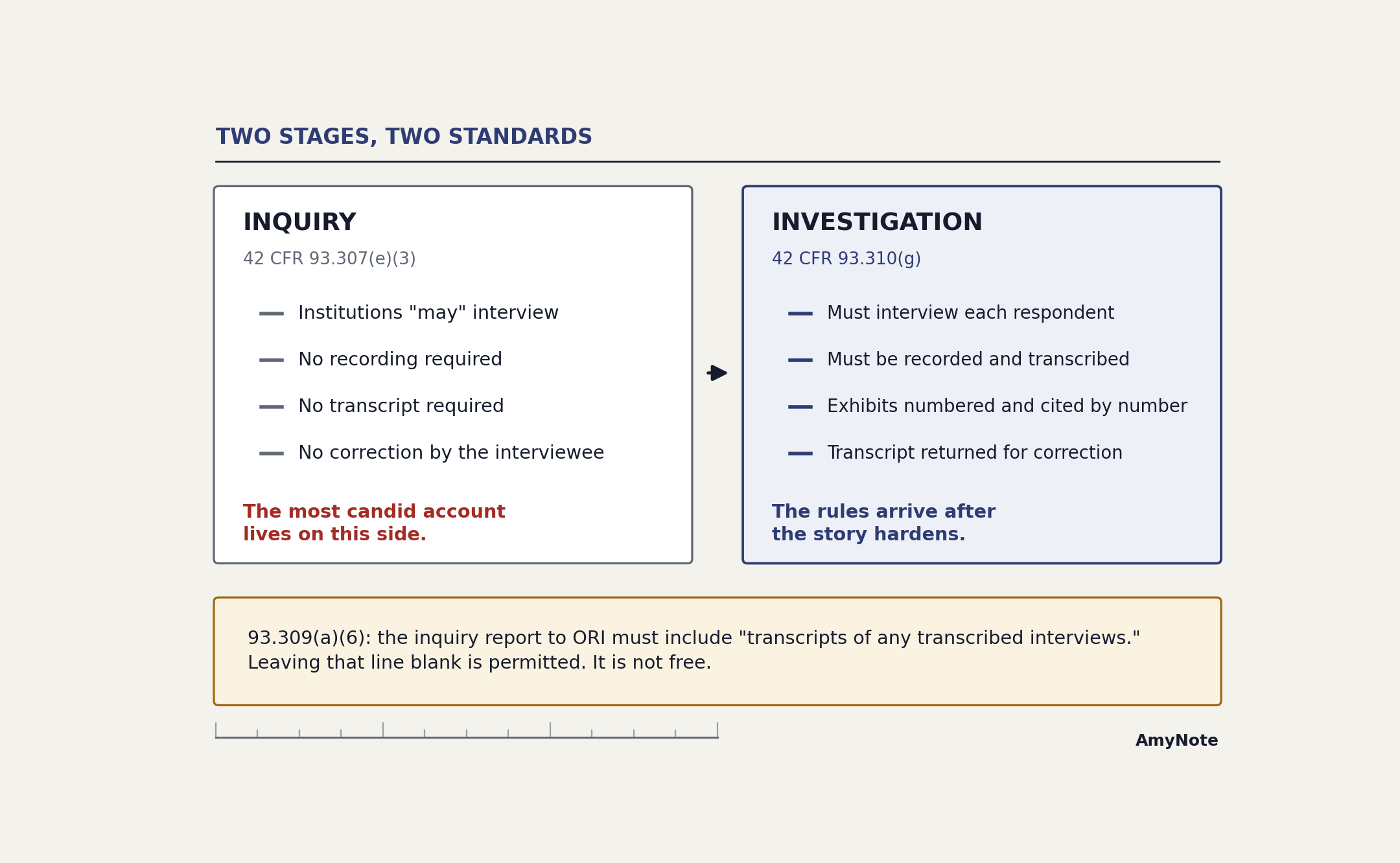
So the most candid account in the entire proceeding is the one nobody is required to capture. Meanwhile 93.309(a)(6) expects your inquiry report to ORI to include “transcripts of any transcribed interviews.” Leaving that line blank is permitted. It is not free.
Read the two provisions next to each other and the logic of the rule becomes visible: the drafters attached the formal machinery to the stage with formal consequences. The difficulty is that candor does not follow procedure. It runs in the opposite direction, highest at the first conversation and lower at every one after it.
Your Inquiry File Documents Objects, Not Explanations
You already have every artifact the rule names. The sequestration inventory under 93.305(a). The written notice to the respondent. The committee composition. The timeline. The forensic image analysis. This is not an argument that your file is thin.
Every one of those documents a thing or a date. Not one documents an explanation.
| What your inquiry file holds | What it proves | What it cannot show |
|---|---|---|
| Sequestration inventory | The records were secured, and when | How the figure came to be assembled that way |
| Written notice to respondent | The respondent was properly notified | What they said when you sat down together |
| Committee composition | The panel was correctly constituted | Nothing about the underlying conduct |
| Forensic image analysis | The panel was duplicated | Whether it was intentional, knowing, or reckless |
| The inquiry memo | Someone’s later recollection of a conversation | The respondent’s own words, in their own order |
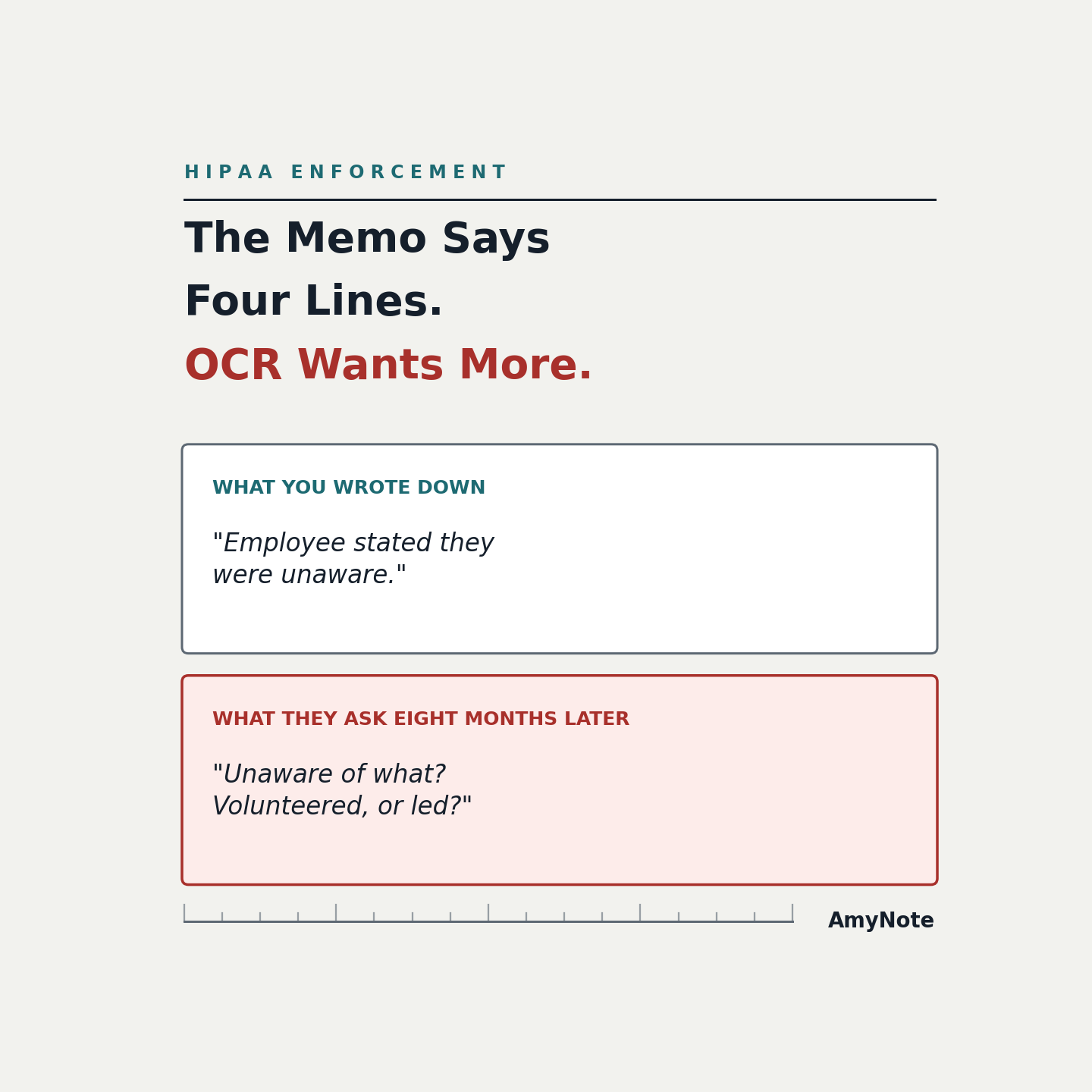
A memo is a paraphrase, and a paraphrase invites the question you cannot answer. Your note reads “respondent stated the duplication was inadvertent.” Inadvertent how? That they grabbed the wrong file off a shared drive, or that everyone in the lab assembled figures that way?
Those are different cases with different outcomes. One is potential honest error, which 93.307(g)(2) requires you to note in the inquiry report. The other is a lab wide practice and probably a second respondent.
The two readings also sit a few seconds apart in a real conversation, usually inside the same anxious answer. A frightened postdoc will offer both and then settle on whichever one your follow-up question rewards. Which version ends up in the memo has less to do with what they meant than with which half you were still holding in your head when you sat down to write it.
A Paraphrase Against a Transcript
By October the position has reversed completely. The respondent’s investigation testimony is recorded, transcribed, and corrected by them under 93.310(g)(3). Yours is a note written from memory eight months earlier.
You are holding a paraphrase against a transcript, and a committee weighing the two has no principled reason to prefer yours. This is not a question of anyone’s good faith. It is a question of which document can be checked and which one cannot.
Capture the Inquiry on the Terms the Investigation Will Demand
Nothing in Part 93 stops you from recording at the inquiry stage. Give notice, put it in the file, follow your institution’s policy and your state’s recording law. You are simply doing early what 93.310(g) will require of you later.
Number your exhibits from the first conversation. The investigation rule already demands it. Start at the inquiry and the figure you slid across the desk in February is still identifiable in October, referred to by the same number in both records.
AmyNote runs on the phone already in the research integrity officer’s pocket. No meeting bot joins, nothing external gets invited into a confidential proceeding, and it behaves the same across a desk as it does on a call. It captures the audio, transcribes with OpenAI’s Speech API, and runs the analysis through Anthropic’s Claude Opus to surface what the respondent said about who assembled the figure, who directed it, and what the lab treated as normal.
Confidentiality is the whole game here, so here is the architecture. Both OpenAI and Anthropic contractually guarantee zero training on user data. Audio is encrypted in transit and not retained after processing. Transcripts are stored locally on device with end to end encryption. Run your vendor review before the first interview rather than after.
That record pays off three times. At the inquiry decision, when whether the allegation “may have substance” under 93.307(f) turns on what you were told. At the investigation, when a committee has to weigh intent. And at oversight review, where 93.317(c) lets ORI direct an institution to address deficiencies in the institutional record.
Getting Started
Do not wait for an allegation with a journal retraction behind it. The next low stakes conversation is the one to practice on.
- Start with the conversations that already happen. An authorship dispute, a data management question, a lab audit. None of these involve an open ORI matter, and all of them build the workflow.
- Clear it against your own policy first. Follow your state law and your institution’s written recording policy, and tell the respondent they are being recorded. Note the notice in the file.
- Number the exhibits from day one. Whatever you put in front of someone gets a number, and that number appears in the record of the conversation.
- Summarize the same day. Pull out the stated account of who assembled the figure, who directed it, and what the lab treated as normal, while nobody is reconstructing anything.
- File it with the rest of the inquiry. When the investigation committee asks eight months later, comparing your record against the transcript takes minutes instead of memory.
Build the habit while nothing is at stake so it is automatic when everything is. AmyNote takes about a minute to set up, and amynote.app offers a 3-day full trial with no credit card.
A file you must keep for seven years under 93.318 can trace back to forty minutes in your office. Your research integrity officer may well have run that interview perfectly. The only question is whether anyone on your side kept it.
Originally published as an X Article by @AmyNoteApp.