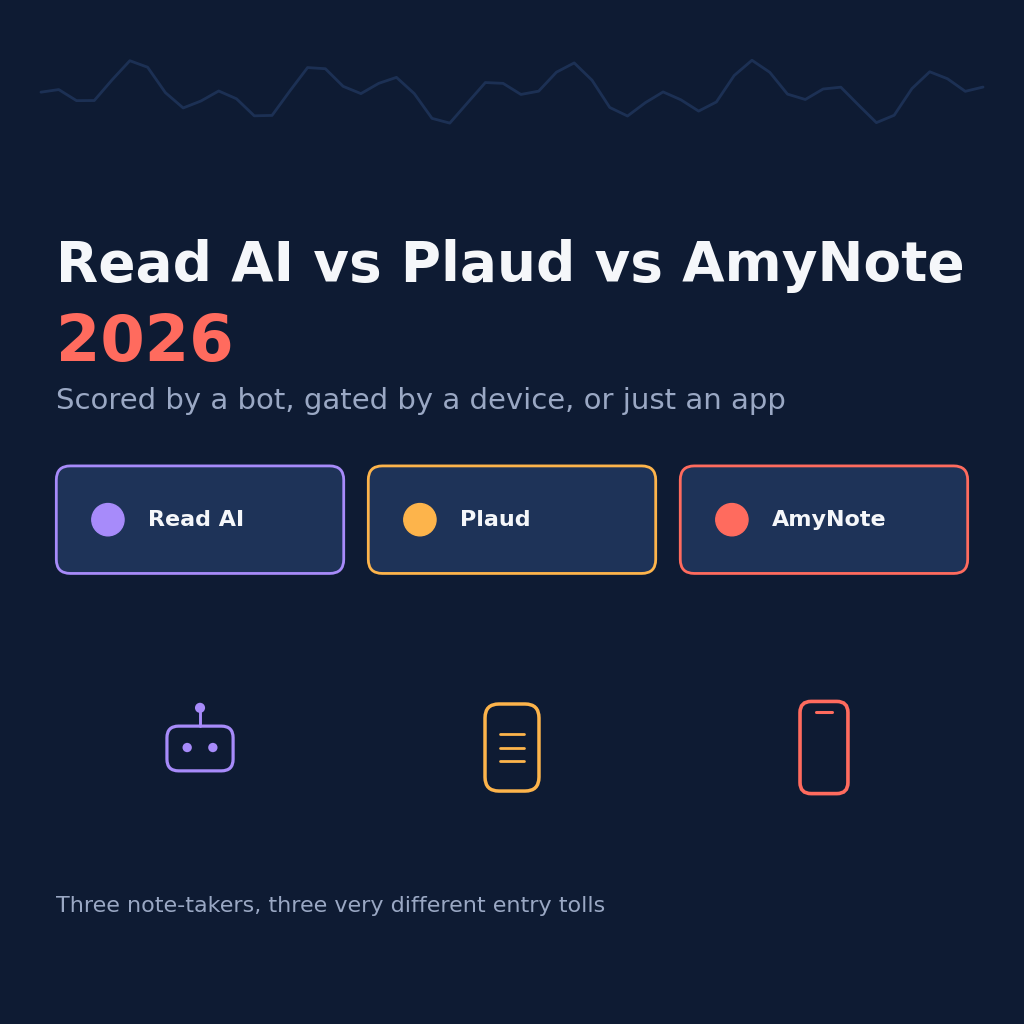
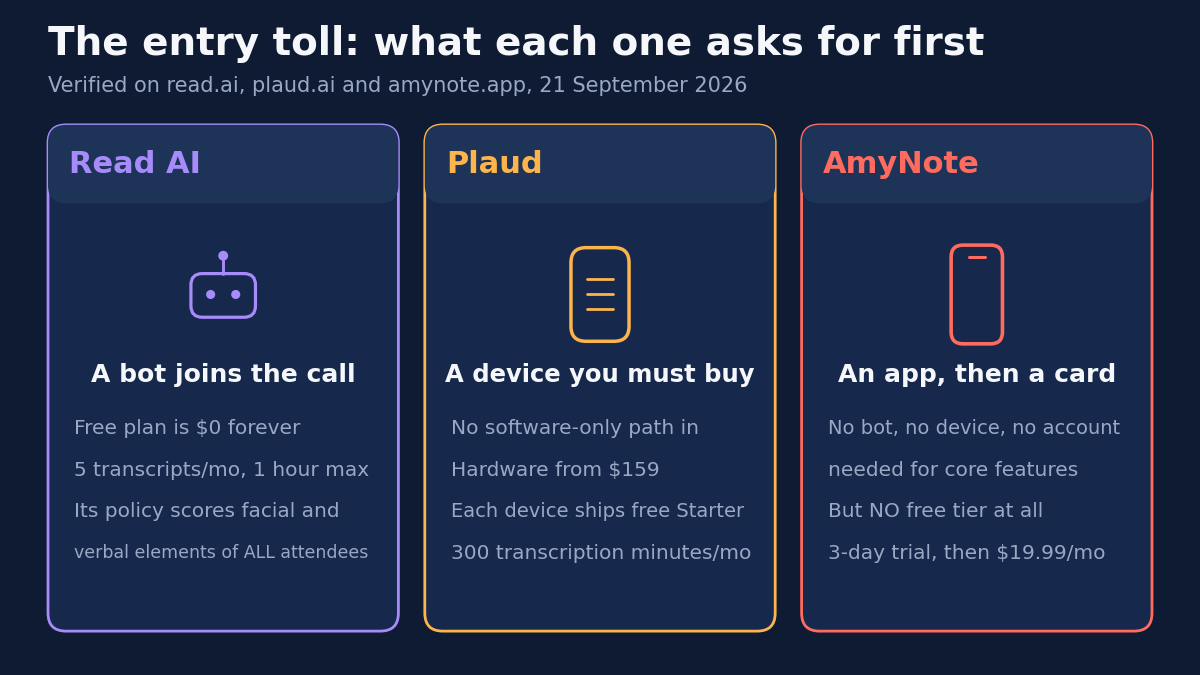
Three products promise the same outcome: you stop taking notes and still walk away with a record. The difference shows up before the first minute is captured. Read AI sends a bot into the call. Plaud sells you hardware and will not work without it. AmyNote asks for neither and has no free tier to fall back on. Every price and quotation below was read off the vendors’ own pricing pages and privacy policies on 21 September 2026.
Quick Verdict
- Read AI if you live in Zoom, Teams and Meet, want a permanent free plan, and are comfortable with a tool that analyses everyone in the room.
- Plaud if your important conversations happen across a table rather than a link, and you want the strongest published compliance sheet here.
- AmyNote if nothing should join the meeting at all, you carry an iPhone, and a flat annual price matters more than certifications.
What We Compared
All three transcribe well enough that accuracy is rarely why people switch. Three narrower questions separate them.
- What you must buy before minute one. An account, a subscription, or a device.
- What the vendor’s own policy permits. Not the badge strip, the policy underneath it.
- What the tier you need actually costs. The headline price and the tier carrying the controls are rarely the same tier.
Prices are US list for a single buyer. The third question is the one that catches people out most often, because the number on the pricing page and the number you end up paying are separated by whichever feature turns out to be non-negotiable for your organisation.
Read AI: Free Forever, With Something in the Room
Strengths. Read AI has the broadest platform spread here: Windows, macOS, iOS, Android and a Chrome extension. It publishes a price on all four tiers rather than hiding them behind a sales call, at $15, $22.50 and $29.75 per user monthly billed annually, and the free plan is permanent. It is also the only one of the three publishing a hard retention ceiling, storing audio and video “in no case for longer than 2 years.” The other two do not match that.
That retention ceiling deserves more credit than it usually gets. A published maximum is a commitment a buyer can hold a vendor to and a compliance team can write into a policy document. Both competitors here leave retention unstated, which means it is governed by whatever the current operational practice happens to be.
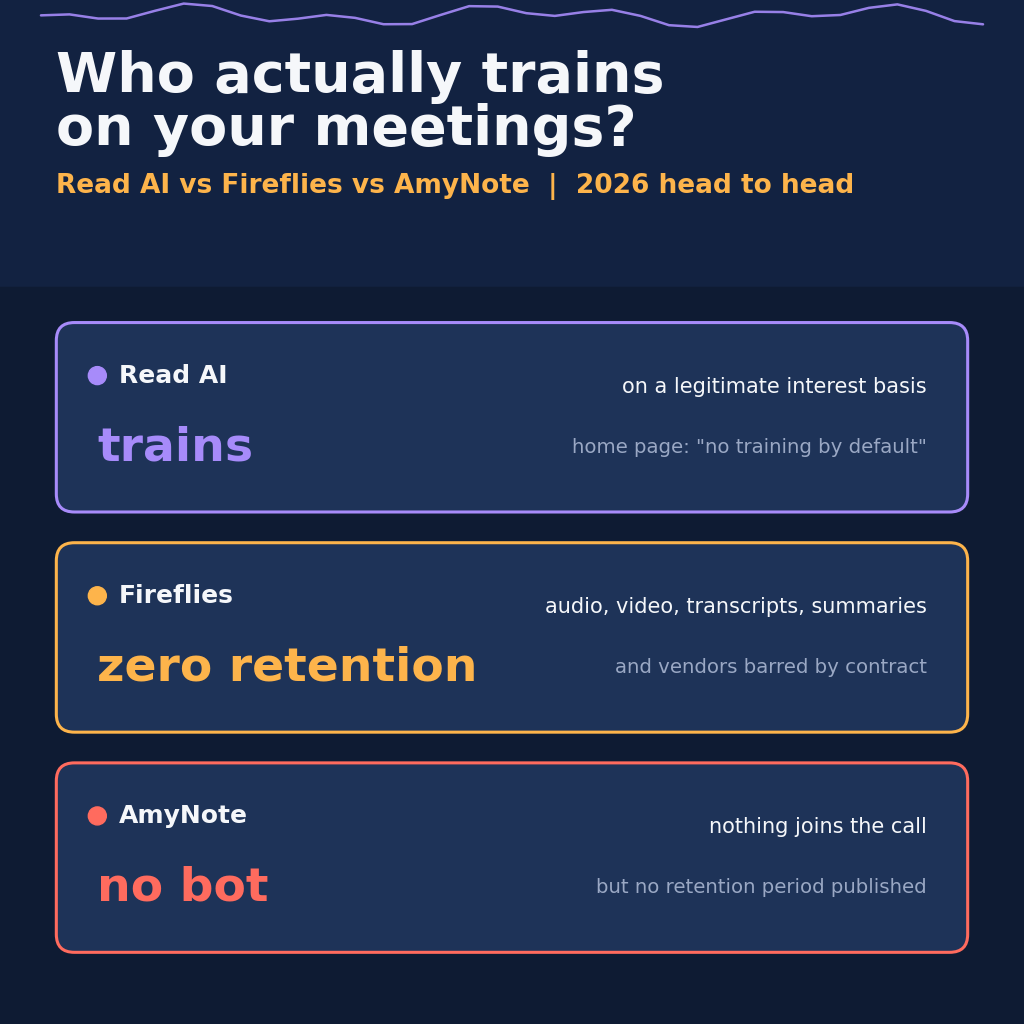
Weaknesses. The Read Score, in Read AI’s own words, “involves analyzing facial and verbal elements of all meeting attendees.” That reaches people who never signed up for anything, though in the EU and UK the score drops video and facial elements. The policy also uses audio and visual information “as well as other information like language” to infer demographic characteristics and each person’s role.
On training, the home page says “SOC II certified, and no training on your data by default” while the policy lists “using information to train and improve our models within our Services” on a legitimate interest basis rather than consent. Those two statements can be reconciled, but the reconciliation depends entirely on what “by default” is doing in the first sentence, and a legitimate-interest basis is not the same thing as asking.
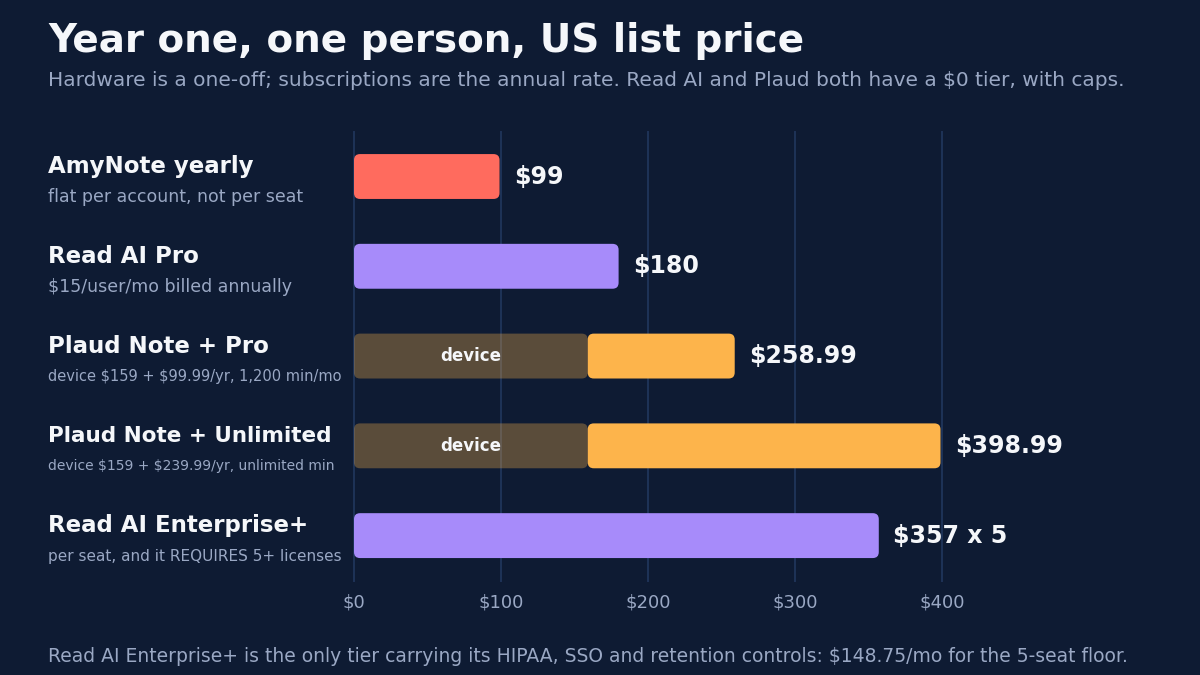
The gating is aggressive too. The tier called Enterprise does not include Enterprise SSO. SSO and SAML, SCIM, the data retention control and HIPAA compliance are excluded from Free, Pro and Enterprise alike, unlocking only on Enterprise+, which requires five or more licences. That puts the cheapest configuration carrying Read AI’s own HIPAA claim near $148.75 a month. And “30 meetings measured per month” sits under every card, Enterprise+ included, while the free plan returns five transcripts.
Plaud: The Best Paperwork, Behind a Hardware Door
Strengths. Plaud’s compliance list is the strongest here and it is not gated behind an enterprise contract: ISO 27001, ISO 27701, GDPR, SOC 2 Type II, HIPAA and EN 18031 are listed as covering the plans themselves. That distinction matters, because a certification that only applies to a tier you are not buying is not a certification you have.
Its privacy commitment is unhedged, stating it will “never use your Content (such as your audio files, photos, or text) to train, optimize, or develop our own or any third-party” AI models without explicit consent in advance, and that its agreements “prohibit service providers from using your data for any purpose other than performing the requested task.” The second half is the part most vendors omit; a no-training promise that stops at the vendor’s own boundary leaves the subprocessors unaddressed.
It supports 112 transcription languages, and as a recorder rather than a bot it handles in-person conversations natively — the meeting across a table, the corridor conversation, the phone call taken in a car.
Weaknesses. There is no software-only path in. Hardware starts at $159 for the Note or NotePin and runs to $189 for the Note Pro. The feature list marks Plaud Desktop as “Requires Device”, and the FAQ confirms the free plan is a hardware accessory rather than a signup: “Every Plaud device includes the Starter Plan at no extra cost.”
That plan is 300 transcription minutes a month. Pro lifts it to 1,200 minutes at $8.33 a month billed annually, and only Unlimited removes the cap at $19.99. Monthly billing costs roughly double either rate. For all its certifications, Plaud publishes no hard retention ceiling of its own — so the vendor with the best paperwork loses the one row the vendor with the weakest privacy posture wins.
AmyNote: No Bot, No Device, No Free Tier
Strengths. AmyNote is a pure iOS app, so in-person conversations work without hardware and video calls work without a bot announcing itself to the room. It transcribes 140 or more languages and translates into 100 or more, with explicit optimisation for East Asian and Arabic, the widest verified coverage of the three.
Transcription runs through OpenAI’s speech services and analysis through Anthropic’s Claude Opus, and both providers contractually commit to never training on user data. Its security page states it does not use your data to train AI models, does not sell meeting content, and, unusually, that it does not require an account to use core features. Pricing is flat per account rather than per seat at $12.99 weekly, $19.99 monthly or $99 yearly, which is why it wins the year-one row against products whose headline monthly price looks lower.
Weaknesses, stated plainly. AmyNote is iOS only. No Android, no desktop, which rules it out for many buyers immediately. There is no free tier, only a three day trial, against permanent free plans from both competitors.
It publishes no SOC 2, ISO 27001, HIPAA or GDPR certification and sells no SSO or SCIM at any price, so a regulated buyer needing that paperwork should not shortlist it. It publishes no retention period either, so Read AI genuinely wins that row.
AmyNote is also explicit that local-first is not local-only: the library lives on the device, but when transcription, translation or a summary runs, a processing copy may be retained on its cloud infrastructure. It encrypts in transit with TLS and declines to call that end-to-end encryption. There are no CRM integrations and no video recording.
Side by Side
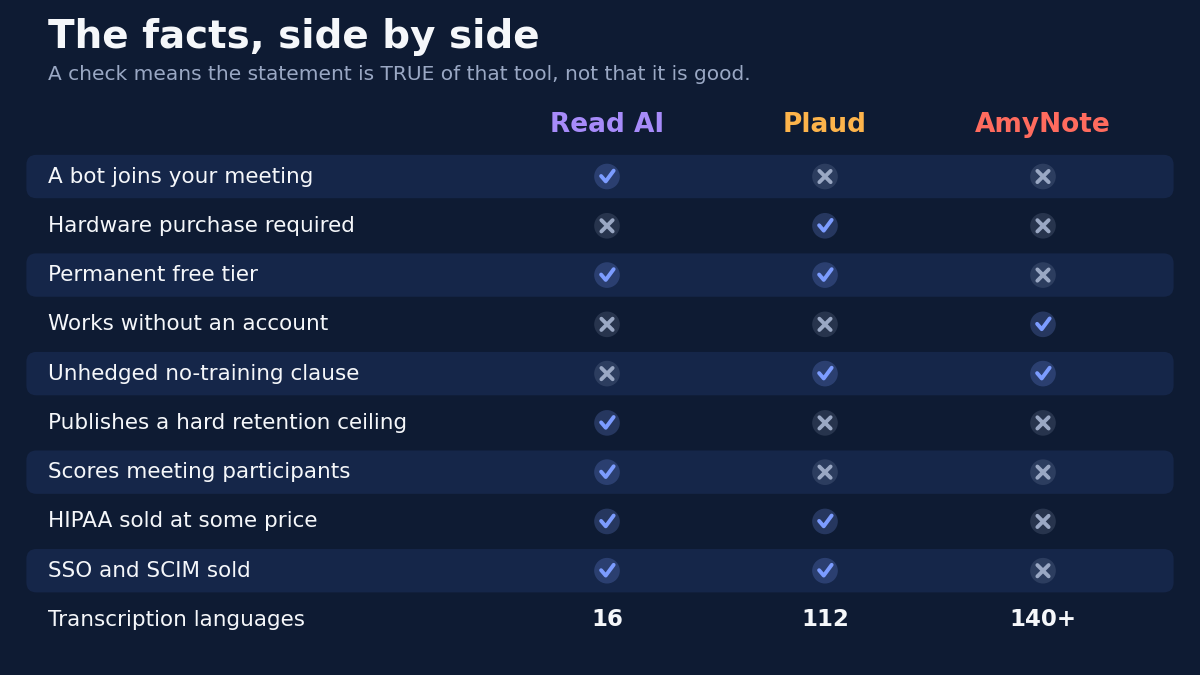
- A bot joins your meeting. Read AI only.
- Hardware required first. Plaud only, from $159.
- Permanent free tier. Read AI five transcripts a month. Plaud 300 minutes, with a device. AmyNote none, three day trial only.
- Participants scored or profiled. Read AI only.
- Unhedged no-training commitment. Plaud and AmyNote yes, Read AI no.
- Published retention ceiling. Read AI two years. The other two publish none.
- HIPAA, SSO and SCIM. Plaud across plans. Read AI only on Enterprise+ at a five licence floor. AmyNote at no price.
- Transcription languages. Read AI 16, Plaud 112, AmyNote 140 or more.
- Year one, one person. AmyNote $99. Read AI Pro $180. Plaud Note plus Pro $258.99. Plaud Note plus Unlimited $398.99.
The Bottom Line
These three are not really competing on transcription. They are competing on what you are willing to let into the room.
Read AI suits a video-call team that wants engagement analytics and a free plan that never expires, if nobody objects to being analysed and nobody needs SSO below the Enterprise+ floor. Plaud suits anyone whose real conversations happen in person and who needs certifications on file today, if the hardware cost and minute caps are acceptable. AmyNote suits the case where the right number of things joining your meeting is zero and you are on iOS.
It is worth being clear that the deciding factor is rarely a feature. It is usually a constraint that was already true before the evaluation started: the platform your team is on, whether your conversations are scheduled links or unscheduled rooms, and whether a procurement checklist requires certifications you cannot obtain from an app with no enterprise tier.
Each one wins a different row and none wins all of them. Read AI publishes the retention ceiling the other two do not. Plaud publishes the certifications the other two do not. AmyNote needs neither a bot nor a device nor even an account, and is also the only one with no free tier. Pick the constraint you actually care about, then buy the tool that respects it.
Originally published as an X Article by @AmyNoteApp.