Almost every AI note-taker runs a badge strip across its home page. SOC 2. GDPR. HIPAA. No training on your data. The strip is placed high, rendered in grey, and designed to be scanned rather than read — which is exactly the right design, because a badge is a claim about a process, not a promise about your meeting.
Badges are marketing. The privacy policy is the binding document, and on one of these three the two say opposite things.
What matters is not what a vendor says about your meetings on the page built to sell you something. It is what its own policy permits it to do with them, in the document its lawyers wrote and its customers agreed to.
Quick Verdict
Fireflies has the strongest data sheet here, and it is not close. Its privacy policy states without hedging that it does not use personal information for AI model training and contractually prohibits its vendors from doing so, then layers a Zero Data Retention policy on top.
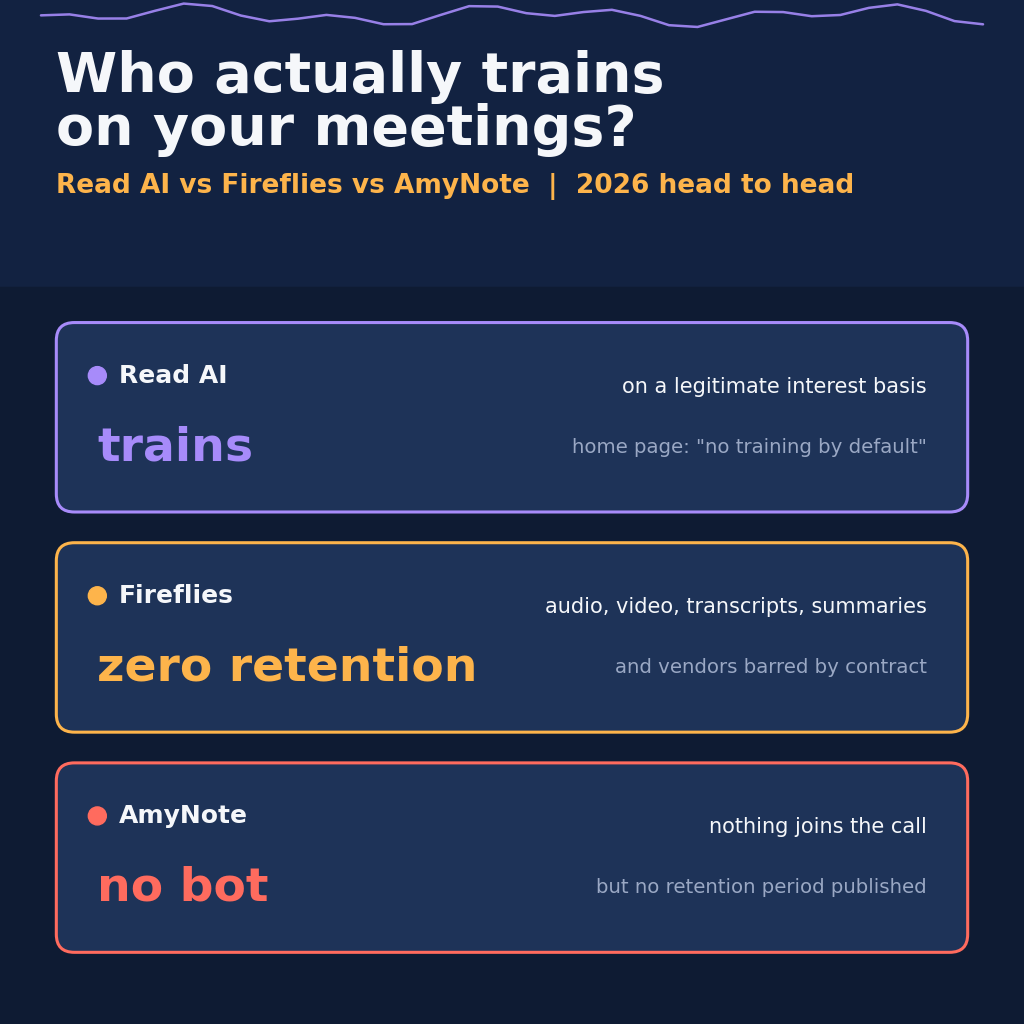
Read AI has the broadest platform spread and a published retention ceiling. It also carries an affirmative clause permitting it to train on your information, on a legitimate interest basis, while its home page says there is no training on your data by default.
AmyNote does not train and needs no bot, no account and no seat count. It also publishes no retention period and holds no compliance certification, which belongs in the same paragraph rather than a footnote.
What We Compared
Each vendor’s pricing cards, the plan comparison table parsed cell by cell, the pricing FAQ, and the training and retention clauses of each privacy policy. Every figure and quotation below was read off the vendors’ own pages on 19 September 2026.
One note on method, because it decides what this article can and cannot tell you. A privacy policy describes permissions, not practices. A clause permitting training does not prove a vendor trains today, and its absence does not prove a vendor never will. But the clause is the thing a customer can hold a vendor to, and it is the only part of the relationship that survives a change of management, a funding round or an acquisition. So the clause is what gets quoted here, and the home page gets quoted only where it disagrees with the clause.
Read AI: Strengths and Weaknesses
Strengths. Read AI runs on Windows, macOS, Android and iOS with a Chrome extension, the widest spread here, and joins Zoom, Teams and Meet. All four tiers carry a published USD price: Free, Pro at $15 per seat billed annually, Enterprise at $22.50, Enterprise+ at $29.75. It also publishes a hard retention ceiling, storing audio and video “in no case for longer than 2 years.”
That ceiling deserves more credit than it usually gets. A published number is a commitment a customer can quote back in a procurement review; an unpublished one is a posture. Read AI is the only vendor on this page that hands you a figure specific enough to hold it to.
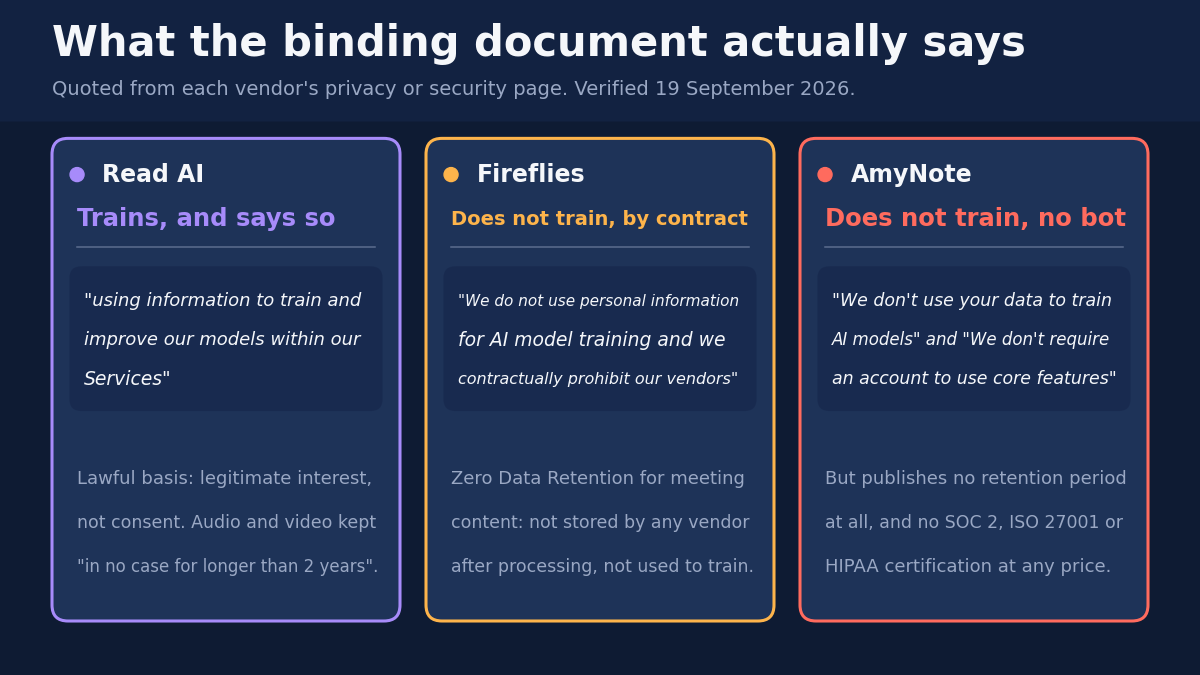
Weaknesses. The training position is the problem. Read AI’s privacy policy lists, among its uses of your information, “using information to train and improve our models within our Services.” The stated lawful basis is legitimate interest, not consent. Meanwhile the home page reads “SOC II certified, and no training on your data by default.”
The distinction between those two bases is the entire point, and it is easy to miss. Consent is something you give and can withdraw. Legitimate interest is a determination the vendor makes about its own interests, balanced against yours, and it does not require you to agree. The phrase “by default” on the home page implies a setting that can be checked; the policy describes a lawful basis that does not work that way.
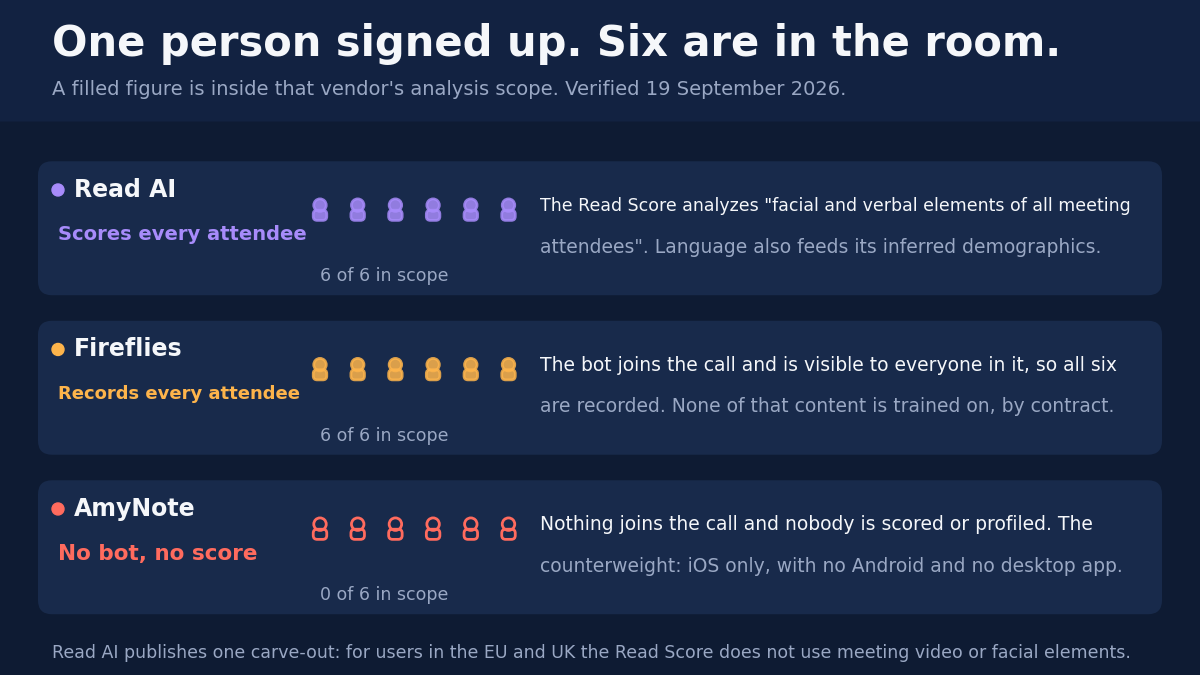
The scope is also wider than the account holder. The Read Score “involves analyzing facial and verbal elements of all meeting attendees”, and the policy adds that Read uses audio and visual information “as well as other information like language” to infer demographic characteristics. Most people in a recorded call never signed up for anything, never saw the policy and have no account to adjust. One carve-out is published: in the EU and UK the Read Score does not use video or facial elements.
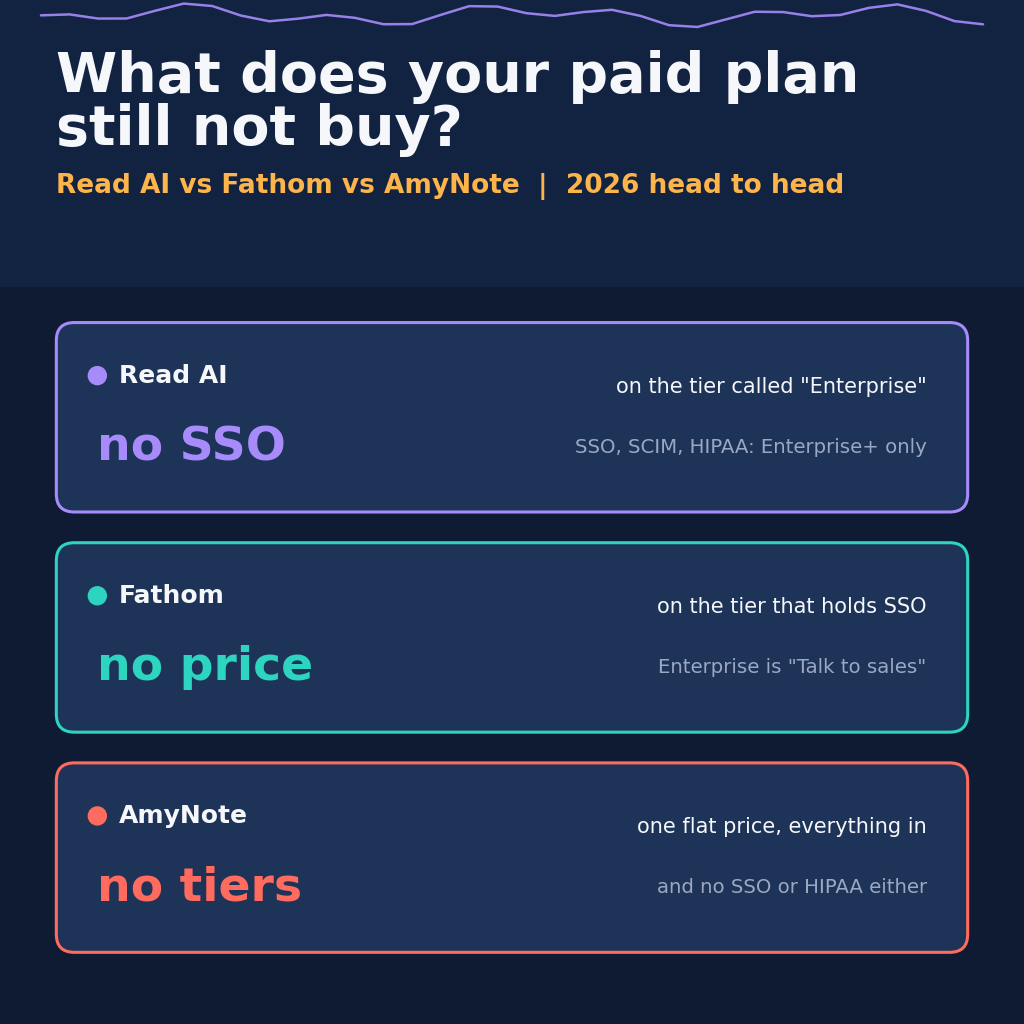
The tiering surprises too. In Read AI’s comparison table the row “Enterprise SSO + SAML” is em-dashed in the Enterprise column, as are SCIM, HIPAA Compliance and the Data Retention Policy control. All four unlock only on Enterprise+, which requires five licences. And one cap never lifts: “30 meetings measured per month” sits under every card, Enterprise+ included.
Fireflies: Strengths and Weaknesses
Strengths. The privacy sheet is the headline. Verbatim: “We do not use personal information for AI model training and we contractually prohibit our vendors from using this information for their own model training.” On top of that sits a Zero Data Retention policy for meeting content, covering audio, video, transcripts and summaries: not stored by any third-party vendor after processing, not accessed once the service completes, not used to train internal or external AI models.
The second half of that clause is the part worth noticing. Plenty of vendors promise not to train on your data themselves while routing it through a model provider whose terms say something else entirely. Extending the prohibition to vendors by contract closes the gap that most no-training claims quietly leave open.
The free plan is useful rather than bait: unlimited transcription, 100+ languages, API access, and desktop, iOS, Android and Chrome apps. The asterisk resolves in Fireflies’ favour, since the FAQ confirms no monthly rate limits on the bot or extension. Paid tiers are the cheapest here, $10 per seat annually for Pro and $19 for Business.
Weaknesses. Storage is where free bites: 400 minutes per team, not per seat. A five-person team does not get five allocations; it gets one, shared. Pro raises that to 8,000 minutes per seat and adds video recording; unlimited storage waits for Business.
Language is oversold on the card. It advertises 100+ languages, but the pricing FAQ qualifies it: “Currently English is the primarily language that is supported. We also support Spanish, French, Portuguese, Italian, and 100+ other languages in beta.” Mixed-language meetings need Multi-language Mode, a Business feature at $19 per seat. SSO, SCIM, audit logs, HIPAA compliance and custom data retention all sit on Enterprise at $39 per seat, a card stamped annual only.
Sign-up is narrow too: “Today sign in is only possible via Google Auth or Outlook Auth.” And a bot still joins your call, visible to everyone in it. That visibility cuts both ways — it is honest, in that nobody is recorded without seeing a participant appear, and it is a friction, in that some rooms will not tolerate one.
AmyNote: Strengths and Weaknesses
Strengths. Nothing joins the meeting. AmyNote records the room from an iPhone, so in-person conversations work the way calls do, and no participant is scored or profiled. Pricing is flat and per account rather than per seat: $12.99 a week, $19.99 a month or $99 a year, everything in, no licence floor. It transcribes 140+ languages and translates into 100+. Its security page states plainly that it does not train AI models on your data, does not sell meeting content, and does not require an account to use core features.
That last item is unusual enough to name directly. On the other two products, the first step is an account, which is a record of you that exists whether or not you ever record a meeting. On AmyNote, the core capture path does not create one.
Weaknesses. Judged by this article’s own standard, AmyNote loses rows. It publishes no retention period whatsoever, weaker than Read AI’s two-year ceiling and far weaker than Fireflies’ zero-retention policy. A promise not to train is not a promise to delete, and AmyNote currently makes only the first.
It holds no SOC 2, ISO 27001, HIPAA or GDPR certification, so what the other two gate behind Enterprise tiers, AmyNote does not sell at any price. It is iOS only, with no Android and no desktop, and there is no free tier, only a 3-day trial. Local-first is not local-only: when transcription or AI analysis runs, audio or text is uploaded and a processing copy may be retained. AmyNote does not claim TLS is end-to-end encryption.
Side by Side
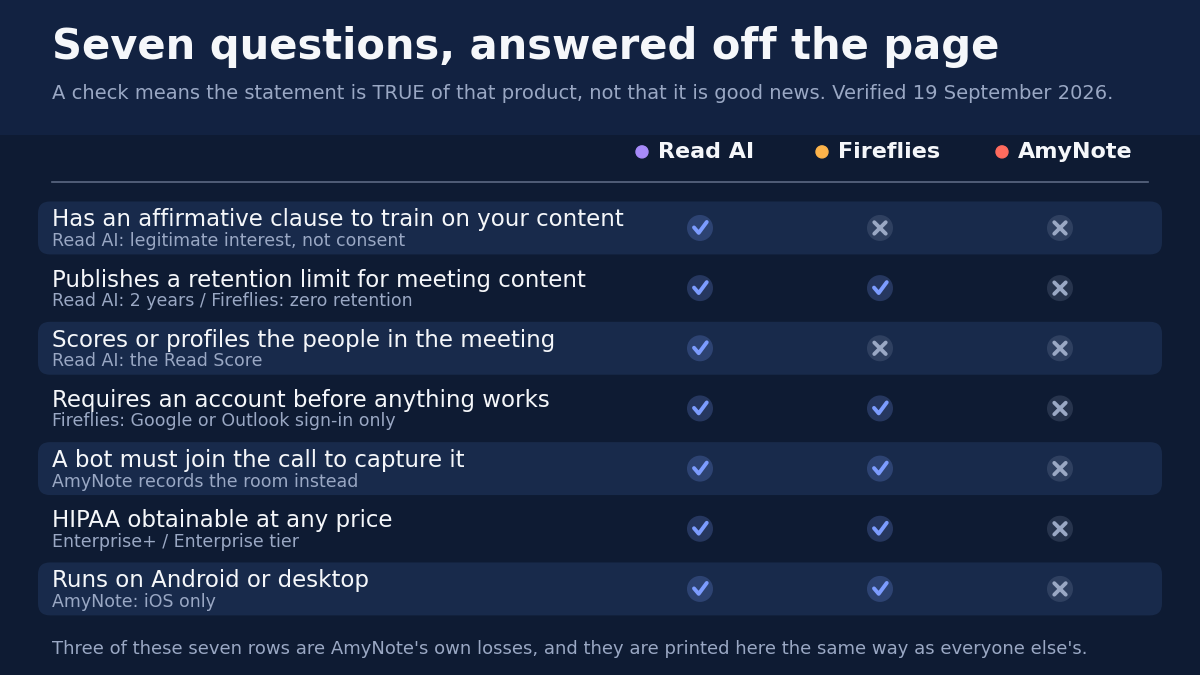
- Training clause. Read AI: affirmative, legitimate interest, no opt-out. Fireflies: prohibited for itself and its vendors. AmyNote: does not train.
- Retention. Fireflies publishes zero retention for meeting content. Read AI publishes a two-year ceiling, auto-delete on Enterprise+. AmyNote publishes nothing.
- Who gets analyzed. Read AI scores all attendees, including people who never signed up. Fireflies records everyone and trains on nobody. AmyNote scores nobody.
- Getting started. Read AI and Fireflies require accounts, and Fireflies takes only Google or Outlook sign-in. AmyNote needs no account for core features.
- Compliance. Fireflies sells HIPAA on Enterprise, Read AI on Enterprise+ with five licences. AmyNote does not sell it.
How to Read a Training Clause Yourself
This comparison will age. The method will not, and it takes about ten minutes per vendor.
Open the privacy policy rather than the security page, and search it for the words train, improve and models. Marketing pages say “we don’t train on your data”; policies say “to train and improve our models,” usually inside a list of purposes rather than under a heading you would notice. Then look for the lawful basis attached to that purpose. Consent and legitimate interest are not interchangeable, and only one of them is yours to withdraw.
Next, check whether the prohibition extends to subprocessors. A vendor that promises not to train itself, but says nothing about the model providers it routes your audio through, has made a narrower promise than it appears.
Then find the retention section and look for a number. “As long as necessary” is not a number. A ceiling in years is; zero retention is. And finally, ask who is in scope: the account holder, or everyone in the room. That question rarely appears in the pricing table, and it is the one the other participants in your meetings would most want answered.
The Bottom Line
Choose Fireflies if data handling is your first filter. Its no-training clause and Zero Data Retention policy are the strongest published commitments here, and the free tier costs nothing to try. Accept the bot in the call and the beta asterisk on everything that is not English.
Choose Read AI for platform coverage and a published retention ceiling, after reading the training clause and the Read Score section yourself. If HIPAA or SSO matter, budget for Enterprise+ and five licences.
Choose AmyNote if you want the meeting captured without a bot, a score, a seat count or an account: one flat price at amynote.app, every feature in. Transcription runs on OpenAI’s Speech API and analysis on Anthropic’s Claude Opus, both contractually barred from training on customer data, with TLS in transit and a local-first library on the device. The trial needs no credit card. Read the honest list first: iOS only, no certifications, no retention period published.
Originally published as an X Article by @AmyNoteApp.