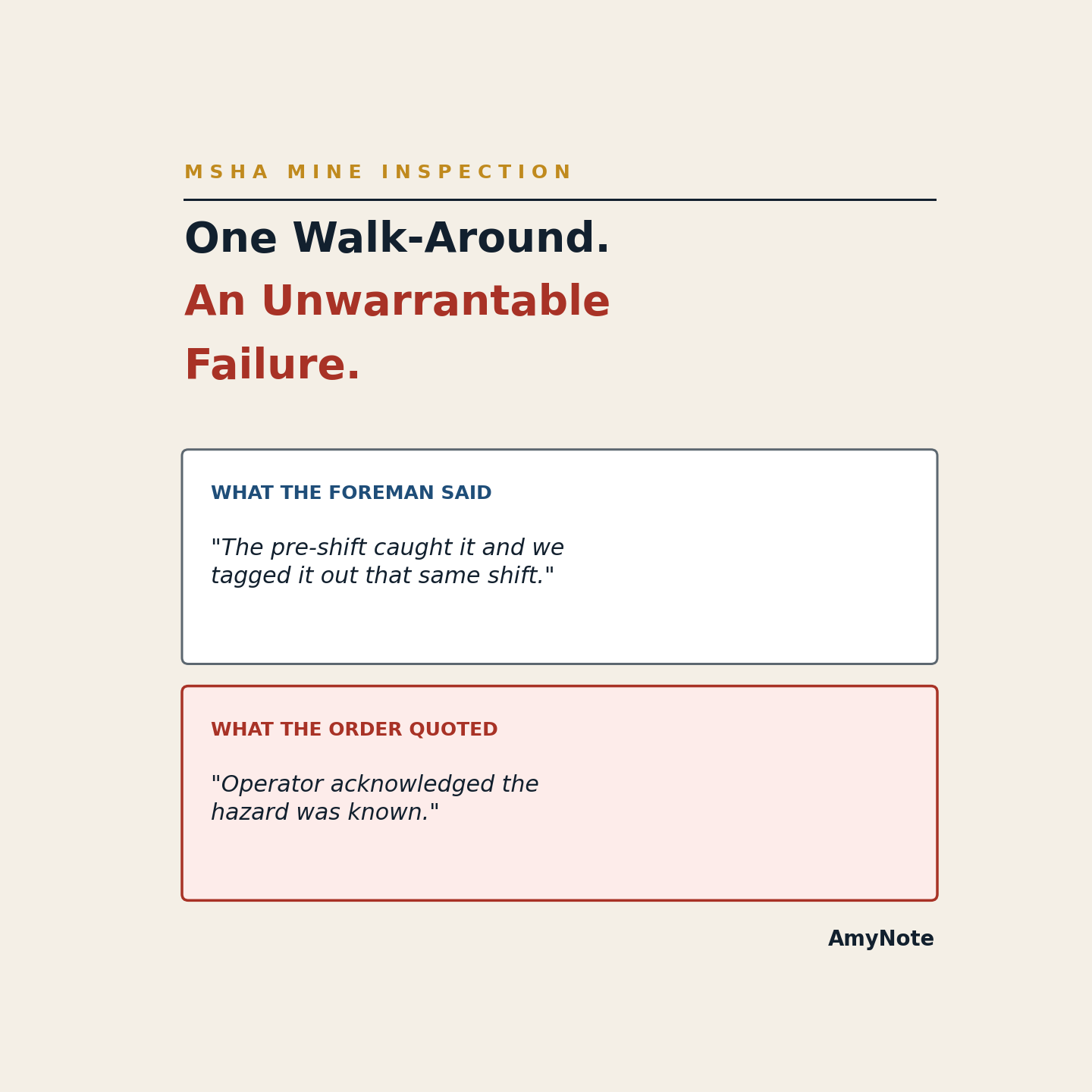
A safety director walks into the Area Office to talk through four citation items. Ninety minutes later he has agreed to an earlier abatement date on the machine guarding item and explained why the foreman was never told the interlock was bypassed. Nothing in that room was recorded, and the clock on his right to contest the citation kept running the entire time.
He did nothing wrong by going. The informal conference is one of the most useful things an employer can do after a citation lands. It is where classifications get discussed, penalties get negotiated and items sometimes get withdrawn, and it costs nothing but an afternoon. Nobody sensible skips it.
The problem is narrower than that, and it is structural rather than anyone’s fault. The rule that invites the employer into that room says two things about it that most safety directors learn exactly once: the meeting does not buy a single additional day, and nobody in it is required to write anything down.
The Clock Does Not Pause for the Conference
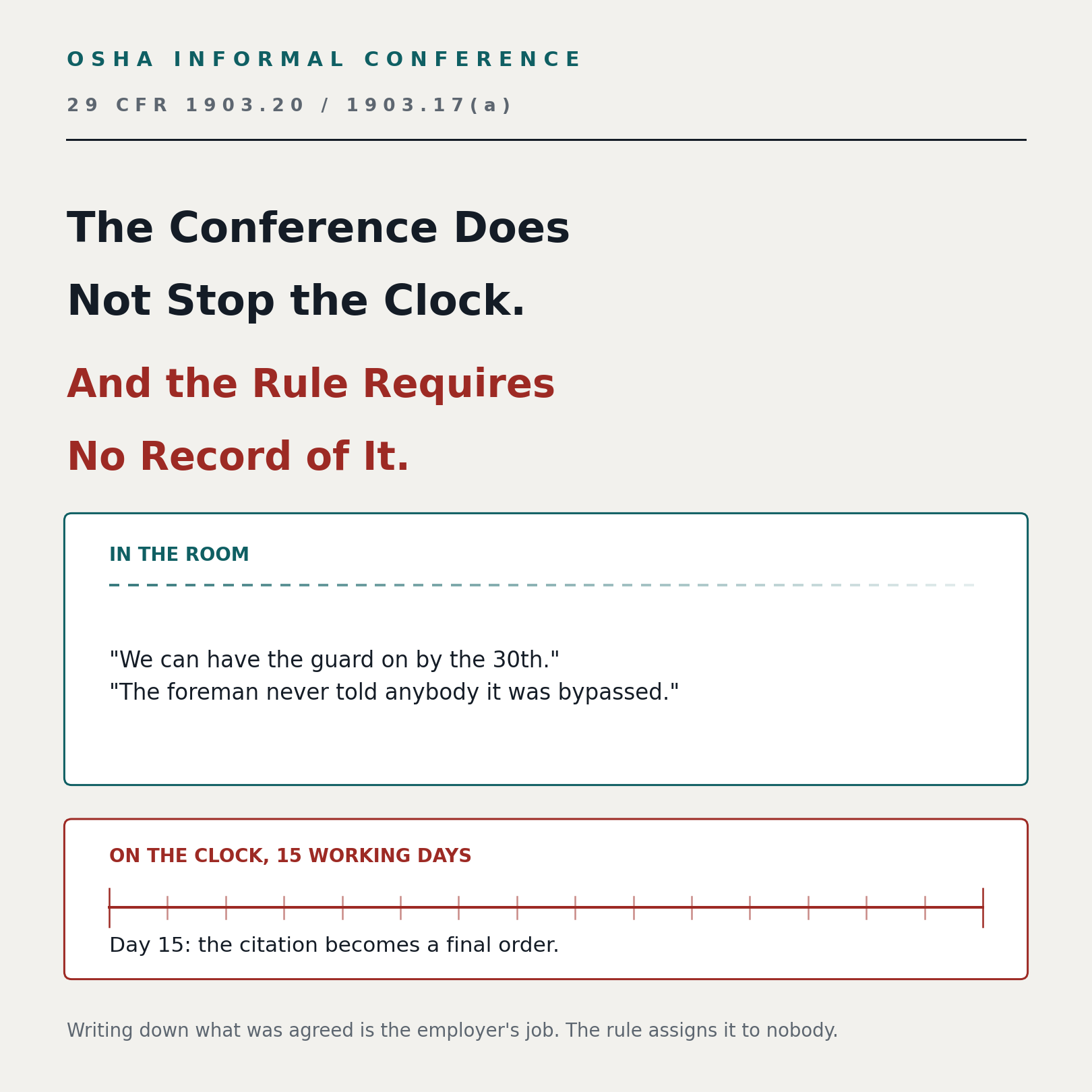
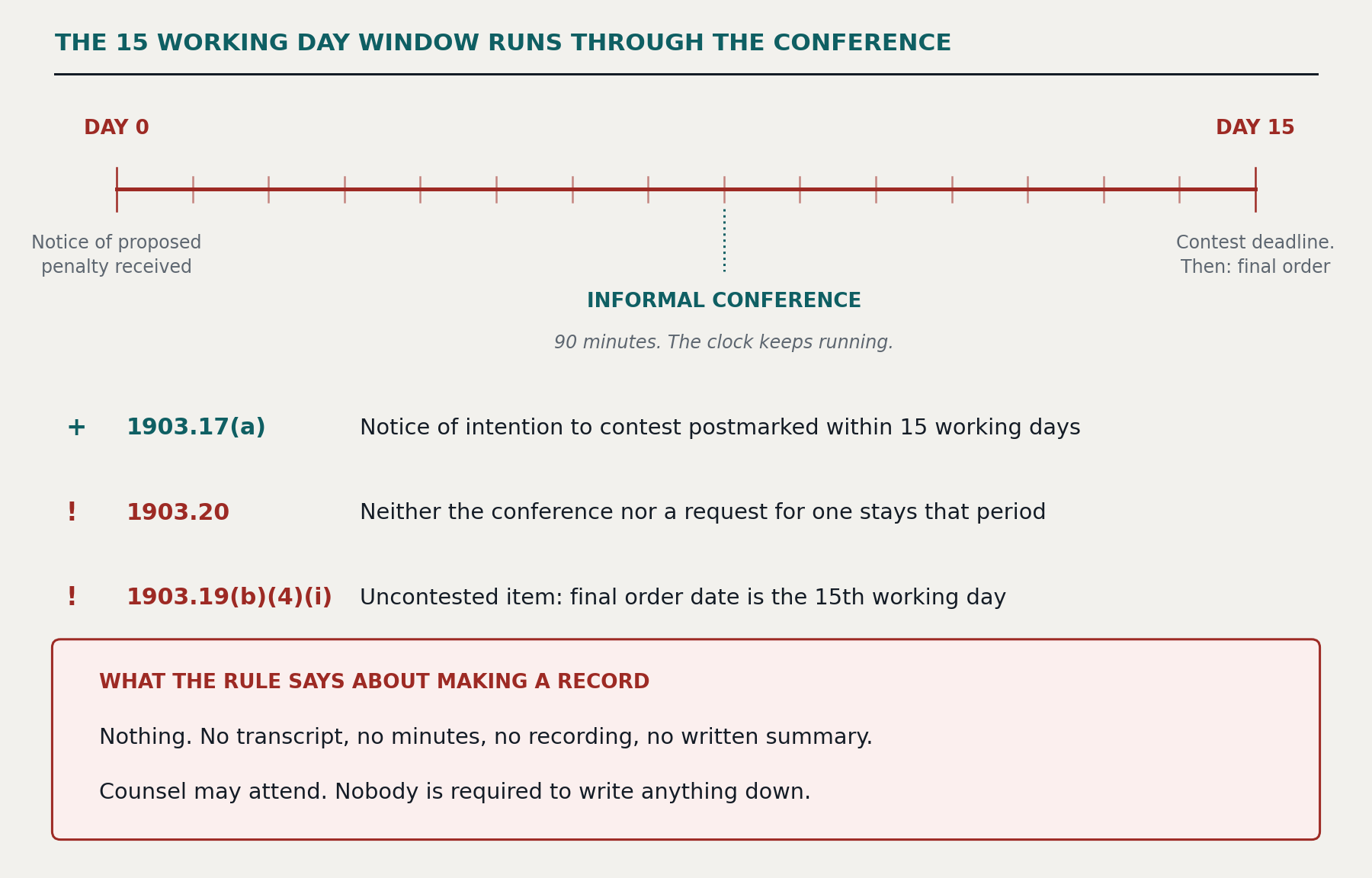
29 CFR 1903.20 lets an affected employer, employee, or representative of employees ask the Assistant Regional Director for an informal conference to discuss any issue raised by an inspection, citation, or notice of proposed penalty. The rule then closes with the sentence that costs employers cases: no such conference, and no request for such a conference, operates as a stay of the 15 working day period for filing a notice of intention to contest under 29 CFR 1903.17.
29 CFR 1903.17(a) requires that notice to be postmarked within 15 working days of the employer’s receipt of the notice of proposed penalty. Miss it and 29 CFR 1903.19(b)(4)(i) finishes the job: for an uncontested citation item, the final order date is the fifteenth working day after receipt.
A final order is not reviewable. That phrase is worth sitting with, because it is doing more work than it looks like it is. There is no motion to reopen on the ground that settlement talks were productive, no tolling for a conference the agency itself scheduled, and no discretion to consider the merits of an item that went final while everyone was being reasonable about it. The conference that felt like progress is the same conference that consumed the only window the employer had.
Notice that the conference and the deadline are not sequential. They occupy the same fifteen days. An employer who requests a conference, waits for a date, attends, and then waits to see whether the informal settlement agreement comes back in acceptable form has spent that window on a process the rule expressly declines to treat as a substitute for contesting. The safe posture is not to choose between the two. It is to prepare the notice of intention to contest on the assumption that the conference will resolve nothing, and to be pleasantly surprised.
None of this requires bad faith from anyone. Area Office staff are not running a clock down on purpose, and most conferences end in an agreement both sides are content with. But the employer walks in believing the discussion is the process, and the regulation treats the discussion as something happening alongside a process that never stopped running.
What the Rule Requires as a Record: Nothing
Read 1903.20 again and count the words devoted to documentation. There are none. No transcript, no minutes, no recording, no written summary, no requirement that either side confirm what was agreed. Any party may be represented by counsel. Nobody is required to write anything down.
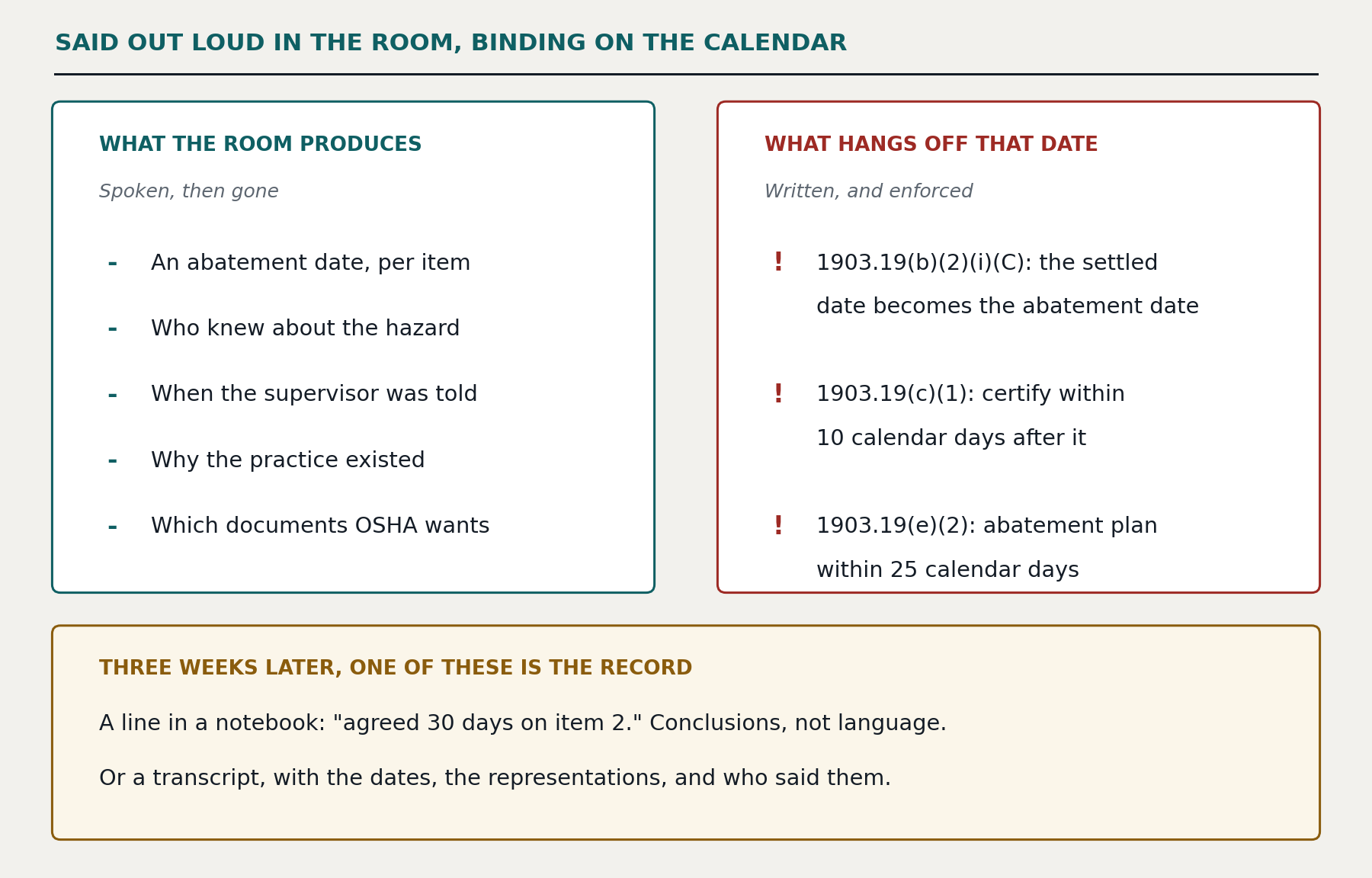
That silence matters because the conference produces binding terms. 29 CFR 1903.19(b)(2)(i)(C) treats the date established in a citation by an informal settlement agreement as the abatement date. From that date, 1903.19(c)(1) gives the employer 10 calendar days to certify that each cited violation has been abated, and 1903.19(d)(1) requires supporting documents for every willful or repeat violation and any serious violation the citation flags. An abatement plan, where the citation requires one, is due within 25 calendar days of the final order date under 1903.19(e)(2).
Every one of those deadlines runs from something said out loud in a room where no record was required.
Set that against the rest of the enforcement scheme and the asymmetry is obvious. The inspection generates a file. The citation is a written document served on the employer. A contest is docketed and litigated on a record before the Review Commission. The one proceeding in which the employer does most of the talking, and makes most of the commitments, is the only one that produces no document at all unless somebody decides to create one.
The consequence is not that the employer loses an argument. It is that three weeks later there is no shared text to argue from. Two people remember an afternoon differently and only one of them has an official file to remember it into.
Why Notes and Recall Fail Here
- Handwritten notes capture conclusions, not language. The safety director writes “agreed 30 days on item 2.” The Area Office file reflects that the employer represented the guard was already on order. Those are different facts, and only one of them survives.
- The explanation is the exposure. Employers narrate at these conferences: who knew what, and when the supervisor was told. Characterization of employer knowledge is the line between serious and willful. Nobody reconstructs that phrasing accurately three weeks later.
- The good faith showing gets built backward. A petition for modification of abatement date under 29 CFR 1903.14a(a) is available only where the employer made a good faith effort to comply and abatement was blocked by factors beyond its reasonable control. The evidence for that petition is the same conversation nobody captured.
The second of those deserves the most attention, because it is where an informal setting does the most damage. Employers are candid at these conferences, and candour is usually the right instinct: it is how penalties come down. But candour in a room with no transcript means the most consequential sentence of the afternoon — the one about what a supervisor knew and when — exists afterward only as somebody’s summary of it. The distance between “he was never told the interlock was bypassed” and “he had not been formally notified” is small in conversation and enormous in a classification fight.
Memory does not degrade evenly, either. What survives a month is the gist: the conference went well, they seemed reasonable about item 3. What disappears first is exactly the material the deadlines hang on — which date attached to which item, what was promised about documentation, and the precise words used about knowledge.
What Actually Works
The fix is not a court reporter. It is a complete, searchable record of a proceeding the rule leaves undocumented, plus the discipline to treat the contest deadline as independent of the conversation.
Three habits do most of the work. Calendar the fifteenth working day the moment the notice of proposed penalty is received, and treat the conference as something that happens before that date rather than something that moves it. Ask whether the session may be recorded, and capture your own side either way, including the internal prep call and the debrief in the parking lot. And hold the readout while the phrasing is still exact, not on the evening before the notice is due.
AmyNote records the conference on the phone already in the room and transcribes it with OpenAI’s Speech API, which holds up on the vocabulary that decides these cases: abatement, interlock, lockout tagout, feasibility, notice of proposed penalty, PMA. Speaker identification separates the Area Director, the compliance officer, counsel, and the employer’s own witnesses, so the transcript shows who committed to which date.
Anthropic’s Claude Opus then turns 90 minutes into the artifacts the deadlines actually require: every abatement date agreed and the citation item it attaches to, every representation the employer made about knowledge or training, every document the Area Office asked for, and the exact date the 15 working day contest window closes. Semantic search across sessions surfaces the earlier inspection where the same standard was cited, which is where repeat classification is won or lost.
Regulated employers ask about privacy first. Both OpenAI and Anthropic contractually guarantee zero training on user data. Audio is encrypted in transit and not retained after processing. Transcripts are stored locally on device with end-to-end encryption.
Recording rules vary by state and a federal office may decline. Ask, and write down the answer. A dated written request that went unanswered is a materially better position than a silence nobody can place in time, and the internal prep and debrief are yours to record regardless.
Getting Started
Before the next informal conference, decide who owns the record and who owns the calendar. Those are two different jobs and in most safety departments neither is assigned.
AmyNote runs on the phone in your pocket, transcription by OpenAI, analysis by Anthropic Claude Opus, transcripts encrypted on device, and zero training on your data. Walk out with the abatement dates, the representations, and the contest deadline written down while the citation is still contestable. amynote.app.
Originally published as an X Article by @AmyNoteApp.