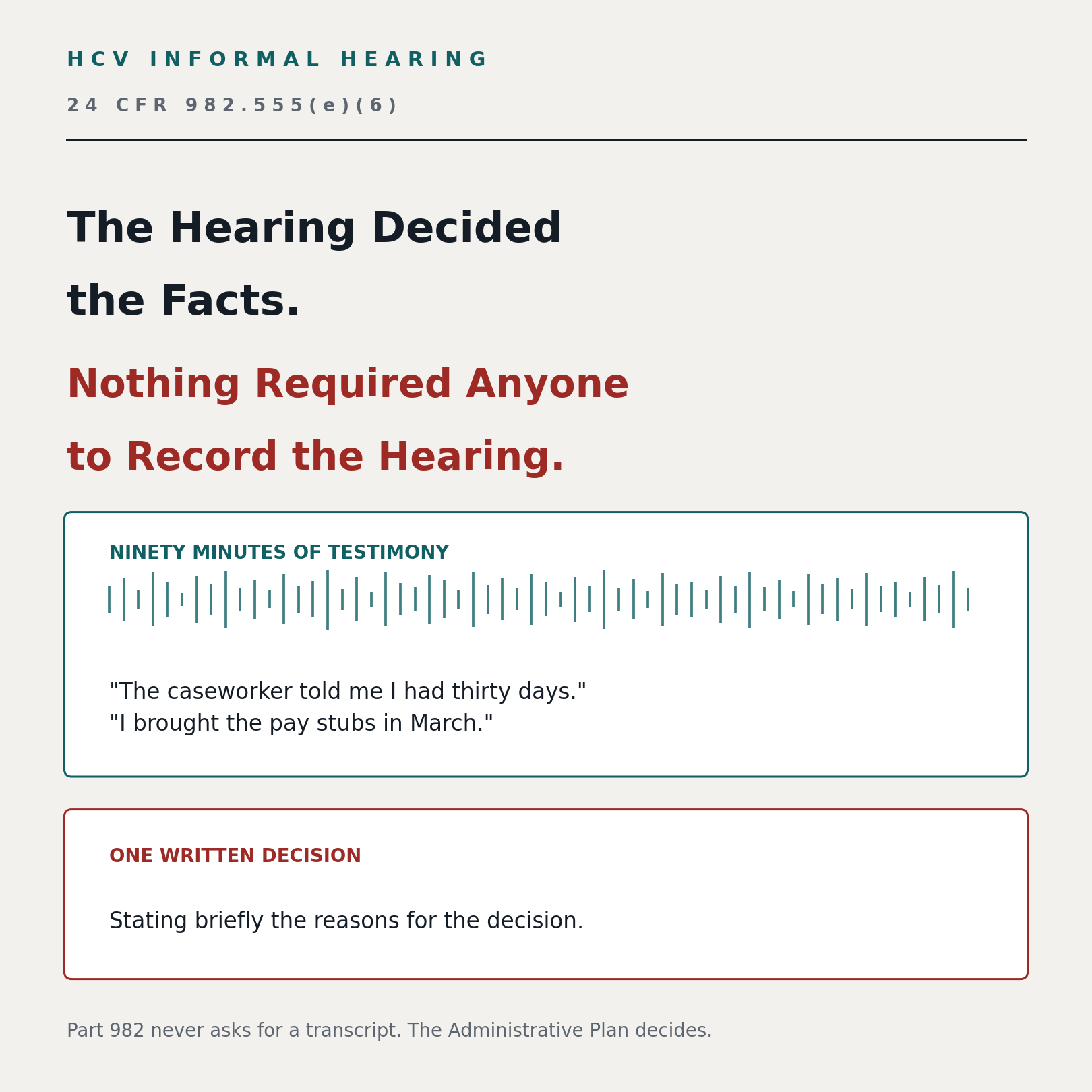
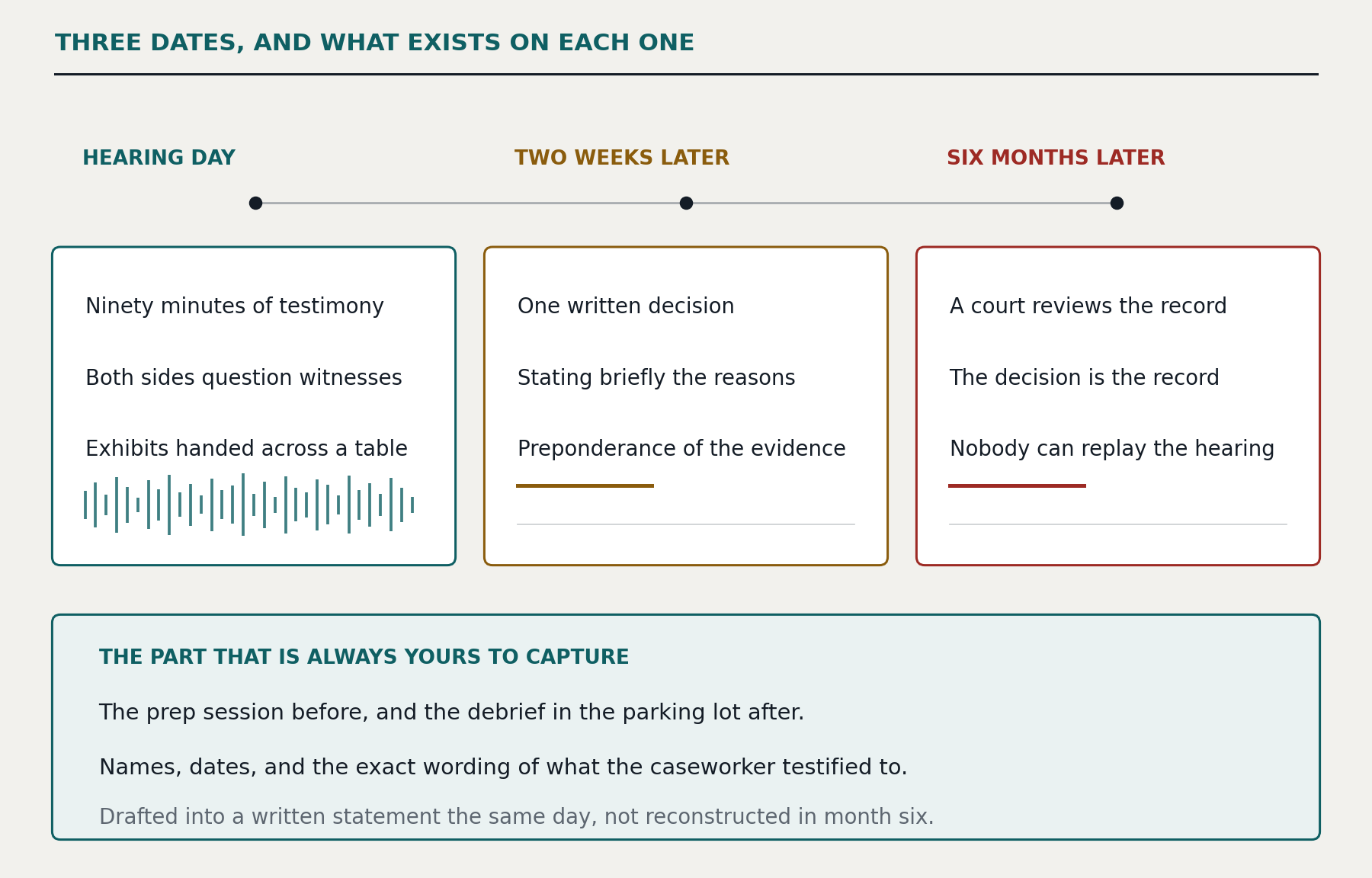
The hearing runs ninety minutes in a conference room at the housing authority. Your client explains that her caseworker told her she had thirty days to report the income change. The caseworker, sitting across the table, remembers saying something different. There is back and forth. A supervisor is called in. Somebody produces a printout.
Two weeks later a one page decision arrives terminating the voucher, and the only sentence touching that exchange reads: the family failed to report income in a timely manner.
Nobody recorded the hearing. Nobody was required to.
The Rule Decides Facts and Never Asks for a Record
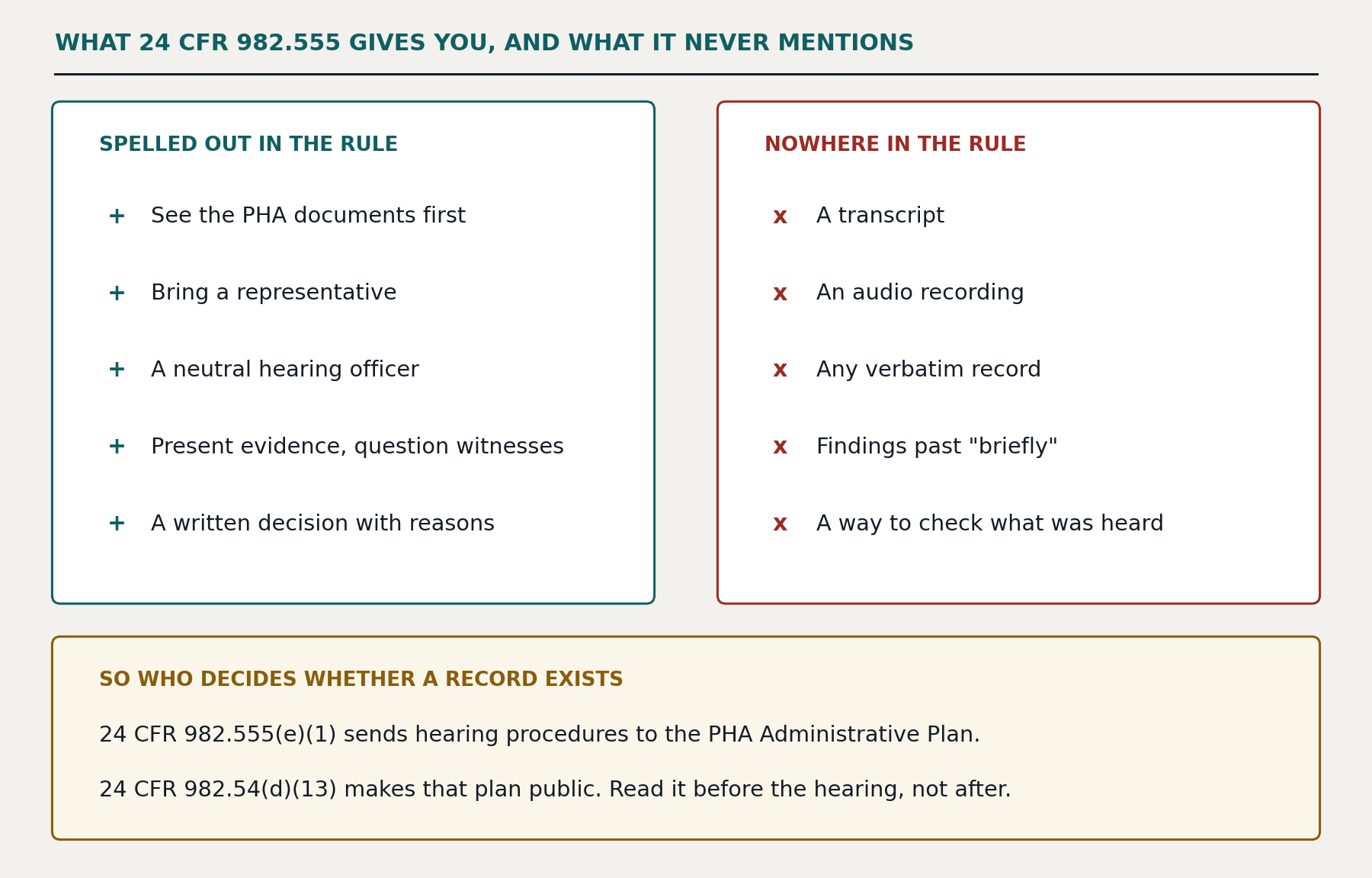
24 CFR 982.555 is where a family’s assistance lives or dies. Under 982.555(e)(5), the PHA and the family both get to present evidence and question witnesses, and evidence may be considered without regard to admissibility under the rules of evidence applicable to judicial proceedings.
Then 982.555(e)(6) sets the standard. Factual determinations relating to the individual circumstances of the family shall be based on a preponderance of the evidence presented at the hearing. The person who conducts the hearing must issue a written decision stating briefly the reasons for the decision.
Read those two sentences together and the problem is structural rather than accidental. The hearing is the evidentiary proceeding. Testimony given out loud in that room is the evidence that decides the case. And the entire required output of that proceeding is a decision that states its reasons briefly.
Part 982 never mentions a transcript, a recording, or a verbatim record. What the witnesses actually said is gone the moment the room clears.
What That Costs Six Months Later
A termination does not end at the hearing. Families seek review in state court, and a court reviewing an administrative decision reviews the record. When the record is one page, the one page wins.
Three things quietly evaporate between the hearing room and the courthouse:
- The concession. The caseworker acknowledges under questioning that the March paperwork was received at the front office. Everyone in the room hears it. It never appears in the decision, and there is nothing to point at afterward.
- The document nobody produced. Under 982.555(e)(2)(i), a PHA may not rely at the hearing on a document it declined to let the family examine beforehand. That is a real protection, and it is enforceable only if you can prove the objection was raised — which requires a record of the objection.
- The theory that moved. The notice gave a brief statement of reasons under 982.555(c)(2)(i). The decision rests on something else. Without a record, you cannot show the ground shifted underneath the family between the notice and the ruling.
None of these are exotic. They are the ordinary texture of a contested hearing, and each one depends on being able to say what was said.
Why the Usual Workarounds Fail
- Handwritten notes. You cannot question a witness and transcribe at the same time. Notes thin out at exactly the moment testimony turns favorable, because that is the moment you stop writing and start listening.
- The written decision. It is drafted by the person who ran the hearing, and the rule asks only for brief reasons. It is a conclusion, not a record, and it is written by someone with no obligation to preserve the parts that cut against it.
- Two memories. Advocate and client reconstruct different versions of the same admission inside a week. Neither is lying. The exchange simply was not built to be remembered in sentences.
- Assuming recording is prohibited. Usually it is not. 982.555(e)(1) sends hearing procedures to the PHA Administrative Plan, and 982.54(d)(13) requires that plan to cover informal hearing procedures and be available for public review. Many plans permit a party to record on request. Read the plan before the hearing, not after.
The Administrative Plan Is the Part You Can Actually Control
This is the piece most advocates never check until they need it. Whether a record of an HCV informal hearing exists is not a question of federal law — Part 982 delegates it. 982.555(e)(1) points hearing procedures at the PHA Administrative Plan, and 982.54(d)(13) requires that plan to address informal hearing procedures and to be available for public review.
Two practical consequences follow. First, the answer varies by housing authority, so the correct question is never “can hearings be recorded” but “what does this PHA’s plan say.” Second, because the plan is public, you can read it in advance of any particular case, once, and know the answer for every hearing you take at that authority afterward.
If the plan permits a party to record on request, the gap closes entirely, and the only cost is remembering to ask before the hearing rather than during it.
What Actually Works
Start with what the plan allows. Where the Administrative Plan permits a party to record, record.
Where it does not, the two conversations on either side of the hearing are entirely yours. The prep session with your client and the debrief immediately afterward are not the hearing, nobody’s permission is required, and they are the highest value ten minutes in the case. A debrief recorded in the parking lot, while the testimony is still exact, is the closest thing to a record you are going to get.
AmyNote records that on the phone already on the table. Transcription runs through OpenAI’s latest Speech API, which handles the vocabulary that breaks consumer tools: HAP contract, payment standard, subsidy standard, interim recertification, unauthorized occupant, family unit size. Analysis runs on Anthropic’s Claude Opus, so you can ask the transcript what the caseworker said about the March pay stubs instead of scrubbing an hour of audio.
Speaker identification separates the client, the caseworker, and the hearing officer, with cross session memory that carries across intake, prep, and hearing day. Semantic search spans every conversation in the matter, which matters when the informal review, the hearing, and the appeal sit months apart and the useful sentence was spoken in the first of them.
On privacy: both OpenAI and Anthropic contractually guarantee zero training on user data. Audio is encrypted in transit and not retained after processing. Transcripts stay local on the device with end to end encryption. No client’s income history or household composition sitting on a third party server.
Getting Started
Pull your housing authority’s Administrative Plan and read the informal hearing section before your next case, not after you lose one. It is public, it is short, and it answers the recording question permanently for that authority.
Then record the debrief — five minutes, while the testimony is still exact — and draft your written statement that day from a transcript instead of from memory.
AmyNote runs on the phone already in your pocket. The trial at amynote.app is three days with no credit card.
Originally published as an X Article by @AmyNoteApp.