The notice arrives by email on a Thursday. A proposed debarment, three paragraphs of alleged conduct, and an invitation to come present matters in opposition.
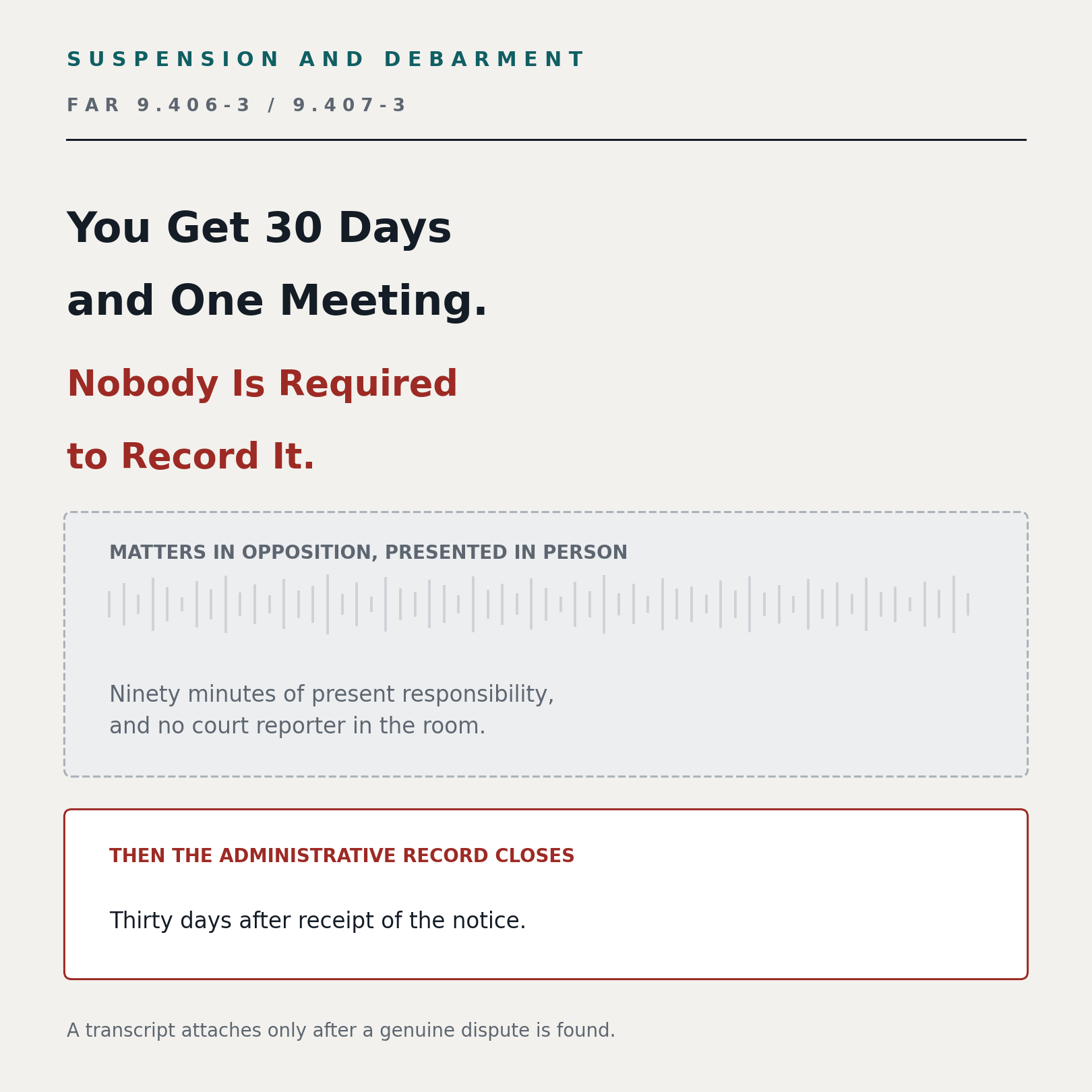
Counsel books the session. Ninety minutes, four people from the company, a slide deck, and no court reporter. What the suspending and debarring official decides is your access to the entire executive branch.
That is not the story of one badly run meeting. It is the predictable result of how the subpart is written — and understanding why matters more than complaining about it, because the gap is deliberate and it is not going to close.
The Presentation Is the Hearing
FAR 9.406-3(b)(1) sets the tone. Agency procedures shall be as informal as is practicable, consistent with principles of fundamental fairness, and they must give the contractor an opportunity to submit in person, in writing, or through a representative, information and argument in opposition to the proposed debarment.
The same paragraph lets the official use flexible procedures to allow a contractor to present matters in opposition in person or remotely through appropriate technology.
Section 9.406-3(c)(3)(iv) gives the contractor 30 days after receipt of the notice to submit that information and argument.
Section 9.406-1(b) puts the burden on you: if a cause for debarment exists, the contractor has the burden of demonstrating, to the satisfaction of the suspending and debarring official, its present responsibility and that debarment is not necessary.
Read those together and the shape of the problem is clear. Informality is a feature here, not a defect — the drafters deliberately avoided building a trial-type proceeding, and for most contractors that is a kindness. But informality cuts in a specific direction when the burden of proof is yours. The proceeding with the fewest procedural guarantees is the one in which you must affirmatively prove something about your own character, to the satisfaction of a single official, on a record you do not control.
The Transcript Is Conditional, and the Record Closes on Schedule
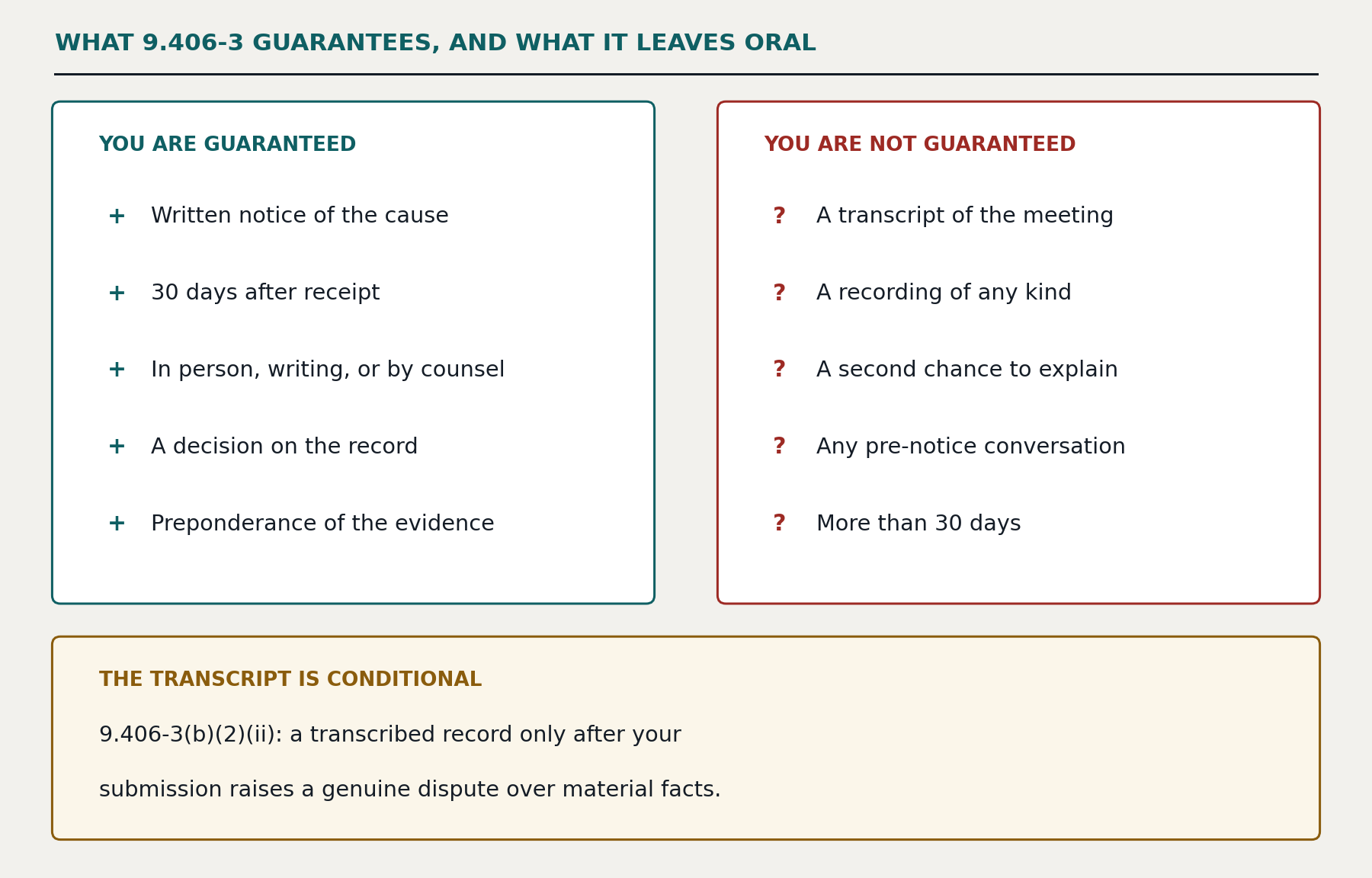
A transcribed record is not a feature of the presentation meeting. Under 9.406-3(b)(2) it attaches only in actions not based upon a conviction or civil judgment, and only if the contractor’s submission raises a genuine dispute over facts material to the proposed debarment.
Only then does 9.406-3(b)(2)(ii) require the agency to make a transcribed record of the proceedings and make it available at cost to the contractor upon request.
Notice the ordering, because it is the whole trap. Clear that bar and you get a transcript of the fact-finding that follows. The meeting where you tried to clear it is already over. The transcript is a reward for having successfully made an argument, not a record of the argument that earned it.
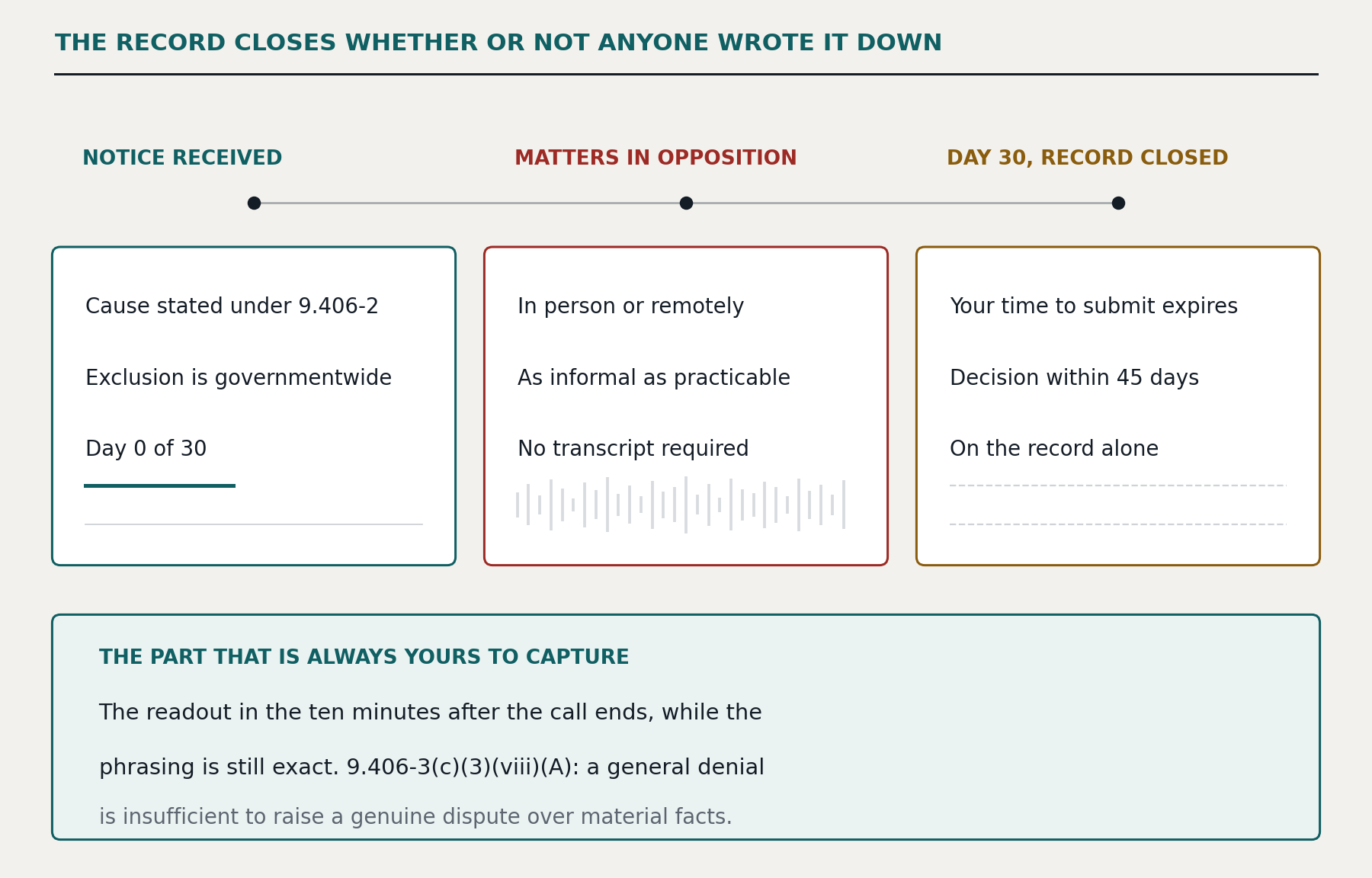
Section 9.406-3(d)(1) says the decision runs on all the information in the administrative record, including any submission made by the contractor. That record closes upon the expiration of the contractor’s time to submit information and argument in opposition, and if no suspension is in effect the decision follows within 45 days.
So the deadline is not a filing convenience. It is the moment the universe of things the official may consider stops expanding. Whatever your executives said out loud is in the record only if someone on your side turned it into a document before the clock ran out. After that, an accurate account of what was said in the meeting is not late evidence — it is no evidence at all.
Why the Usual Workarounds Fail
- Relying on a general denial. Section 9.406-3(c)(3)(viii)(A) demands specific facts that contradict the statements contained in the notice and states that a general denial is insufficient to raise a genuine dispute over facts material to the proposed debarment.
- Treating suspension as the slower case. Under 9.407-3(b)(1) the presentation happens following the imposition of suspension, and 9.407-3(c)(5) gives the same 30 days. You are already excluded while you prepare.
- Assuming the mitigation story carries itself. The factors in 9.406-1(a) include whether the contractor has fully investigated the circumstances and whether management recognizes, accepts, and understands the seriousness of the misconduct. Those live in what people say in a room.
- Waiting for a pre-notice letter. Under 9.406-3(h) a pre-notice letter is not required to initiate debarment under this subpart. The first conversation can also be the last one before the notice.
The third of those deserves emphasis, because it is where the record gap does the most damage. The present-responsibility factors are not documentary in nature. Whether management genuinely understands the seriousness of what happened is something an official infers from tone, candour and specificity in a live conversation — exactly the qualities that survive worst in a paraphrase written nine days later. A company can have the better case on the facts and lose the impression, and the impression is what 9.406-1(a) asks the official to weigh.
What Actually Works
Treat every contact with the official as the record it functions as. Ask whether the session may be recorded, and capture your own side either way, including the internal prep calls. Nobody needs permission to keep an accurate account of a conversation their own team just had, and a documented refusal is useful too — a dated written request that went unanswered is a materially better position than a silence nobody can place in time.
Hold the readout in the ten minutes after the call ends, while the phrasing is still exact, and write the submission from that instead of from partial notes on day 29.
Timing matters more than effort here, because memory does not degrade evenly. What survives a week is the gist: the official seemed worried about the compliance program. What disappears first is the part that decides the case — which control he named, in whose words, in answer to which question, and what your general counsel committed to in reply.
AmyNote captures it on the phone already sitting on the table. Transcription runs on OpenAI’s latest Speech API, which handles the vocabulary that breaks consumer tools: present responsibility, proposed debarment, mandatory disclosure, voluntary exclusion, preponderance of the evidence.
Analysis runs on Anthropic’s Claude Opus, so counsel can ask the transcript what the official actually pressed on instead of replaying ninety minutes the week the record closes. Speaker identification separates the official, agency counsel, and your own executives, and cross session memory carries the first call into every session that follows.
On privacy: both OpenAI and Anthropic contractually guarantee zero training on user data. Audio is encrypted in transit and not retained after processing. Transcripts stay local on the device with end to end encryption. No internal investigation detail sitting on a third party server.
Getting Started
Write the capture step into the mandatory disclosure and exclusion playbook now, before a notice starts a 30 day clock you cannot pause. Record every contact with the official and every internal prep session, hold a fifteen minute readout after each one, and build the submission from a transcript rather than from four sets of partial notes.
The subpart guarantees you a hearing and leaves the record to whoever thought to keep one. That part was always yours. AmyNote runs on the phone already in your pocket.
Originally published as an X Article by @AmyNoteApp.