A DEA Diversion Investigator walks into the pharmacy at 9:14 on a Tuesday morning with Form DEA-82 and an audit team. The Pharmacist In Charge is asked, on the floor, how she resolved four oxycodone prescriptions flagged in the last quarter. Two minutes per prescription, between counter interruptions and the technician asking about a verification. The DI writes longhand in a green notebook. The Memorandum of Investigation gets drafted weeks later from those notes.
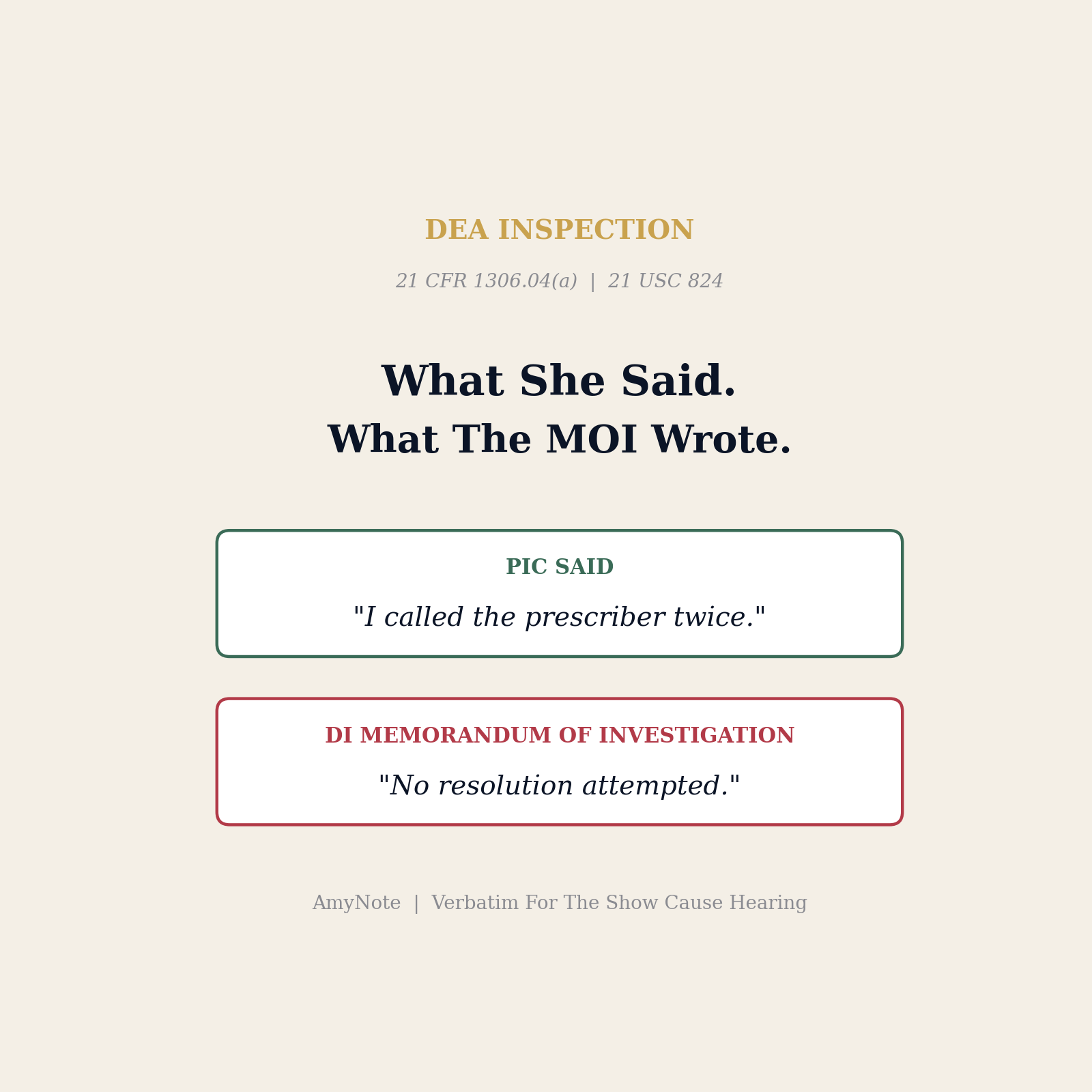
By the time the Show Cause Order arrives in the mail under 21 USC 824, the four prescriptions have already been narrativized. "Registrant unable to verify resolution at time of inspection." "No contemporaneous documentation of prescriber contact produced." The PIC remembers a phone call she placed to the prescriber's nurse on a Thursday morning, a PDMP query she ran while the patient stood at the counter, a counseling conversation about safe storage that ran four minutes longer than her queue allowed. None of those facts appear in the MOI in her words. They appear as the DI's compressed reading of them.
The Problem: The MOI Is The Case File
The Memorandum of Investigation is the case file. Every Show Cause Order seeking revocation or suspension of a DEA registration quotes the MOI's narrative version of what the registrant said during the inspection. The Administrative Law Judge at the Office of Administrative Law Judges hearing reads the MOI before any defense witness takes the stand. Opening briefs in registrant-defense cases are written against the MOI's findings of fact, not against the inspection itself.
The PIC's verbal answers move fast. A typical Diversion Investigator inspection covers cycle counts of every controlled-substance schedule, a Prescription Drug Monitoring Program audit, ARCOS reconciliation against the wholesaler distribution data the DEA already holds, dispensing records under 21 CFR 1304.04, biennial inventory verification, and live questions about resolution of red flag prescriptions under the corresponding-responsibility doctrine at 21 CFR 1306.04(a). The DI writes notes longhand. The full MOI gets drafted three to six weeks later from those notes, often by an investigator who was not in the pharmacy on inspection day.
What the PIC actually said about each red flag — including phone calls placed to the prescriber, PDMP queries run, patient counseling delivered, the conversation with the technician who took the original phone order — gets compressed into administrative shorthand. "Registrant unable to verify." "No documentation produced." "PIC could not articulate resolution protocol." Those phrases become the operative facts in the Show Cause Order seeking revocation of the DEA registration.
Why Current Solutions Fail
Most pharmacies rely on three things that do not survive inspection scrutiny.
- Memory. The PIC is asked about prescriptions filled six to twelve months earlier. Specific phone calls to specific prescribers, specific counseling conversations, specific PDMP queries blur together across hundreds of dispenses per week. Even a careful PIC cannot reliably reconstruct a four-minute conversation with a prescriber's medical assistant nine months after it happened.
- The dispensing software audit trail. The pharmacy management system logs the fill. It logs the prescription number, the NDC, the day's supply, the patient signature on the counseling acknowledgment. It does not log the conversation with the prescriber's office, the call-back that was promised by the PA at 11:40 that morning, the verbal confirmation of diagnosis that the PIC accepted under corresponding-responsibility before releasing the fill.
- Sticky notes and notebook entries. Resolution work that lives on a notepad next to the verification window does not transfer into the patient profile, does not get scanned into the document management system, and does not survive the next staff turnover. The MOI will note its absence as "no contemporaneous documentation of red flag resolution provided."
When the DI asks "what did you do to resolve this red flag," the answer needs a timestamp, a counterparty name, and an exact phrase. Reconstruction from memory at the OALJ hearing does not hold up against the MOI's contemporaneous-feeling narrative. The DI was the one taking notes in real time. The PIC was the one being interrupted by every other obligation of running a pharmacy floor.
What An OALJ Hearing Actually Turns On
Administrator's Show Cause hearings before the OALJ are not jury trials. The Administrative Law Judge weighs the MOI as the agency's contemporaneous record of what was said at inspection, and the defense bears the burden of producing evidence that the resolution work was actually performed. "The PIC testified at hearing that she telephoned the prescriber" reads very differently from "the PIC produced a contemporaneous audio recording of the resolution call placed to the prescriber on March 14 at 11:38 a.m."
The five-factor public-interest analysis under 21 USC 823(f) includes the registrant's experience dispensing controlled substances, compliance with state and federal law, and any other conduct threatening public health. A pattern of "unable to verify resolution" findings across multiple red flag prescriptions reads, to the Administrator, as a pattern of indifference to corresponding-responsibility. A pattern of timestamped resolution calls, with patient counseling segments and prescriber confirmations on tape, reads as the opposite. The same underlying pharmacy practice gets characterized one way or the other based entirely on whether the verbatim record survives.
What Actually Works
The fix is verbatim capture of the inspection interview itself, and of the underlying resolution calls when they happen at the counter. Both sides of the conversation, both halves of the case file. The inspection captures what was said to the DI on the day. The resolution-call archive captures what was actually done on the original dispensing day.
AmyNote runs on the PIC's phone or iPad behind the counter. Transcription is powered by OpenAI's latest Speech API, which handles drug names like hydromorphone, oxycodone, buprenorphine, alprazolam, and clonazepam at the accuracy a DEA case file requires — the difference between "schedule three" and "schedule four" is one syllable, and a transcription tool that gets that wrong is worse than no transcription at all. AI summaries and structured extraction run through Anthropic's Claude Opus, producing a per-prescription resolution log that maps directly to each fill in the dispensing system.
When the DI arrives with Form DEA-82, AmyNote captures the interview live with the DI's consent. The PIC walks through each flagged prescription using the resolution log she has been building all year. Phone calls to the prescriber surface with timestamps. PDMP query screenshots line up with patient counseling notes. The MOI that the DI later drafts has a parallel verbatim transcript that the defense file can use to either confirm or impeach every narrative finding the agency makes.
Both OpenAI and Anthropic contractually guarantee zero training on user data. Audio is encrypted in transit; processing copies may be retained to deliver and recover requested features. Transcripts and recordings are stored locally on the PIC's device with encrypted transport. Cloud processing copies are handled under the controls described in AmyNote’s Privacy Policy. No pharmacy data feeding model training pipelines. The privacy posture matches the discovery posture: the only people who see the recording are the people the PIC chooses to share it with.
The Show Cause Order still gets issued sometimes. Diversion Investigators have a job to do, and not every inspection ends in a clean exit interview. The difference is what the defense file looks like the morning after the SCO arrives. With memory and sticky notes, the defense file opens with a paraphrase of the PIC's testimony. With a verbatim record, the defense file opens with the audio.
The Documentation Pattern That Holds Up At Hearing
A defensible pharmacy workflow has four properties.
- Resolution work is captured the day it happens. The phone call to the prescriber's office, the verbal confirmation from the medical assistant, the patient counseling conversation about safe storage and disposal — recorded on the PIC's device with one-party consent under applicable state law, then attached to the prescription number in the patient profile within the same shift.
- The transcript is contemporaneous and searchable. Every adverse comment, every prescriber callback, every PDMP query is timestamped, searchable by prescription number, and retrievable in under a minute when the DI walks in with Form DEA-82 nine months later. Reconstruction from memory is not the workflow. Retrieval from an indexed archive is.
- The inspection interview itself is captured. With the DI's knowledge, the PIC records the on-floor interview so that the eventual MOI has a parallel record. When the MOI later compresses a four-minute answer into "registrant unable to verify," the defense file has the four minutes.
- The privacy posture matches the regulatory posture. Pharmacy records are PHI under HIPAA, sensitive under state pharmacy law, and discoverable in administrative proceedings. The transcription pipeline must be contractually zero-training, the audio must not be retained by third parties, and the transcripts must be encrypted at rest on the PIC's device. Anything less invites a second front of regulatory exposure on top of the DEA inspection itself.
Pharmacies that adopt this pattern do not change the DI's inspection cadence. They do not slow Form DEA-82 down. They eliminate the specific category of revocation case that turns on the gap between the PIC's actual work and the MOI's typed paraphrase of it — the category that converts otherwise diligent corresponding-responsibility practice into a Show Cause Order seeking the loss of the pharmacy's DEA registration.
Getting Started
AmyNote runs on iOS and macOS. Transcription by OpenAI's Speech API, AI by Anthropic's Claude Opus, audio processing copies may be retained to deliver and recover requested features by providers, everything stored locally on the PIC's device with encrypted transport. Three-day free trial, no credit card. Start using it the morning of your next inspection, or better, the first time a red flag prescription hits the counter today. The MOI will get written either way. The defense file is the difference between the verbatim and the paraphrase.
Originally published as an X Article.