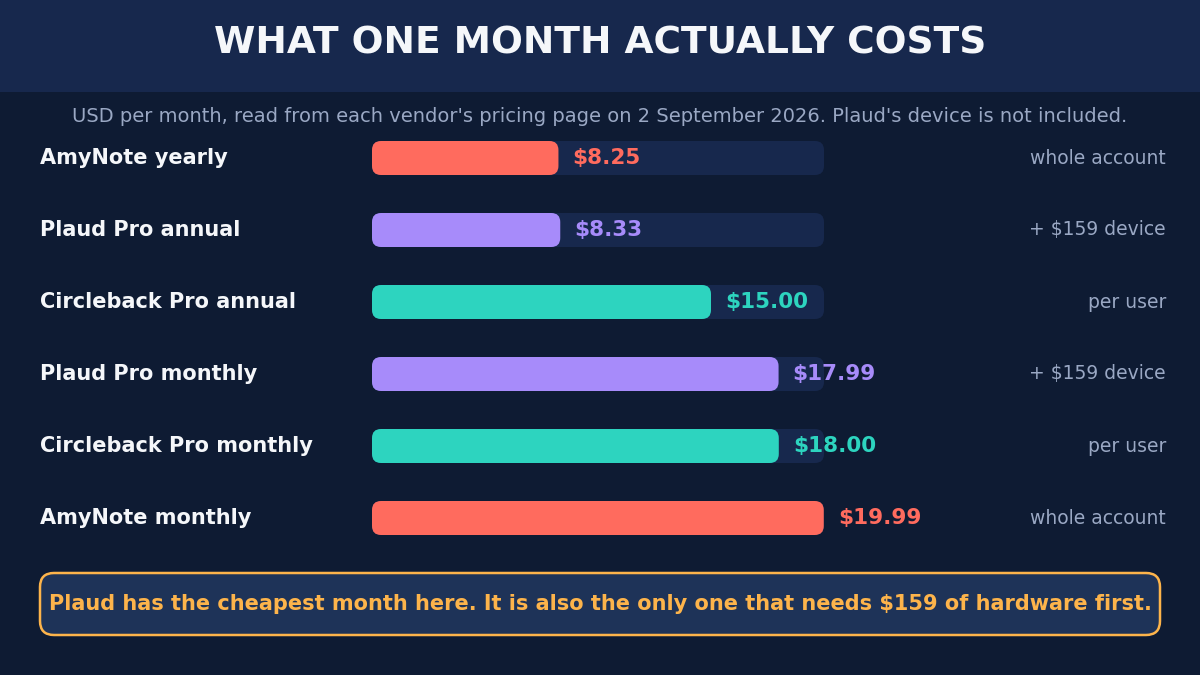
Plaud has the cheapest subscription in this comparison. Pro is 8.33 dollars a month on annual billing, which undercuts Circleback’s equivalent plan by almost half.
You cannot buy it on its own.
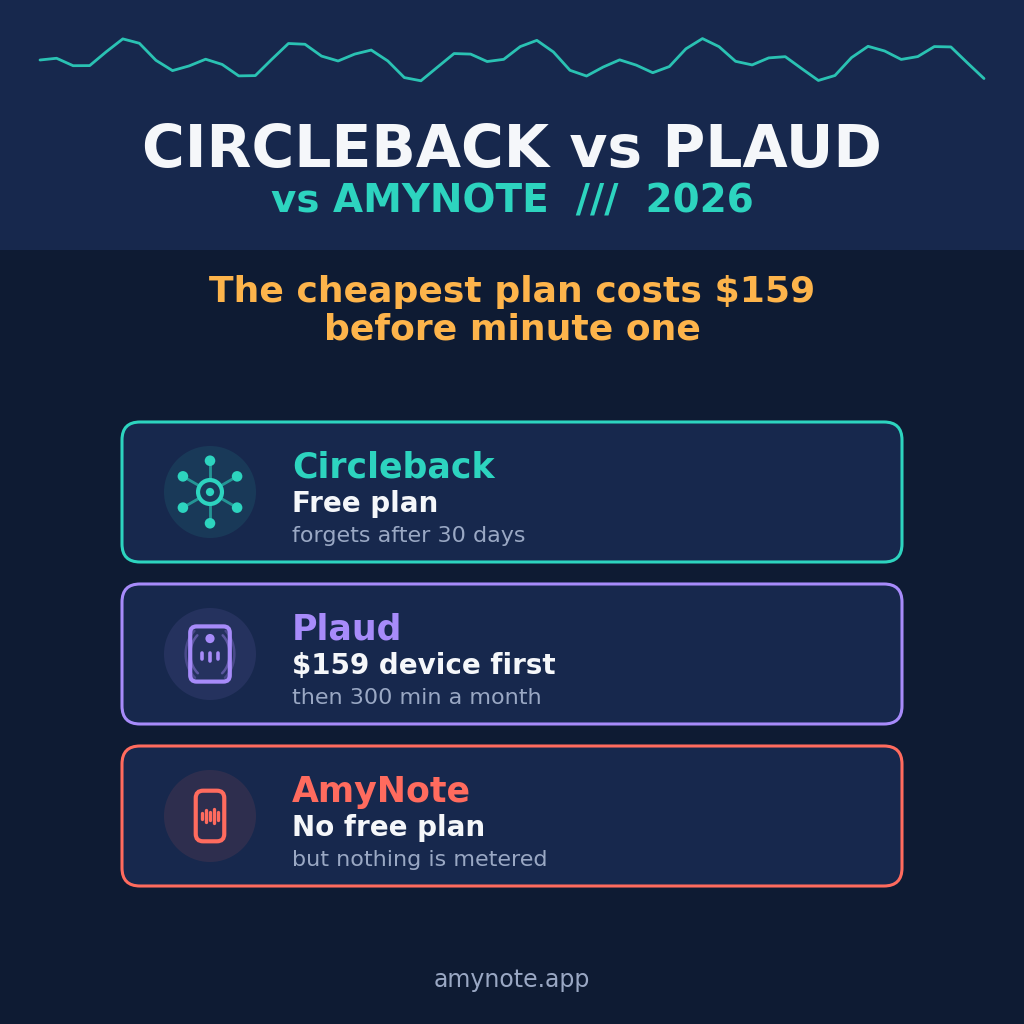
Plaud’s software runs on a Plaud recorder, and the cheapest one is 159 dollars. Even the free tier is not something you sign up for — it ships in the box. Plaud’s own FAQ says every device includes the Starter Plan at no extra cost, which is a generous way of saying the free plan has a 159 dollar entry fee.
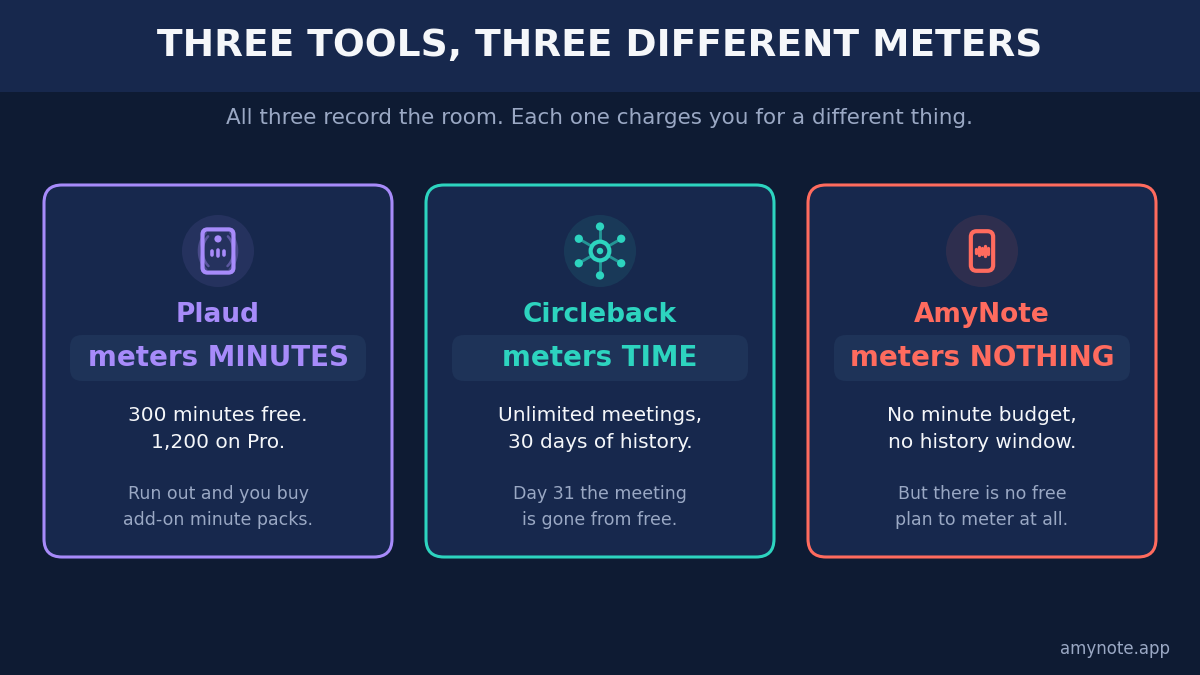
That is the shape of this comparison, and it is why the sticker prices mislead. All three tools can capture a conversation happening in a room, and all three meter something completely different. Plaud meters minutes. Circleback meters time. AmyNote meters nothing, and has no free plan at all.
The Quick Verdict
Choose Plaud if you record constantly, in rooms where a phone lying on the table is not good enough. The hardware is the product, and it carries the strongest compliance sheet here — HIPAA included, on every plan. Budget 159 to 249 dollars upfront plus a minute cap on top.
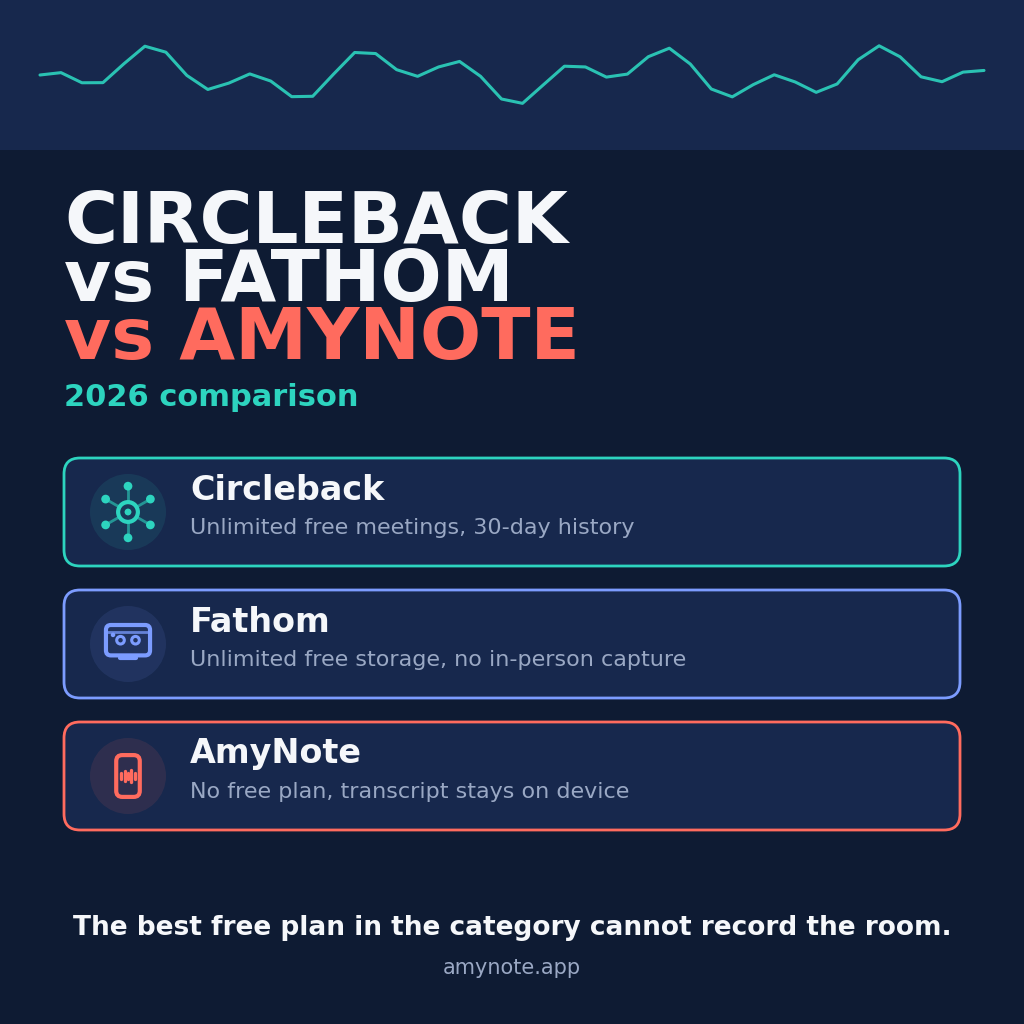
Choose Circleback if you want the most capable free plan and your meetings are mostly online. Free covers unlimited meetings with a bot or a bot-free desktop app, but forgets everything after 30 days, and HIPAA sits behind the top tier.
Choose AmyNote if the recording should never leave your phone. It is 99 dollars a year for the whole account rather than per seat, and keeps transcripts on the device. No free plan, and iPhone only.
What We Compared
Every price below was read from the vendor’s own pricing page on 2 September 2026, with the billing toggle clicked both ways. That detail matters more than it sounds. Circleback and Plaud both ship both price sets into the page at once, so a careless read returns the annual figure and calls it monthly — which is how a plan that costs 17.99 a month ends up quoted at 8.33 in a roundup.
Plaud restructured its pricing, and most published comparisons are now wrong. The repeated figures of 99 dollars a year for Pro and 239 for Unlimited still work as annual totals, but the page now leads with per-month equivalents, has added monthly billing at roughly double the rate, and lists a new Team plan that did not exist when most of those articles were written. Roundups that cap Plaud hardware at 179 dollars are stale for the same reason.
Feature claims come from published help center and policy text rather than from review sites, which in this category copy each other and go stale within a release cycle.
Circleback: Strengths and Weaknesses
Strengths. The free plan is the most generous starting point in this group. It covers unlimited meetings, online and in person, using either a calendar bot or a bot-free desktop app, and includes mobile and Apple Watch apps, speaker-labeled transcripts and over 100 languages.
It also has the widest integration surface here by a distance: an API, an MCP server, a CLI, and direct connections to Notion, HubSpot and Salesforce. If the point of recording a meeting is to get its contents into another system automatically, Circleback is the only tool in this comparison built around that assumption.
The privacy answer is the cleanest of the three. The published FAQ reads simply that it does not train AI models on customer data. No de-identification caveat, no opt-out buried in a settings pane.
Weaknesses. Free keeps 30 days of history and then the window closes, which makes it a trial with extra steps for anyone who wants a searchable archive. Storage is the real ladder here: Pro buys one year of recordings, Business two, and only Enterprise is unlimited. The thing you are actually paying Circleback for, past a certain point, is the right to keep what you already recorded.
Pricing is per seat and climbs quickly. Pro is 15 dollars per user per month billed yearly and 18 monthly, Business is 25 and 29, Enterprise is 35. HIPAA lives on that top tier, so regulated buyers go straight into a sales call rather than a checkout page.
Plaud: Strengths and Weaknesses
Strengths. The hardware does something no app can. The Note Pro records for 50 hours continuously, weighs about an ounce, and uses four MEMS microphones to pick up speech at up to 16.4 feet. The 159 dollar Note manages 30 hours and 9.8 feet. In a boardroom, a site visit or a long deposition, that reach is not a specification — it is the difference between a usable transcript and an unusable one.
The compliance sheet is the best here, and it is not gated behind a sales call. Plaud lists ISO 27001, ISO 27701, GDPR, SOC 2 Type II, HIPAA and EN 18031 as covering its plans, while Circleback reserves HIPAA for its 35 dollar tier. If you are a clinician or a lawyer, that difference decides the comparison before price enters into it.
The privacy policy is explicit rather than vague. Plaud commits to never using your audio, photos or text to train any AI model without your explicit and informed consent in advance, and says its agreements bar its model providers from doing the same.
Weaknesses. You have to buy the device: 159 dollars at minimum, 189 for the Note Pro, 249.99 for the Plaud One. Plaud Desktop is explicitly listed as requiring a device, so there is no software-only path in. Every price comparison involving Plaud is really a comparison of a subscription plus a purchase.
Then the minutes. Free gives 300 a month, which is five hours. Pro gives 1,200, which is twenty. Exceed either and you buy add-on minute packs on top of a subscription you already pay for. Twenty hours a month sounds ample until you count a week of client meetings.
Monthly billing is punishing. Pro is 17.99 month to month against 8.33 annually, a 54 percent penalty for not prepaying. And the new Team plan at 20 dollars per user is a launch price that ends on 30 November 2026, so it should not be treated as the long-run number.
AmyNote: Strengths and Weaknesses
Strengths. No hardware to buy and no bot to admit into the call. The iPhone in your pocket records the room — the same job Plaud does, without the 159 dollar entry fee.
It also has the broadest language coverage in this comparison: transcription in more than 140 languages and translation into more than 100, against Plaud’s 112 and Circleback’s 100 plus.
Pricing is flat and per account rather than per seat, at 12.99 a week, 19.99 a month or 99 a year. Nothing is metered, so there are no minute budgets and no history window. Nothing disappears on day 31, and a heavy month costs exactly what a light one does.
Transcription runs on OpenAI and analysis on Anthropic’s Claude Opus, and both contractually guarantee zero training on user data. Audio is encrypted in transit and not retained after processing, and transcripts are stored locally with end-to-end encryption.
Weaknesses. It is iPhone only — no Android and no desktop app — and there is no free plan, just a 3-day trial. It has no CRM integrations, no video recording, and no team administration, and it does not carry the formal certifications Plaud publishes. For a compliance officer who needs to see an audit report rather than read a policy page, that absence is the whole conversation.
Side by Side
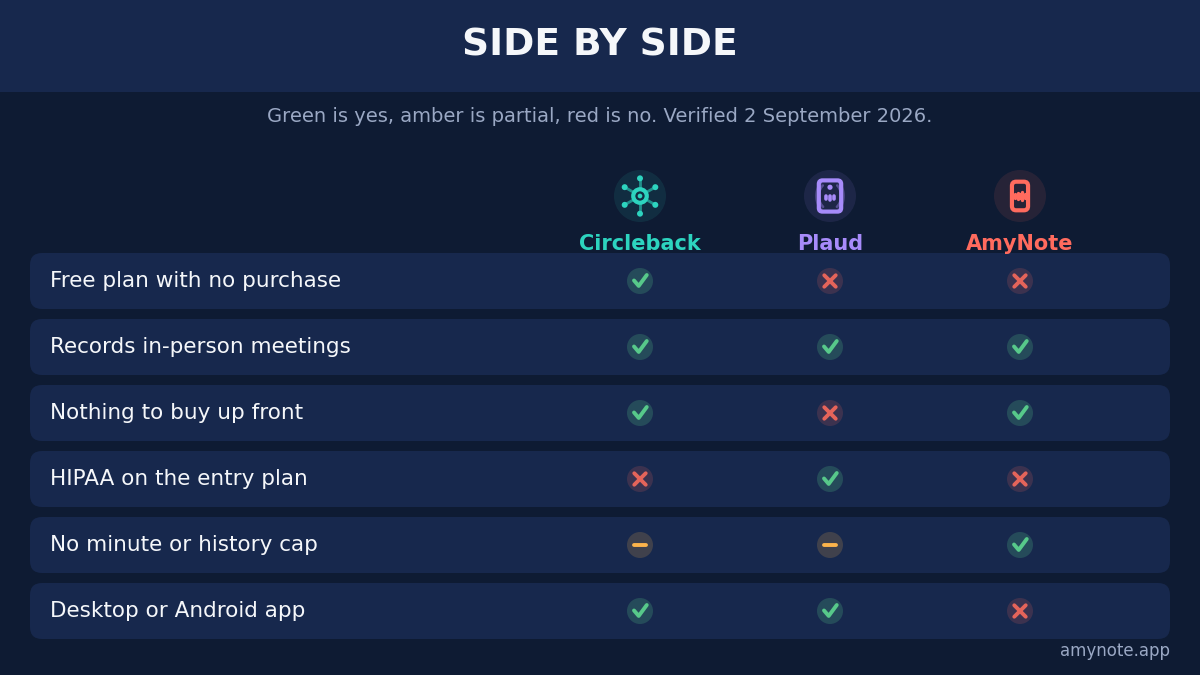
- Free plan. Circleback yes, unlimited meetings with 30 days of history. Plaud yes, but only once you own a device, capped at 300 minutes a month. AmyNote no, a 3-day trial.
- Hardware you must buy first. Circleback zero, Plaud 159 to 249.99 dollars, AmyNote zero.
- Cheapest paid plan, annual. Plaud Pro at 8.33 a month, AmyNote at 8.25, Circleback Pro at 15 per user.
- Month to month. Plaud Pro 17.99, Circleback Pro 18, AmyNote 19.99. The gap closes almost entirely when you refuse to prepay.
- What gets metered. Plaud meters minutes, Circleback meters retention, AmyNote meters nothing.
- Languages transcribed. AmyNote 140 plus, Plaud 112, Circleback over 100.
- In-person capture. All three, but only Plaud brings its own microphones.
- HIPAA. Plaud across its plans, Circleback at Enterprise only, AmyNote not offered.
- Platforms. Circleback desktop, mobile and Apple Watch. Plaud a device plus desktop and mobile apps. AmyNote iPhone only.
Three Buyers, Three Different Answers
A clinician recording patient conversations. HIPAA decides this one on its own. Plaud publishes it across its plans; Circleback puts it on a 35 dollar Enterprise tier that starts with a sales call; AmyNote does not offer it. The 159 dollar device stops being a barrier the moment the alternative is either a per-seat enterprise contract or a tool that cannot carry the workload at all.
A distributed team that lives on video calls. Circleback, and the free plan is a genuine starting point rather than a demo. Unlimited meetings, a bot-free desktop option, and an integration surface wide enough to push notes into Notion or HubSpot without anyone copying and pasting. Budget for the upgrade, though: the 30 day window is short enough that the first time someone needs a meeting from last quarter, you will be on Pro at 15 dollars a seat.
A solo practitioner whose meetings happen in rooms. This is the case the pricing pages handle worst. Plaud wants 159 dollars and then caps you at twenty hours a month on Pro. Circleback records the room but wipes it on day 31 unless you pay per seat for storage you are the only person using. AmyNote charges one flat 99 dollars a year for the account, meters nothing, and keeps the transcript on the device — at the cost of an iPhone requirement and no free tier to test the water beyond three days.
The Bottom Line
These three are not competing for the same buyer, and reading them as a price ladder produces the wrong answer.
Plaud is a hardware purchase with a subscription attached. If your work is conversations in rooms, the Note Pro and its compliance paperwork will pay for themselves once you are past the entry fee — and the minute cap is the number to watch, not the monthly price.
Circleback is the best free plan for online meetings, provided you accept a rolling 30 day window and per-seat pricing that scales with headcount rather than usage. It is also the only one of the three designed to feed other software automatically.
AmyNote sits in the gap between them. It records the room like Plaud, costs nothing upfront like Circleback, and meters neither minutes nor months. The tradeoffs are real and worth stating plainly: iPhone only, no free tier, no admin controls for teams, and policy commitments rather than published certifications.
If you want to record in-person conversations without buying a recorder or giving your archive a 30 day expiry date, the trial at amynote.app runs three days with no credit card.
Originally published as an X Article by @AmyNoteApp.