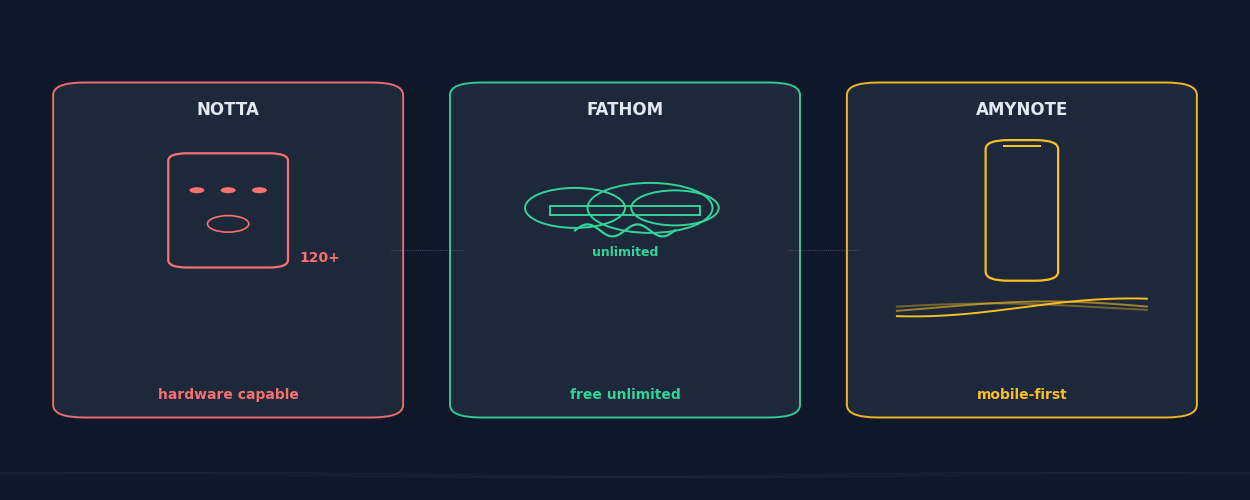
Three very different shapes solve three very different problems. Plaud Note Pro is a premium dedicated gadget — a 0.95-inch AMOLED pocket recorder that costs real money up front and asks for a subscription on top to turn audio into anything useful. Notta is a SaaS dashboard that started life as a meeting bot and now sells a 28-gram handheld recorder on the side for people who want hardware optionality. AmyNote skips the hardware entirely and runs on the phone you already own, leaning on contractual zero-training guarantees from the AI providers themselves rather than building its own model stack.
This is a fair three-way comparison, with honest weaknesses for each side. Pricing and specs are pulled from each vendor's published pages as of June 2026. No tool wins every column. Pick for the shape of your conversations, not the length of the feature list.
Quick Verdict
If you live in coffee-shop meetings and want a premium dedicated gadget with phone-call pickup, Plaud Note Pro is the most polished hardware story on the market. If you want a cheap SaaS plan plus an optional 58-language pocket recorder for the road, Notta is the most flexible combo. If you do not want a second device on the table and you care about zero-training privacy guarantees from the AI providers themselves, AmyNote is the simplest answer.
What We Compared
This comparison covers three things any buyer actually cares about: total cost in the first 12 months, capture flexibility (in-person, phone calls, video meetings), and what the vendor does with your audio. Where the vendors publish actual numbers, we cite them. Where the spec sheets fade into marketing copy, we say so.
Plaud Note Pro: Premium Hardware, Cloud AI
Strengths. The Plaud Note Pro is a $189 credit-card-sized recorder with a 0.95-inch AMOLED display, 4 MEMS microphones plus a voice pickup unit, 64GB of storage (about 400 hours of audio), and up to 50 hours of continuous recording. It auto-switches between phone-call mode (vibration capture against the phone back) and in-person ambient mode, which is genuinely useful if a chunk of your day is on calls. The industrial design is the best in this category — thin enough to live in a wallet pocket, with a small color display that tells you at a glance that the recorder is actually recording.
Weaknesses. The hardware is one bill, then the AI is another. Free transcription caps at 300 minutes per month. Pro is $99.99 per year (1,200 minutes per month). Unlimited is $239.99 per year. A new Team plan launched at $20 per user per month annual billing, rising to $25 in September. There is no real-time transcription on the device, no live translation, and if you forget the recorder at home you are back to thumb-typing notes. You are also trusting Plaud's cloud with raw audio for the AI step, which is fine for a casual coffee chat and meaningfully less fine for anything privileged or regulated.
Notta: SaaS-First, Hardware Optional
Strengths. Notta started as a meeting-bot SaaS and now sells the Notta Memo, a 28-gram handheld recorder for $149 with a 30-hour battery, 32GB storage, and transcription/translation across 58 languages. The software side is the cheapest of the three: Free includes 120 minutes per month, Pro is $8.17 per month billed annually ($97.99 per year) and unlocks 1,800 minutes per month. Business adds shared workspaces and CRM integrations at $16.67 per seat per month annually. If you mostly take Zoom and Meet calls, you can skip the hardware entirely and run the bot from a browser tab.
Weaknesses. Notta's headline 98.86% accuracy claim is anchored on Japanese, where it really does shine. Independent reviews in 2026 describe English and Spanish accuracy as patchier, with frequent speaker misattribution on three-or-more-person calls. The free plan caps any single recording or file at three minutes, which is closer to "demo" than "use." The Memo device does not auto-detect language — you have to pick it before the conversation starts, which is awkward for multilingual offices. And the SaaS half is a classic cloud product: transcripts live on Notta's servers, not on your phone, which matters more in regulated industries than it does for a general SMB user.
AmyNote: Phone-First, Bot-Free, Zero-Training
Strengths. AmyNote skips the hardware entirely. Transcription runs through OpenAI's latest Speech API, AI analysis runs on Anthropic's Claude Opus, and both providers contractually guarantee that user data is never used for model training. Audio is encrypted in transit; processing copies may be retained to deliver and recover requested features. Transcripts and recordings live locally on the device with encrypted transport. The app supports 120+ languages with real-time translation, remembers speakers across meetings, and works equally well for in-person conversations, phone calls held on speaker, and live audio from a laptop. A 3-day free trial requires no credit card.
Weaknesses. Be honest: AmyNote is mobile-first, which means no native desktop app yet. There are no CRM integrations like the ones Notta Business ships, no video recording (Notta and the hardware recorders do not record video either, but tl;dv and Fathom do), no team or enterprise tier yet, and the brand is smaller than Plaud's or Notta's. If your workflow is built around a Salesforce sync, you are not the buyer this year. If your meetings live in a twelve-person boardroom and the phone has to sit at one end of the table, a dedicated four-mic recorder will still pick up the far corner better than a single phone microphone.
Side-by-Side Comparison
| Dimension | Plaud Note Pro | Notta | AmyNote |
|---|---|---|---|
| Form factor | $189 AMOLED hardware | SaaS + optional $149 Memo | Phone-only, no hardware |
| Cheapest AI plan | $99.99/year Pro | $97.99/year Pro | Trial then flat subscription |
| Free tier | 300 min/mo | 120 min/mo, 3-min file cap | 3-day full-feature trial |
| In-person capture | 4 MEMS mics + VPU | Memo handheld, 30h battery | Phone microphone |
| Phone-call capture | Vibration mode (standout) | Memo slide-switch mode | Speaker-phone audio |
| Video meeting capture | Play through device | Native Zoom/Meet/Teams bot | Play through phone |
| Languages | 112 | 58 (Memo) | 120+ with translation |
| Real-time transcription | No | SaaS yes, Memo offline-first | Yes |
| Transcript storage | Cloud | Cloud | On-device, encrypted in transit |
| Model-training opt-out | SOC2 / ISO 27701 cloud | SOC2 cloud | Contractual zero-training |
| Setup friction | Buy device, pair, subscribe | Sign up, install bot, optional Memo | Install and record |
- Hardware cost. Plaud Note Pro $189, Notta Memo $149, AmyNote $0.
- Cheapest AI plan. Plaud Pro $99.99/year, Notta Pro $97.99/year, AmyNote free trial then a single subscription with no minute caps.
- In-person capture. Plaud and Notta Memo both shine here. AmyNote uses the phone's mic, which is fine for one table but weaker for a 12-person boardroom.
- Phone-call capture. Plaud's vibration mode is the standout. Notta Memo has a slide-switch mode for calls. AmyNote captures speaker-phone audio.
- Video meeting capture. Notta has a native bot for Zoom/Meet/Teams. Plaud and AmyNote need you to play meeting audio through their respective device or phone.
- Languages. Plaud 112, Notta Memo 58, AmyNote 120+.
- Real-time transcription. AmyNote yes. Notta SaaS yes, Notta Memo offline-first then sync. Plaud no.
- Where transcripts live. Plaud cloud, Notta cloud, AmyNote on-device with encrypted transport.
- Model-training opt-out. Plaud SOC2 / ISO 27701 but cloud-processed. Notta cloud-processed with SOC2. AmyNote inherits OpenAI and Anthropic's contractual zero-training guarantees.
- Setup friction. AmyNote is "install and record". Notta is "sign up, install bot connector, optionally buy Memo". Plaud is "buy device, wait for shipping, pair, subscribe".
How To Pick
Map a normal week. Count how many conversations happen on Zoom, Meet, or Teams. Count how many happen in person across a table, on phone calls, or in places where opening a laptop would be inappropriate. Count how many involve external attendees who would not appreciate a visible cloud-bot tile on the participant grid. That breakdown picks the tool.
If half your week is video calls and you want the cheapest path that still covers some hardware optionality, Notta Pro at $97.99 per year plus an optional Notta Memo on the road is the most flexible combo. If your week is dominated by in-person meetings and phone calls and you want a premium dedicated gadget with the best phone-call pickup in the category, Plaud Note Pro at $189 plus the Pro subscription is the best hardware-first answer. If your conversations are sensitive enough that you want zero-training guarantees from the AI providers themselves and you do not want a second device to charge, AmyNote on the phone in your pocket is the simplest answer with the strongest privacy posture.
For many teams, the honest answer is not one tool. It is one hardware recorder for the boardroom and one phone-first app for everything else — or one cloud-bot SaaS for scheduled video and one phone-first app for the in-person half of the week.
The Bottom Line
Pick Plaud Note Pro if you want a premium dedicated gadget, you take a lot of phone calls, and you are happy paying $189 up front plus $100 a year for the AI to be useful. The AMOLED display and dual-mode capture are genuinely best in class.
Pick Notta if your meetings are split between Zoom and the real world, you want the cheapest SaaS in this group, and you would rather pay $97.99 a year for 30 hours of transcription per month than commit to a hardware-first ecosystem. The Memo is a nice add-on, not a requirement.
Pick AmyNote if you want the simplest possible answer to "capture this conversation, transcribe it accurately, summarize it with Claude Opus, and do not let anyone train a model on it." No hardware to charge, no bot joining the call, no transcripts sitting on a vendor's S3 bucket. Just open the app, hit record, and read the summary on the train home. Start the 3-day trial at amynote.app, no credit card needed, and decide for yourself whether the phone in your pocket is enough.
No tool is perfect. Pick for the shape of your meetings, not the length of the feature list.
Originally published as an X Article.