An employee stops at an HR business partner’s desk on a Tuesday afternoon. A new medication makes early mornings unmanageable, and they ask whether the 7 a.m. shift could start at 9 instead. It is not framed as a legal request. There is no form, no email, no meeting invitation — just a person explaining a problem on the way past a desk.
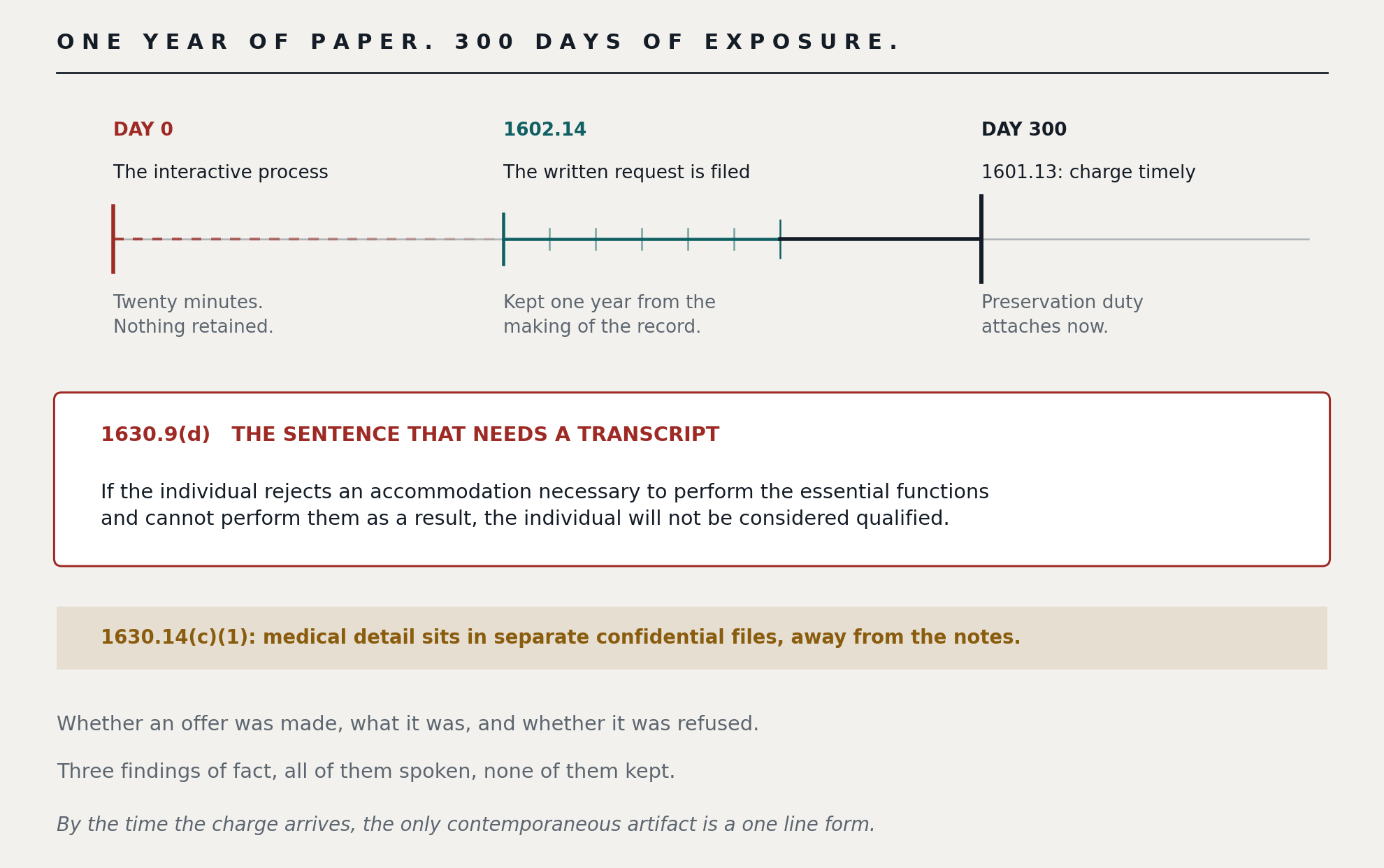
The conversation runs twenty minutes. Two schedule options get floated. HR says they will look into it and check what the coverage requirements actually are. Nobody records it.
Under 29 CFR 1630.2(o)(3), that conversation was the legal process.
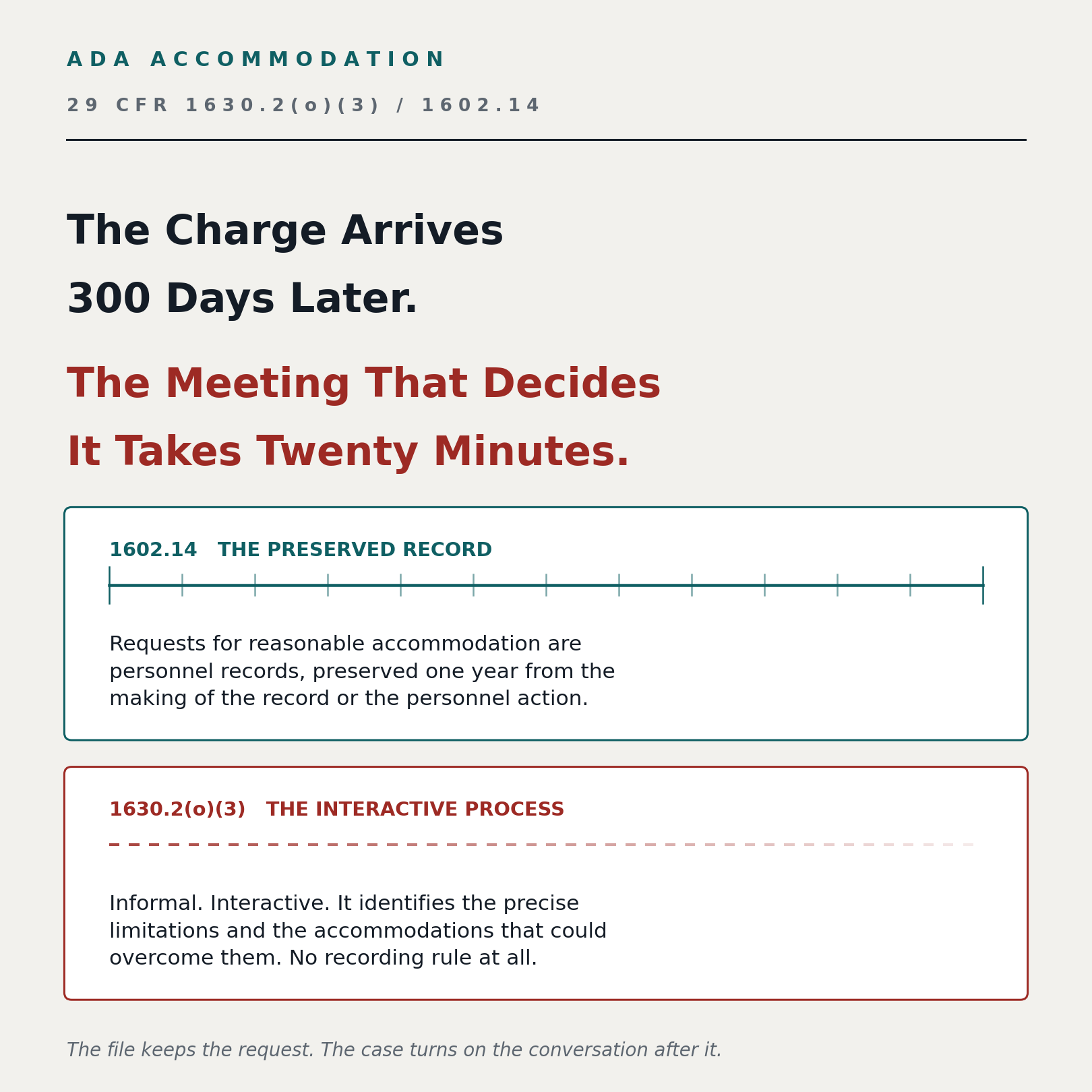
This is the part of accommodation practice that surprises people who have read the regulation only for its deadlines and its forms. The written request that eventually lands in the file is a personnel record. The exchange that decided what was offered, what was refused and why is not required to be a record at all.
The Rule Asks for a Conversation, Not a Document
The text is unusually direct about its own informality. To determine the appropriate reasonable accommodation, 1630.2(o)(3) says, “it may be necessary for the covered entity to initiate an informal, interactive process with the individual with a disability in need of the accommodation.” That process “should identify the precise limitations resulting from the disability and potential reasonable accommodations that could overcome those limitations.”
The interpretive guidance in the Appendix to Part 1630 is equally plain. The appropriate accommodation “is best determined through a flexible, interactive process that involves both the employer and the individual with a disability.”
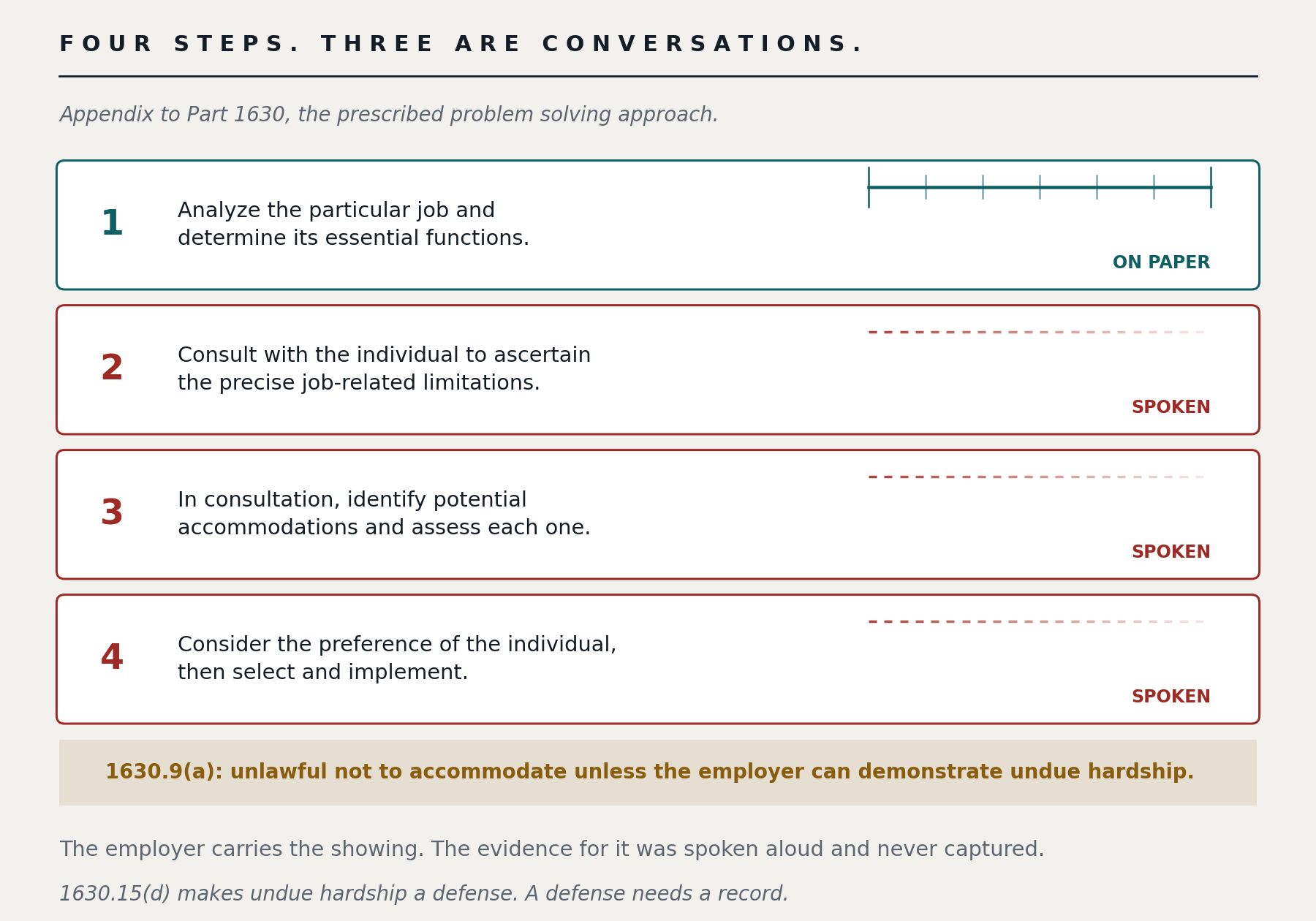
It then prescribes a four-step problem solving approach: analyze the particular job and determine its purpose and essential functions; consult with the individual with a disability to ascertain the precise job-related limitations; in consultation with the individual, identify potential accommodations and assess the effectiveness of each; and consider the preference of the individual before selecting and implementing the accommodation most appropriate for both.
Three of the four steps are talking. None of the four is a form.
Two Sentences That Turn Talk Into Liability
Read 1630.9(a) next. It is unlawful for a covered entity not to make reasonable accommodation to the known physical or mental limitations of an otherwise qualified individual, “unless such covered entity can demonstrate that the accommodation would impose an undue hardship on the operation of its business.” 1630.15(d) confirms that undue hardship is a defense, and 1630.2(p)(1) defines it as significant difficulty or expense assessed against the listed factors.
Note where the burden sits. The employer is the one who must demonstrate undue hardship. That is a showing about what was considered, what was costed and what was discussed — and the discussion happened in a room.
Then 1630.9(d) runs the other way. If an individual rejects an accommodation “that is necessary to enable the individual to perform the essential functions of the position held or desired” and cannot, as a result of that rejection, perform those functions, “the individual will not be considered qualified.”
That sentence is one of the strongest positions an employer can be in. It is also the one that depends most completely on an accurate account of a conversation. A refusal is not a document. It is something someone said.
So the case turns on three facts, and all three live in a conversation. What limitation was described. What was actually offered. Whether it was refused.
Why the Current Paper Trail Fails
- The form captures the request, not the exchange. 29 CFR 1602.14 expressly names “requests for reasonable accommodation” as a personnel or employment record. A request is one line. The negotiation that follows is an hour spread over six weeks.
- Retention runs one year. 1602.14 preserves the record for one year from the date of the making of the record or the personnel action involved, whichever occurs later.
- A charge can land at day 300. Under 29 CFR 1601.13(a)(4)(ii)(A), a charge is timely if received within 300 days from the date of the alleged violation. The duty to preserve all personnel records relevant to the charge attaches only once that charge is filed — which is the moment memory is already ten months old.
- The medical detail is walled off by design. 1630.14(c)(1) requires information regarding an employee’s medical condition or history to be collected and maintained on separate forms, in separate medical files, and treated as a confidential medical record. Notes thin out at exactly the point where the limitation was explained.
None of this is a drafting oversight. Each rule is doing its job. 1602.14 is a retention floor, not a ceiling. 1630.14(c)(1) is a privacy protection that employees benefit from. The gap is what falls between them: an informal process the regulation asks for by name, with no instrument designed to preserve it.
The Three Findings of Fact
It is worth being concrete about what an investigator or opposing counsel will actually reconstruct, because it is a short list and it maps cleanly onto the regulation.
What limitation was described. 1630.2(o)(3) asks the process to identify “the precise limitations resulting from the disability.” Precise is the operative word. “Mornings are hard” and “the medication makes it unsafe for me to drive before 8:30” produce different analyses, and a year later both compress into the same remembered sentence.
What was actually offered. The Appendix asks the employer to identify potential accommodations and assess the effectiveness of each, in consultation with the individual. An employer who did all of that well and wrote down only the outcome has a file showing a decision and no file showing the assessment that justified it.
Whether it was refused, and on what terms. 1630.9(d) makes rejection dispositive in the right circumstances, but only when the accommodation refused was one that would have enabled performance of the essential functions. Whether something was offered firmly or floated conditionally is the entire difference, and it is a difference in tone and phrasing that only a contemporaneous record preserves.
An accommodation file is also rarely one meeting. It is an intake conversation, a follow-up after medical documentation arrives, a manager check-in about how the schedule is working, and a revisit when the role or the coverage changes. Each of those is separately forgettable and jointly decisive.
What Actually Works
The fix is not a longer form. Longer forms capture more of the request and none of the exchange. It is keeping the conversation the regulation asked for.
Recording the interactive-process meeting itself, with the employee’s consent, converts the one artifact that decides the case from recollection into a record. AmyNote runs transcription through OpenAI’s latest Speech API and analysis through Anthropic’s Claude Opus, so the March meeting stays searchable in November.
Speaker identification with cross-session memory matters here more than in most settings, precisely because the file is a sequence rather than an event. Semantic search across all of those sessions answers the only question the EEOC asks: what was offered, and what did the employee say back.
AmyNote records in-person conversations, not just video calls, which is how most of these actually happen — at a desk, in a corridor, in a manager’s office with the door shut.
On privacy, the honest version matters in an HR file. Transcription runs through OpenAI and Microsoft Azure speech services and analysis through Anthropic’s Claude. AmyNote states it does not use customer data to train AI models and does not sell content. Audio and text are encrypted in transit with TLS, and the saved library lives on the HR professional’s iPhone or iPad, with playback, reading and export working offline. AmyNote is also explicit about the limit: local-first is not local-only, and when transcription or an AI summary runs, a processing copy may be retained on its cloud infrastructure. In an accommodation file that carries medical detail, that limit is something to weigh against 1630.14(c)(1) rather than to assume away.
Getting Started
Pick the next accommodation intake meeting and capture it with consent, after checking applicable consent law and your own policy. Nothing else in the file is contemporaneous. AmyNote runs on the phone already in the room, and the twenty minutes that decide the charge stop depending on who remembers them.
Originally published as an X Article by @AmyNoteApp.