The inspector walks your fields for six hours, pulls a soil sample, and hands you a signed receipt for it. Then you sit down for the exit interview and they run through what they saw. Forty minutes of findings, clarifications, and two things flagged as concerns — and the only copy of that conversation lives in two people’s memories.
Every certified operation has been through some version of that afternoon. It feels like the informal part of the day, the debrief after the real work. The regulation does not treat it that way at all.
The Exit Interview Is Where Accuracy Gets Confirmed
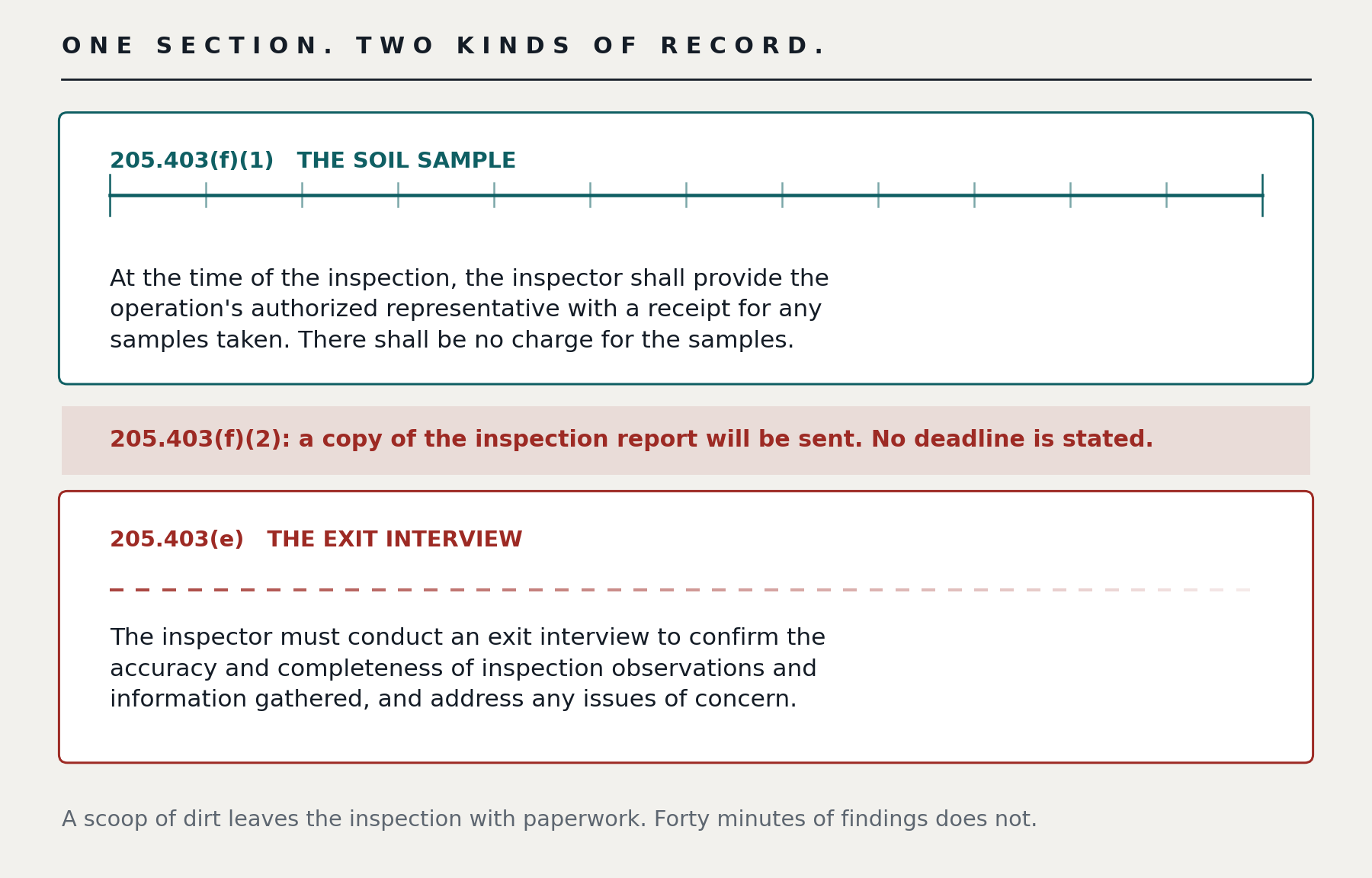
7 CFR 205.403(e) does not treat the exit interview as a courtesy. The inspector must conduct an exit interview with an authorized representative of the operation who is knowledgeable about the inspected operation to confirm the accuracy and completeness of inspection observations and information gathered during the on-site inspection.
Read what that sentence assigns. The exit interview is the designated accuracy checkpoint for everything the inspector wrote down that day. It is the place where a misread field history, a misheard input name, or a wrong date on a buffer-zone log is supposed to get caught — the one structural opportunity to correct the record before the record becomes the finding.
The same paragraph adds that the inspector must address the need for any additional information as well as any issues of concern. Concerns surface here first, out loud, before anything is written to you. That ordering matters more than it appears: the first time you hear the theory of your own noncompliance is in a conversation, not in a document.
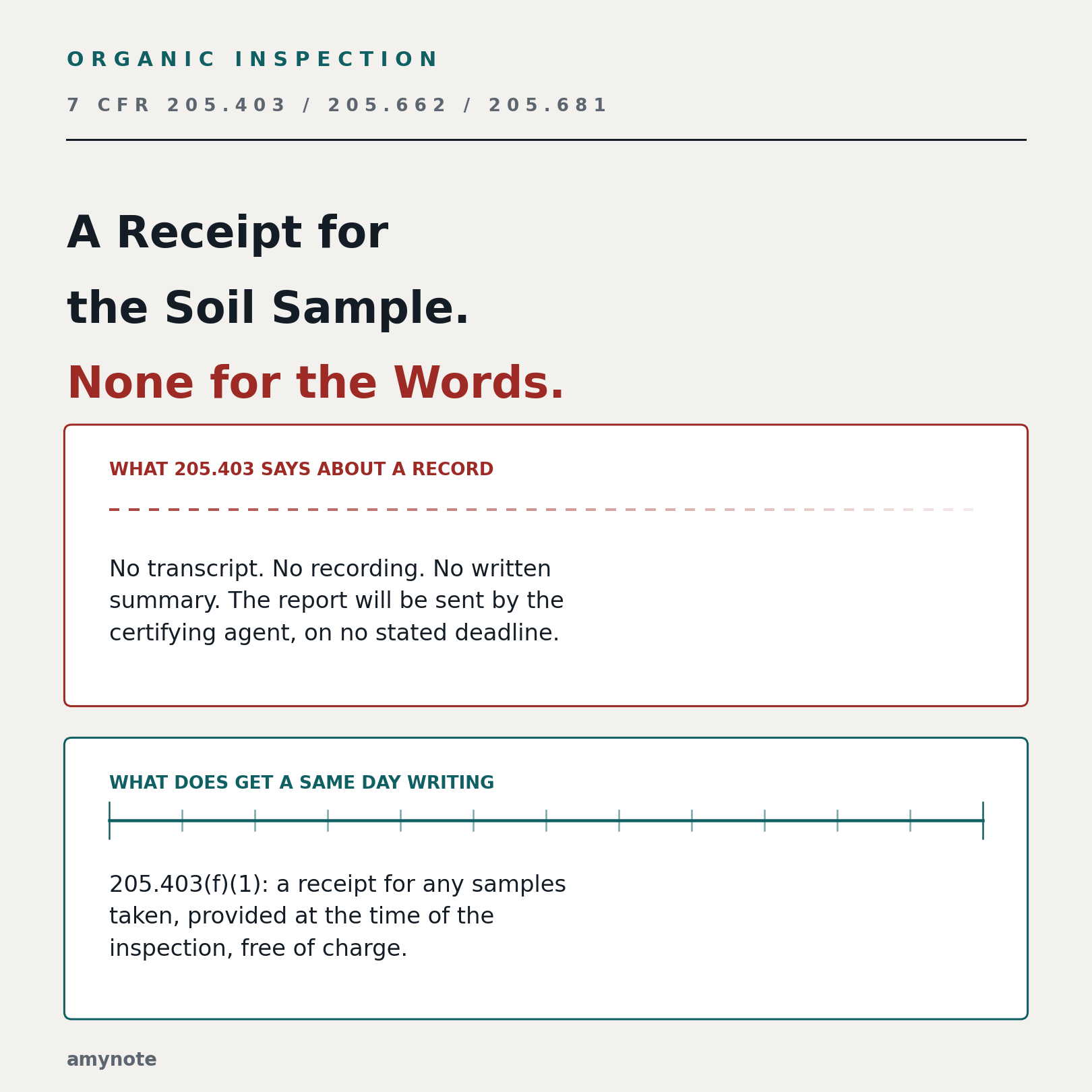
Now read 205.403 for the words transcript, recording, or written summary. They are not in the section.
A Receipt for the Dirt, Nothing for the Conversation
The regulation knows how to require same-day paper when it wants to. Under 7 CFR 205.403(f)(1), at the time of the inspection, the inspector shall provide the operation’s authorized representative with a receipt for any samples taken, and there shall be no charge to the inspector for the samples.
Sit with the asymmetry. A scoop of soil generates an immediate written record with your name on it, handed over before anyone leaves the property. The forty-minute conversation that confirms the accuracy of the entire inspection generates nothing at all.
Then 205.403(f)(2) hands off the report itself in the passive voice: a copy of the on-site inspection report and any test results will be sent to the inspected operation by the certifying agent. No deadline appears in that sentence. For applicants, 205.402(b) asks only that the agent act within a reasonable time.
So the written version of the day travels to you on no fixed schedule, and when it arrives it is the certifying agent’s account of a conversation you have no record of. Whatever memory you had of the exit interview has been decaying the entire time you waited for it.
The One Clock With No Number
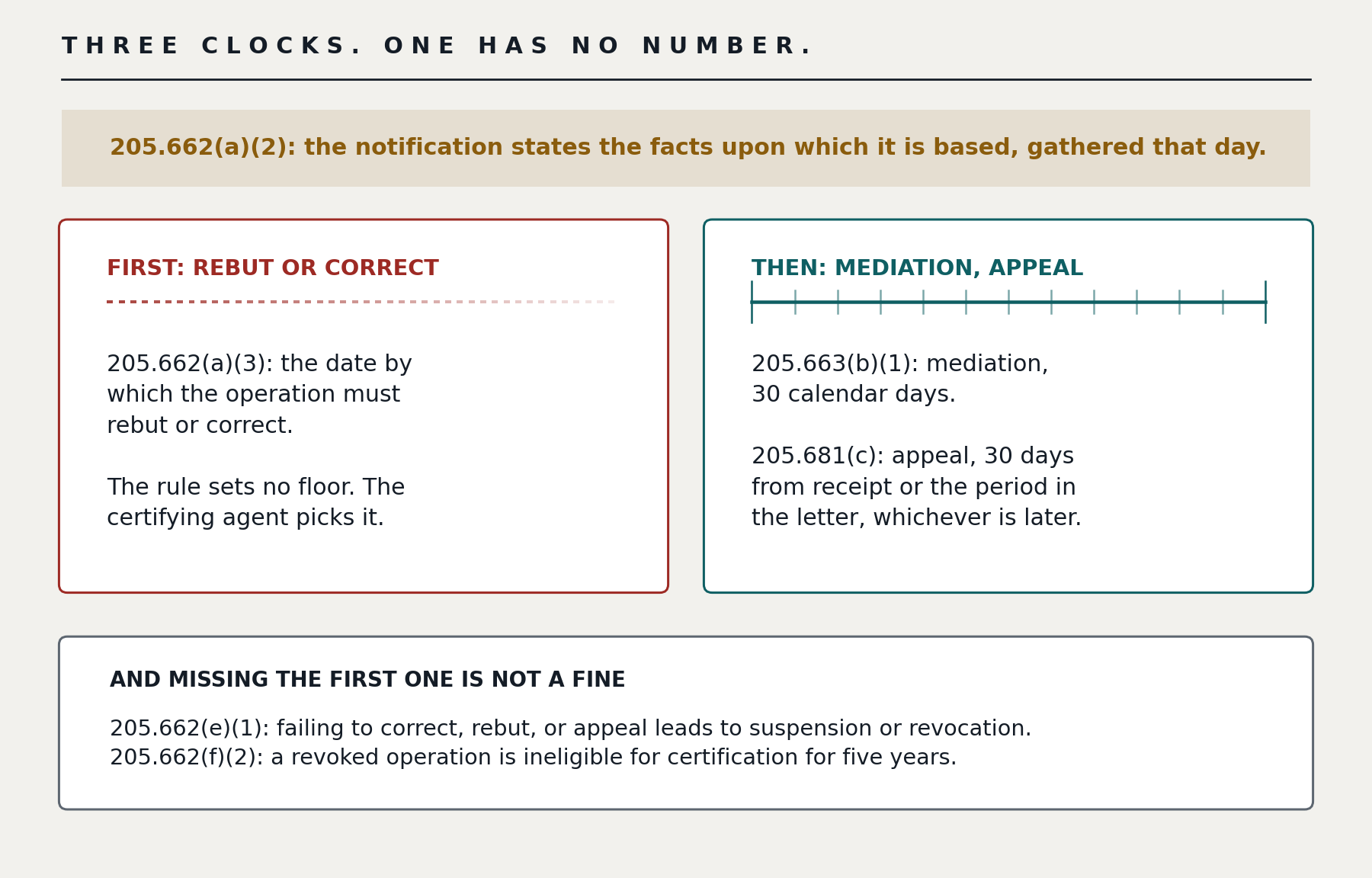
- Every later deadline is fixed. The first one is not. Under 7 CFR 205.662(a)(3), the notification of noncompliance provides the date by which the operation must rebut or correct each noncompliance. The rule sets no floor, so the certifying agent picks it. Mediation under 205.663(b)(1) is 30 calendar days. An appeal under 205.681(c) is 30 days from receipt or the period stated in the letter, whichever is later. Only the rebuttal window — the one that depends on remembering the exit interview — has no number.
- The facts come from that day. 205.662(a)(2) requires the notification to state the facts upon which the notification of noncompliance is based. Those facts were gathered at an inspection whose sole accuracy-confirmation step was an unrecorded conversation weeks earlier.
- The downside is not a fine. Under 205.662(e)(1), failing to correct, rebut, or appeal leads to suspension or revocation, and 205.662(f)(2) makes a revoked operation ineligible for five years.
- It repeats every year. 205.406(b) requires an on-site inspection at least once per calendar year, and 205.403(b)(1) sends unannounced inspections to five percent of each agent’s operations.
Why the Usual Substitutes Do Not Close This
Most operations already do something, and it is worth being honest about why each of those things falls short of what a rebuttal actually needs.
Handwritten notes. You are participating in the interview and transcribing it at the same time, which means you write down what you already understood and miss the sentence that surprised you. The surprising sentence is the one that becomes the finding.
The inspector’s report. It arrives on no deadline, and it is the other party’s summary. Using it to reconstruct what you said at the exit interview is circular: it is the document you may need to dispute.
Your own organic system plan. The OSP describes how the operation is supposed to run. It says nothing about what was discussed, clarified, or conceded on the day, which is exactly the territory a noncompliance notice lands in.
A colleague who was also there. Two memories agreeing months later is better than one, and it is still two memories. It does not become evidence merely by being duplicated.
What Actually Works
Start with what makes this different from a courtroom. Nothing in part 205 bars you from recording your own exit interview. It happens at your table, on your operation, so tell the inspector you are recording your notes and start. Most will not blink; the interview is meant to confirm accuracy, and a recording serves that purpose rather than working against it.
That is the discipline AmyNote is built for. It runs on the phone already in your pocket and transcribes with OpenAI’s Speech API, which holds up on the vocabulary these inspections turn on: organic system plan, split operation, buffer zone, mass balance, audit trail, prohibited substance. Speaker identification separates the inspector from your production manager, so a disputed statement is attributable line by line rather than collectively remembered.
Anthropic’s Claude Opus then turns the session into what the next thirty days actually need: every issue of concern the inspector named, what you answered, and the corrective evidence you promised to send. Semantic search across sessions sets this year’s exit interview against last year’s — the comparison a rebuttal usually has to make, and the one that is hardest to reconstruct from memory across an annual cycle.
Certified operations ask about privacy first, and they are right to, because an inspection recording is a map of the business. Both OpenAI and Anthropic contractually guarantee zero training on user data. Audio is encrypted in transit and not retained after processing. Transcripts are stored locally on device with end-to-end encryption, so the record of your inspection stays on your side of the table.
Getting Started
Decide who owns the exit interview record before the next inspection, because 205.403 assigns it to nobody on your side. Name the person, make it their job the way the sample receipt is somebody’s job, and do it before the annual inspection is on the calendar rather than the morning of.
AmyNote runs on the phone you already carry, with transcription by OpenAI, analysis by Anthropic Claude Opus, transcripts encrypted on device, and zero training on your data. When the notification of noncompliance arrives — on a clock the certifying agent sets, about facts gathered on a day you cannot replay — the difference between a rebuttal and an apology is whether somebody wrote down what was actually said.
Originally published as an X Article by @AmyNoteApp.