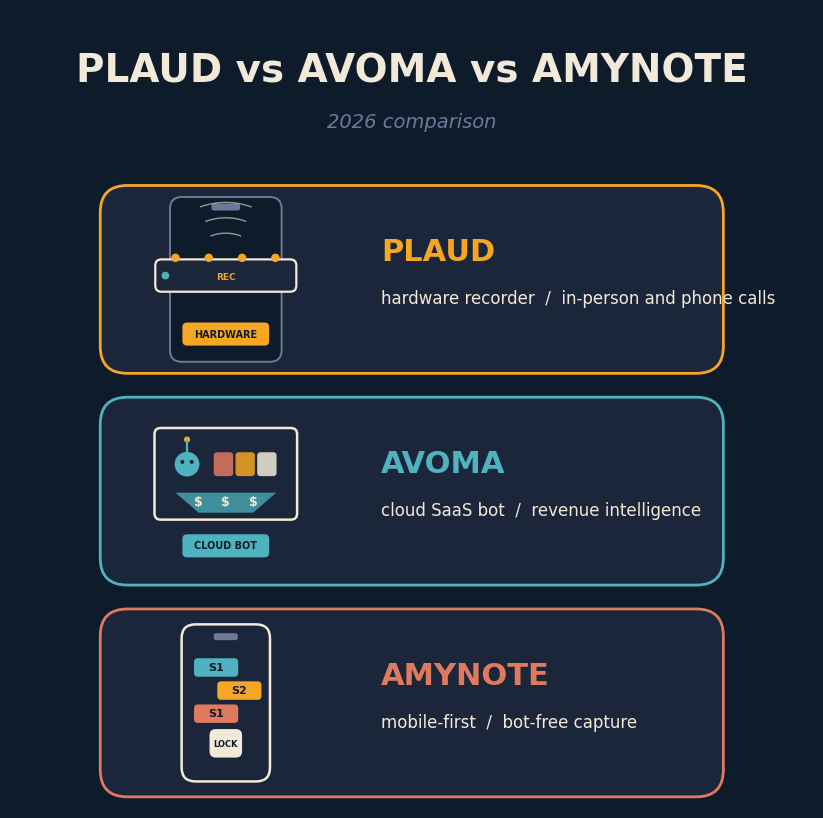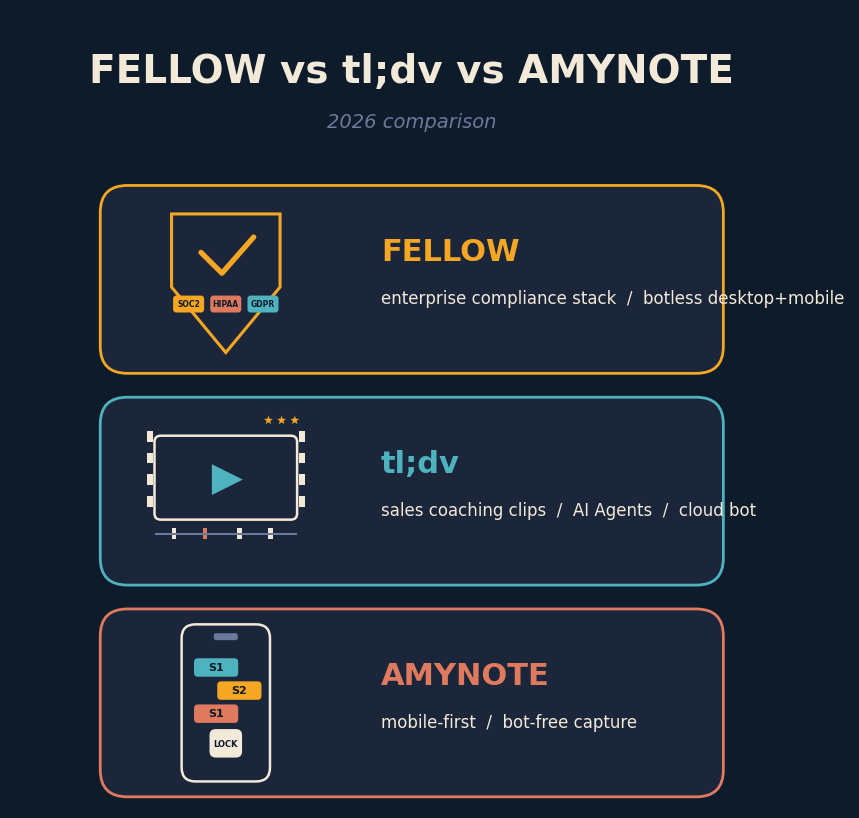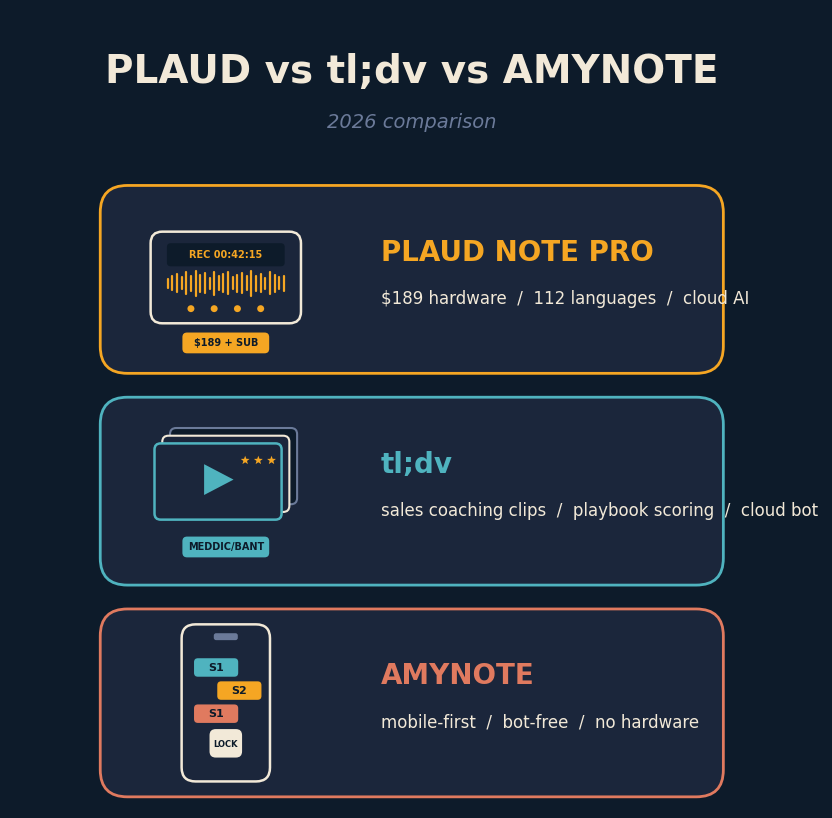
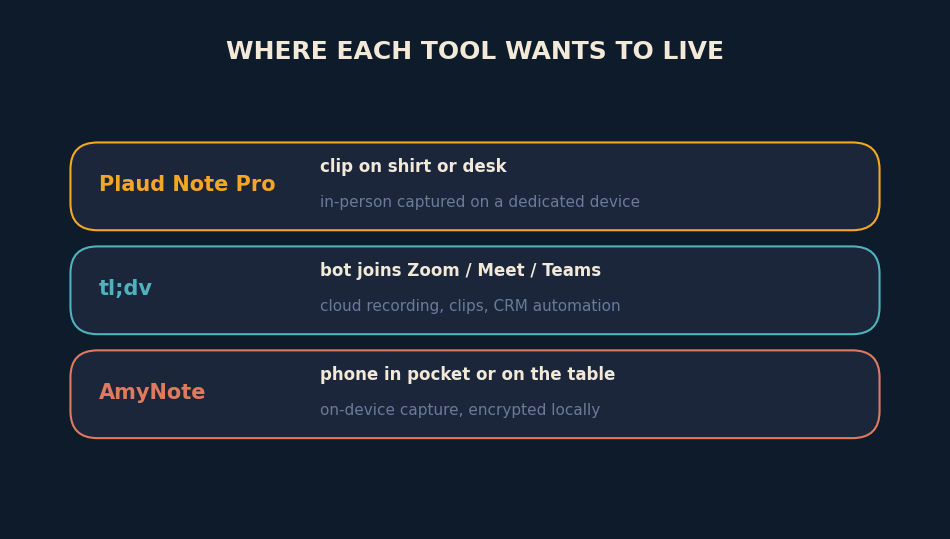
A field sales rep walks into a diner for a customer visit. A revenue ops lead opens Zoom for a HubSpot pipeline review. A patient advocate sits down with a family in a hospital cafeteria. Three meetings, three theories of what a notetaker should be. Plaud pitches a credit-card sized recorder that clips on the shirt and lasts 30 hours on a charge. tl;dv pitches unlimited free cloud recording, AI Agents that update the CRM, and sales-coaching video clips. AmyNote pitches a phone in your pocket that captures in-person and phone conversations bot-free, with local storage. The right pick depends less on features than on where the audio has to live.
Quick Verdict
Pick Plaud Note Pro if your most valuable conversations are in-person and you want a purpose-built device that will not miss a word across a 30-hour battery. Pick tl;dv if you run a sales or CS team, live inside HubSpot or Salesforce, and want video highlights and coaching playbooks feeding your reps. Pick AmyNote if your highest-stakes conversations happen on a phone or across a table and you want privacy by architecture instead of policy fine print, without buying a second device.
What We Compared
Three axes that change your workflow: what you have to carry, what a realistic year costs, and how each tool treats your audio after capture.
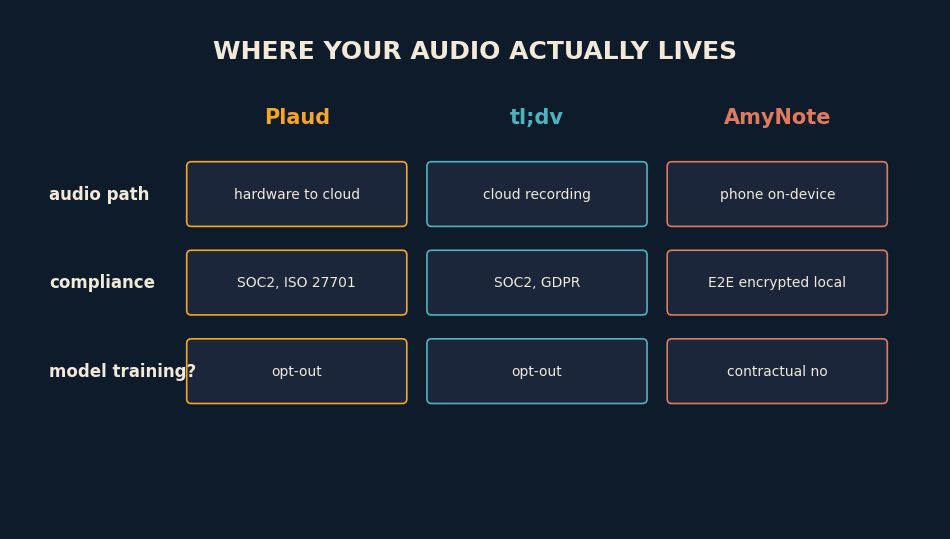
Plaud captures audio through a physical recorder with four MEMS microphones plus a vibration pickup, then sends it to a cloud AI stack for transcription and summaries. tl;dv defaults to a bot joining Zoom, Meet, or Teams, with a botless mode rolled out in 2026. AmyNote records through the phone microphone, keeps files on device, and only sends audio to OpenAI's Speech API and Anthropic's Claude Opus for analysis, both under contractual zero-training terms.
Plaud Note Pro: Strengths and Weaknesses
Strengths
The Plaud Note Pro is $189 hardware the size of a credit card, 30 grams, with a 0.95-inch AMOLED display, four MEMS microphones plus a voice pickup unit, and 64 GB onboard storage. Battery runs 30 hours in enhanced mode and up to 50 hours in endurance mode, with 60-day standby. Transcription covers 112 languages with speaker labels and custom vocabulary. The app lets you pick between Claude, ChatGPT, and Gemini, then apply one of 10,000 templates or generate a mind map. Compliance includes SOC 2 and ISO 27701.
The hardware advantage compounds in every meeting a bot cannot join. Site visits, ward rounds, factory-floor debriefs, ride-alongs with a service technician, and the hallway conversations right after a courtroom hearing. In all of those, a phone microphone in a pocket is muffled or aimed at the wrong voice. A four-mic card with a dedicated voice processor clipped to the same phone gets a materially cleaner capture, and the 30-hour battery removes the low-battery anxiety of a phone that also has to run maps and messages all day.
Weaknesses
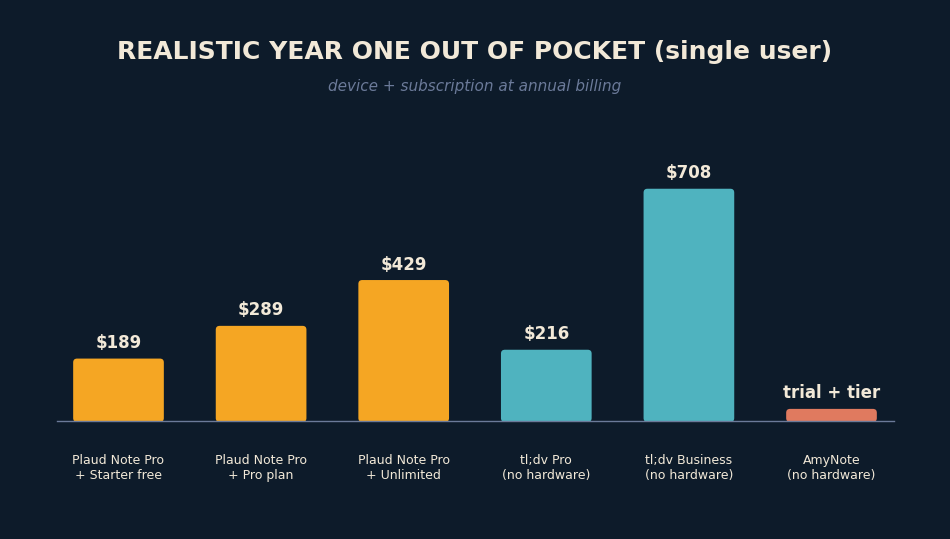
The device is only the entry ticket. The included Starter plan gives 300 transcription minutes per month. Pro at USD 99.99 per year adds 1,200 minutes. Unlimited at USD 19.99 per month annual is what heavy users actually need. Team billing runs USD 20 per user per month on annual. A working professional who bought the recorder for meetings ends up at a year-one out of pocket near USD 429. AI features require the cloud, so a real offline mode does not exist, and the device is one more thing to remember, charge, and not lose.
Best for. Field sales, consultants, journalists, and doctors who spend hours in in-person conversation and want a dedicated recorder with a battery longer than any phone.
tl;dv: Strengths and Weaknesses
Strengths
tl;dv shipped a strong 2026. AI Agents write follow-up emails, update CRM fields, and file tasks the moment a call ends. Multi-Meeting Intelligence surfaces patterns across hundreds of calls at once. Sales Coaching with playbook scoring grades reps against MEDDIC, BANT, or a custom playbook, and turns any transcript highlight into a shareable video clip. Transcription covers 40 plus languages via OpenAI Whisper, with 5,000 plus integrations. Botless recording shipped in 2026 for teams that cannot bring a bot on a call.
Weaknesses
The Free plan advertises unlimited recordings, but every recording auto-deletes after 90 days and the account is capped at 10 AI summaries for its entire lifetime. Pro at USD 18 per month removes those limits. Business jumps to USD 59 per month and is really where sales coaching and playbook analytics live. The default path remains a bot in the meeting, which prospects notice, and the tool is designed around online video calls, so in-person meetings are a secondary use case.
Best for. Sales, customer success, and revenue operations teams inside HubSpot or Salesforce who want AI-generated clips and CRM automation without a heavier enterprise stack.
AmyNote: Strengths and Weaknesses
Strengths
No bot to invite, no laptop required, no hardware to buy. Cross-session speaker identification remembers voices from meeting to meeting instead of resetting per session. 120 plus languages with real-time translation. Deep semantic AI analysis rather than a canned template. Simple pricing with no minute cap. Three-day free trial with no credit card. Transcription runs through OpenAI's Speech API and analysis through Anthropic's Claude Opus, both under contractual zero-training terms. Audio is encrypted in transit, processed, and not retained on provider servers. Transcripts sit locally on the phone with end-to-end encryption.
The mobile-first design solves the use case the other two miss entirely. A litigator meeting a client at a jail intake window cannot bring a laptop, cannot invite a bot, and often cannot bring a recorder card because facility rules bar it. A phone that already goes through security, running a bot-free app, captures the conversation without adding a device to the search line. The same logic applies to hospital corridors, courtroom hallways, and any hardware-restricted environment.
Weaknesses
Mobile-first, so there is no dedicated desktop application. No native CRM integrations, a real gap against tl;dv for sales reps who live in HubSpot. Audio only, so no video-clip workflow. Battery and background limits are the phone's, not a purpose-built recorder's. No team SSO or SCIM tier yet. Smaller brand than either competitor, which some procurement teams will flag.
Best for. Professionals whose highest-stakes conversations are in person or on a phone call. Lawyers on jail intake, field sales at coffee shops, clinicians in patient consults, and consultants on site walks are the archetypes.
Side-by-Side Comparison
- What you carry. Plaud a dedicated recorder. tl;dv nothing extra, bot joins the call. AmyNote your phone.
- In-person meetings. Plaud primary use case. tl;dv secondary via botless mode. AmyNote primary use case.
- Realistic year one cost. Plaud USD 189 hardware plus 100 to 240 for a subscription. tl;dv USD 216 (Pro) to 708 (Business). AmyNote free trial then single tier without minute caps.
- Free plan reality. Plaud 300 minutes per month after buying the device. tl;dv unlimited recordings but 90-day retention and 10 lifetime AI summaries. AmyNote 3-day trial, no credit card.
- Languages supported. Plaud 112. tl;dv 40 plus via Whisper. AmyNote 120 plus with real-time translation.
- AI stack. Plaud user-selectable Claude, ChatGPT, or Gemini in the cloud. tl;dv proprietary plus OpenAI Whisper. AmyNote OpenAI Speech plus Anthropic Claude Opus.
- Model training on your data. Plaud opt-out. tl;dv opt-out. AmyNote contractual no, both providers.
- Storage default. Plaud cloud after upload, SOC 2 plus ISO 27701. tl;dv cloud SaaS, SOC 2 and GDPR. AmyNote local device with end-to-end encryption.
- CRM integration. Plaud limited. tl;dv strong, plus AI Agents that auto-fill fields. AmyNote none native.
- Speaker identification. Plaud per meeting. tl;dv per meeting. AmyNote cross-session memory.
The Bottom Line
These three tools are competing for three different jobs. Plaud is a dedicated hardware recorder for people whose day is mostly face-to-face and who accept both the device cost and the subscription in exchange for a battery no phone can match. tl;dv is a sales coaching and CRM automation platform that happens to record meetings, and the Business tier is where the marketing promises actually land. AmyNote is a privacy-first mobile capture app for the meetings that do not fit either shape.
It will not join a Zoom call as a bot and it is not a shirt-clip recorder. It will record the customer conversation at the diner, the hallway follow-up nobody thought to schedule, and the phone call your CRM tool cannot sit inside. For many teams these are complements, not substitutes. A revenue org might run tl;dv on scheduled Zoom calls, Plaud for on-site customer visits, and AmyNote for the phone conversations that happen between the two. The point is not to pick one winner. It is to route your calendar to whichever tool matches where the audio has to live.
Try AmyNote for three days without a credit card at amynote.app and see whether the most valuable conversations in your week already happen where your desktop tools cannot reach.
Originally published as an X Article by @AmyNoteApp.