A customer success manager runs 30 Zoom calls a week and wants every one of them recorded and summarized, forever, without paying. A solo founder lives on her MacBook and wants the cleanest possible notetaker that no participant ever sees. A field consultant runs intake interviews in cafes across Singapore and Jakarta, where the meeting is in person, in three languages, and the only device on the table is a phone.
Three completely different work shapes. Three completely different tools.
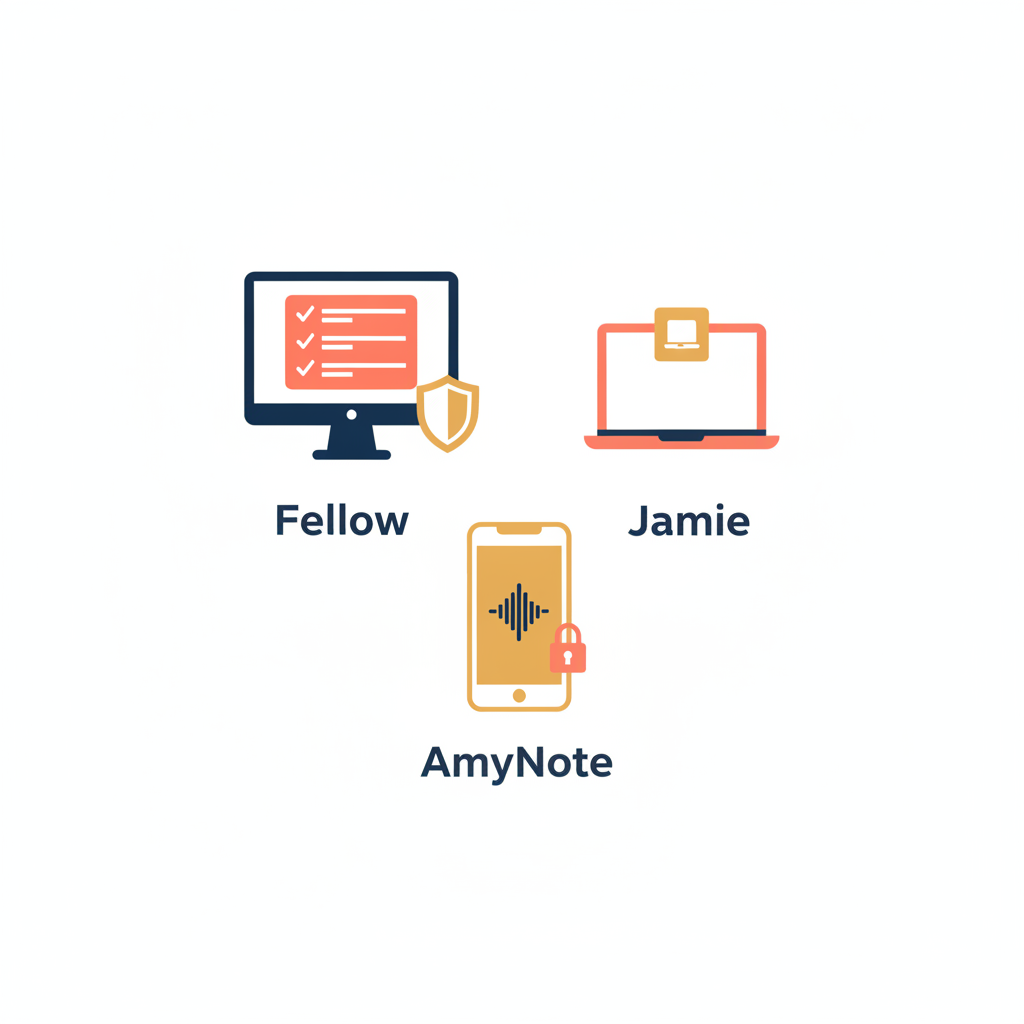
Fathom, Jamie, and AmyNote each lead in one of those lanes. This is an honest look at where each one wins, where each one breaks, and how to decide. Pricing and feature claims pulled from each vendor's documentation and current help center pages as of June 2026.
Quick Verdict
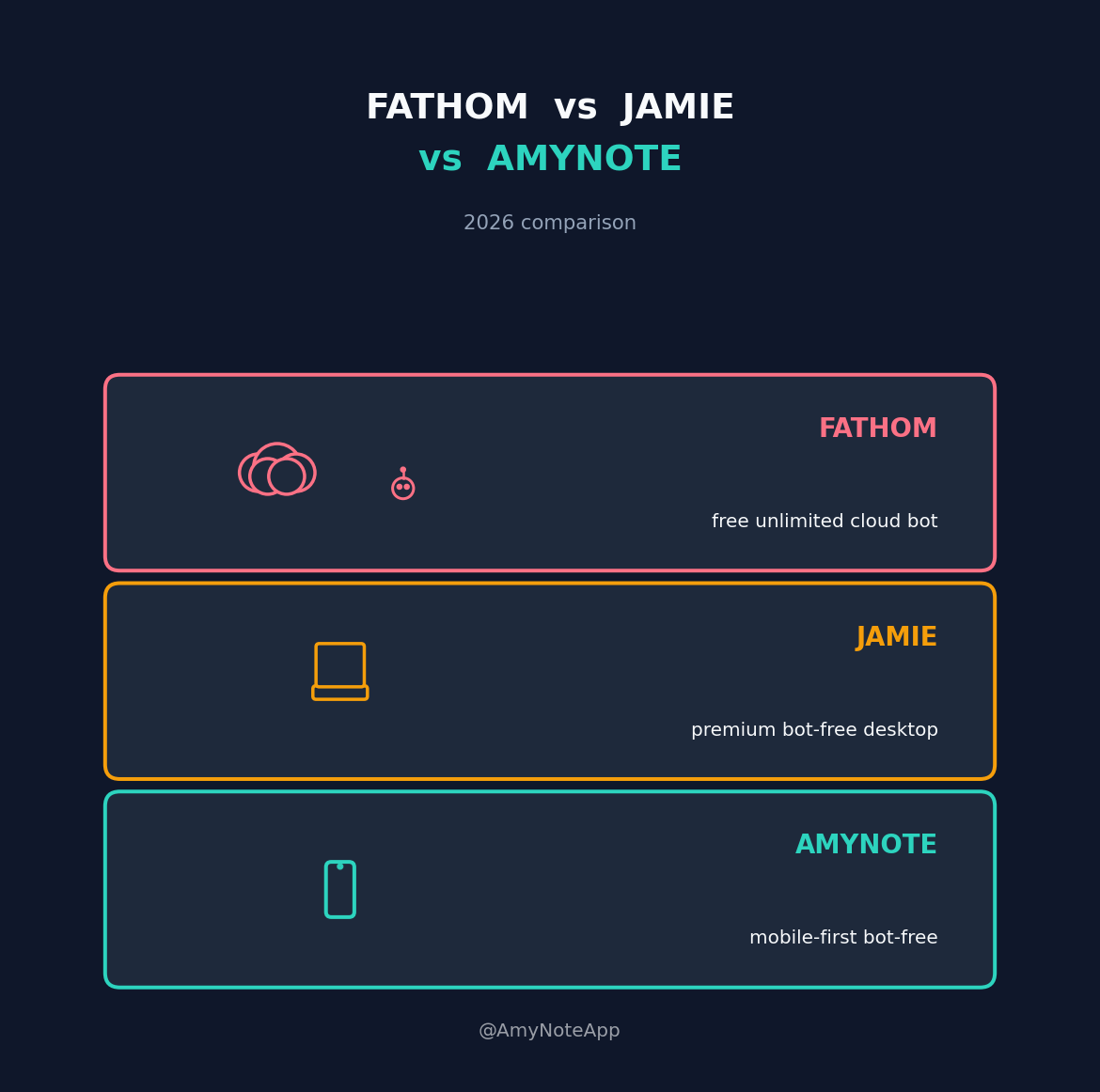
Fathom is the strongest choice for cloud-meeting volume where the priority is free unlimited recording, free unlimited transcription, and a clean Zoom or Google Meet integration with no minute caps. The free tier is the differentiator, not the AI.
Jamie is the strongest choice for bot-free desktop workflows on Mac or Windows where the meeting must look completely unobserved to other participants and a flat premium subscription is acceptable in exchange for that polish.
AmyNote is the strongest choice for mobile, multilingual, in-person capture where there is no laptop, no bot, and the conversation is happening in 120 languages.
None of these tools is a drop-in replacement for the other two. The decision is about where the meeting actually happens.
What We Compared
Same four dimensions for each tool: capture surface (where the recording actually happens), language coverage, pricing and caps, and privacy posture. Every claim ties back to a specific data point in vendor documentation rather than marketing copy.
Fathom: Free Unlimited Cloud Recording
Strengths. Fathom is the rare tool with a free tier that actually means free. Recording, transcription, and storage are all unlimited and stay unlimited forever, with no card on file required. Native integration with Zoom, Google Meet, and Microsoft Teams generates a clean summary roughly thirty seconds after the call ends. Ask Fathom search runs across every past meeting. Speaker labels are reliable on clean cloud audio, and action items get extracted automatically. A botless private mode is in beta.
For a sales team running back-to-back demos, the friction is genuinely the lowest in the category. Connect a calendar, the bot starts showing up, and the recap lands in inbox shortly after the call. Customer success teams with thirty meetings a week tend to settle on Fathom because no other tool gives them every recording for free.
Weaknesses. The free tier caps advanced AI summaries at five calls per month. After that, the free user gets the general template, not the structured one. Language coverage is 25, the smallest of the three by a wide margin. Premium runs around $15 per month on annual billing, Team around $14 per user per month with a two-seat minimum, and Business around $22 per user per month for CRM sync. The default capture mode still puts a visible participant in the meeting, which is awkward for client-sensitive calls, regulated workflows, or any setting where a third-party logo in the participant list invites questions.
Jamie: Premium Bot-Free Desktop
Strengths. Jamie is built around one promise: no bot ever joins the call. The desktop app on Mac, Windows, and iOS records device audio directly, so a Zoom, Teams, or Webex call looks completely unobserved to the other side. A coffee-shop conversation gets captured the same way. Language coverage is 100 plus. Speaker memory learns voices over time and stays accurate across recurring meetings. Summaries arrive within one to five minutes. Native sync to Salesforce, HubSpot, Pipedrive, Attio, Notion, and Asana covers most CRM workflows out of the box.
The polish shows up in small details. Templates feel writer-friendly rather than dropdown-heavy. The desktop UI is calm and stays out of the way during the call. For a solo founder, an executive coach, or a freelance consultant who wants the bot-free promise without giving up CRM sync, Jamie is the cleanest experience in the category.
Weaknesses. Pricing is the friction. The free tier allows only 10 meetings per month with a 30-minute cap, which most regular users blow through in a week. Plus is €25 per month for 20 meetings with a two-hour cap. Pro is €47 per month for unlimited meetings with a three-hour cap. There is no Android product, no real-time translation, and no in-person hardware story. Compared to a free unlimited tool, the cost of bot-free polish is high.
AmyNote: Mobile-First, No Bot, No Hardware
Strengths. AmyNote is a pure mobile app, which is a different shape of product. There is no bot to join the meeting and no hardware to buy. The capture surface is whatever the phone hears: a hallway conversation, a vendor call on speaker, a multilingual interview, a site walk. Transcription runs through OpenAI's latest Speech API, which delivers accuracy on accents and domain-specific terminology that cloud-bot tools rarely match outside English. AI analysis is powered by Anthropic's Claude Opus. Language coverage is 120 plus with real-time translation. Speaker identification remembers voices across sessions, not just within one meeting.
The mobile-first shape matters more than it sounds. A field consultant running interviews across three cities does not have a laptop open. A clinician walking between patients does not have a desktop. A reporter taking a source meeting in a cafe does not want a visible bot. The meetings that most need capture are often the ones where every other tool in this category does not work at all.
Privacy. Both OpenAI and Anthropic contractually guarantee zero training on user data. Audio is encrypted in transit; processing copies may be retained to deliver and recover requested features. Transcripts and recordings are stored locally on the device with encrypted transport. This is the architecture that matters most when the conversation being captured is the kind that would not belong on a third-party drive after the call ends.
Weaknesses. Be honest about the gaps. There is no desktop app, so a user who lives in Zoom on a laptop will find the workflow awkward. There are no CRM integrations like Jamie's HubSpot and Salesforce sync. There is no video recording. Team and enterprise governance features like admin retention policies and SSO are not on the roadmap yet. Brand recognition is smaller than Fathom or Jamie. AmyNote is the right tool for individuals and small teams whose meetings happen off the laptop, not for a 500-seat rollout that needs admin governance.
Side-by-Side Comparison
- Capture surface. Fathom is a cloud bot for Zoom, Meet, and Teams. Jamie is a desktop app on Mac and Windows, plus iOS. AmyNote captures in-person, phone, and dictation on iOS and Android with no bot.
- Language coverage. Fathom 25. Jamie 100 plus. AmyNote 120 plus with real-time translation.
- Pricing entry. Fathom Free is genuinely unlimited recording, capped at 5 advanced summaries per month. Jamie Free is 10 meetings per month with a 30-minute cap. AmyNote offers a 3-day full-access trial, no card.
- Pricing ceiling. Fathom Business around $22 per user per month for CRM features. Jamie Pro €47 per month for unlimited meetings. AmyNote runs a flat subscription with no minute caps and no tier ladder.
- Bot visibility. Fathom default puts a visible participant in the call. Jamie shows no bot. AmyNote shows no bot.
- Privacy posture. Fathom stores transcripts in its cloud. Jamie stores on the device with sync. AmyNote stores locally on the device with encrypted transport, uses providers that contractually guarantee zero training, encrypts audio in transit, and does not retain audio after processing.
- In-person meetings. AmyNote is built for them. Jamie works for any conversation the laptop hears. Fathom assumes a meeting platform.
- Mobile reach. Fathom companion app. Jamie iOS only, no Android. AmyNote iOS plus Android, first-class.
How To Pick
Start with the meeting you keep losing. Not the average meeting on the calendar, but the one that gets away. The hallway decision, the call on the train, the client lunch where the actual buying signal got mentioned over coffee. Whichever tool catches that meeting is the one worth paying for.
If the meeting you keep losing is a Zoom call you forgot to record, Fathom solves it for free. If it is a Mac-based call where a visible bot would be awkward, Jamie solves it. If it is anything that happens away from a desk — in person, on a phone, in another language — AmyNote solves it.
The second filter is sensitivity. If the audio is sales discovery, the cloud is fine. If it is a board conversation, an HR situation, an attorney call, a deal under NDA, or any client interaction that should not sit on a third-party drive after the call ends, the local-storage architecture stops being a nice-to-have and becomes the only acceptable answer.
The Bottom Line
These three tools are not really competing for the same hour of the day.
If meetings happen in Zoom, Google Meet, or Teams every day and the priority is recording every single one for free, Fathom is the answer. The free tier is the most generous in the category.
If meetings happen on a Mac or Windows desktop and the priority is a polished bot-free experience with CRM sync, Jamie is the answer. The premium is real, but the bot-free promise is the cleanest in the category.
If meetings happen on a phone, in person, or in a language other than English, AmyNote is the answer. Both OpenAI and Anthropic contractually guarantee zero training on user data. Audio is encrypted in transit; processing copies may be retained to deliver and recover requested features. Transcripts stay on the device with encrypted transport. The free trial runs 3 days, no credit card.
Pick the tool that matches where the meeting actually happens. That decision saves more time than any feature comparison.
Originally published as an X Article.