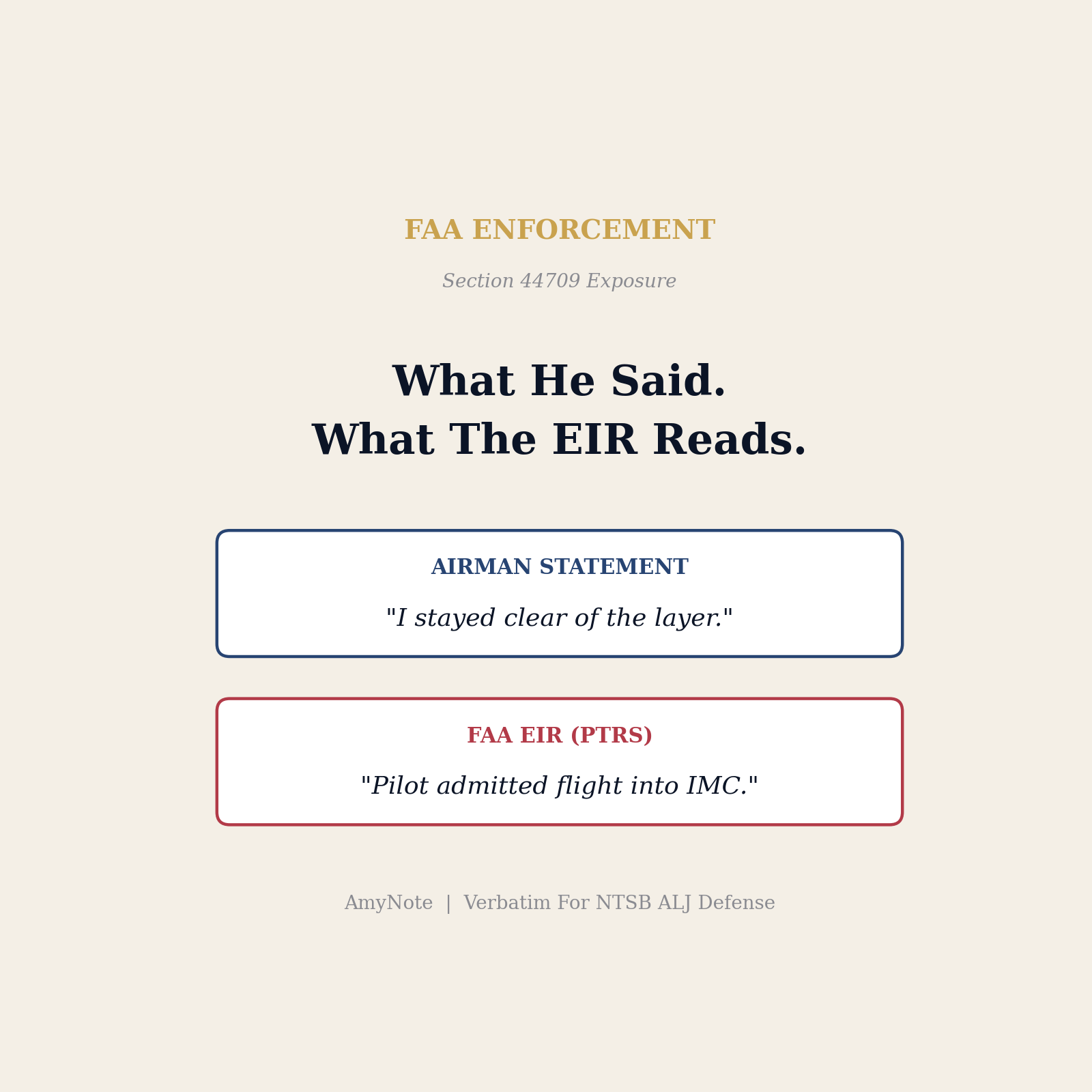
The Aviation Safety Inspector closes her laptop at 3:45 PM after two hours of questions about your March 14 Part 91 flight from KAPA to KBJC. You walk her to the FSDO lobby, drive back to the hangar, and by the time you finish the next post-flight you cannot remember whether you told her you saw the traffic on TCAS or only heard the RA aural. Seven months later the Enforcement Investigation Report quotes you back through a Notice of Proposed Certificate Action, and the quote is not what you said.
This is the shape of Part 91 enforcement in 2026. The interview is the evidence. The interview is not recorded. The airman gets a fifteen-day window to rebut words that only exist in one Aviation Safety Inspector's typed synthesis. The clearance readback, the altitude on descent, and the traffic call from Approach are all reconstructed from memory against a Foreflight track log the inspector already downloaded before the interview started.
The Problem: A Two-Hour Interview With No Court Reporter
The FAA runs a Letter of Investigation interview that has no court reporter and no recording. Under FAA Order 2150.3 and 14 CFR Part 13, once a hotline report or an ATC brasher notification lands in the district office, the Aviation Safety Inspector schedules a subject interview with the airman of record. Those meetings are typed on an ASI laptop and are not transcribed. The inspector leaves with a Word document, drafts an Enforcement Investigation Report over the next several weeks, and that EIR becomes the record that moves to the FAA Office of the Chief Counsel or into the Compliance Program tracking system.
The record that matters is the inspector's synthesis, not the words the airman actually said. When the Notice of Proposed Certificate Action arrives, often six to nine months later, it cites conversations no one can quote back. The pilot has to reconstruct the clearance readback, the altitude on descent, the traffic call from Approach, and whether the callouts in the room matched the Foreflight track log the inspector already downloaded.
The airman then faces a fifteen-day response window that combines a factual denial and a request for informal conference under 49 USC 44709. Counsel is asked to attest to statements that live only in the inspector's notes. The interview is the evidence, and no one owns the evidence.
What The Inspector's Typed Notes Actually Look Like
The EIR is not a transcript. It is a heavily compressed narrative that has to pass through three filters before it reaches the airman: the inspector's own hearing and typing speed during a two-hour meeting, the inspector's rewrite of those notes into the EIR narrative structure days or weeks later, and the FSDO manager's edits before it moves upstream. Each pass shortens the record and hardens the conclusions.
The recurring failure modes are almost always the same. Conditional language collapses: "I think I heard Denver Approach clear me to niner thousand" becomes "Pilot stated he was cleared to 9,000." Sequence flattens: the order in which the pilot noticed the traffic, glanced at TCAS, and reacted to the RA aural gets rewritten as a single instant. Missing verbs get added by inference: the inspector types "admitted" or "conceded" in front of statements that were volunteered as context, not as admissions.
By the time the EIR reaches the Office of the Chief Counsel, the narrative reads as a coherent case theory. The pilot's actual answers were rambling, hedged, corrected mid-sentence, and interrupted by clarifying questions from the ASI. None of that texture survives the compression.
Why Current Solutions Fail
Bringing AOPA counsel to take notes sounds useful and rarely works. Counsel is tracking prior statements against the ATC transcript and cannot write full sentences while the pilot answers a follow-up about winds aloft at 8,000 feet. Every aviation defense attorney who has taken these notes will admit the write-up is a paraphrase at best.
The other habit is a debrief memo drafted the same evening. It captures the pilot's version, not the inspector's. When the EIR cites a phrase the pilot does not remember using, the memo cannot rebut it. Counsel then argues interpretation, not fact. Interpretation loses to a written record almost every time.
A court reporter at the FSDO is priced out of most Part 91 defenses. Stenographic vendors do not contract for short-notice interviews at a district office. So the verbatim documentation defaults to: the inspector's typed summary, and nothing else. The airman's only contemporaneous record is memory, running against a case theory the inspector has been drafting since the moment the interview started.
What Actually Works
Capture the full audio of the interview and hold a searchable transcript from the moment the ASI opens the LOI packet. FAA Order 2150.3 does not prohibit an airman from recording a subject interview, and most district office inspectors will consent on the record when asked at the start of the meeting. With that consent, the pilot or defense counsel runs AmyNote on a phone across the table. AmyNote uses the OpenAI Speech API for high-accuracy multi-speaker transcription and Anthropic Claude Opus for structured summaries. The transcript is timestamped against the flight timeline, the summary uses the aviation vocabulary the inspector actually used, and both are ready before the pilot gets home.
Every subsequent step gets faster. Counsel reviews the transcript for accuracy that same evening. When the EIR arrives, the response team can pull the exact question and answer next to the inspector's paraphrase. The defense stops arguing about what the pilot meant and starts citing verbatim testimony to the Office of the Chief Counsel or the NTSB Administrative Law Judge on appeal. The 15-day informal conference response is grounded in a timestamped transcript, not a same-evening memo.
Privacy is a boundary condition, not a footnote. Both OpenAI and Anthropic contractually guarantee zero training on user data. Audio is encrypted in transit and is not retained after processing. Transcripts are stored locally on device with end-to-end encryption. That posture is compatible with FAA confidentiality practice and the attorney-client privilege that attaches to interview preparation.
The gap closes when the pilot owns the words. Cases get closed with a Warning Notice or Letter of Correction instead of a suspension. Compliance Action tracks replace certificate action. Answers to the Notice of Proposed Certificate Action cite documented cockpit behavior instead of hypothetical procedural failures.
The Documentation Pattern That Holds Up
A defensible airman-interview workflow has four properties.
- The airman has the audio. The recording is captured on the airman's device with the inspector's on-record consent. It never sits on an FAA drive, and it never depends on FAA discovery for retrieval.
- The transcript is contemporaneous. It is generated in real time during the interview, not reconstructed the same evening. Timestamps map to the Foreflight track log, the ATC audio, and the ADS-B replay.
- The LOI response is grounded. Every factual assertion in the 15-day response cites the transcript by minute and second. There is no "the airman recalls" — there is only "the airman said, at 47:12 of the recording."
- The privacy posture matches the discovery posture. Zero-training contracts, encrypted transport, on-device storage. The transcript is a defense document, not a training corpus.
Airmen who adopt this pattern do not eliminate FAA enforcement actions. They eliminate the specific category of certificate action that turns on the gap between the inspector's typed EIR and what the pilot actually said. That is the category that ends careers.
Getting Started
Install AmyNote on the pilot's phone before the FSDO confirms the LOI interview date. Pilot it on the next flight review or IPC debrief so the airman is fluent with the workflow before the inspector arrives. When the interview starts, obtain consent on the record, begin capture at the greeting, keep it running through the closing, and route the transcript to defense counsel the same evening. The next response you file will be shorter, sharper, and built on evidence rather than recall.
Originally published as an X Article.