A ransomware note pops up at 3:47 AM on a Friday. Your SOC lead is paged at 3:52. By 4:15 the incident bridge is open, external counsel has been looped in under a preservation letter, and the breach coach is on standby. Fourteen days later the environment is contained, the initial access vector is closed, and the domain controllers have been rebuilt from clean media. Six weeks after the all clear the DFIR firm's Final Report lands in outside counsel's inbox. It quotes your SOC lead on an alert she does not remember triaging and a Slack message she does not remember sending. Neither citation is malicious. Both are reconstructed. And both are about to be filed with the state attorney general as ground truth.
The Problem
Digital forensics and incident response engagements follow a predictable arc. The retainer letter is signed under external counsel privilege the same afternoon the note is discovered. Containment happens in a fog of adrenaline and eighteen-hour bridge calls. The DFIR firm then settles into a four to eight week reconstruction phase. Forensic examiners parse disk images and endpoint telemetry, while interview leads schedule sit downs with the SOC analysts, sysadmins, DevOps engineers, and application owners who lived through the incident.
Those interviews happen weeks after containment. The analyst who saw the first EDR alert has run six unrelated pages since. She cannot recall exactly what the alert payload said, which enrichment steps she performed, whether she ran the hash through the private VirusTotal instance before or after messaging the on call Windows admin, or whether the ServiceNow ticket she opened contained the string "possible ransomware" or "suspicious encryption activity." The forensic interviewer writes down her best reconstruction, and that reconstruction becomes a paragraph in the Final Report that regulators, cyber insurers, and plaintiffs counsel later cite as ground truth in an SEC 8-K amendment, a state attorney general filing under state breach notification law, or a class action complaint under state consumer protection statutes.
The gap is not that the DFIR firm did a bad job. The interview lead is skilled and the notes are careful. The gap is that the responder's memory of an event that occurred four to eight weeks earlier is being converted into a legal record without the responder holding an independent copy of what she actually said in the interview.
Why Current Solutions Fail
Every substitute for a responder-controlled record has a specific failure mode, and they compound.
- SIEM logs record events, not the reasoning behind them. Splunk ES will show that a Falcon detection fired at 03:47:12 and that the analyst acknowledged it at 03:47:58, but not why she interpreted the enrichment the way she did or which of the twelve open incidents she was already juggling.
- Slack captures fragments but not the tone of a 4 AM verbal handoff at the war room whiteboard. The transcript reads "yeah, let me check" and the Final Report has to guess whether that was concurrence or a hedge.
- Some DFIR firms record video calls, but responders often speak on the phone, in hallways, in privileged bridges where recording is disallowed, or across breach-coach conference rooms where the outside counsel expressly turns recording off.
- Outside counsel takes notes for privilege framing, not for verbatim capture. Their file is written to survive a Rule 26 challenge, not to reconstruct what the analyst actually said.
- Ticketing systems get updated in fifteen minute bursts, days late, by exhausted responders paraphrasing what they think they did rather than what they actually did. The Jira comment written on day nine is not a contemporaneous record.
By the time the interview happens the alert queue has rolled over three times. The whiteboard has been wiped. The responder is answering questions from memory of a fourteen day sprint that ended six weeks ago, and there is no independent transcript to check her reconstruction against.
What Actually Works
The only durable fix is a responder controlled verbatim record of the interview itself. Not a paraphrase. Not a counsel summary. Not a bulleted takeaway. The audio and an accurate timestamped transcript, held by the person answering the questions.
AmyNote records the full DFIR interview on device, generates a speaker labeled transcript using OpenAI Whisper for the audio and Anthropic Claude for entity resolution across CVE identifiers, hostnames, IP addresses, hash values, and MITRE ATT and CK technique IDs. Audio and transcript live locally on your phone or laptop. Both OpenAI and Anthropic contractually guarantee zero training on user data. Audio is encrypted in transit; processing copies may be retained to deliver and recover requested features. Transcripts are stored locally on device with encrypted transport. Speaker identification carries across sessions, so the DFIR interviewer, breach coach, and responder each get their own lane on the transcript without any manual tagging.
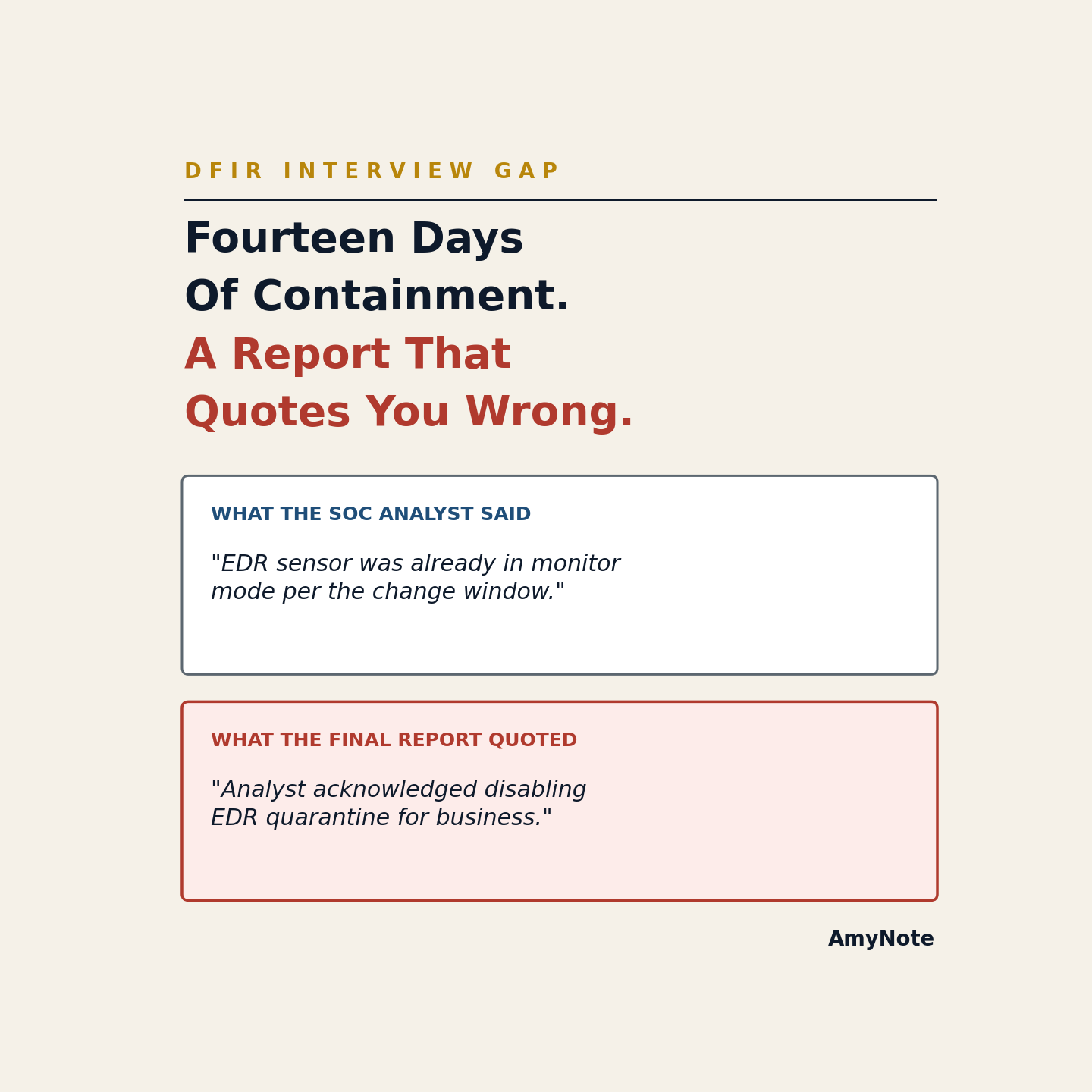
When the Final Report says a SOC analyst "acknowledged she disabled the EDR quarantine action to permit business continuity," she opens the timestamp, surfaces the verbatim line where she actually said "the EDR sensor was already in monitor mode per the change window that closed at 2 AM," and her counsel files the transcript as an exhibit in the response to the regulator or insurer. Under privilege, the responder's copy still supports her recollection when the engagement's public deliverables get her sequence wrong. When the plaintiffs' expert deposition asks whether she recognized the initial access vector on day one, she has the exact language from the interview to work from.
The Consent Question
State recording consent law applies. Roughly 38 states are one party consent for in person conversations, meaning you can lawfully record any conversation you are a party to. Eleven states require all party consent. Your counsel advises on the rule for your jurisdiction and on whether the recording enters the privileged file or stays personal.
In practice most responder-controlled interview recordings live outside the privileged deliverable and inside the responder's own file. Counsel decides at the end whether to invoke it as an exhibit or leave it as a personal memory aid. Either way the option exists, which is more than can be said for a paraphrased memo written four weeks after the conversation ended.
Getting Started
Before your next tabletop exercise or on call rotation, install AmyNote on the phone that stays with you during incidents. Test it on a mock post incident interview with your CISO or outside counsel. Confirm transcript accuracy on the tools your SOC actually runs, from CrowdStrike Falcon to Splunk ES to Google Chronicle to Microsoft Sentinel. Test the entity resolution against your organization's CVE tracker and MITRE mapping so it captures your naming conventions cleanly.
When the DFIR interviewer arrives six weeks after containment, walk in knowing the official Final Report is no longer the only record of what your team said. That single fact changes the review cycle. The report cites verifiable statements instead of reconstructed ones. Outside counsel gets a defensible response file. Regulators get a factual record that survives Rule 26 discovery. And your responders stop discovering, months after the fact, that the words attributed to them in a public filing are not the words they actually spoke.
Originally published as an X Article by @AmyNoteApp.