The Problem
Every public bridge in the United States — more than six hundred thousand of them — must be inspected on a biennial cycle under FHWA 23 CFR 650.311. Since the National Bridge Inspection Standards moved to element-level ratings, each inspector now assigns AASHTO condition states, CS-1 through CS-4, to over a hundred defined elements per structure. Deck joints, bearings, pier caps, floor beams, gusset plates, splash zones on prestressed girders. Every defect has to be tied to a specific span, a specific pier or joint, a specific measurement, and a specific photo.
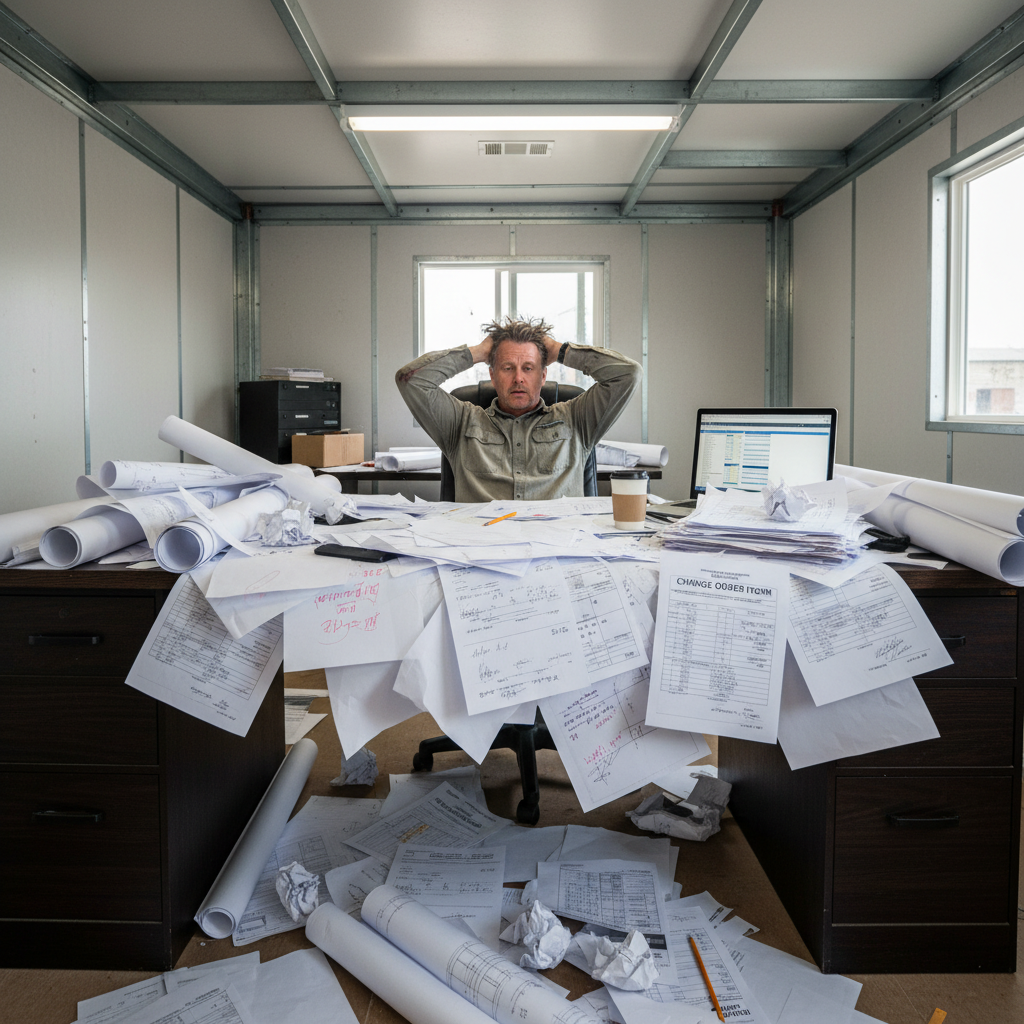
The physical reality of the job makes real-time entry impossible. Both hands are on the structure with a chipping hammer, sounding chain, calipers, or borescope. You are in a harness on a UBIT boom, on a climbing ladder inside a fracture-critical box girder, or lying under a deck slab checking the underside for delamination. Even a rugged tablet does not fit through most bay access hatches, and its screen washes out in full sun. After Silver Bridge, I-35W, and Fern Hollow, your field notes have real legal weight. And you are writing them at a laptop hours after you saw the crack.
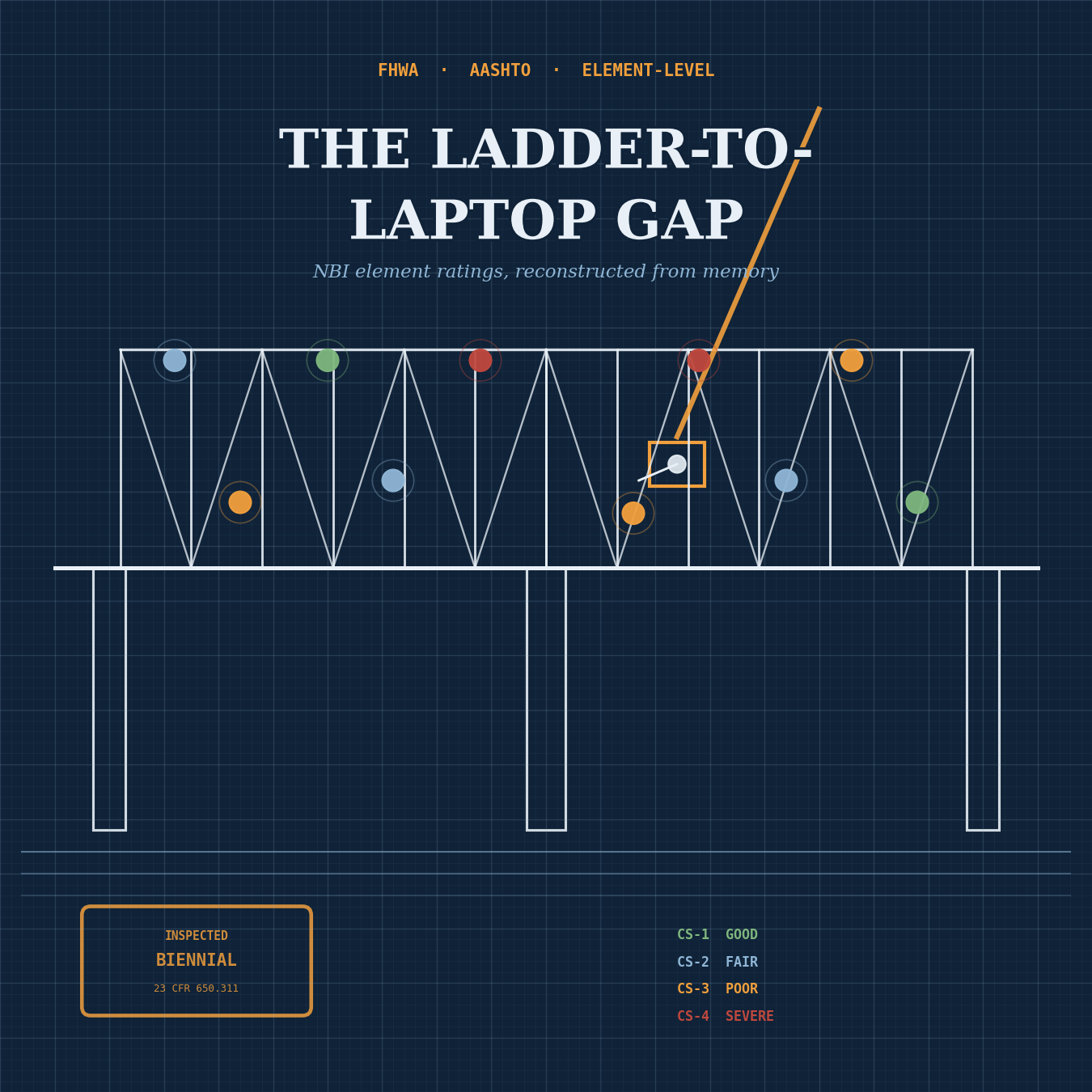
Why The Ladder-to-Laptop Gap Is Where Reports Get Weak
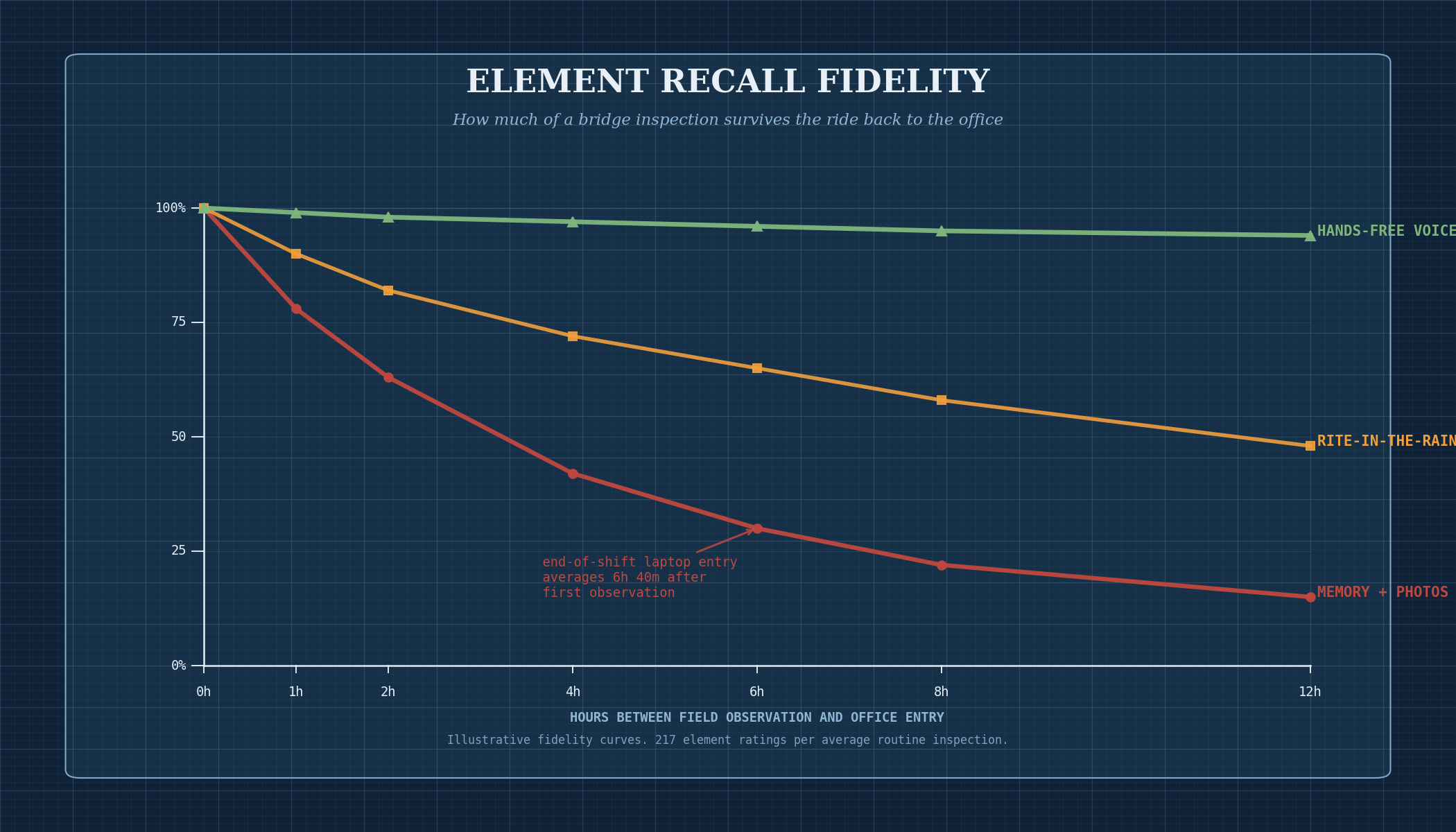
The industry has known about this gap for a decade. The FHWA's own guidance on element-level inspection is explicit: the whole point of moving from a general condition rating to individual element ratings is to make condition data useful for asset management, load rating, and prioritization of federal-aid bridge program dollars. That utility falls apart the moment ratings are reconstructed from partial memory eight hours after they were observed.
When the report ships to the DOT and gets aggregated into the National Bridge Inventory, the data flows into every downstream decision: LRFR load rating cutoffs, posting decisions, scour-critical routing, the FHWA's own Bridge Formula Program allocations. A CS-3 rating on a floor beam that should have been CS-4 does not just misstate the beam. It misstates the truck routing that county issues over the structure until the next cycle.
Why Current Solutions Fail
Paper field notes. Gloved hands cannot write neatly, wind blows pages off the deck, and rain smears the ink. Rite-in-the-Rain notebooks help, but every note still requires a one-handed transcription pass later that night. Handwriting from a boom seat rarely captures the measurement to the tenth of an inch, and the abbreviation you used at ten in the morning does not always parse the same way at nine in the evening.
Rugged tablets. They do not survive the access constraints of real inspection work. Screens are unreadable in sun, capacitive input hates harness gloves, and the device is another thing to drop from height. On a fracture-critical routing you are already carrying a headlamp, a sounding hammer, calipers, a paint marker, and often a borescope. The tablet is the thing that stays in the truck.
Photo-first documentation. Eight hundred photos come back with almost no context. Which pier was this again? Was it the north face or the south? The photo shows a crack; it does not say whether the crack is on the U3 gusset or the L3 gusset, or that it opens under live load and closes under dead load. Without a spoken narrative attached to each photo, the office pass reconstructs geometry from the image alone, and that reconstruction is where CS-3 slides into CS-2.
Pocket voice recorders. They capture audio but produce nothing usable. Transcription is manual, unstructured, and rarely happens the same day. A four-hour recording with two hundred element ratings in it is unsearchable and slow to replay. By the third bridge in a week the audio files stack up and never get transcribed at all.
Dictation into a phone note app. Better than a recorder, worse than a structured tool. There is no element code, no condition-state field, no photo timestamp linkage. When you open the note file at the desk, you get a wall of text you still have to parse element by element into InspectTech or AASHTOWare BrM.
What Actually Works
Talk while you work, and let the words arrive at your laptop already sorted by element. Both hands stay on the structure.
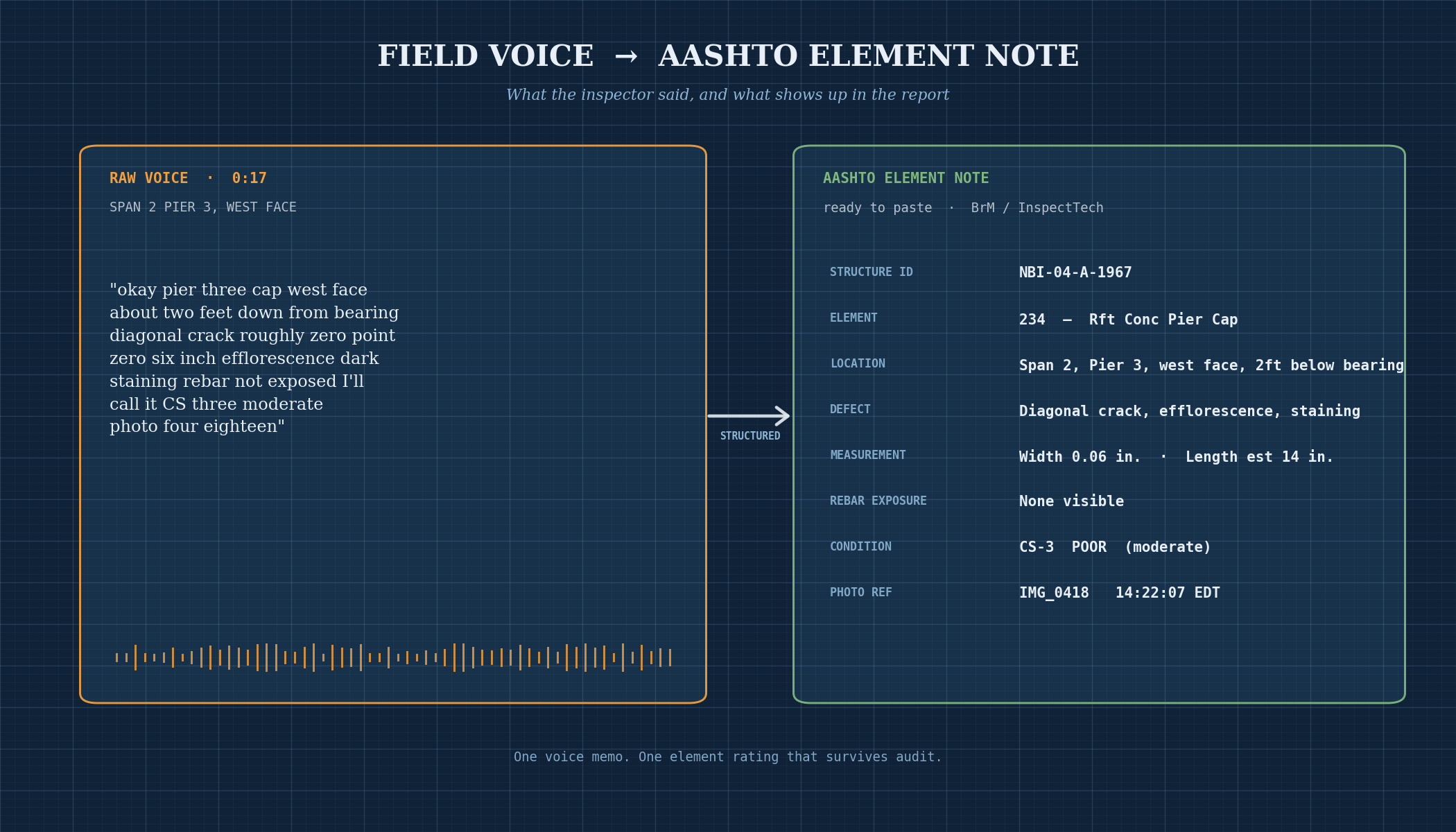
Pair a Bluetooth push-to-talk headset with the phone in your chest pocket before you climb up. Speak the element first, then the location, then the defect, then the measurement. "Pier three cap, west face, two feet below bearing, diagonal crack, roughly zero point zero six inch, efflorescence, dark staining, no rebar exposure, call it CS-3 moderate, photo four eighteen." Seventeen seconds. Both hands never left the concrete.
AmyNote is built for this pattern. Whisper handles the transcription with domain-adaptive prompting so gusset plate, spall, delamination, efflorescence, section loss, and prestressed girder come out spelled correctly the first time. Claude structures the raw dictation into an AASHTO element note keyed to the AASHTO Bridge Element Inspection Manual: structure ID, element number, span and location, defect, measurement, condition state, and photo timestamp. It runs when there is no cell signal, which is most of the time under a bridge.
At the end of the shift, your ratings are already grouped by element and ready to paste into AASHTOWare BrM, InspectTech, or your state's PONTIS derivative. Photos time-align to the voice note captured within the same minute. The 4:18 photo lands next to the 4:18 dictation, and the office pass sees the pair together instead of reconstructing which observation belonged to which image.
Both OpenAI and Anthropic contractually guarantee zero training on user data. Audio is encrypted in transit; processing copies may be retained to deliver and recover requested features. Transcripts stay on device with encrypted transport. Nothing sensitive about a fracture-critical routing leaves your phone.
The Documentation Pattern That Holds Up At Load Rating
A defensible NBI workflow has four properties that the ladder-to-laptop gap breaks and that structured dictation restores.
- Contemporaneous. The rating is spoken while both hands are on the defect, not typed six hours later from memory. The timestamp on the audio file matches the timestamp on the photo file within the same minute, and both match the moment the observation was made.
- Element-keyed. Every dictation is captured against a specific AASHTO element number from the AASHTO Bridge Element Inspection Manual, not against a paragraph of free text the office pass has to re-parse.
- Measurement-preserved. The exact figure — zero point zero six inch crack, six inches of section loss, two feet below bearing — is captured in the inspector's own voice. If the load rating engineer questions the field call three months later, the audio is the answer.
- Photo-linked. Each photo has a spoken caption attached to it inside the same minute of the same shift. The office pass never has to guess which pier is in the frame.
DOTs that adopt this pattern do not change the FHWA inspection cadence. They do not slow the biennial cycle. They eliminate the specific class of transcription errors that turn a defensible field call into a load-rating dispute six months later — the class of errors that gets the state's NBI submission flagged by the FHWA and pulls the routing engineer into a call she did not need to be on.
Getting Started
Try AmyNote on your next NBI cycle. Pair a PTT headset before the ladder-up. Speak the element name first, then defect, then measurement, then photo reference. When you come down, your report is already structured. The gap between what you saw at the tenth-point and what shows up in AASHTOWare closes to zero.
The FHWA does not care whether you like your inspection tool. The FHWA cares whether the ratings you submit reflect what you actually observed on the structure. Structured dictation, captured at the ladder and delivered to the laptop pre-sorted by element, is the shortest path between the two.
Originally published as an X Article.