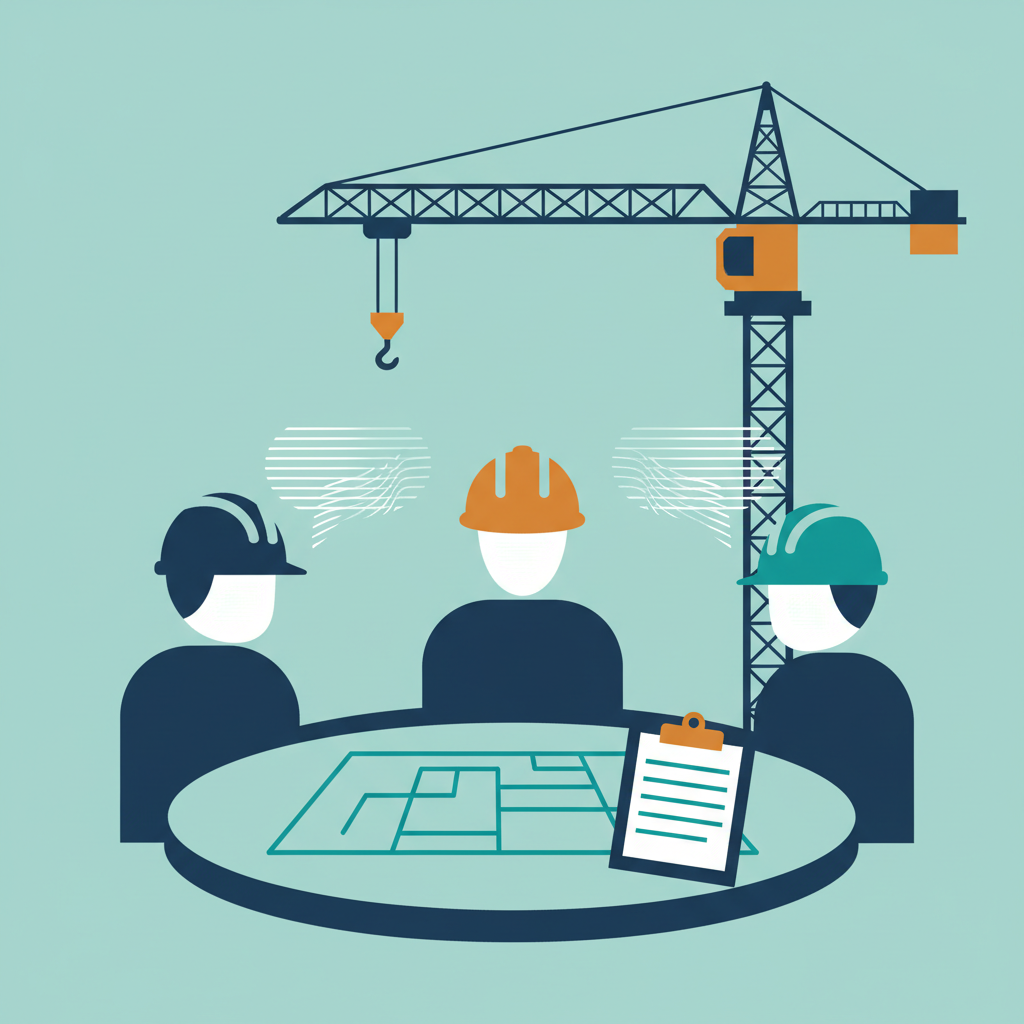
A principal architect sits in a design review with a client couple building their forever home. The wife mentions she hates exposed ductwork — "it reminds me of my college dorm." The husband wants the kitchen island angled 15 degrees to face the garden view. The structural engineer flags that the cantilevered balcony needs a deeper beam, which will drop the ceiling height by 200mm in the master bedroom below.
Three weeks later, the revised drawings come back. The ductwork is exposed in the living room. The island faces the wrong direction. The ceiling height issue is unresolved. The client is frustrated. The firm eats 40 hours of redesign time.
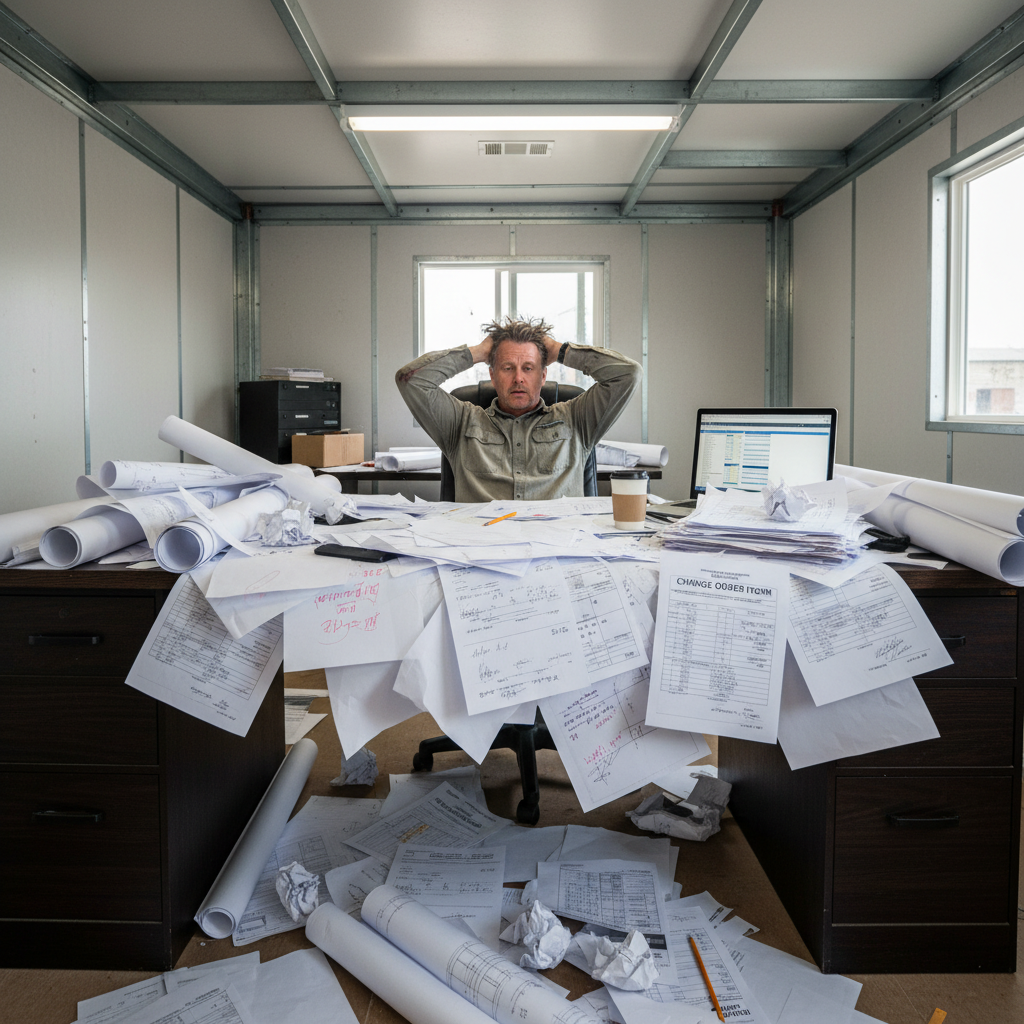
This is the design review documentation gap — and it costs architecture firms a meaningful share of margin on residential and commercial work alike. It also shows up as something harder to measure: client trust eroded by small contradictions that accumulate over months.
The Documentation Problem in Architecture
Design decisions happen fast in review meetings. A typical 90-minute client session generates 30-50 discrete decisions: material preferences, spatial relationships, budget tradeoffs, regulatory constraints, and aesthetic directions. Many of them are conditional, layered, or contingent on information that arrives later in the project lifecycle.
Most firms rely on one of three documentation methods, each of which fails predictably:
- Handwritten notes during the meeting, transcribed later — if there is ever a quiet hour to transcribe them. By the time they reach the project folder, the nuance has decayed.
- One team member assigned as scribe, missing the visual and spatial discussion that drives most design decisions. The scribe is heads-down while the principal is sketching on a napkin or pointing at a 3D model.
- Post-meeting memory, where the lead architect reconstructs decisions hours or days later. This is the most common method on smaller projects, and the least defensible when a dispute arises.
The problem compounds across project phases. A mid-size residential project involves 15-25 formal meetings over 12-18 months — plus dozens of informal site conversations, contractor calls, and planning board sessions. Each undocumented decision becomes a potential dispute, redesign trigger, or liability exposure.
When a project architect leaves the firm mid-project, the institutional knowledge loss is catastrophic. The replacement inherits drawings, but not the reasoning behind them. The "why we did it this way" lives in a former employee's head, and the new architect either rediscovers it through painful trial-and-error or quietly redesigns around the inherited decisions.
Why Meeting Minutes Don't Work for Design
Traditional meeting minutes fail architecture for specific reasons that are unique to the discipline:
- Spatial decisions need context. "Client prefers option B for the facade" means nothing six months later when nobody remembers what option B looked like or why it was preferred over A. Design discussion is inherently visual and gestural — minutes flatten it into text that loses 80% of the meaning.
- Decisions are conditional. "We'll go with timber cladding IF the fire rating comes back acceptable" — these conditional branches get lost in flat note formats. Six weeks later the team treats the conditional as confirmed, the fire rating fails, and someone has to call the client.
- Multiple speakers, overlapping expertise. The structural engineer, MEP consultant, landscape architect, and client all contribute in the same meeting. Attributing decisions to speakers matters for liability — and for figuring out who to call when something needs clarification three months later.
- Site conversations are undocumented entirely. The contractor mentions a soil condition that affects foundation design. The architect nods, makes a mental note, and forgets by the time they're back at the office. These hallway-and-site moments are where most coordination failures originate.
The Cascade From a Single Lost Decision
A single missed verbal request rarely stays contained. The client says "let's bump the kitchen ceiling up by 300mm" in a design review. That triggers:
- Structural review — does the new floor-to-floor work with the existing beam grid?
- MEP coordination — ductwork, sprinklers, and lighting all need to be re-routed at the new ceiling plane.
- Cost implications — the curtain wall on that elevation gets taller, fenestration ratios shift, structural steel may need to be repriced.
- Permit drawings — if the building height changes by even a small amount, planning approval may need to be re-submitted.
When the original verbal request is not captured precisely — who said it, when, and conditional on what — downstream teams work from rumor. The structural engineer hears "raise the ceiling," but not the caveat about preserving the parapet line. By the time the discrepancy surfaces in coordination, weeks of work need revision.
What Effective Design Documentation Looks Like
The gap closes when every conversation — studio reviews, client presentations, site walks, planning hearings — becomes a searchable, attributed record. Not a recording sitting unwatched on a hard drive, but a structured artifact the project team can actually use.
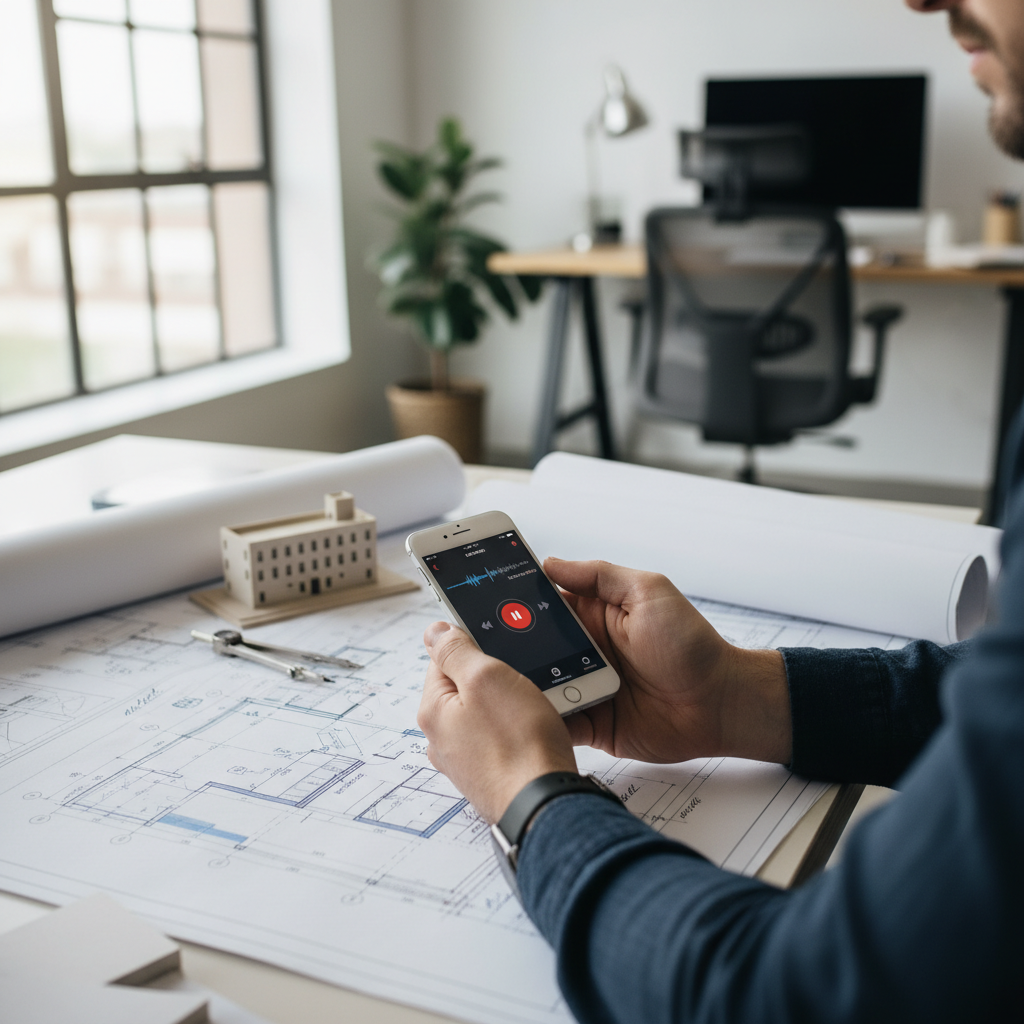
AmyNote approaches this differently from desktop meeting tools. It runs on the architect's iPhone — the device they already carry to every site visit, client dinner, and planning board meeting. No laptop required. No meeting bot joining a call. The architect taps record and keeps doing what they were going to do anyway: walk the site, sketch on a napkin, point at a model.
Transcription That Handles Technical Vocabulary
OpenAI's latest Speech API accurately captures terms like "curtain wall mullion," "moment frame connection," "fenestration ratio," and "setback variance" — the domain language that generic transcription mangles into nonsense. A consumer transcription tool turns "voir dire" into "void ear"; the same class of failure happens when an MEP consultant says "VAV box reheat coil" or a structural engineer references a "W14x22 wide-flange."
Speaker Identification Across Sessions
When the structural engineer mentions a load-bearing constraint in meeting 3, and the client references it in meeting 7, AmyNote connects those threads. Cross-session speaker memory means you can search "what did the structural engineer say about the cantilever" across the entire project history — not just within a single meeting transcript.
For multi-disciplinary projects, this is the difference between "the transcript exists somewhere" and "I can find the decision in 10 seconds." Over a 14-month project, that retrieval gap compounds into hours per week.
AI-Structured Summaries for Design Decisions
Anthropic's Claude Opus generates structured decision logs from raw conversation — separating confirmed decisions, open questions, conditional approvals, and action items. Each tagged with speaker attribution and timestamp. The flat-prose meeting minute gets replaced by a typed record an architect can actually reference six months later without re-reading the entire transcript.
Privacy Architecture That Protects Client Confidentiality
Both OpenAI and Anthropic contractually guarantee zero training on user data. Audio is encrypted in transit; processing copies may be retained to deliver and recover requested features. Transcripts are stored locally on device with encrypted transport. Cloud processing copies are handled under the controls described in AmyNote’s Privacy Policy. No privileged project conversations feeding into model training pipelines.
This matters most on high-net-worth residential work and competitively sensitive commercial projects, where the design conversation often includes financial details, family dynamics, or competitive positioning the client expects to stay between them and their architect.
Getting Started
Architecture firms running multiple concurrent projects lose meaningful margin annually to redesign work caused by documentation gaps. The fix is not more diligence with the same broken tools — it is a different tool that captures the conversation as it happens, attributes it to the right speaker, and makes it searchable when someone six months later asks "wait, when did we agree to that?"
AmyNote captures every design conversation — from formal reviews to impromptu site discussions — and makes them searchable across the entire project lifecycle. Transcription by OpenAI, AI analysis by Anthropic Claude Opus, with a 3-day free trial.
Originally published as an X Article.