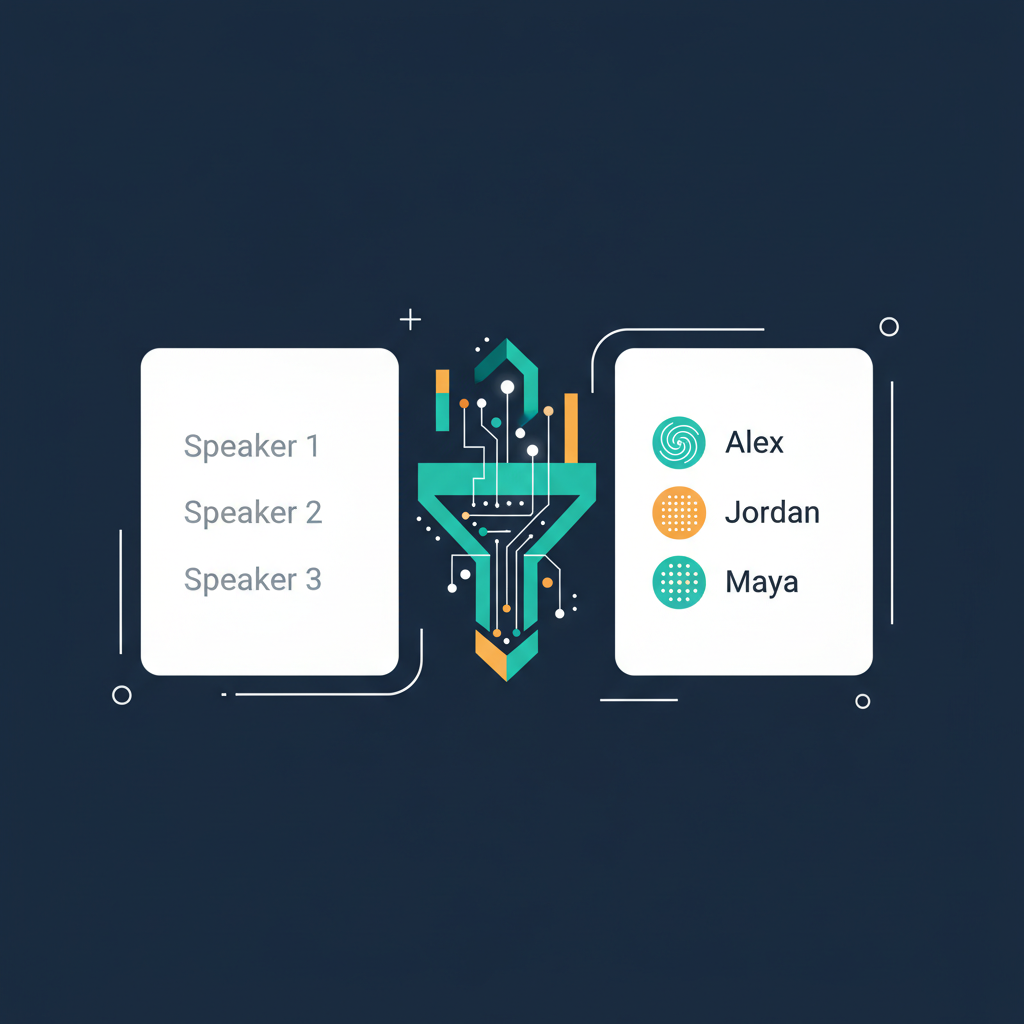
A product manager finishes a cross-functional review with engineering, design, and sales. The AI transcription tool captured every word. But the transcript reads like an anonymous chat log — “Speaker 1 said we should delay launch,” “Speaker 2 disagreed.” Now she is spending 30 minutes matching voices to names, trying to remember who said what.
This is the dirty secret of most AI transcription tools. They nail the words but lose the people.
The Attribution Problem
Transcription accuracy has gotten remarkably good. OpenAI’s Speech API handles domain-specific terminology — EBITDA, thrombocytopenia, voir dire — with surprising precision. But accuracy without attribution is like a courtroom transcript with no witness names. Technically complete, practically useless.
Consider what happens in a six-person board meeting. The CFO presents risk exposure numbers. The general counsel flags a compliance concern. The CEO makes a decision. Without reliable speaker identification, the transcript becomes a wall of text where critical accountability disappears.
In regulated industries, this is not just inconvenient — it is a liability. Financial advisors need to prove who said what during client meetings. Lawyers need attribution for deposition records. Doctors need to know which specialist recommended a treatment change.
Why Most Tools Get Speaker ID Wrong
- Generic voice clustering. Most tools use basic audio fingerprinting that groups similar-sounding voices. Put two men with similar pitch in a room and watch the labels scramble.
- No memory between sessions. Your tool identifies “Speaker 3” perfectly in Monday’s meeting. Tuesday’s meeting? It starts from zero.
- Manual correction loops. Some tools let you fix speaker labels after the fact. But if you are spending 15 minutes per meeting correcting labels, you have just traded one manual task for another.
- Failure at scale. Speaker ID that works for a 3-person call often falls apart at 8 or 10 participants. Crosstalk, interruptions, and varying microphone distances break the model.
What Actually Works: Cross-Session Speaker Memory
The approach that changes the workflow is not just better in-meeting identification — it is persistent identity across meetings.
AmyNote builds a voice profile for each speaker that carries forward. When your CFO speaks in Monday’s board meeting and Wednesday’s budget review, the system recognizes the same person. No re-labeling. No guessing.
Here is how it works technically: OpenAI’s Speech API handles the raw transcription with high accuracy on specialized vocabulary. The speaker identification layer creates and maintains voice embeddings — think of them as acoustic fingerprints — that persist in your local database. When a known voice appears in a new recording, the system matches it automatically.
The practical impact is significant. A consultant who meets with 15 clients per week gets transcripts where “Sarah from Acme Corp” is always labeled correctly, whether it is their first meeting or their tenth. A lawyer reviewing deposition transcripts can search “everything Dr. Martinez said across all sessions” and get accurate results.
Anthropic’s Claude Opus powers the AI analysis layer on top of this. Once speakers are correctly identified, the AI can generate summaries organized by participant, extract action items attributed to specific people, and answer questions like “What did the engineering lead commit to in last Thursday’s standup?”
The Privacy Question
Speaker voice profiles are sensitive biometric data. This is where architecture matters more than features.
AmyNote’s approach: all voice embeddings and transcripts are stored locally on your device. Audio is processed through OpenAI’s Speech API with encryption in transit and zero retention after processing. Both OpenAI and Anthropic contractually guarantee that user data is never used for model training.
Cloud processing copies are handled under the controls described in AmyNote’s Privacy Policy. No biometric data feeding into training pipelines. Provider retention follows the applicable API or enterprise terms.
Getting Started
Speaker identification with cross-session memory is available in AmyNote with a 3-day free trial — no credit card required. Transcription powered by OpenAI, AI analysis by Anthropic Claude Opus. Both with zero-training guarantees.
Try it at amynote.app
Originally published as an X Article.