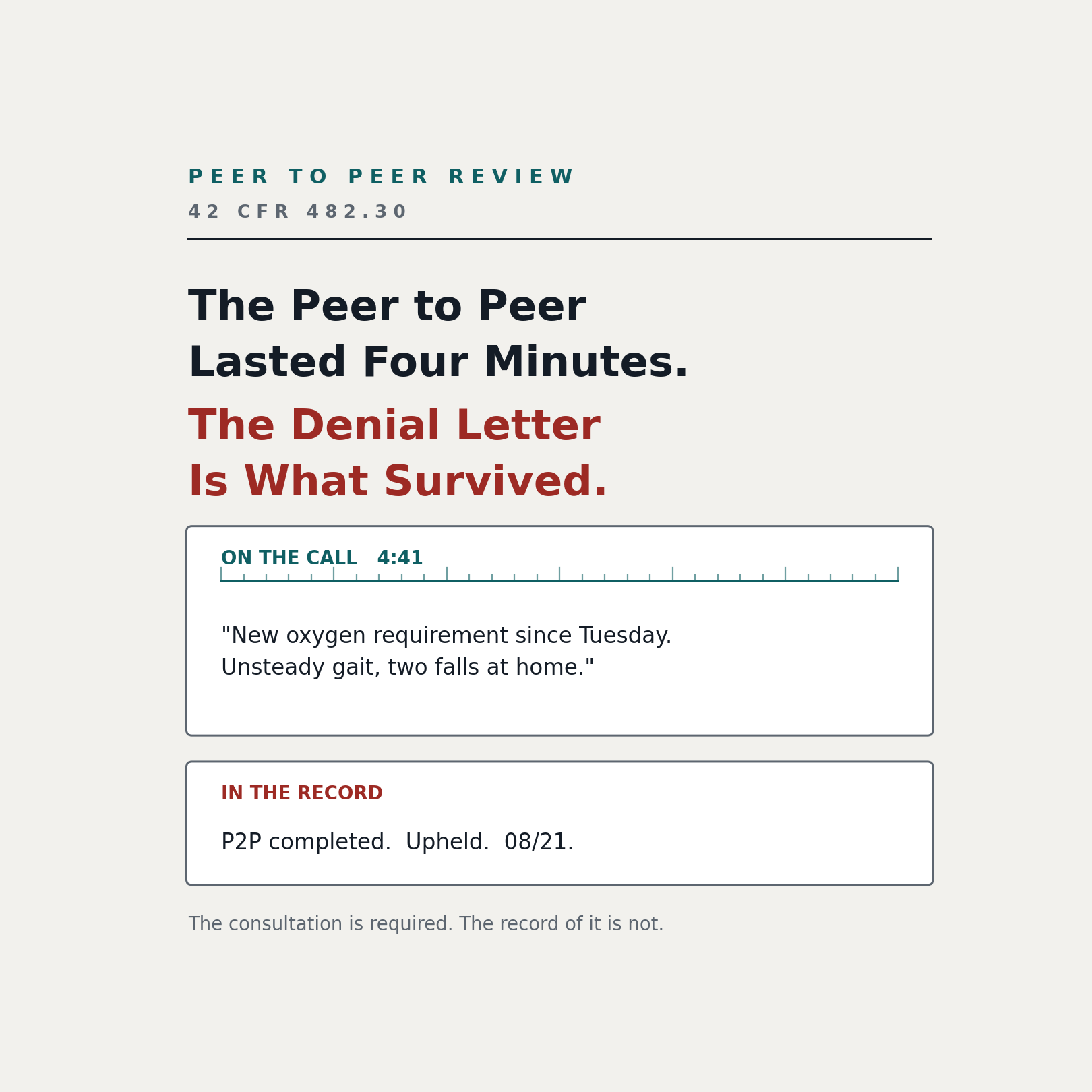
It is 4:40 on a Friday. The medical director has four minutes between his own calls, and you have those four minutes to explain why a 78 year old with a new oxygen requirement and an unsteady gait cannot safely be discharged today. You describe the desaturation on ambulation, the two falls at home, the daughter who works days. He asks two questions. He says he will let you know.
Eight days later the denial letter arrives. It cites a criteria set you never heard named on the phone. What you said is nowhere in it, and nowhere in anything else either.
The Conversation Is Required. The Record of It Is Not.
Under 42 CFR 482.30(d)(2), before a hospital utilization review committee determines that an admission or continued stay is not medically necessary, it must consult the practitioner responsible for the care of the patient and afford them the opportunity to present their views. This is a Condition of Participation, not a courtesy and not a local policy. A hospital that skips it has a survey problem, not a customer service problem.
That opportunity is load bearing in a way most clinicians never see spelled out. 42 CFR 482.30(d)(1)(i) allows a single UR committee member to make the adverse determination alone if the responsible practitioner concurs or fails to present their views when afforded the opportunity. Under 482.30(d)(1)(ii), every other case — every case where you did present your views and did not concur — requires at least two members. Written notification follows within two days under 482.30(d)(3).
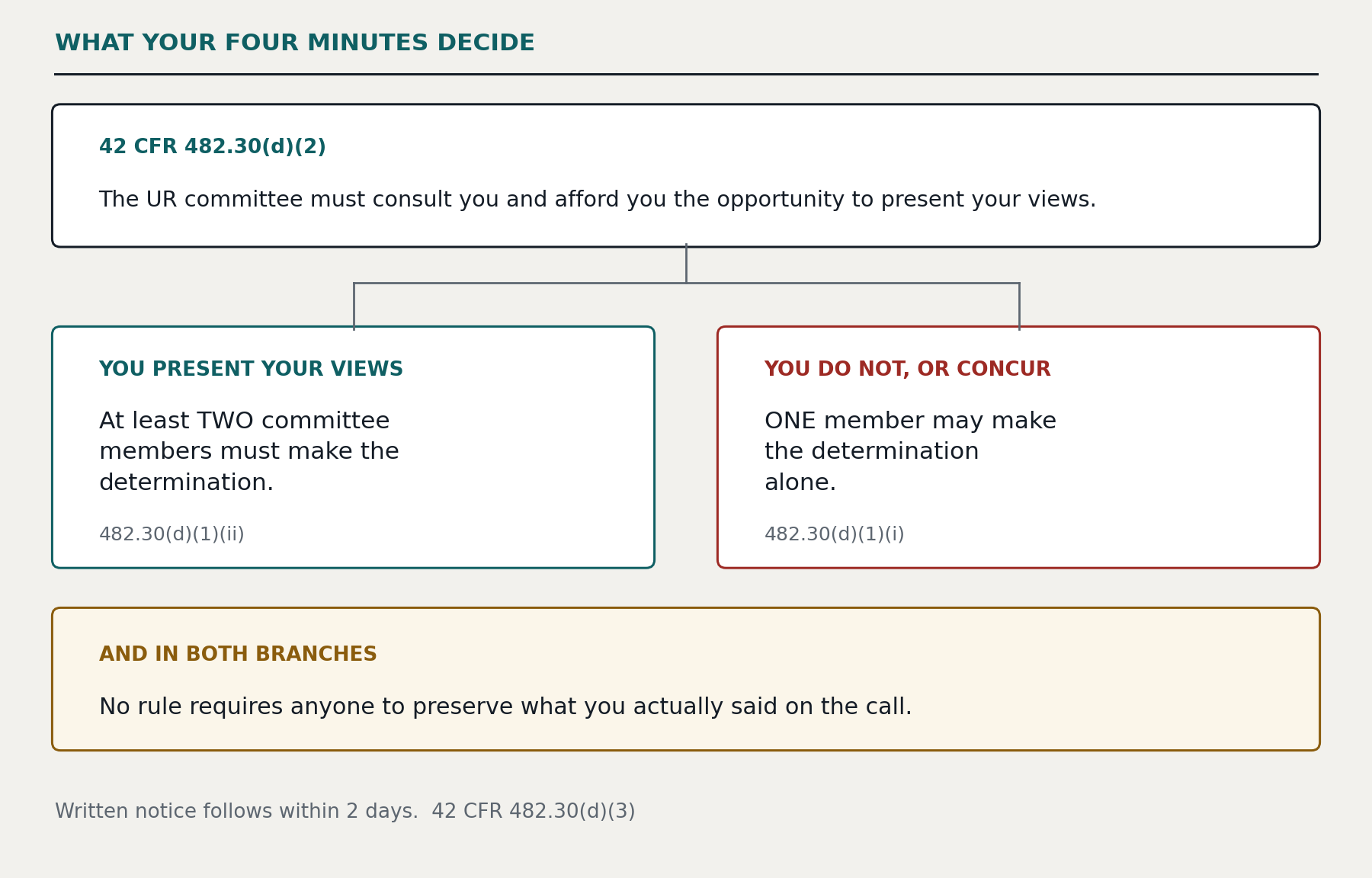
Read the branch carefully. The question that decides whether one signature or two is required is a question about the content of a phone call — did the practitioner present views, or not. It is a factual question with real procedural consequences, and the only evidence of the answer is whatever someone typed afterward.
On the payer side the same asymmetry holds. 42 CFR 422.568(e)(2) requires a Medicare Advantage denial notice to state the specific reasons for the denial. 42 CFR 438.210(b)(2)(ii) requires Medicaid managed care plans to consult the requesting provider when appropriate. Both rules oblige someone to reach you. Neither obliges anyone to preserve the exchange.
So what you say on that call changes who has to sign the denial and how it has to be justified. Nothing in any of it requires anyone to keep what you actually said.
Why the Note You Write Afterward Does Not Hold
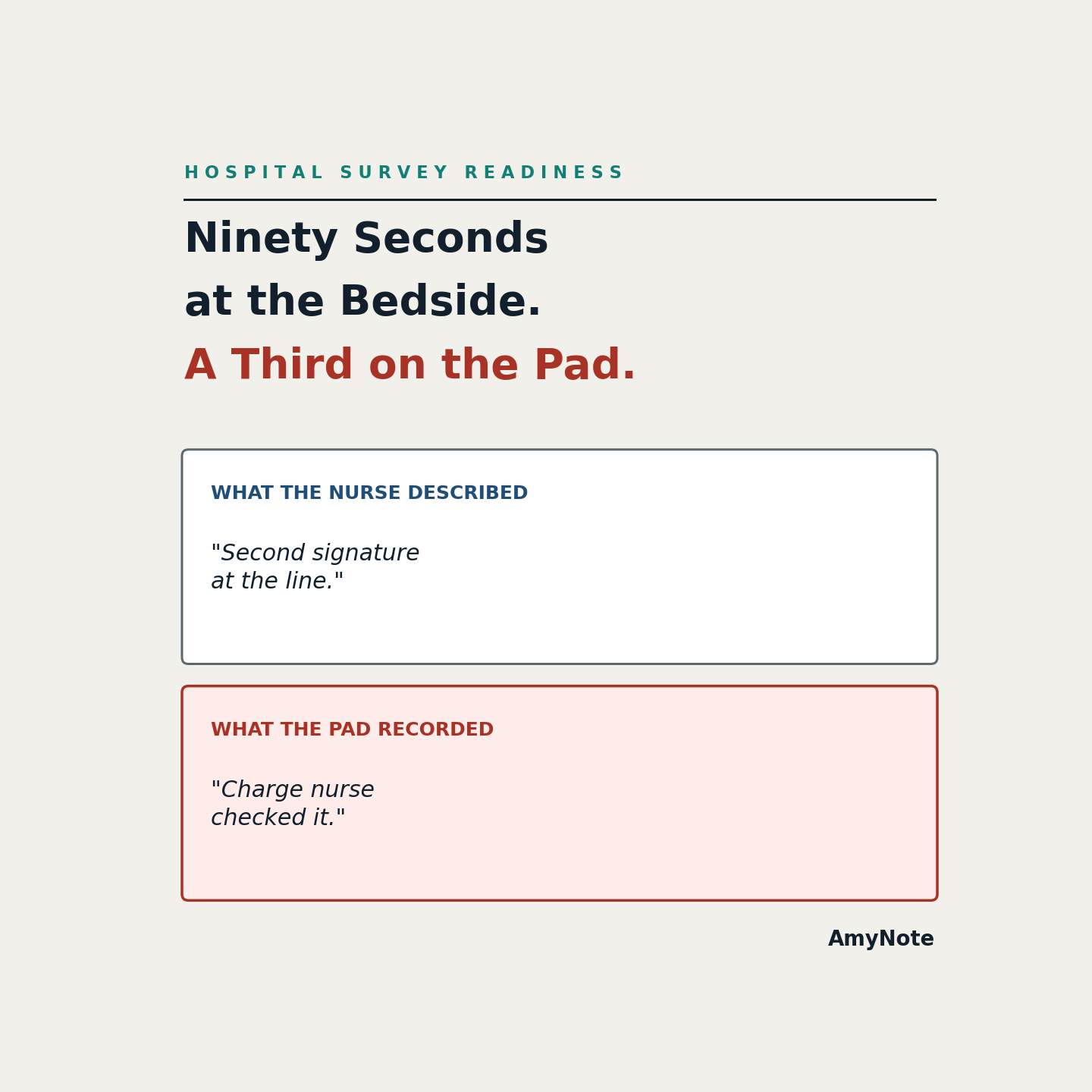
The call lands between patients, or between a discharge and a rapid response. What gets typed into the case management system is a line: peer to peer completed, upheld, spoke with a reviewer whose name you half caught. Maybe a criteria set, if the reviewer named one and you wrote it down before the next page. The clinical reasoning stays in your head for about a day.
That is not carelessness. It is the honest output of a four minute call slotted into a shift with no time set aside for documentation of a conversation nobody has told you will matter later. It matters later.
Then the appeal starts. 42 CFR 422.590(h)(1) requires the reconsideration to be conducted by someone not involved in making the original determination. When the denial rests on medical necessity, 422.590(h)(2) requires a physician with expertise appropriate for the services at issue, who need not be of the same specialty or subspecialty as the treating physician.
Both of those provisions exist to protect the enrollee, and both of them have the same side effect: the person deciding the appeal was not on the call. They work from a file. Your four minutes of reasoning is not in it.
Consider what the plan is actually obligated to retain. For integrated plans, 42 CFR 422.629(h)(2) lists the minimum contents of an appeal record: a general description of the reason, the date of receipt, the date of each review, the resolution at each level, the date of resolution, and the enrollee name. Dates and outcomes. Not substance.
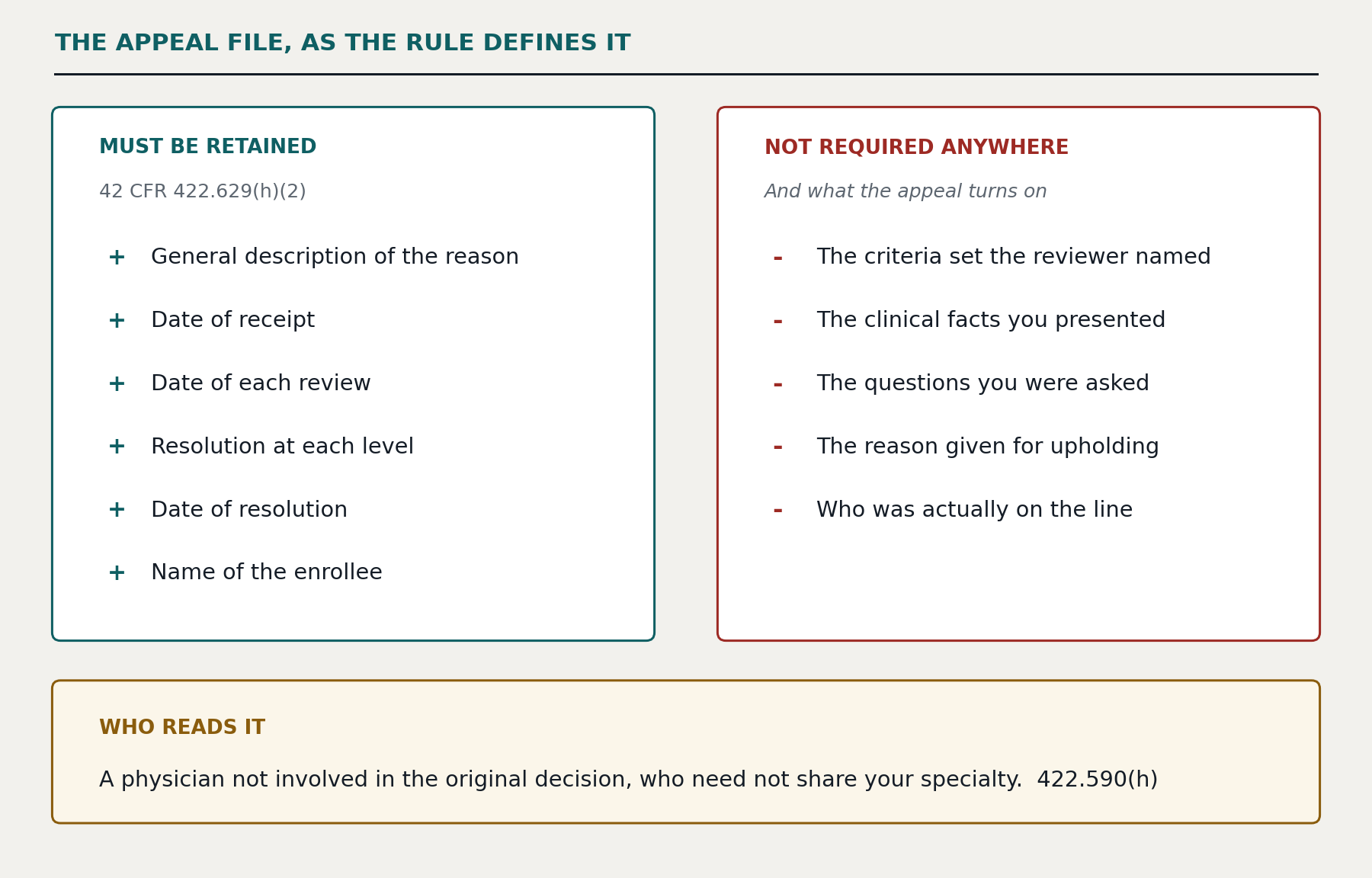
Put the two columns side by side and the problem is structural rather than adversarial. Nobody is hiding anything. The record the rules require is a record of process, and the appeal is decided on content. When a denial management team goes back to build the appeal, they are reconstructing the content from memory — and the memory in question belongs to a hospitalist who has had roughly forty more conversations since.
What a peer to peer record has to carry, if it is going to be worth anything on appeal:
- Who was on the line. Name, credential, and specialty of the reviewer — the detail most often lost, and the one that matters when 422.590(h)(2) expertise is at issue.
- The criteria named. Which criteria set, which specific criterion, and whether the reviewer named one at all before the letter did.
- The clinical facts you presented. In the words you used, not compressed into “discussed medical necessity.”
- The questions asked. What the reviewer probed tells you what the plan thought the weak point was.
- The reason given for upholding. And whether it is the same reason the written notice states under 422.568(e)(2).
That last comparison is the one nobody can run today. The oral reason and the written reason may differ, and there is no artifact that lets you see it.
The Clocks Run Against the Record
Timing makes reconstruction worse, because the windows are short and they start before anyone knows an appeal is coming. Expedited organization determinations are due within 72 hours under 42 CFR 422.572(a)(1), and within 24 hours for a Part B drug under 422.572(a)(2). If an adverse expedited decision is delivered orally first, written confirmation follows within three calendar days under 422.572(c).
Beginning January 1, 2026, standard determinations for items and services subject to prior authorization are due in seven calendar days under 422.568(b)(1)(ii). Faster decisions are good for patients. They also mean the oral exchange and the written notice are separated by days, not weeks, and the person who has to compare them is working from a one line note.
What Actually Works
Capture the conversation while it is happening, not after. Nothing about the clinical judgment changes. What changes is that writing the note becomes a review task instead of a recall task, and the comparison against the denial letter becomes possible at all.
AmyNote records the peer to peer on the phone in your hand and transcribes it with the OpenAI Speech API, then runs Anthropic Claude Opus over the transcript to pull out what matters for the appeal: the criteria set the reviewer named, the specific clinical facts you presented, the questions asked, and the reason given for upholding. Speaker separation keeps your case and the reviewer’s questions on separate sides of the record, which is exactly the line that collapses when a four minute call is summarized into one sentence.
Semantic search across your call history means you can find every prior denial that turned on the same criteria in seconds. At the volume a utilization review department runs, that is the difference between arguing one case and recognizing a pattern — the reviewer who always lands on the same criterion, the service line where oral and written reasons routinely diverge.
The privacy architecture is the part regulated teams ask about first. Both OpenAI and Anthropic contractually guarantee zero training on user data. Audio is encrypted in transit and not retained after processing. Transcripts are stored locally on device with end to end encryption. For a conversation that carries protected health information about a named inpatient, where the data rests is not a detail.
The point is not to build a case against the reviewer. Most of them are doing the same job you are, from the other side, under their own clock. The point is to make sure that the views you were legally afforded the opportunity to present are still recoverable when someone who never heard them decides the appeal.
Getting Started
Start with the calls you already lose. Pick the next peer to peer on your schedule, record it, and compare your transcript against the denial notice when it arrives. Do not change anything else on the first pass — write your note exactly as you do now, then put the two records next to each other.
Most utilization review teams find the gap on the first case. It is usually one of two things: a criterion in the letter that was never raised on the call, or a clinical fact you presented that does not appear anywhere in the plan’s stated reason. Either one is an appeal argument you could not have made from memory.
AmyNote runs on the phone already in your pocket, so there is nothing to install in the hospital environment and nothing routed through a bot on a bridge line. The peer to peer happens on a phone call. The record should too.
Originally published as an X Article by @AmyNoteApp.