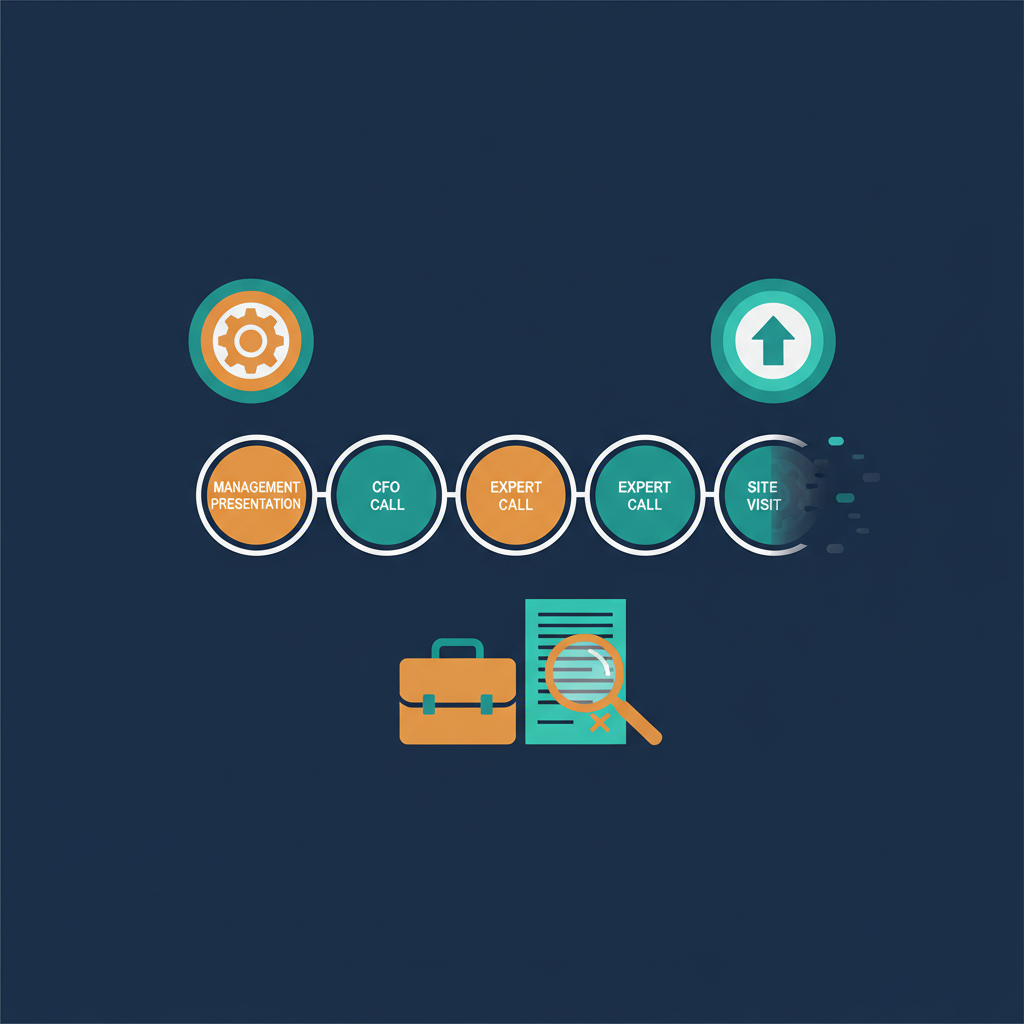
This is the structural problem at the heart of modern M&A. Bankers and PE deal teams run back-to-back diligence sessions, then have to reconstruct what was said for the IC memo, the bid letter, the SPA reps, and the integration plan. The gap between what was said and what gets documented is where mispriced offers, busted earnouts, and post-close surprises live. It is also where the deal team's own credibility with the IC quietly erodes — every time a VP has to caveat a number with "I think the CFO said," the room loses faith in the model behind it.
The Diligence Documentation Problem
Deal teams are not short on meetings. A typical sell-side process runs 15-25 management presentations, expert calls, and diligence sessions per buyer in a 4-week window. For PE buy-side, add a hundred-day plan workstream, a quality-of-earnings workstream from the accountants, a commercial diligence workstream from a strategy consultant, and reference calls with departing executives on top. The deal team is the connective tissue across all of it, and the connective tissue is one or two associates and a VP.
The associate or VP taking notes is also expected to ask follow-up questions, watch management body language, and track who said what across multiple participants — sometimes through interpreters or over a video call where the audio is uneven. Note-taking and listening compete for the same attention budget, and listening loses. The associate who is heads-down typing during the CEO's answer about retention is the same associate who misses the CFO's eyebrow when working capital comes up.
What gets lost is rarely the headline. It is the qualifier. The CFO who said "EBITDA was 18M" but then quietly added "ex the one-time SAP write-off we are still finalizing." The CEO who described the customer concentration as "low" but later admitted the top three represent 38% of revenue. The head of sales who walked back a forecast number when pressed but whose original commitment is what landed in the deal model. These nuances do not make it to the IC memo, and they show up in a post-close working capital dispute, a missed earnout target, or an indemnification claim eighteen months after signing.
The same gap affects the legal workstream. Reps and warranties in the SPA are negotiated against what management said in diligence. When the legal team drafts a representation about pending litigation or material customer contracts, they are working from a memo that was reconstructed from notes that were reconstructed from memory. Two layers of compression sit between the actual conversation and the document that allocates risk between buyer and seller.
Why Current Solutions Fail
Most deal teams have tried to close this gap. None of the common approaches actually work.
- Junior associate manual notes. Subject to the same attention split. Notes are reconstructed after the meeting from memory and shorthand, with the same biases. The associate writes down what they thought was important; the qualifier the CFO buried in a parenthetical does not survive the trip from the meeting room to the deal folder.
- Generic AI notetakers built for sales calls. They miss financial terminology. EBITDA becomes "even-da." Carve-out becomes "carbide." Working capital adjustments get summarized as "they discussed numbers." The transcript is technically present in the deal folder and functionally useless when the VP needs to defend a price.
- Verbatim audio recordings with no structure. Helpful for compliance, useless for the Friday IC memo. Nobody is going to scrub through 14 hours of audio to find the synergy comment. The recordings sit in a SharePoint folder and become the deal team's version of "we have it if we ever need it" — which is to say, never.
- Compliance bot recorders. Built for regulatory archival, not for synthesis. They produce a defensible record for the surveillance team without reducing the workload on the deal team by a single hour.
- External transcription services. Slow turnaround, expensive per-minute pricing, and the privacy posture is a non-starter for live processes. A deal team is not going to send target-company audio to a third-party vendor that may retain or train on it.
The deeper issue is that the deal team is the most expensive part of the process and the most overloaded. Anything that adds friction or requires after-hours review fails on contact with a live process. The tool that survives is the one that runs in the background, produces something useful by the time the team is back at their desk, and never asks the associate to do extra work.
What Effective M&A Diligence Capture Looks Like
The workflow that works does three things: it captures audio with domain accuracy, structures it with speaker context, and makes the entire diligence corpus searchable across sessions.
Transcription accuracy on financial terminology
AmyNote uses OpenAI's latest Speech API for transcription. It handles EBITDA, basis points, working capital peg, NWC, run-rate, deferred revenue, earnout, escrow, RWI, MAC clause, no-shop, breakup fee, and ASC 606 with accuracy that does not require a glossary upload. Not perfect, but accurate enough that the VP can paste a quote directly into the IC memo without retyping it. When the deal moves to mark-up of the SPA and the legal team asks "what did the CFO actually say about working capital," the answer is a searchable transcript, not a recollection.
Speaker identification across sessions
When the CFO from the target shows up in three different calls plus a site visit, AmyNote remembers the speaker. The Friday deal memo can answer "what did the CFO commit to about working capital" by searching one name across every diligence session, not four separate transcripts. The same lookup works across an entire process — a buy-side team that ran twelve calls with target management can pull every quote from the head of sales in seconds, and the contradictions surface themselves.
AI summaries powered by Anthropic's Claude Opus
Each session produces a structured summary: headline numbers committed, qualifiers and caveats, open items, follow-up requests, and red flags. The associate spends 20 minutes reviewing instead of two hours reconstructing. The qualifier the CFO buried in a parenthetical actually shows up in the summary, because the model is reading the full transcript with no attention split. The IC memo gets drafted from a structured input, not from a tired associate's memory.
Privacy architecture that survives the compliance review
Both OpenAI and Anthropic contractually guarantee zero training on user data. Audio is encrypted in transit; processing copies may be retained to deliver and recover requested features. Transcripts are stored locally on the banker's device with encrypted transport. Cloud processing copies are handled under the controls described in AmyNote’s Privacy Policy. The compliance team has clear answers when the MD asks where target audio lives, and the seller's representations about confidentiality are not silently violated by the buyer's choice of notetaking tool.
What Changes by Signing
Deal teams who run this on a single live process notice the shift quickly. The first week, the back end of every meeting goes faster — fewer notes to type, faster handoffs to the QofE team, faster turnaround on follow-up question lists. By week two, the IC memo writes itself from structured summaries instead of being assembled from a stack of legal pads at 11pm Thursday night. By week four, the SPA negotiation is anchored to actual quotes from management, and the reps and warranties section shrinks because both sides are negotiating against the same record.
Post-close, the searchable archive becomes its own asset. A working capital dispute that surfaces six months after signing has the original CFO quote with a timestamp. An earnout disagreement with the seller can be resolved by pulling the exact commitment the CEO made in management presentation #3, not by re-litigating what people remember. The deal team's institutional memory survives associate turnover, because the record lives in the corpus, not in the head of the associate who left for the buy-side.
Getting Started
Deal teams running an active process do not have time to deploy enterprise software. AmyNote runs on the banker's device, captures in-person and remote diligence sessions, and produces structured summaries the same evening. A 3-day free trial is enough to test it on a single management presentation and see whether the IC memo writes itself.
Originally published as an X Article: @AmyNoteApp on X.