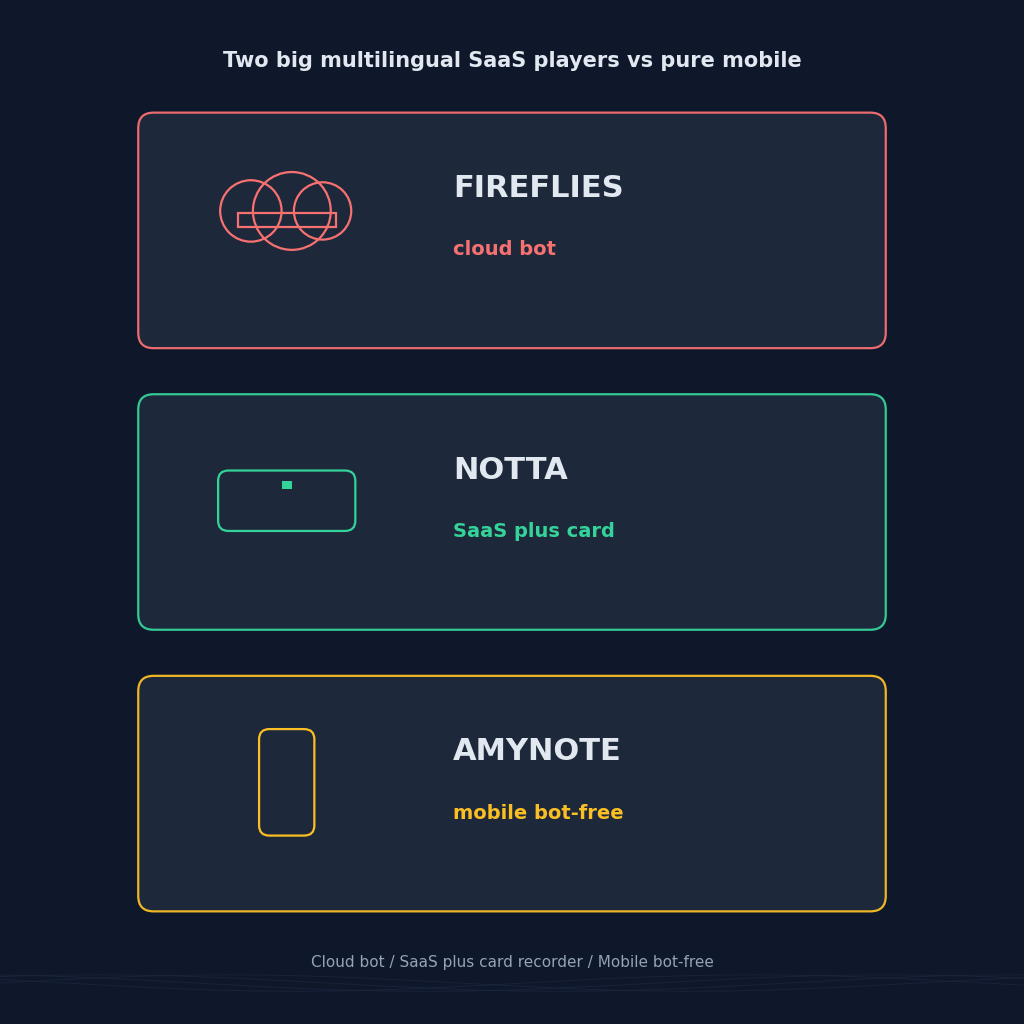
Two of the biggest multilingual meeting tools in 2026 both cover 60-plus languages, both promise real-time transcription, and both cost less than a lunch per month. They just capture conversations in completely different ways. Fireflies is a cloud SaaS that sends a bot into your video calls. Notta is a cloud SaaS too, but it also sells a card-thin hardware recorder for meetings that never touch a laptop. AmyNote skips both models and runs entirely on your phone.
If you have been trying to line the three up on price, on language coverage, and on which one actually works for the meetings you have, this piece is for you. The temptation is to reduce the choice to a spec table. It is not that simple — because the spec that matters most is where each tool captures audio, and that decides which meetings ever end up recorded at all.
Quick Verdict
Pick Fireflies if most of your meetings are on Zoom, Meet, Teams, or Webex, you care about CRM sync and AskFred cross-meeting search, and you are fine with a visible bot joining the call.
Pick Notta if you split time between online meetings and in-person conversations, want a small hardware recorder for the offline ones, and can live with 58-language coverage.
Pick AmyNote if you want a single mobile app that records in-person meetings, phone calls, and dictation without a bot on any call and without buying hardware. There is a trade-off — no desktop app, no bot, no CRM integrations.
What We Compared
We looked at four axes that actually decide which tool wins for a given user:
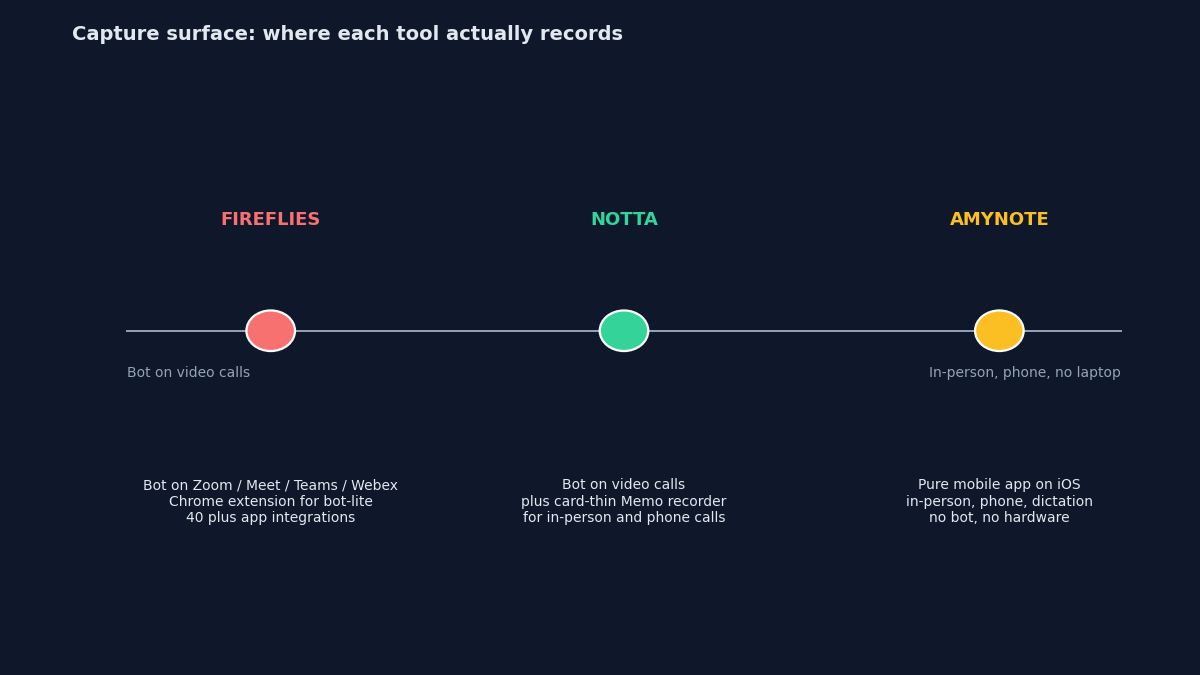
- Where each tool captures audio. Bot in the video call, dedicated hardware in the room, or the microphone on the phone you already carry.
- Entry pricing and the caps that come with it. The headline number is rarely the real one. The relevant number is what you pay after the first storage overage or credit refill.
- Language coverage. How many languages each supports for transcription and summaries, and how translation is priced.
- Privacy posture. What the AI vendor is allowed to do with your meeting after the transcript exists.
We ignored feature comparisons for things that all three do reasonably well: real-time transcription, speaker labels, action-item extraction, and searchable transcripts. Pricing verified directly from each vendor as of July 2026.
Fireflies: The Cloud Bot Powerhouse
Strengths
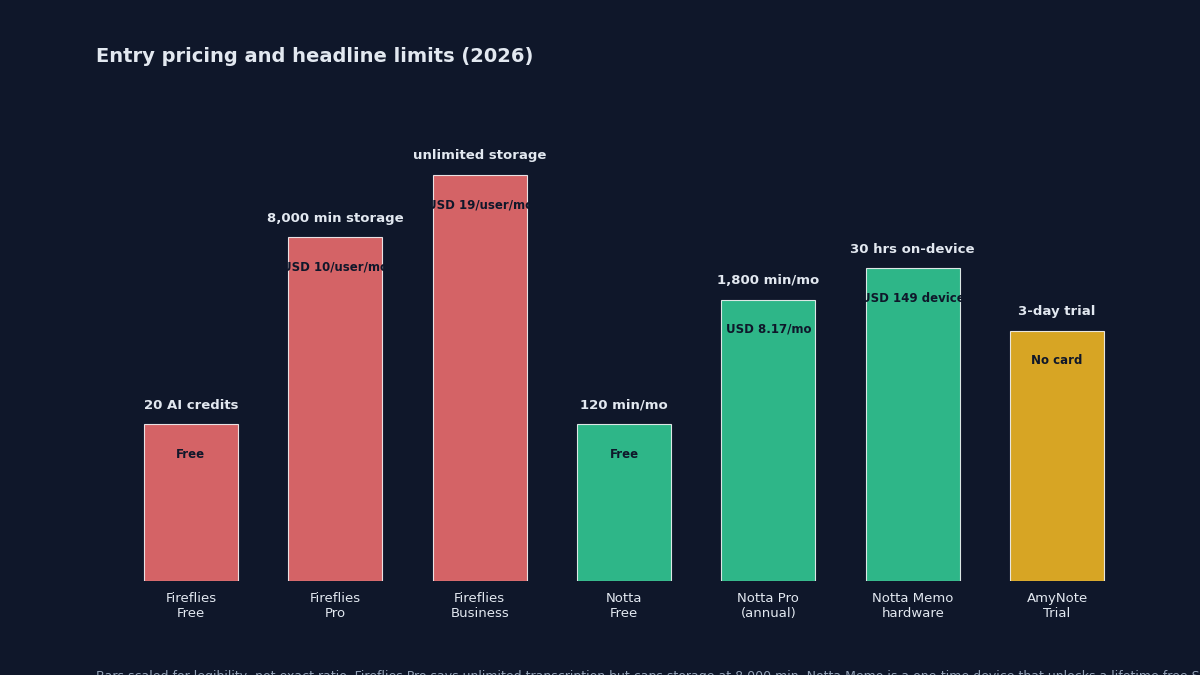
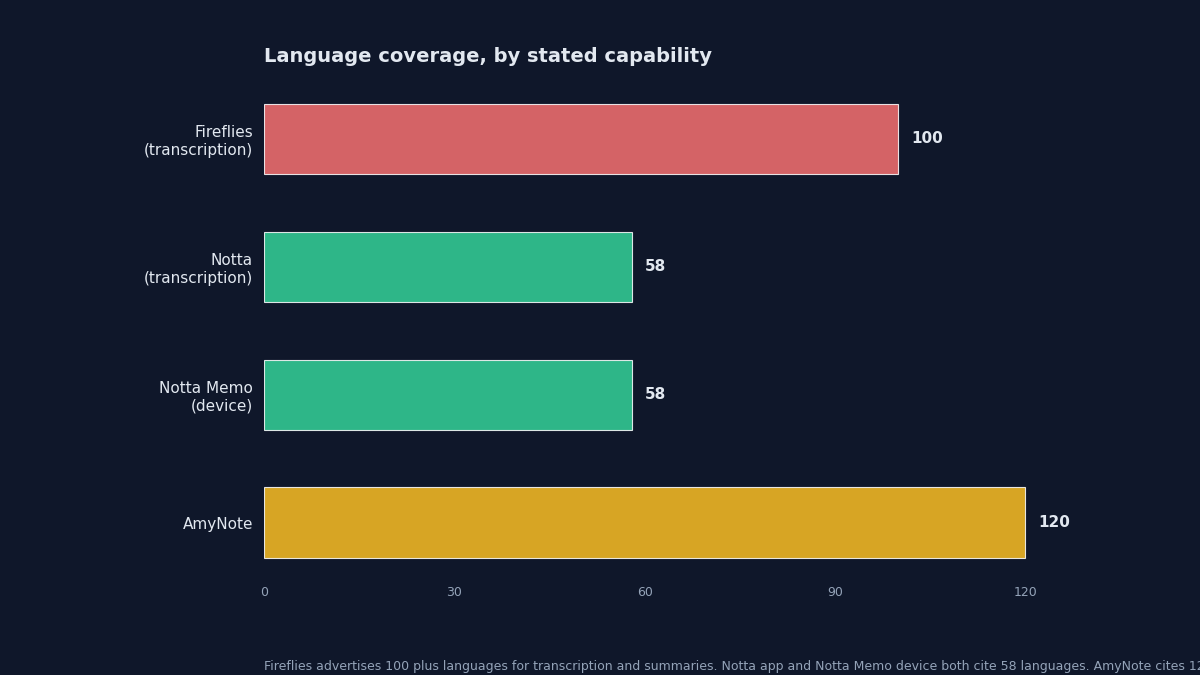
Fireflies is the AskFred assistant done well. You can ask questions across your entire transcript library and get intelligent, context-aware answers. It integrates with Zoom, Meet, Teams, Webex, and 40-plus other apps. Language coverage is genuinely broad: 100-plus languages for transcription and summaries, plus a Multi-Language Mode (Beta) that auto-detects and transcribes multiple languages in the same meeting. Pricing is friendly at the entry point: Free for basics, Pro at 10 USD per user per month billed annually, Business at 19 USD.
For a sales org that already runs on HubSpot or Salesforce, the value compounds every week. Every scheduled call ends up as a structured note in the CRM, action items are pre-routed to owners, and the AskFred index grows into a searchable memory layer for the entire revenue team. That memory layer is the closest thing the category has to a real institutional recall.
Weaknesses
The AI credit system is confusing on purpose. Each plan gets a shared workspace pool of credits, not monthly per-user allocations: Pro gets 20 credits total, Business gets 30. Heavy AskFred users burn through the pool fast and pay 5 to 600 USD per add-on credit pack. Pro also caps storage at 8,000 minutes, so "unlimited transcription" is unlimited only until you hit the retention wall. Video recording maxes out at 2 hours per meeting on Pro.
And the bot itself is visible in every call, which some participants dislike. Executive escalations, layoff calls, and sensitive customer conversations often quietly drop the bot after the second or third occurrence — which means the meetings that most needed a transcript are the ones that never got one.
Notta: The Multilingual SaaS With A Hardware Twist
Strengths
Notta is one of the few tools that sells you both a SaaS product and hardware. The Notta Memo is a 0.35cm thin, 28g card-style recorder priced at 149 USD, with 30 hours of continuous recording, 28 days of standby, 32GB storage for up to 144 hours of audio, and a slide-switch that toggles between in-person and phone-call modes. Buying the device unlocks a lifetime free Starter plan, which is unusual in a category that treats hardware and subscription as independent revenue streams.
Pro at 8.17 USD per month billed annually is the cheapest premium tier in this comparison, with 1,800 minutes of monthly transcription. For a solo consultant who mixes Zoom time with client site visits, Notta plus the Memo is a coherent single-vendor answer.
Weaknesses
Language coverage is 58 languages, less than half of what Fireflies advertises and roughly half of AmyNote. If your team ships work in Vietnamese, Bengali, Tagalog, Swahili, or any of the long-tail languages Notta does not support, you will hit a wall the pricing page will not warn you about.
Real-time translation and bilingual transcription features are an add-on at 6 USD per month, not part of the base plan. The Business plan at 16.67 USD per seat per month is per-seat, which stacks up on larger teams. And the Notta Memo, while polished for hardware, still needs cloud upload for AI features. It captures on-device, then the AI summaries happen after sync — which is fine most of the time, but a real gap for anyone working in an environment with no reliable cellular or Wi-Fi.
AmyNote: The Mobile-First Bot-Free Option
Strengths
AmyNote records everything on your phone. There is no bot to invite, no hardware to buy, no desktop app to install. Language support is 120-plus with real-time translation baked in, matching or beating both Fireflies and Notta. Transcription uses OpenAI's latest Speech API. Summaries and semantic search run through Anthropic's Claude Opus. Both providers contractually guarantee zero training on user data. Audio is encrypted in transit; processing copies may be retained to deliver and recover requested features. Transcripts stored locally on device with encrypted transport.
The mobile-first bet matters because the most important meeting of the week is increasingly not on a calendar at all. A hallway conversation at a conference. A one-on-one at a client's office. A field interview in a hospital corridor. A pitch that starts as coffee and ends as a term sheet. None of those accept a bot or wait for you to unbox a separate device.
Weaknesses
Be honest about the trade-offs. No desktop app. No CRM integrations for Salesforce or HubSpot. No video recording of any kind. No team dashboards. No shared workspaces. Smaller brand than either Fireflies or Notta. Mobile-first means it excels at conversations that a laptop cannot easily join, and stays out of the workflow where a proper cloud SaaS earns its price.
If your day is eight back-to-back Zooms from a desk chair and every call needs to update HubSpot before your standup tomorrow, Fireflies wins that day. AmyNote is built for the other days.
Side-by-Side Comparison
| Dimension | Fireflies | Notta | AmyNote |
|---|---|---|---|
| Capture surface | Bot on video calls | Bot + card-thin recorder | Phone microphone |
| Languages | 100+ (multi-lang Beta) | 58 | 120+ w/ real-time translation |
| Entry pricing | Pro $10/user/mo annual | Pro $8.17/mo annual | Single tier, 3-day trial |
| Hidden caps | 8,000-min storage + 20 shared AI credits | 1,800 min/mo on Pro | None on trial |
| Hardware option | None | Memo, $149 | None |
| In-person meetings | Weak (bot-only) | Native via Memo | Native from phone |
| Cross-meeting AI | AskFred | Notta Brain | Claude Opus semantic search |
| CRM sync | Salesforce, HubSpot (Business) | Salesforce, HubSpot (Business) | None |
| Privacy posture | Cloud-stored, SOC 2 | Cloud-stored | Local-on-device, contractual zero-training, encrypted transport |
| Bot in the room | Yes | Yes on calls (no via Memo) | No |
How To Decide In Five Minutes
- Where do the meetings happen? Online with a scheduled invite — Fireflies is built for this. Mix of online and in-room — Notta plus the Memo covers both from one vendor. Off-calendar, on-the-go, phone-first — AmyNote is the fit.
- What languages do you work in? Long-tail multilingual — Fireflies and AmyNote have you. If Notta's 58 covers you and you want the hardware, it is fine.
- What does the privacy review require? Cloud retention is acceptable for most sales orgs (Fireflies, Notta). Zero training plus local storage is the bar for legal, medical, and high-trust use cases (AmyNote).
- Where does the data need to go after? Into Salesforce or HubSpot — Fireflies or Notta Business. Into a structured archive on the device of the person who recorded it — AmyNote.
If the answers split — and they often do — the right move is usually two tools, not one compromise. Fireflies or Notta for the calendar meetings, AmyNote for the rest, is a common combination and cheaper than forcing one tool to cover both surfaces.
The Bottom Line
The choice is really about how the meeting arrives at you. If it comes through a laptop and a calendar invite, Fireflies is the mature, credit-metered pick, and Notta is the cheaper, less feature-dense alternative. If half your meetings happen in a room, on a phone call, or in a corridor, a cloud bot cannot help you, and hardware or a phone app is the only honest answer.
Notta solves that with the Memo, at the cost of an extra device to carry and a subscription that unlocks the good stuff. AmyNote solves it by treating the phone you already have as the recorder, and by treating privacy as a design constraint rather than a paid tier.
If you already trust the Notta ecosystem and want one vendor for online meetings and offline moments, the Memo plus Pro is a coherent bet. If you want one app that records anything you can hear, with 120-plus language coverage and zero-training privacy guarantees from OpenAI and Anthropic, AmyNote is the mobile-first alternative worth trying. Free 3-day trial, no credit card. See amynote.app.
Originally published as an X Article.