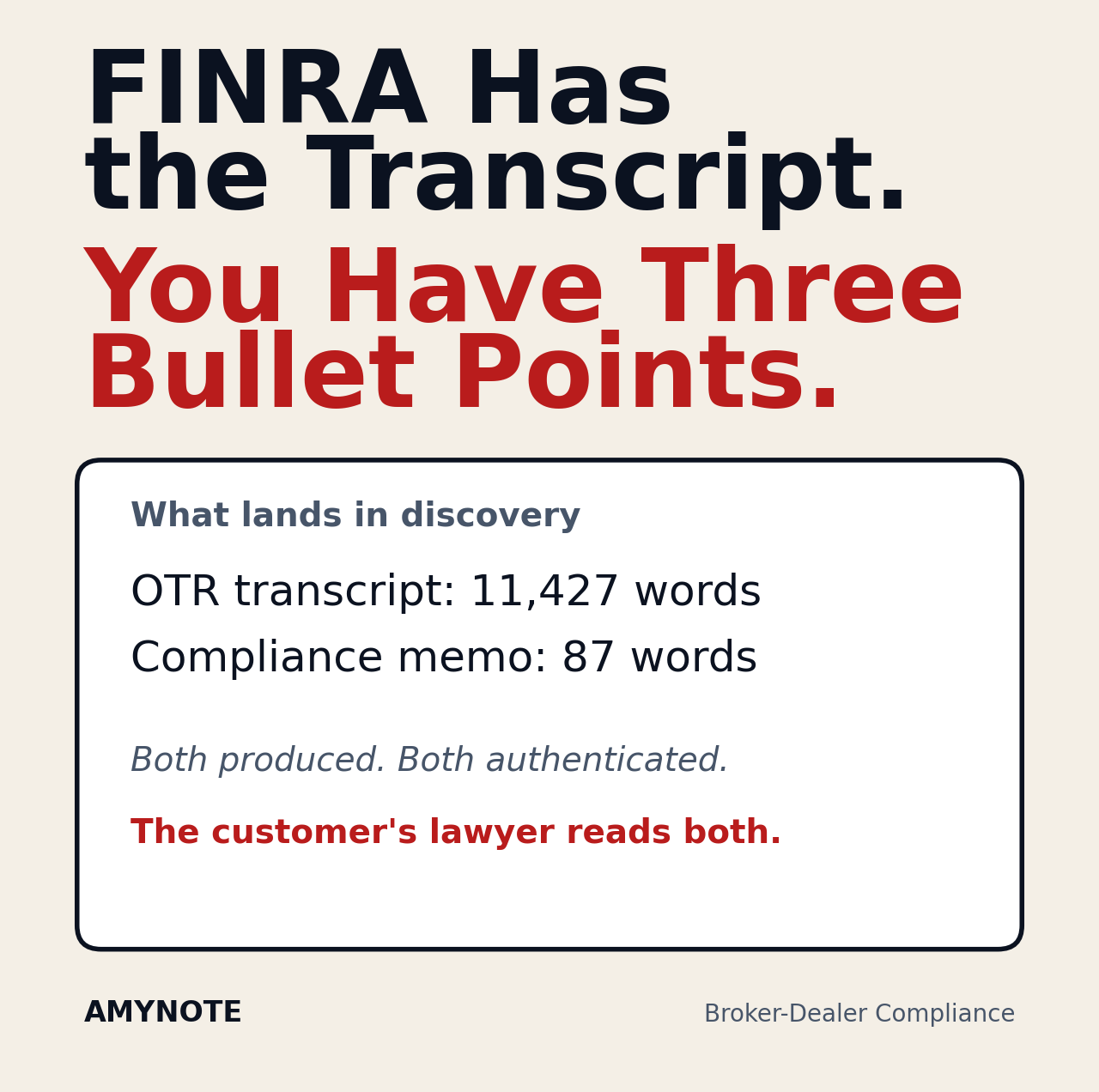
A 401(k) investment committee meets for ninety minutes. Forty of those minutes go to one target date series: the fee is defensible, the glidepath changed last year, the three year number looks bad and the manager has an explanation. Two members push back. The adviser walks through peer dispersion. Someone asks whether the change to the glidepath was the reason the three year number moved, and the answer takes another ten minutes. The committee keeps the fund.
The minutes record one line: the Committee reviewed the series and voted to retain.
Nothing about that meeting was careless. The committee did the work. The problem is narrower and harder to see, because it only becomes visible years later: the deliberation and the record of the deliberation are two different artifacts, and only one of them was preserved.
The Duty Is a Conversation. The Record Is a Vote.
ERISA does not judge fiduciaries on whether the fund went up. Section 404(a)(1)(B) (29 USC 1104(a)(1)(B)) requires a fiduciary to act “with the care, skill, prudence, and diligence under the circumstances then prevailing that a prudent man acting in a like capacity and familiar with such matters would use in the conduct of an enterprise of a like character and with like aims.”
Read that sentence for what it measures. Every operative word — care, skill, prudence, diligence, under the circumstances then prevailing — describes conduct at the time a decision was made, not the outcome that followed it. A fund that underperformed is not itself proof of a breach, and a fund that outperformed is not itself a defence. What is being evaluated is the quality of the process that produced the decision.
The Labor Department’s investment duties regulation makes the procedural nature of that standard explicit. Under 29 CFR 2550.404a-1(b)(1), the prudence requirement is satisfied if the fiduciary “Has given appropriate consideration to those facts and circumstances that, given the scope of such fiduciary’s investment duties, the fiduciary knows or should know are relevant to the particular investment or investment course of action involved,” and “Has acted accordingly.”
Appropriate consideration is something a committee does out loud. It is the forty minutes, not the one line. It is the question about the glidepath, the answer the adviser gave, the member who was not satisfied by it and the reason that member was satisfied twenty minutes later. Nothing in ERISA or in the regulation requires anyone to preserve any of that.
That asymmetry is the whole problem. The standard lives in deliberation, and then declines to require that deliberation be kept.
The Six Year Arithmetic
Everything around the deliberation is preserved, and preserved for a long time. Section 107 (29 USC 1027) requires records kept “available for examination for a period of not less than six years after the filing date.” Section 504 (29 USC 1134) lets the Secretary “enter such places, inspect such books and records and question such persons as he may deem necessary.”
Under Section 413 (29 USC 1113), an action may be brought as late as “six years after ... the date of the last action which constituted a part of the breach or violation.”
Put the three provisions side by side and the shape of the exposure becomes clear. The retention duty is measured in years from the filing date. The examination power reaches both the books and the people. And the limitations period runs from the last act rather than the first, so the window a committee is actually managing is measured in years, not in quarters.
Six years is long enough for the committee’s composition to turn over, for the adviser relationship to change, for the recordkeeper to be replaced and for the fund itself to be gone from the lineup. What does not change is the question. Someone asks what the committee considered when it decided to retain the series.
The surviving answer is a sentence.
The sentence is not a lie. It is simply not responsive to what is being asked. The Committee reviewed the series and voted to retain establishes that a review occurred. It does not establish that the review gave appropriate consideration to the facts and circumstances the fiduciary knew or should have known were relevant — which is the thing the regulation actually asks. The one artifact that would answer the question directly, the forty minutes of argument, was never captured by anyone.
Why the Usual Substitutes Do Not Close It
Committees know the gap is there. Each of the standard patches fails somewhere specific, and each fails in a way that is invisible until the record is tested.
- Minutes are drafted to be defensible, not complete. They are written afterward by someone who was participating in the discussion rather than transcribing it, and the act of writing them compresses an argument into an outcome. The objection that was raised and answered usually disappears entirely, because it did not change the result.
- The adviser’s quarterly deck proves what was presented, not what was weighed. A deck establishes the data that was put in front of the committee. It is silent on which numbers moved anyone, which pages nobody discussed, and which concern came from a member rather than from the slides.
- The investment policy statement proves the framework existed. It shows the criteria the committee committed to applying. It does not show the committee applying those criteria to this fund on this date, which is the application the regulation is concerned with.
- Meeting bots miss the room. Committee meetings are routinely in person or hybrid, and the decisive exchange often happens in the part nobody put on a calendar — the ten minutes before the formal agenda starts, or the corridor conversation after the vote.
The instinctive response is to write longer minutes. That helps at the margin, and it introduces a second problem: minutes drafted specifically to demonstrate diligence begin to read like advocacy rather than record, and a reader years later cannot tell which sentences describe what happened and which were added because someone thought they should be there. A contemporaneous capture of the discussion has the opposite property. It is not persuasive, which is exactly why it is credible.
What Closing the Gap Looks Like
The fix is not longer minutes. It is capturing the deliberation itself, so the minutes have something underneath them.
Record the meeting where it happens. AmyNote runs on the iPhone or iPad already sitting on the conference table, so the meeting produces a recording rather than a reconstruction. Nothing needs a calendar invite, and nothing announces itself to the room, which matters when half the committee is physically present and the agenda item that generates the real discussion was not on the agenda.
Get the vocabulary right. Transcription runs on OpenAI’s latest Speech API, which handles what these meetings are made of: glidepath, expense ratio, revenue sharing, R6 share class, tracking error, qualified default investment alternative. A transcript that garbles the share class is not a record of a share class decision.
Know who raised the objection. Speaker identification with cross-session memory separates committee members from the adviser and the recordkeeper, and holds those identities stable across quarters instead of relabeling everyone each meeting. Attribution is not a nicety here. The difference between a concern raised by a fiduciary and a reassurance offered by the party being evaluated is the difference between two very different records.
Find the reasoning six years later. AI analysis runs on Anthropic’s Claude Opus, and semantic search works across every transcript in the library. When someone asks why the series was retained, the answer is a timestamped passage, not a recollection assembled from a one-line minute entry and whatever the surviving members remember.
Privacy a plan sponsor can actually represent. Transcription runs through OpenAI and Microsoft Azure speech services, and AI analysis through Anthropic. AmyNote states plainly that it does not use customer data to train AI models and does not sell content. Audio and text are encrypted in transit with TLS. The saved library of recordings, transcripts and notes lives on the member’s own device, and recording, playback, reading and export all work with no network at all.
AmyNote is equally explicit about the limit: local first is not local only. When transcription or an AI summary runs, the required audio or text is uploaded, and a processing copy may be retained on AmyNote’s infrastructure to complete and recover the request. That trade-off is published rather than hidden.
What This Does Not Decide for You
Recording a fiduciary meeting is a governance decision, not merely a tooling one, and it should be made deliberately rather than by default. A recording that exists is a record that exists, with everything that follows from that. Committees adopting the practice generally want counsel involved first, want the participants told, want the practice reflected in the committee charter or the plan’s own procedures rather than left to whoever happens to be chairing, and want a consistent rule about which meetings are captured — because a committee that records selectively has created a different problem from the one it set out to solve.
None of that is an argument against closing the gap. It is an argument for closing it on purpose.
Getting Started
Bring it to the next committee meeting. The bar is low: one device already in the room, no bot, no invite, and no change to how the meeting is run. What changes is what survives it.
ERISA judges the process. Make the process something that can still be examined when the returns are the only thing anyone remembers. Transcription by OpenAI, analysis by Anthropic’s Claude Opus, zero-training commitments from both, and a three day free trial with no credit card.
Originally published as an X Article by @AmyNoteApp.